Every year, climbers spend weeks working their way up the slopes of Mount Everest. They battle frostbite, oxygen deprivation, and brutal wind. Meanwhile, most of us have had the same thought at least once: why not just take a helicopter up there?
It sounds reasonable. Helicopters can fly high. They are nimble and powerful. Surely one could zip up to that snowy peak and drop you off in style?
The truth is a lot more interesting than a simple "no." The story of why a helicopter can't fly to the top of Everest — at least not in any practical or repeatable way — involves the laws of physics, extreme weather, and the very edge of what machines can do. One pilot did pull it off once, under conditions so precise they bordered on miraculous. But it has not been repeated since.
Here is the full story of what happens when aviation meets the world's highest mountain.
Key Takeaways
No, a helicopter cannot practically fly to the top of Everest because the air at 8,848 meters is far too thin to generate enough lift for a safe, controlled flight. Most helicopters reach their safe operational ceiling well below that altitude. Only one specialized aircraft has ever managed a brief summit landing, and it required near-perfect weather, a stripped-down airframe, and exceptional pilot skill. For routine use, helicopters are limited to lower altitudes in the Everest region, typically around Everest Base Camp and nearby viewpoints.
| Factor | Detail |
| Everest summit elevation | 8,848 meters (29,032 feet) |
| Typical helicopter safe ceiling | Around 6,000 to 7,000 meters |
| Air density at summit | Roughly one-third of sea-level density |
| Wind speeds at summit | Can exceed 200 mph during storm season |
| Only known summit landing | French pilot Didier Delsalle, May 14, 2005 |
| Helicopter used | Airbus AS350 B3 (Eurocopter) |
| Standard tourist helicopter access | Up to Everest Base Camp (~5,364 meters) |
If you love pushing the limits of what's possible in the air, Flying411 is your go-to source for everything aviation — from helicopter basics to high-altitude flying facts.
Why Helicopters Need Dense Air to Fly
Before we talk about Everest, it helps to understand how a helicopter actually stays in the air.
A helicopter rises by spinning rotor blades at high speed. As those blades cut through the air, they create a pressure difference — lower pressure above the blade and higher pressure below. That difference generates lift. The whole system depends on having enough air molecules for the blades to push against.
Think of it like rowing a boat. If the water is shallow and thin, your oar can't get a solid grip. The same thing happens to rotor blades in thin air. They spin just as fast, but there isn't enough air mass to push against.
Fun Fact: At sea level, the air we breathe contains roughly 21% oxygen. At the top of Everest, the air pressure is about one-third of what it is at sea level. That's not just tough on human lungs — it's also tough on engines and rotors.
At lower altitudes, this isn't a problem. Most helicopters operate comfortably up to around 3,000 to 5,000 meters. But above 6,000 meters, the air becomes thin enough that rotor performance drops sharply. Lift decreases, stability becomes harder to maintain, and engine output falls.
The higher you go, the worse it gets — and Everest sits at nearly 9,000 meters.
What Actually Happens to a Helicopter at High Altitude
When a helicopter climbs into thinner air, several things happen at once.
Rotor Blades Lose Their Grip
The rotor blades still spin at the same RPM, but they're moving through air that has far fewer molecules. The result is less lift per rotation. To compensate, the pilot can increase blade pitch (the angle of the blade), but that only works up to a point. Beyond a certain altitude, no amount of pitch adjustment can make up for the loss of air density.
Good to Know: The technical term for how well a rotor performs at a given altitude is "density altitude." A high density altitude means the air behaves as if it were even thinner than the actual elevation suggests — especially on hot days.
Engines Struggle to Breathe
Helicopter engines — like all combustion engines — need oxygen to burn fuel. At 8,848 meters, there is roughly one-third the oxygen available compared to sea level. The engine has to work much harder to produce the same power, and at some point, it simply cannot produce enough thrust to maintain controlled flight.
This is why most helicopters have a published "service ceiling" — the maximum altitude at which they can still perform useful work. For the majority of commercial and civilian helicopters, that ceiling sits between 18,000 and 20,000 feet (roughly 5,500 to 6,100 meters). Everest's summit is nearly 10,000 feet above that.
Pilots Face Hypoxia
It's not just the machine that struggles. At extreme altitude, the lack of oxygen affects human performance too. Pilots can experience hypoxia — a condition where the brain doesn't get enough oxygen — which impairs decision-making, slows reflexes, and distorts vision.
Even with supplemental oxygen equipment, managing all of this while also controlling an aircraft in thin air and unpredictable wind is extraordinarily difficult.
Heads Up: Hypoxia can set in quickly and quietly. Pilots may not even realize their judgment is impaired until it's too late. This is one reason why high-altitude flight training is so critical for anyone operating in extreme conditions.
The Weather Problem: Everest Is Basically Trying to Kill You
Even if physics weren't a barrier, the weather on Everest would be.
Wind That Can Destroy Metal
Everest sits at the intersection of powerful atmospheric systems. For much of the year, the jet stream hammers the summit with winds that can exceed 200 miles per hour. These aren't just uncomfortable gusts. They're strong enough to shred metal, destabilize rotor systems, and make controlled flight essentially impossible.
Even during the so-called "calm season" in late spring and early autumn, winds at the summit can still hit 75 mph or more — which is strong enough to qualify as a Category 1 hurricane by conventional weather standards.
Storms Appear Without Warning
Weather at Everest changes with frightening speed. A clear sky can become a whiteout blizzard in minutes. Because the Everest region has very limited radar infrastructure, pilots flying there rely heavily on visual flight rules. If visibility drops, there is almost no instrument guidance to help navigate safely.
Why It Matters: Snowstorms at high altitude don't just reduce visibility. They carry ice particles at extreme speeds. A blizzard near the summit has enough force to send icicles through metal — a serious hazard for any aircraft.
Temperature Extremes
At the summit, temperatures can drop to around minus 60 degrees Celsius. Cold this severe affects battery performance, hydraulic fluids, and fuel systems. It can freeze components that need to move freely. Combined with the physical stress of extreme altitude, these temperatures push aircraft systems to — and sometimes past — their design limits.
The One Time It Actually Happened
Here is where the story gets remarkable.
On May 14, 2005, French test pilot Didier Delsalle flew an Airbus AS350 B3 helicopter to the summit of Mount Everest and briefly landed. It remains, as far as is publicly known, the only time a helicopter has ever touched down on the world's highest point.
How He Did It
Delsalle didn't just hop in a helicopter and fly up. The mission required months of planning and preparation.
- The AS350 B3 was a high-altitude specialist aircraft with a particularly powerful turbine engine
- The helicopter was stripped of every non-essential component to reduce weight
- The flight was timed for the narrow weather window in mid-May when Everest conditions are at their most stable
- Delsalle wore full oxygen equipment throughout the flight
- He kept the engine running during the landing and never shut it down — a cold restart at that altitude would have been nearly impossible
- He did not step out of the aircraft
Even with all those precautions, the landing was extraordinarily risky. The rotors were barely generating enough lift to hold the aircraft in place. One change in wind or a slight mechanical issue could have been catastrophic.
Fun Fact: Delsalle actually completed the summit landing twice in the same week to satisfy Guinness World Records' requirement for verification. The second attempt was, if anything, even more nerve-wracking than the first.
The achievement is stunning. But it was a stunt under near-perfect conditions, with a stripped aircraft and one of the most skilled high-altitude pilots in the world at the controls. It has not been repeated.
Why Can't a Helicopter Fly to the Top of Everest Routinely?
So we know it happened once. Why can't it happen regularly? Here are the key reasons this remains, in practice, a near-impossible feat for normal operations.
1. Most Helicopters Simply Can't Reach That Altitude
The AS350 B3 used by Delsalle was a purpose-built, high-altitude machine. Standard commercial or military helicopters max out their useful performance ceiling thousands of feet below the summit. Even pushing them past their service ceiling would leave them without enough power to hover, maneuver, or respond to wind gusts.
2. The Weight Problem Is Severe
Every kilogram counts at extreme altitude. Passengers, fuel, gear, safety equipment — it all adds up. Delsalle's summit flight was possible partly because the aircraft was stripped bare. A real transport mission with people, oxygen equipment, and emergency supplies would be far too heavy for the rotors to manage in that thin air.
3. Landing on Ice at 40-Degree Slopes Is Extremely Dangerous
The summit of Everest isn't a flat pad. It's a narrow, icy ridge tilted at steep angles. There is no safe, stable surface to put down a helicopter. Even hovering near the summit risks the rotors clipping the terrain.
4. Weather Windows Are Tiny and Unpredictable
The narrow season when conditions are even marginally safe lasts only a few weeks per year. Within that window, truly calm days at the summit are rare. A mission that requires precise, repeatable conditions simply can't be scheduled with any reliability.
5. Fuel Margins Become Dangerously Thin
At extreme altitude, engines burn fuel less efficiently. A flight that starts with a full tank at low altitude may arrive near the summit with dangerously low reserves. The fuel math for a summit operation leaves almost no buffer for delays, diversions, or unexpected conditions.
6. Pilot Oxygen and Cognitive Load
Managing a helicopter at the edge of its performance envelope, in wind, on a tilted icy surface, while managing hypoxia is an almost impossibly complex cognitive task. Even with supplemental oxygen, the physical and mental demands are extreme. One small error can be fatal.
7. Emergency Options Are Essentially Zero
If something goes wrong near the summit, there is no backup. There are no emergency landing fields. There is no rescue service that can reach that altitude quickly. A mechanical failure or a sudden storm could be unsurvivable. This is the final reason why routine helicopter operations at the Everest summit remain firmly in the category of "technically imaginable but practically impossible."
Pro Tip: If you are interested in high-altitude helicopter performance — how rotor design, engine output, and density altitude interact — that knowledge is directly transferable to understanding ultralight helicopter requirements and the certification standards that govern lightweight aircraft in general.
Where Helicopters Do Fly Around Everest
Just because the summit is off-limits doesn't mean helicopters have no role in the Everest region. In fact, they are essential.
Everest Base Camp and Kala Patthar
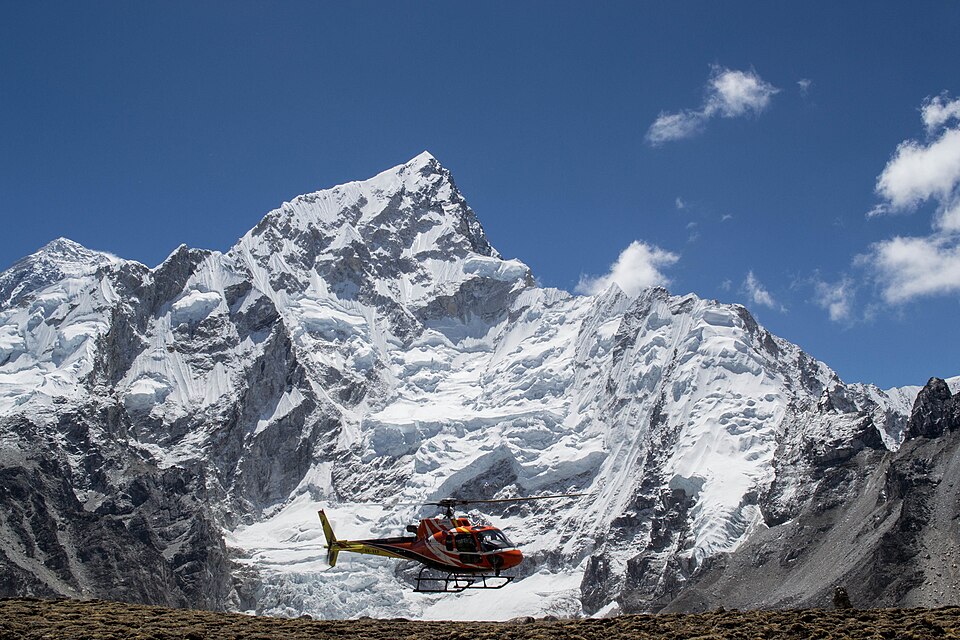
Most Everest helicopter tours fly up to Base Camp at around 5,364 meters or to Kala Patthar at roughly 5,545 meters. These altitudes are within the safe operating range of well-maintained high-altitude helicopters. The views are extraordinary, and it remains one of the most dramatic aerial experiences available anywhere in the world.
Rescue Operations
Helicopters are a lifeline for injured or distressed climbers in the Everest region. Rescue missions typically operate up to around Camp 2 at approximately 6,400 meters. Above that, the risks to the rescue aircraft and crew become extreme. The highest documented rescue operation was carried out around 7,800 meters — a feat that required exceptional skill and favorable conditions.
If you are curious about what makes small rotorcraft tick and what it takes to fly one safely, Flying411 has in-depth coverage of ultralight helicopter rules and everything you need to know before getting airborne.
Supply and Logistics
The Khumbu Valley region near Everest has no roads. Helicopters carry food, fuel, building materials, and medical supplies to remote villages and high-altitude camps. Without helicopter access, many communities in the region would face significant hardship — especially during winter months or after natural disasters.
Comparing Helicopter Performance at Different Altitudes
To put the challenge in perspective, here is how altitude affects typical helicopter performance.
| Altitude | Air Density | Typical Helicopter Capability |
| Sea level (0 m) | 100% | Full load, full performance |
| Denver, USA (~1,600 m) | ~85% | Slight reduction in lift and power |
| Everest Base Camp (~5,364 m) | ~55% | Manageable with high-altitude models |
| Camp 2 (~6,400 m) | ~47% | Near operational limit for most aircraft |
| Camp 4 / Death Zone (~8,000 m) | ~36% | Extremely dangerous, most aircraft cannot operate |
| Everest Summit (~8,848 m) | ~33% | Practically impossible for routine operations |
Keep in Mind: These figures are approximate and vary based on temperature, humidity, and the specific aircraft. Hot days make high-altitude performance worse — air density drops further when temperatures rise, even at the same elevation.
Could Future Technology Change This?
It is a fair question. Technology improves constantly. Could the helicopters of tomorrow make summit flights routine?
Possibly, but not easily. The fundamental challenge is physics. Thinner air means less lift per rotor revolution, no matter how advanced the engineering. To overcome this, future aircraft would need either dramatically more powerful and efficient engines, larger or faster rotor systems, or entirely new lift mechanisms.
Electric rotorcraft and advanced turbines are being developed for high-altitude use. Drone technology has already pushed unmanned rotorcraft to extraordinary altitudes. Some researchers believe that purpose-built aircraft could eventually operate more reliably in extreme mountain environments.
But for a crewed helicopter carrying passengers to the summit of Everest on a repeatable schedule? That remains a very long way off.
Good to Know: If you are drawn to the idea of small, nimble rotorcraft that push performance limits in interesting ways, you might find one-person mini helicopters a fascinating area to explore — they represent a different approach to rotorcraft design focused on minimizing weight and maximizing simplicity.
What This Means for Aviation Enthusiasts
The Everest helicopter question is more than just a curiosity. It illustrates some of the most important principles in aviation — density altitude, service ceilings, weight management, and the relationship between engine performance and atmospheric conditions.
Understanding these limits makes you a better, safer pilot and a more informed observer of what aircraft can and cannot do. Whether you are learning to fly, shopping for your first aircraft, or just fascinated by the limits of technology, the Everest story is one of the clearest examples of physics putting a boundary on ambition.
Ready to explore what's possible in rotorcraft — and where to start? Flying411 has guides on the best helicopters for beginner pilots and what to look for when getting started.
The good news is that even without summiting Everest, there is a huge and exciting world of aviation waiting — from ultralight helicopters to scenic mountain flights at altitudes that are actually survivable.
For those wondering about the safety side of small rotorcraft, are ultralight helicopters dangerous is a question worth exploring in depth, and the answer is more nuanced than most people expect.
Conclusion
So why can't a helicopter fly to the top of Everest? The short answer is that the summit sits in a zone where thin air, brutal weather, and the hard limits of mechanical performance converge into something close to a physical wall. The air is too thin for rotors to generate consistent lift. Engines lose power. Winds can exceed hurricane force. The weather window is measured in days, not months. And even on the best possible day, landing on a narrow, icy, tilted ridge at 8,848 meters leaves almost no margin for anything to go wrong.
One extraordinary pilot proved it could be done once, under conditions that may never perfectly align again. But routine helicopter access to the Everest summit remains beyond current practical reach for why can't a helicopter fly to the top of Everest — and likely will for some time to come.
The mountain still wins.
If the science and adventure of high-altitude flight has sparked your curiosity, Flying411 is the place to keep learning — from the basics of how rotorcraft work to the real-world rules and skills that keep pilots safe.
Frequently Asked Questions
Has a helicopter ever actually landed on top of Everest?
Yes, once. French pilot Didier Delsalle landed an Airbus AS350 B3 on the summit on May 14, 2005. He kept the engine running, stayed inside the aircraft, and departed quickly. It was a controlled test flight under near-perfect conditions and has not been repeated.
How high can a regular helicopter fly?
Most civilian and commercial helicopters have a practical service ceiling of around 18,000 to 20,000 feet, which is roughly 5,500 to 6,100 meters. Some specialized high-altitude models can operate somewhat higher, but performance degrades significantly above 6,000 meters.
What is the "death zone" on Everest and why does it matter for helicopters?
The death zone refers to altitudes above roughly 8,000 meters, where oxygen levels are too low to sustain human life without supplemental oxygen for extended periods. For helicopters, this zone also represents a point where engine performance and rotor efficiency fall to dangerous levels, making controlled flight extremely difficult.
Can drones fly to the top of Everest?
Lightweight unmanned drones have operated at very high altitudes in the Himalayas, and some have reportedly flown near or above Everest's elevation in test conditions. However, payload, battery life, and wind resistance remain significant challenges even for drones at those heights.
Why don't rescue helicopters fly above Camp 2 on Everest?
Camp 2 sits at around 6,400 meters, which is near the upper limit of most rescue helicopter operations in the region. Above that, the combination of thin air, wind, and terrain makes flight too dangerous for crews and aircraft alike. The highest recorded rescue in the region was conducted around 7,800 meters and is considered an exceptional achievement.