Some machines don't just fly — they dominate. Attack helicopters are among the most complex, deadly, and expensive pieces of military hardware ever built. They can strike armored vehicles from miles away, support ground troops under fire, and survive in some of the harshest combat environments on the planet. These aren't just aircraft. They are flying weapons platforms that have shaped the outcome of real-world battles.
The top 10 attack helicopters in the world represent decades of engineering, combat experience, and relentless upgrades. Whether you're an aviation enthusiast, a defense follower, or just someone who finds these machines fascinating, this guide breaks down the best of the best in plain, easy-to-follow language.
From the iconic American Boeing AH-64E Apache Guardian to Russia's coaxial-rotor Kamov Ka-52 Alligator and South Africa's underrated Denel Rooivalk, each of these helicopters brings something unique to the battlefield. Here's what separates the elite from the rest.
Key Takeaways
The top attack helicopter in the world as of 2025 is widely considered to be the Boeing AH-64E Apache Guardian, praised for its advanced avionics, drone-control capability, and long combat record spanning multiple continents. Russia fields strong competitors in the Mi-28 Havoc and Ka-52 Alligator, while Western allies rely on platforms like the Bell AH-1Z Viper and Eurocopter Tiger. China's Changhe Z-10 is a rising contender, and South Africa's Denel Rooivalk proves that great attack helicopters aren't limited to superpowers.
| Helicopter | Country | Key Strength | Approx. Top Speed |
| Boeing AH-64E Apache Guardian | USA | Drone integration, combat experience | ~300 km/h |
| Mil Mi-28 Havoc | Russia | Anti-armor, rugged design | ~300 km/h |
| Bell AH-1Z Viper | USA | Speed, Marine Corps backbone | ~411 km/h |
| Eurocopter Tiger | France/Germany | Agility, composite construction | ~290 km/h |
| TAI T129 ATAK | Turkey | Export potential, modern avionics | ~281 km/h |
| Kamov Ka-52 Alligator | Russia | Coaxial rotors, maneuverability | ~315 km/h |
| Agusta A129 Mangusta | Italy | Europe's first dedicated attack helo | ~278 km/h |
| Mil Mi-24 Hind | Russia | Troop transport + attack combo | ~335 km/h |
| Changhe Z-10 | China | Anti-tank, growing PLA fleet | ~270 km/h |
| Denel Rooivalk | South Africa | Ingenuity, proven combat debut | ~278 km/h |
Speed figures are approximate and may vary by variant and configuration.
If you love reading about incredible flying machines, Flying411 is a go-to resource for aviation enthusiasts at every level. From beginner guides to deep dives on cutting-edge aircraft, there's always something worth exploring.
What Makes an Attack Helicopter "The Best"?
Before jumping into the list, it helps to understand what separates a great attack helicopter from a merely good one. These machines are judged on several factors, and no single helicopter wins on every front.
Firepower and Weapons Load
The most obvious measure is what a helicopter can carry and fire. That means anti-tank guided missiles (ATGMs), cannons, rocket pods, and sometimes air-to-air missiles. The more precise and powerful the weapons, the more dangerous the platform.
Survivability and Armor
The best attack helicopters can take hits and keep flying. Armored cockpits, self-sealing fuel tanks, crash-resistant landing gear, and defensive countermeasures like flares and radar warning systems are all part of the picture.
Avionics and Target Acquisition
Modern warfare is won on information. Helicopters with advanced sensors, night-vision systems, and radar can find and engage targets that others would miss completely. The ability to track multiple threats simultaneously is a massive advantage.
Why It Matters: Attack helicopters that can operate at night and in bad weather give commanders a round-the-clock strike option that ground forces and slower aircraft simply cannot match.
Operational Range and Endurance
A helicopter that runs dry before finishing the mission is a liability. Range, fuel efficiency, and the ability to refuel quickly all matter in extended combat operations.
Real-World Combat Experience
There is a difference between a helicopter that performs well in testing and one that has been proven under fire. Combat exposure reveals weaknesses, drives upgrades, and builds the kind of trust that military planners rely on.
A Brief History of Attack Helicopters
The attack helicopter is a relatively young invention. Before the 1960s, helicopters were used mainly for transport and reconnaissance. The Vietnam War changed everything.
The United States needed a way to protect troop-carrying helicopters from ground fire and to suppress enemy positions quickly. The Bell AH-1 Cobra, introduced around 1967, became the world's first purpose-built attack helicopter. It was slim, fast, and deadly compared to anything that had come before.
Fun Fact: The Bell AH-1 Cobra is often said to be the "grandfather" of all modern attack helicopters. Its tandem-seat, narrow-fuselage design became the blueprint that almost every attack helicopter since has followed in some form.
The Soviets responded with the iconic Mil Mi-24 Hind, a massive machine that could both attack and carry troops. By the 1980s, both superpowers were racing to field the next generation of dedicated anti-armor helicopters, and the modern attack helicopter was born.
Today, attack helicopters serve dozens of nations and have seen combat on virtually every continent. Their roles have expanded too. They now network with drones, guide precision strikes, and operate in complex electronic warfare environments that their designers in the 1960s could never have imagined.
The Top 10 Attack Helicopters in the World
Here is a detailed look at the 10 most advanced and capable attack helicopters in active service today, ranked by overall capability, combat proven performance, and modern technological integration.
1. Boeing AH-64E Apache Guardian (USA)
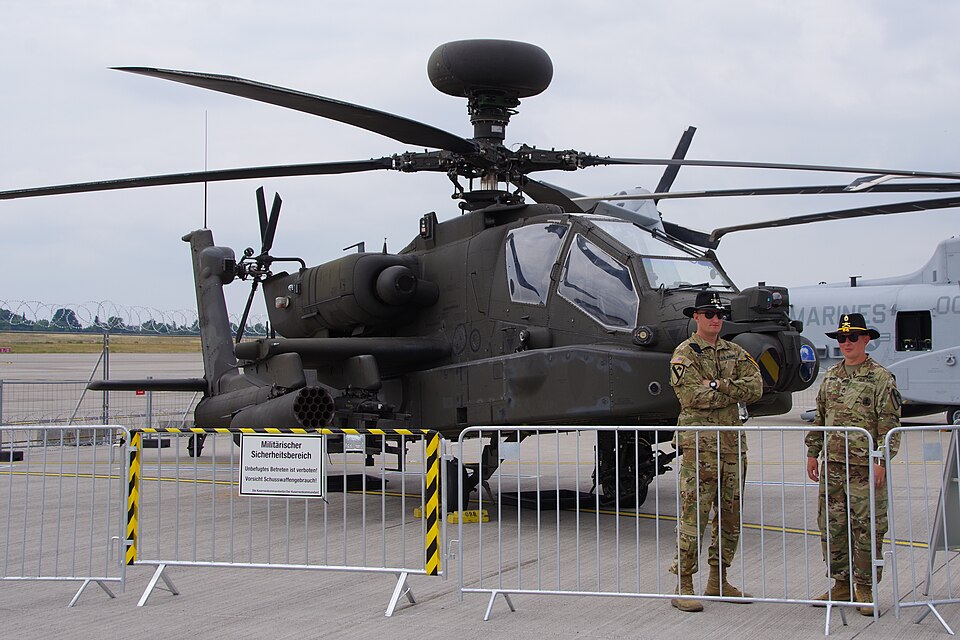
The Boeing AH-64E Apache Guardian is widely considered the most advanced attack helicopter in the world as of 2025. It sits at the top of nearly every credible ranking for good reason.
The AH-64E can command unmanned aerial vehicles to extend sensor reach and force multiplication across the battlespace and is built for modern command and control with fully integrated Link 16 for shared battlespace awareness. This means the Apache doesn't just fight on its own — it acts as a hub, pulling in data from drones and other platforms to give its crew a complete picture of the battlefield.
More than 2,875 Apaches have been produced across A through E-models, with the E-model in active production and more than 891 delivered as of November 2025. That's an enormous production run, giving it one of the strongest logistics and support networks of any military aircraft.
Key specs:
- Primary gun: M230 30mm chain gun
- Missiles: Up to 16 AGM-114 Hellfire missiles
- Top speed: approximately 300 km/h
- Operators: 19+ countries including the US Army, UK, India, Israel, and South Korea
The latest and most advanced version, the AH-64E Apache Guardian, first fielded in 2011, builds on earlier models with more powerful 701D engines, a reinforced airframe, improved transmission, and the ability to control UAVs.
The Apache's combat record stretches from Desert Storm to Afghanistan, Iraq, and beyond. The Apache has accumulated over 5.3 million flight-hours, more than 1.3 million of which have been in combat.
Pro Tip: If you're curious about what the cockpit experience of a high-performance helicopter feels like, check out this guide on best helicopters for beginner pilots — it's a world away from the Apache, but it's a great starting point for understanding rotorcraft.
2. Mil Mi-28 Havoc (Russia)
Russia's answer to the Apache is the Mil Mi-28 "Havoc," a brutally effective anti-armor platform built for one thing: destroying tanks.
Armed with 16 anti-tank guided missiles that can penetrate over 800mm of armor, it can also carry rocket pods, bombs, and gun pods. It sports a 30mm Shipunov 2A42 autocannon and has a bulletproof windshield and titanium-reinforced cockpit.
One unusual design choice sets it apart from most western designs. It has a tandem two-seat cockpit in a unique configuration — the pilot sits at the back. As well as the gunner up front, the pilot also has full weapons control, giving it more flexibility than western designs.
The Havoc has seen combat in Syria and Ukraine, where it proved both its lethality and its vulnerabilities, particularly to shoulder-fired missiles. Due to energy-absorbing landing gear and seats, the crew can survive a vertical fall of up to 12 meters per second. That level of crash survivability shows just how seriously its designers took crew protection.
Key specs:
- Primary gun: 30mm Shipunov 2A42 cannon
- Missiles: Up to 16 Ataka-V anti-tank missiles
- Top speed: approximately 300 km/h
- Operators: Russia, Algeria, Iraq
3. Bell AH-1Z Viper (USA)
The Bell AH-1Z Viper is the backbone of the United States Marine Corps attack helicopter fleet and one of the fastest attack helicopters in service today.
The AH-1Z Viper is heavily armed, with a total of six hardpoints capable of carrying more than 5,700 lbs of armaments. These can include up to 76 unguided Hydra rockets or 38 APKWS guided rockets, as well as Sidewinder, Hellfire, or JAGM missiles.
The American Viper is a third-generation descendant of the venerable Bell AH-1 Cobra, the grandfather of all modern attack helicopters. Its unique four-blade rotor system, made of composite materials for lightweight durability, makes the Viper faster, more agile, and a much smoother ride than the original two-blade Cobras.
The AH-1Z Viper achieves an impressive 222 knots top speed and boasts an operational range of 370 nautical miles, making it one of the fastest in its class.
Good to Know: The Viper's speed advantage over most rivals comes largely from its four-blade composite rotor system, which reduces drag and vibration while improving lift efficiency — a design evolution that took decades of rotorcraft engineering to achieve.
Key specs:
- Primary gun: 20mm rotary cannon
- Top speed: approximately 411 km/h
- Operators: US Marine Corps, Bahrain, Czech Republic
This powerful attack helicopter is expected to be in service until at least 2040, with continuous upgrades planned.
4. Eurocopter Tiger (France/Germany)
The Eurocopter Tiger is proof that great attack helicopters can come from collaboration. Developed jointly by France and Germany, it represents the best of Western European rotorcraft engineering.
Born of French and German collaboration, the Eurocopter Tiger offers a sophisticated balance of stealth, agility, and firepower. Its variants — HAP, UHT, ARH, and HAD — cater to specific mission profiles. With a top speed of 160 knots and an impressive 430 nautical mile range, it carries a lethal suite: a 30mm turret-mounted cannon, guided missiles, and multiple rocket pods.
The Eurocopter Tiger boasts an impressive composite airframe, with over 80% of its structure composed of advanced materials such as carbon laminates, Kevlar, and honeycomb structures. This lightweight yet durable design, coupled with its powerful engines and sophisticated avionics, makes the Tiger a highly capable and versatile platform.
The Tiger has seen action in Afghanistan and Mali, where its combination of speed and precision made it valuable in counterinsurgency operations. Australia has considered transferring its Tiger ARH fleet as part of foreign aid packages, reflecting the type's continued perceived value on the international stage.
Key specs:
- Primary gun: 30mm cannon (variant dependent)
- Top speed: approximately 290 km/h
- Operators: France, Germany, Spain, Australia
5. TAI T129 ATAK (Turkey)
The TAI T129 ATAK is Turkey's entry into the world of purpose-built attack helicopters, and it is a genuinely impressive platform for a nation that was once entirely dependent on foreign designs.
Developed by Turkish Aerospace Industries (TAI) in collaboration with AgustaWestland, the T129 is derived from the A129 Mangusta but extensively redesigned for Turkish requirements. It features a tandem cockpit, a powerful 20mm cannon, and can carry a mix of rockets, anti-tank missiles, and air-to-air missiles.
Its design is optimized for operations in varied terrain, from mountain regions to desert environments. Turkey has used the T129 in operational deployments, and the platform has attracted interest from several export customers, though export deliveries have faced hurdles due to restrictions on engine components.
Key specs:
- Primary gun: 20mm cannon
- Missiles: UMTAS long-range anti-tank missiles, Cirit laser-guided rockets
- Top speed: approximately 281 km/h
- Operators: Turkish Land Forces
Keep in Mind: Export challenges tied to the T129's engine supply chain have slowed its international sales ambitions, but Turkey continues to invest in domestic engine alternatives that could eventually unlock the global market.
6. Kamov Ka-52 Alligator (Russia)
The Kamov Ka-52 "Alligator" is the most distinctive helicopter on this list and one of the most unusual attack aircraft in the world. Its design breaks almost every rule.
Probably the most unique attack helicopter in service today, the Ka-52 is a wildly unconventional design. It has dual contra-rotating main rotors and no tail blades, known as a coaxial rotor system. This provides several advantages, including greater lift, better survivability, and increased agility. It is one of the most maneuverable helicopters of any kind in the world today.
The Ka-52 has a titanium armored cockpit which can withstand 23mm rounds. Unusually, it also has an ejector seat, which is a rarity in rotary wing aircraft. Before ejecting, explosive charges blow off the rotor blades to allow the pilots to eject safely.
Fun Fact: The Ka-52 is one of the very few helicopters in history to feature ejection seats as standard equipment. Getting out of a helicopter mid-flight requires clearing the rotor system first — and the Ka-52 solves this by explosively jettisoning the blades before the seats fire.
The Ka-52 has seen extensive combat in Syria and, more recently, in Ukraine. In the 2015 Syria campaign, Ka-52s destroyed ISIS tanks and provided close support. Combat in Ukraine has also revealed its vulnerabilities to drone threats and shoulder-fired missiles, driving continued armor and countermeasure upgrades.
Key specs:
- Primary gun: 30mm Shipunov 2A42 cannon
- Missiles: Up to 12 Vikhr anti-tank missiles
- Top speed: approximately 315 km/h
- Operators: Russia, Egypt
Flying411 offers a wealth of content about how helicopters handle extreme and unusual conditions — including a fascinating look at what happens if a helicopter gets struck by lightning.
7. Agusta A129 Mangusta (Italy)
The Agusta A129 Mangusta holds a special place in aviation history. The A129 Mangusta (Italian for "Mongoose") holds the distinction of being Western Europe's first domestically manufactured attack helicopter.
Italy's Agusta A129 Mangusta has been in service since the 1980s. With a 150-knot top speed and a 280 nautical mile range, its compact profile belies its firepower: a 20mm cannon, TOW and Spike ATGMs, and Stinger or Mistral air-to-air missiles. Originally focused on anti-armor missions, it has evolved to include reconnaissance and close fire support roles.
The Mangusta served with Italian forces in Somalia, Bosnia, and Iraq. Its lean, angular profile makes it a relatively small target, and its modular weapons system gives operators flexibility on each mission. The T129 ATAK (number 5 on this list) traces its lineage directly back to the Mangusta, which speaks to how influential this Italian design has been.
Key specs:
- Primary gun: 20mm cannon
- Top speed: approximately 278 km/h
- Operators: Italy, Turkey (T129 variant)
8. Mil Mi-24 Hind (Russia/Soviet Union)
No list of the world's greatest attack helicopters is complete without the Mil Mi-24 "Hind." This Soviet-era giant is one of the most recognizable and most produced military helicopters ever built.
The Mil Mi-24 Hind boasts an impressive array of armaments, including a machine gun, air-to-ground rockets, and a variety of air-to-ground missiles. Its formidable capabilities were put to the test during the Soviet invasion of Afghanistan, where the Hind's devastating air support played a crucial role.
What makes the Hind truly unique is its dual role. No list of attack helicopters is complete without the Mil Mi-24 Hind, a Cold War legend still in active service. With over 2,600 units built, it combines firepower and troop transport capability — able to carry eight infantry while attacking with gun pods, anti-tank missiles, and bombs.
With over 50 operators worldwide and a production count exceeding 2,600 units, the Mi-24 holds the record as the most manufactured attack helicopter in history.
Good to Know: The Mi-24 Hind is sometimes called a "flying IFV" (Infantry Fighting Vehicle) because it can shoot its way into a landing zone and then deliver troops — a capability no western attack helicopter was designed to replicate.
Despite being introduced in the 1970s, the Mi-24 family continues to serve with dozens of militaries thanks to ongoing upgrades. The Mi-35M export variant brings night-attack capability and improved weapons to an already battle-tested airframe.
Key specs:
- Primary gun: 12.7mm or 23mm cannon (variant dependent)
- Top speed: approximately 335 km/h
- Operators: Russia, dozens of export operators across Africa, Asia, and the Middle East
9. Changhe Z-10 (China)
The Changhe Z-10 represents China's first serious homegrown attack helicopter and a clear signal that the People's Liberation Army (PLA) is serious about building world-class rotary wing capabilities.
The Z-10 is the first indigenous attack helicopter produced in China, arguably built in response to the AH-64 Apache. While its range is greater than that of the Apache, it isn't as fast, although it does pack some firepower. As well as a 23mm cannon, the helicopter has four hardpoints with a combined capacity of more than 3,300 lbs of extra munitions, which can include various rockets, laser-guided air-to-surface missiles, air-to-air missiles, and guided bombs.
The Changhe Z-10 marks China's entry into the top tier of attack helicopters. Operational since 2003, it reaches a 160-knot top speed with a range of 430 nautical miles.
So far, more than 200 have been produced for the People's Liberation Army, but foreign buyers remain elusive. China debuted the Z-10 at the Singapore Airshow in 2024, the first time the type has been displayed outside of China.
The Z-10's combat record remains limited compared to western and Russian rivals, but its rapid production rate and continued upgrades show that China views it as a long-term platform. The even larger Z-21 heavy attack helicopter is reportedly under development, suggesting the Z-10 may only be the beginning of China's attack helicopter ambitions.
Key specs:
- Primary gun: 23mm cannon
- Top speed: approximately 270 km/h
- Operators: People's Liberation Army Army Aviation Corps
Curious about how helicopters manage unusual flight conditions? Flying411 has an interesting piece on why a helicopter can't fly to the top of Everest that explains the limits of rotorcraft in thin air — a challenge that also affects high-altitude military operations.
10. Denel Rooivalk (South Africa)
The Denel AH-2 Rooivalk is the underdog story of the attack helicopter world. Built by South Africa under an arms embargo, with almost no outside help, it stands as a remarkable feat of engineering.
South Africa's Denel Rooivalk may have had a limited production run, but its battlefield capability is undeniable. With a 150-knot top speed and a 400 nautical mile range, it packs a punch with 20mm cannons, ATGMs, and laser-guided rockets. Derived from the AS332 Super Puma, the Rooivalk was developed under embargo, a testament to South Africa's ingenuity.
The Rooivalk saw its first combat with the South African Air Force (SAAF) in support of the United Nations Force Intervention Brigade in the Democratic Republic of the Congo during 2013. In total, 12 were built for SAAF (although one was lost in an uncontrolled landing) alongside three demonstrators.
The Rooivalk may be the smallest fleet on this list, but it punches well above its weight. Its development story also shows that military aviation innovation isn't the exclusive domain of the world's largest defense budgets.
Key specs:
- Primary gun: 20mm F2 cannon
- Missiles: ZT-6 Mokopa anti-tank missiles, Mistral air-to-air missiles
- Top speed: approximately 278 km/h
- Operators: South African Air Force
How These Helicopters Compare Side by Side
Understanding the differences between these platforms is easier with a direct comparison. Here's a quick look at where each helicopter stands on the most important battlefield metrics.
| Helicopter | Combat Proven | Drone Integration | Night Capable | Export Success |
| AH-64E Apache | Yes (extensive) | Yes | Yes | High |
| Mi-28 Havoc | Yes (Syria, Ukraine) | Limited | Yes | Moderate |
| AH-1Z Viper | Yes | Yes | Yes | Moderate |
| Eurocopter Tiger | Yes (Afghanistan, Mali) | Limited | Yes | Moderate |
| T129 ATAK | Yes (Turkey ops) | No | Yes | Limited |
| Ka-52 Alligator | Yes (Syria, Ukraine) | Limited | Yes | Low |
| A129 Mangusta | Yes (Somalia, Bosnia) | No | Yes | Low |
| Mi-24 Hind | Yes (extensive) | No | Partial | Very High |
| Changhe Z-10 | Limited | Limited | Yes | Very Low |
| Denel Rooivalk | Yes (DRC) | No | Yes | Very Low |
Heads Up: "Night capable" here means the helicopter has dedicated thermal imaging or night-vision targeting systems as standard. Older Mi-24 variants have seen upgrades in this area, but the original design predates modern night-attack technology.
The Future of Attack Helicopters
The battlefield is changing fast, and attack helicopters are adapting with it.
Drones have emerged as a genuine threat to low-flying aircraft, as conflicts in Ukraine have demonstrated. Helicopters that were designed primarily to fight tanks and support infantry now face a new challenge: surviving in airspace full of small, cheap unmanned systems. This is pushing designers toward better electronic warfare suites, longer-range stand-off weapons, and tighter integration with drone technology.
The AH-64E's ability to control and receive feeds from military drones is a preview of where things are heading. Future attack helicopters may act more like aerial command nodes, coordinating swarms of unmanned systems rather than always leading the charge themselves.
Learning how to safely approach and work around helicopters — military or civilian — is a foundational skill for aviation enthusiasts. Flying411's guide on how to approach a helicopter covers the basics in a clear and accessible way.
Several nations are also investing in next-generation platforms. The United States is developing the Sikorsky-Boeing SB>1 Defiant and Bell V-280 Valor as potential successors to the Apache and Black Hawk. These compound rotorcraft designs promise significantly higher speeds and ranges than conventional helicopters — suggesting the attack helicopter as we know it today may look very different by the 2040s.
Pro Tip: If you want to understand the future of personal and light aviation alongside these developments, Flying411's coverage of single-person mini helicopters shows just how broad the rotorcraft world really is — from battlefield giants to one-person machines.
Ready to explore more about the world of rotorcraft? Flying411 covers everything from military helicopters to beginner flying guides. Bookmark the site and keep your passion for aviation growing.
Conclusion
The top 10 attack helicopters in the world reflect everything remarkable about modern military aviation: precision engineering, battlefield ingenuity, and the relentless push to build something faster, smarter, and harder to kill. From the Apache Guardian's drone-linked battlefield dominance to the Mi-24 Hind's Cold War legacy that somehow still flies strong in 2025, each of these machines earns its place on this list.
What stands out most is how diverse this group is. You have American muscle, Russian ruggedness, European precision, Chinese ambition, and South African resourcefulness — all competing in the same sky. No single helicopter wins on every metric, which makes this field endlessly fascinating to follow.
Whether you're an aviation hobbyist or just someone who watched a helicopter fly overhead and wondered what it could do, the world of attack helicopters is a thrilling one to explore.
Keep your curiosity flying — Flying411 is your trusted co-pilot for all things aviation, from the battlefield to the backyard.
Frequently Asked Questions
What is the most advanced attack helicopter in the world right now?
The Boeing AH-64E Apache Guardian is widely regarded as the most advanced attack helicopter in active service as of 2025, thanks to its drone integration, combat-proven record, and advanced avionics. It serves with 19 countries and has accumulated well over five million flight hours across its variants.
How is an attack helicopter different from a transport helicopter?
Attack helicopters are purpose-built for combat, featuring armored cockpits, weapons systems, and targeting sensors. Transport helicopters are designed to carry troops and cargo. Some aircraft, like the Mi-24 Hind, blur this line by combining both roles in a single platform.
Which country has the most attack helicopters?
The United States operates the largest attack helicopter fleet in the world, fielding hundreds of AH-64 Apaches across the Army and AH-1Z Vipers in the Marine Corps. Russia and China also maintain large fleets and continue to expand them.
How much does an attack helicopter cost?
Prices vary widely by model and configuration. The AH-64E Apache Guardian is reported to cost in the range of approximately $35 million to $50 million per unit depending on equipment. Russian platforms like the Mi-28 and Ka-52 are generally believed to cost less, though exact figures vary.
Can attack helicopters be shot down easily?
Modern attack helicopters are designed to survive significant damage, with armored cockpits, redundant systems, and defensive countermeasures. However, combat in Ukraine has shown that shoulder-fired missiles and drones pose serious threats even to well-protected helicopters, driving ongoing upgrades across all major platforms.