When you hear the deep thump of rotor blades overhead, there is something primal about it. Military helicopters are not just machines — they are force multipliers, lifesavers, and symbols of the most advanced aviation engineering on the planet. From desert battlefields to freezing mountain passes, these aircraft show up when nothing else can.
The United States military fields one of the largest and most capable helicopter fleets in the world. The U.S. Army alone operates more helicopters than any single national military, covering everything from armed attack to heavy cargo to covert special operations. Each aircraft in that fleet earns its place with a specific set of skills that no other platform can fully replace.
This guide breaks down the top 10 US military helicopters in service today — what they do, why they matter, and what makes each one special. Whether you are a general aviation enthusiast, a history buff, or just curious about how modern warfare works from the air, you are in the right place.
Key Takeaways
The top 10 US military helicopters span a wide range of roles — from the tank-killing AH-64 Apache and the iconic troop-carrying UH-60 Black Hawk to the massive CH-53K King Stallion and the covert MH-6 Little Bird. Each helicopter is optimized for a specific mission, and together they give the U.S. military unmatched flexibility in the air. The fleet includes attack helicopters, utility transports, special operations aircraft, naval variants, and heavy lifters — making it one of the most diverse rotary-wing forces in the world.
| Helicopter | Role | Branch | Notable Feature |
| AH-64 Apache | Attack | Army | 30mm chain gun, Hellfire missiles |
| UH-60 Black Hawk | Utility / Transport | Multi-branch | Highly versatile, 5,000+ built |
| CH-47 Chinook | Heavy transport | Army | Tandem rotor, 33+ troops |
| CH-53K King Stallion | Heavy lift | Marines | Largest US military helicopter |
| MH-60 Seahawk | Naval multi-mission | Navy | Anti-submarine, anti-surface |
| HH-60 Pave Hawk | Combat search & rescue | Air Force | In-flight refueling probe |
| MH-6 Little Bird | Special operations | Army | Compact, covert insertion |
| AH-1Z Viper | Marine attack | Marines | Updated Cobra for the modern age |
| UH-72 Lakota | Light utility / Training | Army | European-designed, cost-effective |
| V-22 Osprey | Tiltrotor transport | Multi-branch | Converts from helicopter to airplane |
Flying411 covers the full world of aviation — from military rotorcraft to beginner-friendly aircraft. If you are curious about how these machines work or want to explore aviation yourself, Flying411 is your go-to resource.
A Brief History of US Military Helicopters
Helicopters entered U.S. military service in a serious way during the Korean War in the early 1950s, primarily for medical evacuation. By the Vietnam War, the helicopter had transformed battlefield strategy entirely. The Bell UH-1 Iroquois — the famous "Huey" — became the defining image of that conflict, ferrying troops in and casualties out with remarkable regularity.
After Vietnam, the Army and other branches invested heavily in purpose-built attack and special operations variants. By the 1980s and 1990s, the modern fleet started to take shape with the Apache, the Black Hawk, and the Chinook all proving their worth in combat.
Fun Fact: The U.S. military has a long tradition of naming its helicopters after Native American peoples and leaders — Apache, Black Hawk, Chinook, Kiowa, Lakota, and Iroquois are all examples.
Today, the fleet continues to evolve. Older platforms receive advanced avionics upgrades, while new aircraft push the boundaries of what rotary-wing flight can accomplish. The introduction of tiltrotor aircraft like the V-22 Osprey blurred the line between helicopter and fixed-wing airplane entirely.
Why Military Helicopters Are Irreplaceable
No other aircraft can do exactly what a helicopter does. Fixed-wing aircraft need runways. Drones have range and payload limits. Helicopters hover, land almost anywhere, and carry troops or cargo into places where nothing else fits.
Key missions military helicopters perform:
- Troop insertion and extraction in combat zones
- Medical evacuation (MEDEVAC) from the battlefield
- Anti-tank and close air support for ground forces
- Covert special operations insertion and recovery
- Anti-submarine and maritime patrol operations
- Combat search and rescue (CSAR) behind enemy lines
- Heavy cargo lift for logistics and equipment transport
Good to Know: The U.S. Army does not operate combat jets. Its entire airborne firepower comes from helicopters — primarily the Apache and armed variants of the Black Hawk.
Helicopters also adapt. Many airframes serve in drastically different roles depending on the mission equipment fitted to them. The Black Hawk, for example, serves as a troop carrier, a MEDEVAC platform, a special operations aircraft, and even as a variant of Marine One for presidential transport.
The Top 10 US Military Helicopters in Active Service
The U.S. military's helicopter fleet is not one-size-fits-all. Each aircraft on this list was purpose-built for a specific mission, and each has proven its value in real-world operations. Some are built to destroy. Some are built to carry. Some are built to disappear into the night and bring people home.
Here are the ten that define American rotary-wing power today.
1. Boeing AH-64 Apache — The Attack Helicopter Standard
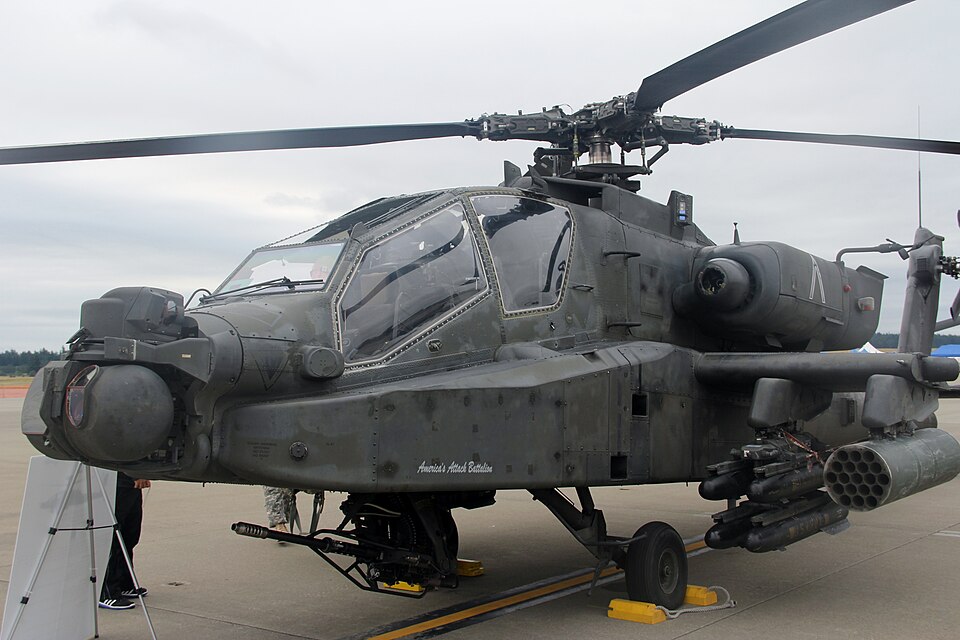
If there is one helicopter that defines what an attack helicopter should be, it is the AH-64 Apache. First introduced in the mid-1980s, the Apache has been the U.S. Army's premier anti-armor and close air support platform ever since.
The Apache carries a 30mm M230 chain gun under its nose, plus four hardpoints loaded with AGM-114 Hellfire missiles and Hydra 70 rocket pods. Its crew of two sits in a tandem cockpit, with the pilot behind and above the copilot/gunner. Both crew members can fly the aircraft independently, which adds a crucial layer of redundancy in combat.
One of the most striking features at the Apache's introduction was its helmet-mounted targeting system. The pilot or gunner can literally move the 30mm cannon by turning their head — the gun tracks wherever they look.
The latest variant, the AH-64E Guardian, takes things further. It can team with unmanned aerial systems in real time, extending the pilot's sensor reach far beyond the aircraft itself. As of recent reporting, the Apache has accumulated well over five million flight hours, with more than a million of those in combat. It is in production through the 2030s and expected to remain in U.S. service into the 2060s.
Why It Matters: During Operation Flyswatter in 2024, AH-64E Apaches scored 13 drone kills out of 14 engagements, showing the platform has evolved well beyond its Cold War anti-tank origins.
| Spec | Detail |
| Role | Attack / armed reconnaissance |
| Crew | 2 |
| Primary weapons | 30mm M230 chain gun, Hellfire missiles, Hydra 70 rockets |
| Top speed | Approx. 182 mph |
| Units in service | Over 800 (U.S. Army) |
| Current variant | AH-64E Guardian |
2. Sikorsky UH-60 Black Hawk — The Military's Workhorse
The UH-60 Black Hawk is arguably the most recognizable military helicopter in the world. First fielding in the late 1970s, it replaced the aging Bell UH-1 Iroquois and quickly became the backbone of U.S. Army aviation.
More than 5,000 Black Hawks have been produced across all variants, making it one of the most widely built military helicopters in history. Its combination of speed, payload, and reliability made it invaluable from the jungles of Panama to the mountains of Afghanistan.
The Black Hawk's standard role is troop transport and utility, but it has been adapted for almost everything. Variants include the MH-60 for special operations, the SH-60 Seahawk for the Navy, the HH-60 Pave Hawk for the Air Force, and even a VH-60N that serves as Marine One for presidential transport.
A special stealth-modified version of the Black Hawk was reportedly used during the 2011 raid that resulted in the death of Osama bin Laden — one of the most high-profile military helicopter missions in recent history.
Pro Tip: If you are interested in what it takes to fly a helicopter at a beginner level, the gap between a military utility helicopter and a civilian trainer is enormous — but the fundamentals of rotary-wing flight are the same. Check out this guide on the best helicopters for beginner pilots to understand where civilian aviation starts.
| Spec | Detail |
| Role | Utility / troop transport / MEDEVAC |
| Crew | 2–3 |
| Top speed | Approx. 183 mph |
| Range | Approx. 367 miles |
| Max takeoff weight | Approx. 23,500 lb (UH-60M) |
| Total produced | Over 5,000 across all variants |
3. Boeing CH-47 Chinook — The Heavy Hauler
The CH-47 Chinook has been hauling heavy loads for the U.S. Army since the early 1960s. Its twin tandem rotors — one at each end of the fuselage — give it a distinctive silhouette that is instantly recognizable from miles away.
The Chinook can carry more than 30 troops, or externally sling heavy loads like artillery pieces, armored vehicles, and military equipment. Its cargo capacity and range make it essential for logistics deep in combat zones where wheeled transport cannot go.
One of the Chinook's most famous maneuvers is the "pinnacle landing" — hovering with only the rear wheels touching a cliff or ledge while troops board or exit. It is the kind of thing that looks impossible until you see it done.
The latest CH-47F variant features digital cockpit upgrades and improved engines, and is expected to remain in U.S. service well into the coming decades. When asked about aerial heavy lift, there is simply no other U.S. Army helicopter in the same league.
Fun Fact: The Chinook is said to be one of the fastest helicopters ever built for its size and weight class, with a top speed approaching 196 mph — faster than many much smaller aircraft.
| Spec | Detail |
| Role | Heavy lift / cargo transport |
| Crew | 3 |
| Troop capacity | 33–55 soldiers |
| Top speed | Approx. 196 mph |
| Range | Approx. 400 miles |
| Service entry | 1962 |
4. Sikorsky CH-53K King Stallion — America's Largest Military Helicopter
The CH-53K King Stallion is the U.S. Marine Corps' newest and most capable heavy lift helicopter. It is the largest military helicopter in the American inventory, powered by three General Electric T408 engines each rated at around 7,500 shaft horsepower.
Its external lift capacity is approximately 36,000 pounds — a dramatic improvement over its predecessor, the CH-53E. That means it can carry a Humvee internally, or sling-load heavy artillery, vehicles, and equipment over significant distances. The King Stallion is built for the kind of amphibious operations the Marine Corps specializes in, moving Marines and their gear from ships to shore even in demanding conditions.
The aircraft features a new digital glass cockpit with fly-by-wire controls, composite rotor blades, and haptic feedback systems — technology that makes it significantly easier to fly than previous heavy lift platforms.
Keep in Mind: The CH-53K received full-rate production approval from the U.S. Navy in 2024, signaling confidence in its long-term role in Marine Corps aviation.
Flying411 covers the full range of aviation topics, from powerful military platforms like the King Stallion to compact personal helicopters. If you have ever wondered what a one-person mini helicopter looks and feels like, the contrast with a machine this size is remarkable.
5. Sikorsky MH-60 Seahawk — The Navy's Multi-Mission Platform
The MH-60 Seahawk is the U.S. Navy's primary shipboard helicopter, built on the same basic airframe as the Army's Black Hawk but optimized for maritime operations. It handles a range of naval missions including anti-submarine warfare, anti-surface warfare, and search and rescue.
The MH-60R "Romeo" variant is the Navy's most capable sub-hunter, carrying dipping sonar, sonobuoys, torpedoes, and Hellfire missiles. It can detect and engage submarines or surface threats while operating from destroyers and cruisers at sea. The MH-60S "Sierra" handles cargo delivery, vertical replenishment, and humanitarian missions.
Seahawks are particularly critical in contested maritime environments. As tensions in the Pacific and other regions have increased, the ability to hunt submarines from surface ships has only grown more important.
Good to Know: The Seahawk can fold its rotor blades for storage in tight shipboard hangars — a critical feature for aircraft that must live and operate at sea.
6. Sikorsky HH-60 Pave Hawk — Combat Search and Rescue
The HH-60G Pave Hawk is the U.S. Air Force's primary combat search and rescue helicopter. Its job is straightforward but incredibly dangerous: fly into hostile territory, day or night, and bring isolated personnel home alive.
The Pave Hawk is a heavily modified version of the Black Hawk airframe, fitted with long-range navigation systems, secure communications, a forward-looking infrared sensor, and an air-to-air refueling probe. That refueling capability is critical — it allows Pave Hawks to fly hundreds of additional miles when paired with a tanker aircraft.
A rescue hoist capable of lifting around 600 pounds from up to 200 feet below is standard equipment. The cabin can be configured for MEDEVAC operations, carrying pararescuemen and their patients.
As of the mid-2020s, the Air Force has been transitioning to a newer variant, the HH-60W Jolly Green II, which modernizes the Pave Hawk concept with upgraded systems for the next generation of combat rescue missions.
Pro Tip: Weather is one of the biggest threats helicopters face, and combat rescue helicopters often operate in precisely the worst conditions. If you are curious about how helicopters handle extreme weather events, this piece on what happens if a helicopter gets struck by lightning is worth a read.
7. MD Helicopters MH-6 Little Bird — The Special Operations Specialist
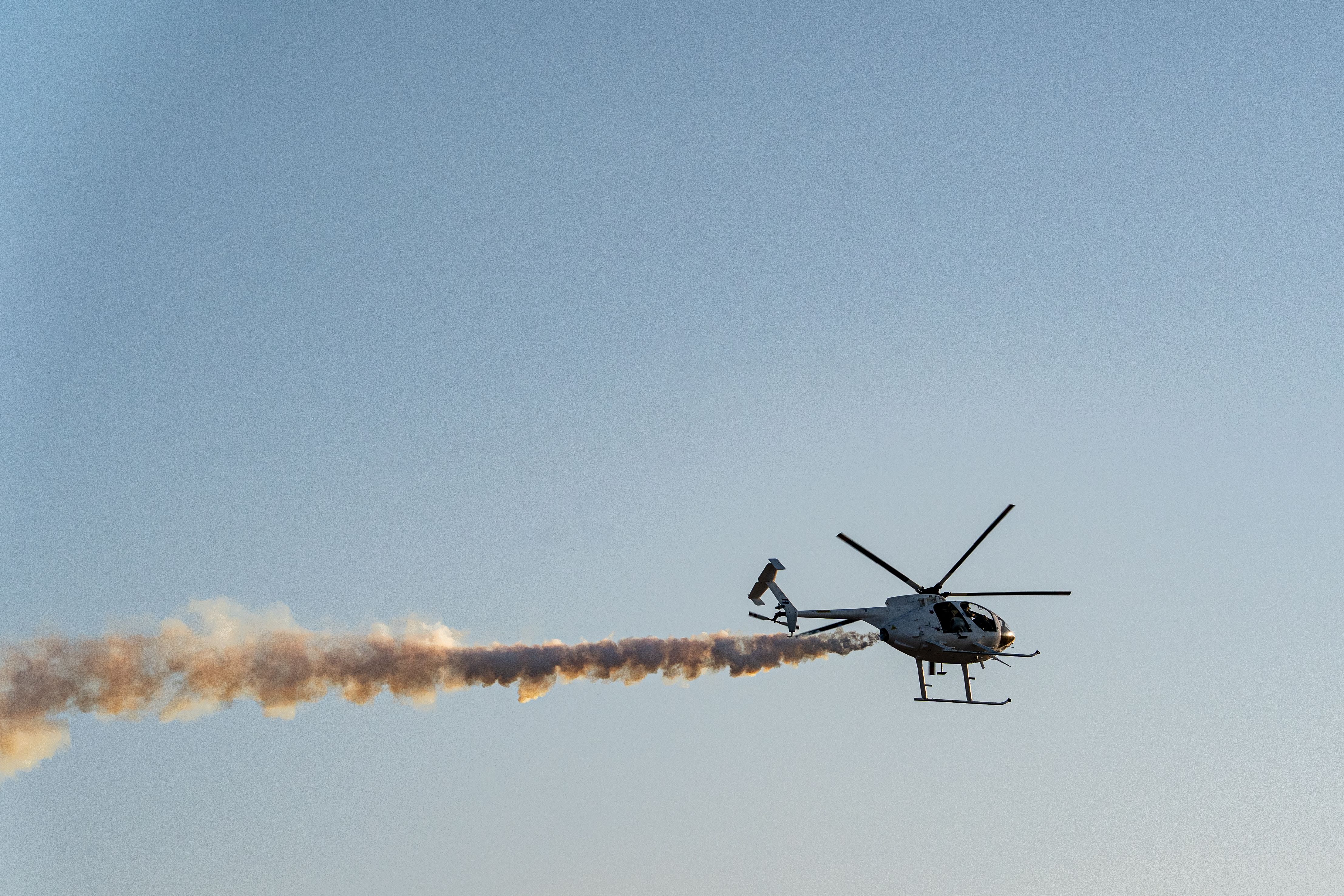
Small, fast, and almost eerily quiet for a helicopter, the MH-6 Little Bird is the go-to aircraft of the U.S. Army's 160th Special Operations Aviation Regiment — better known as the Night Stalkers.
The Little Bird is based on the civilian MD369 airframe, but its military version is a completely different animal. Painted black for nighttime operations, the MH-6 can insert up to six commandos on bench seats mounted outside the fuselage, or extract them from a rooftop in the middle of a city.
Its attack variant, the AH-6, carries rocket launchers, miniguns, Hellfire missiles, and even Stinger air-to-air missiles. The Little Bird can operate in spaces where no larger aircraft fits — narrow streets, rooftops, enclosed courtyards — making it invaluable for hostage rescue and direct action missions.
The MH-6 rose to widespread public attention through the 1993 Battle of Mogadishu, depicted in the book and film Black Hawk Down, where Little Birds provided close air support and helped keep surrounded forces alive.
Fun Fact: Engineers have also developed an unmanned variant of the Little Bird, sometimes called the "Unmanned Little Bird," designed to carry out casualty evacuation missions without putting a pilot at risk.
If you are curious about how helicopters of all sizes navigate complex environments, this guide on how to approach a helicopter safely covers the basics that apply to both military and civilian aircraft.
8. Bell AH-1Z Viper — The Marine Corps Attack Helicopter
The AH-1Z Viper is the U.S. Marine Corps' primary attack helicopter, a thoroughly modern evolution of the legendary AH-1 Cobra that first flew in the 1960s. Where the Army chose the Apache for its attack role, the Marines developed the Viper to fit their specific needs — particularly in amphibious operations.
The AH-1Z features a four-bladed composite rotor system, a new targeting system, and compatibility with advanced air-to-air missiles. It shares about 85 percent of its components with the UH-1Y Venom utility helicopter, which dramatically reduces the Marine Corps' maintenance and logistics burden.
The Viper can carry Hellfire missiles, Sidewinder air-to-air missiles, Hydra rocket pods, and a 20mm three-barrel cannon. It is designed to work closely with Marine ground forces, providing direct fire support in contested environments from land or sea.
Good to Know: The AH-1Z's high component commonality with the UH-1Y Venom means Marine aviation units need fewer unique spare parts, making the combined fleet significantly more cost-effective to operate.
9. Airbus UH-72 Lakota — The Light Utility Workhorse
The UH-72 Lakota might lack the combat glamour of the Apache or the Black Hawk, but it fills a critical role in Army aviation. Based on the civilian Airbus EC145, the Lakota serves as the Army's primary light utility helicopter and pilot training platform.
The Lakota has been used for everything from border surveillance to disaster relief to medevac in non-combat environments. It is also the helicopter many Army pilots now train on, replacing the older Bell 206-based TH-67A in that role.
The U.S. Army has ordered several hundred Lakotas, making it one of the more numerous types in the inventory. Its twin engines, modern avionics, and relatively low operating cost make it an efficient platform for missions that do not require a heavier aircraft.
For anyone exploring the world of rotary-wing aviation — from the military's light utility fleet to cutting-edge personal aircraft — Flying411 has in-depth coverage on platforms of every size, including a look at the fascinating world of the Xiaomi single-person helicopter.
10. Bell-Boeing V-22 Osprey — The Aircraft That Changed the Rules
The V-22 Osprey defies easy categorization. It takes off and lands like a helicopter, then tilts its massive rotors forward to fly like a turboprop airplane — reaching speeds and ranges that no pure helicopter can match.
The Marine Corps uses the MV-22 as a medium-lift transport, replacing the older CH-46 Sea Knight. The Air Force operates the CV-22 variant for special operations. Together, they have been deployed across Iraq, Afghanistan, Libya, and beyond.
The Osprey can carry up to 24 troops or significant cargo loads, cruising at around 275 mph — roughly 100 mph faster than a conventional transport helicopter. Its range is also dramatically longer, allowing it to reach targets that would require multiple refueling stops in a conventional helicopter.
The Osprey has faced criticism and scrutiny over its safety record, and the aircraft has had a challenging operational history in certain conditions. The military has worked continuously to address these concerns through updated procedures and modifications, and the platform remains a critical part of the transport fleet.
Heads Up: The V-22 Osprey cannot hover efficiently at very high altitudes — a limitation that also affects conventional helicopters. If you are curious about how altitude affects rotary-wing aircraft, this article on why helicopters struggle near the top of Everest explains the physics in plain terms.
| Spec | Detail |
| Role | Medium transport / special operations |
| Crew | 2–3 |
| Troop capacity | Up to 24 |
| Top speed | Approx. 275 mph in airplane mode |
| Range | Approx. 879 miles |
| Variants in service | MV-22 (Marines), CV-22 (Air Force) |
How These Helicopters Compare: A Quick Reference
| Helicopter | Primary Role | Top Speed | Crew | Service Branch |
| AH-64 Apache | Attack | ~182 mph | 2 | Army |
| UH-60 Black Hawk | Utility / Transport | ~183 mph | 2–3 | Army / Multi |
| CH-47 Chinook | Heavy Transport | ~196 mph | 3 | Army |
| CH-53K King Stallion | Heavy Lift | ~196 mph | 3 | Marines |
| MH-60 Seahawk | Naval / Anti-sub | ~180 mph | 4 | Navy |
| HH-60 Pave Hawk | Combat SAR | ~184 mph | 4 | Air Force |
| MH-6 Little Bird | Special Ops | ~175 mph | 2 | Army (SOAR) |
| AH-1Z Viper | Marine Attack | ~222 mph | 2 | Marines |
| UH-72 Lakota | Light Utility / Training | ~153 mph | 2 | Army |
| V-22 Osprey | Tiltrotor Transport | ~275 mph | 3 | Marines / Air Force |
Quick Tip: Speed numbers for military helicopters often vary based on configuration, altitude, and payload. The figures above reflect general reported cruise or top speeds and are meant for comparison — not precision planning.
What Makes US Military Helicopters So Advanced?
The U.S. military does not just buy helicopters — it continuously upgrades them. The same airframe that entered service decades ago often carries entirely modern avionics, sensors, and weapons systems today.
A few technologies set American military helicopters apart from most of the world:
Manned-unmanned teaming (MUM-T): The AH-64E Apache can now control unmanned aerial systems during a mission, extending its sensor reach without risking additional crew. This is a major step forward in how helicopters fight.
Night vision and FLIR: Nearly every combat helicopter in the U.S. fleet can operate in complete darkness using forward-looking infrared sensors and night vision compatible cockpits. Most adversaries cannot match this capability.
Fly-by-wire controls: Newer platforms like the CH-53K use electronic flight control systems that reduce pilot workload and make the aircraft more stable, especially under heavy load.
Survivability systems: Modern military helicopters carry radar warning receivers, missile approach warning systems, and flare or chaff dispensers. Armored crew seats and self-sealing fuel tanks add further protection in combat.
The Future of US Military Helicopters
The U.S. military is actively developing the next generation of rotary-wing aircraft through the Future Vertical Lift (FVL) program. The goal is to replace aging Black Hawks and Apaches with faster, longer-range aircraft that can compete in a modern contested airspace.
Two leading designs have emerged from competitions: the Sikorsky-Boeing SB>1 Defiant and the Bell V-280 Valor. The V-280 won the Army's FLRAA (Future Long-Range Assault Aircraft) competition in late 2022, putting Bell back in the running for one of the largest military aviation contracts in history.
The pace of drone warfare is also pushing helicopter design in new directions. As shown by the Apache's counter-drone operations, future military helicopters will need to detect and engage small unmanned aerial systems at close range — a mission very different from the Cold War anti-tank role these aircraft were built for.
Why It Matters: The shift from counterinsurgency operations in the Middle East toward potential peer-competitor conflicts in the Pacific has driven significant changes in how the military thinks about helicopter range, speed, and survivability.
Conclusion
From the thundering power of the CH-53K King Stallion to the silent precision of the MH-6 Little Bird, the top 10 US military helicopters represent decades of hard-won innovation. Each one fills a role that no other platform can fully replace, and together they give the U.S. military an unmatched ability to project force, save lives, and operate in environments where nothing else can go.
These aircraft did not earn their reputations in test labs — they earned them in combat, disaster relief operations, and covert missions around the globe. The technology keeps advancing, but the core mission stays the same: get there fast, do the job, and get everyone home.
If this deep dive into military aviation got you curious about the broader world of flight, Flying411 is the perfect place to keep exploring — from the mechanics of military rotorcraft to guides for those just starting their aviation journey.
FAQs
What is the most powerful military helicopter in the US?
The CH-53K King Stallion is widely considered the most powerful helicopter in the U.S. inventory, powered by three engines and capable of lifting the heaviest external loads of any American military aircraft.
How many helicopters does the US military have?
The U.S. military operates several thousand helicopters across all branches, with the Army fielding the largest portion. The exact number changes as aircraft are retired, upgraded, and added to the inventory.
What helicopter do Navy SEALs use?
Navy SEALs typically insert and extract using MH-60 Sea Hawk variants and MH-47 Chinooks operated by the Army's 160th Special Operations Aviation Regiment, the Night Stalkers. The MH-6 Little Bird is also associated with special operations missions.
Is the V-22 Osprey considered a helicopter?
The V-22 Osprey is technically a tiltrotor aircraft, not a pure helicopter. It uses rotating engine nacelles to take off and land vertically like a helicopter, then converts to fixed-wing flight. It is classified by the military as a multi-mission aircraft.
What replaced the UH-1 Huey in the US Army?
The UH-60 Black Hawk replaced the UH-1 Iroquois (Huey) as the Army's primary utility and troop transport helicopter, entering service in the late 1970s and becoming one of the most produced military helicopters in history.