Helicopters can do things that no other aircraft can. They hover. They lift. They fly into places where roads simply do not exist. But some helicopters take all of that and push it far beyond what most people think is possible.
When you talk about the most powerful helicopter in the world, you are not just talking about raw engine numbers. You are talking about machines that can haul tanks, rescue other helicopters, respond to nuclear disasters, and carry entire relief efforts on their rotor blades. These aircraft exist in a category of their own — part engineering marvel, part logistical lifeline for operations that would otherwise be impossible.
Power in the helicopter world means different things in different situations. For a military cargo crew, it means how many tons you can lift off the ground. For a special operations pilot, it means speed, agility, and precision under fire. For a search-and-rescue team on a mountainside, it means reliable thrust at high altitude when the air is thin and there is no margin for error.
Understanding these distinctions is the key to understanding which helicopter truly earns the title — and why more than one machine can make a compelling claim.
Key Takeaways
The Mil Mi-26 is widely regarded as the most powerful helicopter in the world in terms of raw lifting capacity and sheer size, capable of carrying up to around 20 metric tons of cargo. In the U.S. military, the CH-53K King Stallion holds the title of the most powerful helicopter ever developed by an American manufacturer, with three massive engines producing a combined output that dwarfs its predecessors. Attack helicopters like the Boeing AH-64E Apache Guardian are widely considered the most capable in terms of combat effectiveness. The definition of "most powerful" depends on the mission — whether that means lift capacity, engine output, combat firepower, or high-altitude performance.
| Category | Top Contender | Key Stat |
| Heaviest lift capacity (production) | Mil Mi-26 | Up to ~20 metric tons payload |
| Most powerful U.S. military helicopter | Sikorsky CH-53K King Stallion | ~22,500 shp combined output |
| Most advanced attack helicopter | Boeing AH-64E Apache Guardian | Widely used by 18+ nations |
| Largest helicopter ever built (prototype) | Mil V-12 | Lifted over 44 metric tons |
| Most powerful tandem-rotor | Boeing CH-47F Chinook Block II | ~10,000+ lbs added lift over prior version |
| Most powerful naval helicopter | Sikorsky CH-53K | Triple-engine, shipboard capable |
If you want to go deeper into the world of aviation — from beginner flight training to the biggest birds in the sky — Flying411 covers it all with clear, practical content for everyone from curious newcomers to seasoned pilots.
Why "Most Powerful" Means Different Things in Rotorcraft
Before getting into the rankings, it helps to understand what power actually means when it comes to helicopters. This is not a simple horsepower race. Several different factors determine how "powerful" a helicopter really is, and they do not always point to the same aircraft.
Lift Capacity vs. Engine Output
A helicopter's lifting power depends on a combination of engine shaft horsepower, rotor diameter, blade design, and weight. A larger rotor can generate more lift at lower speeds, which is why big cargo helicopters often have enormous main rotors. A high-horsepower engine means nothing if the rotor system cannot convert that power into useful lift efficiently.
The Mil Mi-26, for example, uses a massive eight-blade main rotor measuring about 32 meters (roughly 105 feet) across. That rotor system is a big reason the aircraft can lift loads that would overwhelm helicopters with smaller rotors — even those with comparable engine output.
Combat Power vs. Lift Power
Attack helicopters are powerful in a completely different way. Their power comes from firepower, avionics, speed, and survivability — not raw payload weight. A Boeing AH-64E Apache cannot haul cargo like the Mi-26, but it can identify targets from miles away, launch precision-guided missiles, and survive conditions that would ground most aircraft.
These are two very different definitions of power, and both are legitimate depending on the mission.
Good to Know: The world's five fastest helicopters are all military aircraft. Raw speed in a helicopter tends to come from military development budgets and specialized mission requirements, not from the civilian market.
The Mil Mi-26 Halo: The Undisputed Heavyweight Champion
If the conversation is about sheer lifting power and overall size, one helicopter stands above all others currently in production: the Mil Mi-26, codenamed "Halo" by NATO.
Developed by the Soviet Mil Moscow Helicopter Plant and first flown in the late 1970s, the Mi-26 entered service with the Soviet military in the early 1980s. It was designed from the start to be massive — a replacement for the earlier Mi-6 that would carry twice the payload while maintaining reasonable speed and range.
What Makes the Mi-26 So Remarkable
The numbers surrounding this aircraft are hard to wrap your head around without some context.
The Mi-26 is powered by two Lotarev D-136 turboshaft engines, each producing around 11,400 shaft horsepower. Together, they drive an eight-blade main rotor that is about 32 meters in diameter — the largest main rotor on any production helicopter in history. The aircraft has a maximum takeoff weight of around 56,000 kilograms and can carry an internal or external payload of up to approximately 20 metric tons.
To put that in perspective, 20 metric tons is roughly the weight of two fully loaded school buses. The Mi-26 can carry that load and cruise at around 255 kilometers per hour, with a range of several hundred kilometers carrying a heavy payload.
Fun Fact: The Mi-26's tail rotor is said to have roughly the same diameter and thrust as the four-blade main rotor fitted to the MD 500, a small light helicopter. The scale difference between these two aircraft is extraordinary.
The Mi-26 has been used in some genuinely remarkable real-world missions:
- In 1986, it played a critical role in the Chernobyl disaster response, delivering construction materials and insulating compounds directly to the damaged reactor
- In 2002, a civilian Mi-26 was leased to recover a U.S. Army MH-47E Chinook helicopter that had been stranded on a mountain in Afghanistan at altitude — a lift that exceeded the maximum capability of American heavy-lift aircraft available at the time
- In 1999, an Mi-26 transported a 23-ton block of frozen soil containing a preserved woolly mammoth from the Siberian tundra for scientific study
- The aircraft has been deployed in Pakistan for earthquake relief operations, in India for flood rescue in Jammu and Kashmir, and across multiple conflict zones for military logistics
Flying411 has helpful resources for aviation enthusiasts curious about how different types of rotorcraft handle everything from beginner flight conditions to extreme-environment operations — check out their article on why helicopters struggle at extreme altitudes for a fascinating look at how altitude affects rotor performance.
Mi-26 Specifications at a Glance
| Specification | Detail |
| Engines | 2x Lotarev D-136 turboshaft |
| Engine output (each) | ~11,400 shp |
| Main rotor diameter | ~32 meters (105 feet) |
| Maximum payload | ~20,000 kg (44,000 lbs) |
| Maximum takeoff weight | ~56,000 kg (123,000 lbs) |
| Maximum speed | ~295 km/h (183 mph) |
| Cruise speed | ~255 km/h (158 mph) |
| Service ceiling | ~4,600 meters (15,000 feet) |
Why It Matters: The Mi-26's gearbox alone is an engineering achievement. It weighs around 3,600 kilograms yet can absorb over 14,700 kilowatts of power — a feat accomplished through a specialized split-torque design that Mil's engineers had to develop themselves because no existing supplier could build it.
The Sikorsky CH-53K King Stallion: America's Most Powerful Helicopter
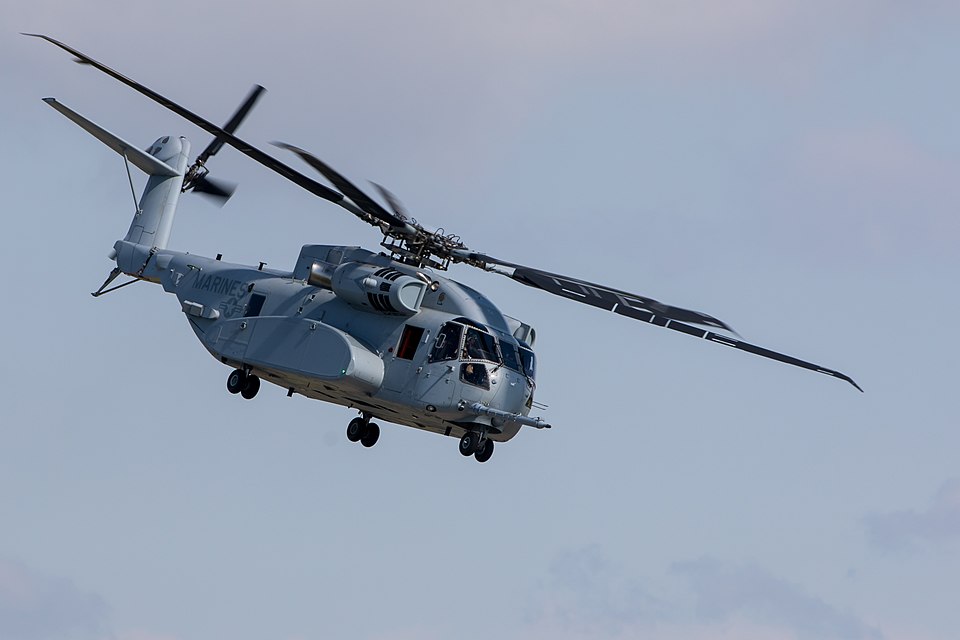
On the American side of the ledger, the title of most powerful helicopter belongs to the Sikorsky CH-53K King Stallion, developed for the U.S. Marine Corps as a replacement for the older CH-53E Super Stallion.
The CH-53K is described by the U.S. Naval Air Systems Command as the most powerful helicopter in the Department of Defense — a significant claim given the breadth of American military aviation.
What Sets the King Stallion Apart
The CH-53K runs on three General Electric T408-GE-400 turboshaft engines, each producing around 7,500 shaft horsepower. Combined, that is over 22,000 shaft horsepower — enough to lift approximately 36,000 pounds (around 16,300 kg) on its external cargo hook.
That is a massive improvement over its predecessor. The CH-53E could lift around 36,000 pounds externally too, but the CH-53K can do it at greater distances and in more challenging environmental conditions — specifically the "high, hot" conditions (high altitude, high temperature) where helicopter performance drops significantly.
Pro Tip: When evaluating helicopter lift claims, always look for "high/hot" performance figures. A helicopter might lift a lot at sea level on a cool day, but that same aircraft could struggle significantly in desert or mountain environments where the air is thinner and hotter.
The King Stallion's cabin is also notably wider than its predecessor's, allowing it to internally carry a Humvee — something the older Super Stallion could not do. This is a significant operational advantage for Marine Corps expeditionary missions.
Key real-world demonstrations of the King Stallion's capability include:
- In September 2021, a CH-53K lifted a Navy MH-60S helicopter from a 12,000-foot mountain in California and transported it approximately 23 nautical miles
- In December 2022, a King Stallion lifted a non-flyable F-35C Lightning II airframe as part of external load certification testing
- The aircraft has conducted successful aerial refueling tests with KC-130J tankers, significantly extending its operational range
The CH-53K entered Initial Operational Capability in April 2022 and is on track for Full Operational Capability by 2029. The U.S. Marine Corps plans to acquire around 200 of them.
If you are curious about how modern military helicopters are maintained and what keeps them airworthy in demanding conditions, learning the basics of how to safely approach a helicopter is a great starting point for understanding rotorcraft operations.
The 8 Most Powerful Helicopters in the World
Power in the helicopter world takes many forms. Here is a look at the top contenders across different categories, from raw lifters to precision attack machines.
1. Mil Mi-26 Halo (Russia)
The Mi-26 is the largest and most powerful production helicopter in history by lifting capacity. Its eight-blade rotor, twin D-136 engines, and approximately 20-metric-ton payload put it in a class entirely by itself. It remains in active production and operational service decades after its first flight, a testament to a design that has never truly been surpassed in the heavy-lift category.
2. Sikorsky CH-53K King Stallion (USA)
The most powerful helicopter ever produced by an American manufacturer, the CH-53K combines three high-output engines with advanced composite rotor blades and fly-by-wire flight controls. It can lift around 36,000 pounds externally and operates effectively in the kind of high-altitude, high-temperature environments that ground lesser aircraft.
3. Boeing AH-64E Apache Guardian (USA)
The Apache Guardian is widely considered the most advanced and capable attack helicopter in the world in 2025. It is armed with a 30mm chain gun, Hellfire missiles, and Hydra rockets, and features a titanium-plated cockpit, an advanced targeting system, and the ability to operate in day, night, and adverse weather conditions. More than 18 nations operate some variant of the Apache.
Fun Fact: The Apache's targeting system is controlled partly by the pilot's eye movements. A sensor in the helmet tracks where the pilot is looking, allowing the 30mm gun to aim wherever the pilot's gaze falls.
4. Boeing CH-47F Chinook Block II (USA)
The Chinook has been in service for more than 60 years, which is remarkable for any military aircraft. The Block II variant introduced an upgraded drivetrain and redesigned rotor blades engineered to lift significantly more weight than the previous version. The Chinook's tandem-rotor design is particularly effective because it eliminates the need for a tail rotor, directing all engine power to lifting. It is widely used by the U.S. Army and dozens of allied nations.
5. Bell AH-1Z Viper (USA)
The AH-1Z Viper is the U.S. Marine Corps' primary attack helicopter and is widely regarded as one of the most capable attack rotorcraft in the world. It is the only attack helicopter required to operate regularly from naval vessels. Its four-blade composite rotor system makes it faster and more agile than the original Cobras it descended from, and its six hardpoints can carry a significant variety of weapons including Sidewinder, Hellfire, and JAGM missiles.
Good to Know: The AH-1Z Viper is the only attack helicopter in the world with a fully integrated air-to-air Sidewinder missile capability, allowing it to engage both rotary and fixed-wing aircraft.
6. Sikorsky CH-53E Super Stallion (USA)
The CH-53E is the three-engine predecessor to the King Stallion and remains in active service with the U.S. military. It held the title of the largest helicopter in the Western world for decades. It can carry up to about 36,000 pounds externally and operate from U.S. Navy ships. The Super Stallion is planned to remain in service into the 2030s as the King Stallion fleet builds up.
7. Mil Mi-24 Hind (Russia)
The Mi-24 Hind is a unique aircraft in that it serves as both a gunship and a troop transport — a combination that most attack helicopters do not attempt. NATO designated it the "Flying Tank," and the nickname fits. It carries a heavy weapons load, including a 12.7mm or 23mm cannon, rockets, and anti-tank missiles, while also being capable of carrying several combat troops inside its fuselage. It has seen combat in dozens of conflicts since the 1970s.
8. Eurocopter Tiger (France/Germany)
The Tiger is a third-generation European attack helicopter featuring an airframe composed primarily of advanced composite materials, making it lightweight yet durable. It has been used operationally in Afghanistan, Libya, and Mali, and is operated by France, Germany, Australia, and Spain. A major upgrade program is extending its service life and adding new capabilities to keep it competitive with more recent designs.
Want to know more about helicopter safety and how these machines handle extreme conditions like lightning strikes? Flying411 has a detailed breakdown of what happens if a helicopter gets struck by lightning — it is more reassuring than you might expect.
How Heavy-Lift Helicopters Are Actually Used
Understanding what these machines can do in theory is one thing. Seeing how they are used in the real world gives a fuller picture of why their power matters so much.
Military Logistics
Heavy-lift helicopters are critical in military logistics because they can move large amounts of equipment directly to locations that have no roads, no runways, and no infrastructure. The CH-53K was designed specifically for the Marine Corps' vision of distributed operations across island chains in the Pacific, where forces need to move equipment quickly between locations that are separated by water.
The Mi-26 has fulfilled a similar role for Russian military forces, transporting armored personnel carriers, ammunition, and other heavy equipment to locations that wheeled and tracked vehicles simply cannot reach.
Disaster Response
Some of the most compelling uses of powerful heavy-lift helicopters have been in humanitarian missions. The Mi-26 played a documented role in Chernobyl response operations, carrying materials and personnel to areas too contaminated or too difficult to reach by ground. It has also been deployed by the United Nations World Food Programme and other international organizations for disaster relief in remote regions.
Keep in Mind: Large helicopters like the Mi-26 consume fuel at a very high rate. The Mi-26 is said to burn through fuel at a rate of several liters per second at full power. Operational planning around fuel logistics is a critical part of deploying these aircraft effectively.
Construction and Infrastructure
Heavy-lift helicopters are also used extensively in civilian construction. They can position large sections of bridges, antenna towers, and power transmission infrastructure in locations where cranes cannot operate. The Mi-26 has been used to position components for power lines, pipelines, and construction projects across remote regions of Russia, Central Asia, and beyond.
Scientific and Specialized Missions
The 1999 recovery of a woolly mammoth from the Siberian tundra by an Mi-26 is one of the more unusual examples of what these aircraft can accomplish. The helicopter lifted a 23-ton frozen block of soil containing the preserved specimen and transported it for scientific study — a mission that no other aircraft in the world could have completed at the time.
Curious about what it takes to get started in the helicopter world yourself? Flying411 has a guide to the best helicopters for beginner pilots — a great read for anyone thinking about taking their first steps toward a rotorcraft license.
The Mil V-12: The Helicopter That Broke All Records (And Never Entered Service)
No discussion of helicopter power is complete without mentioning the Mil V-12, also known as the Mi-12 or by its NATO designation "Homer." This experimental Soviet helicopter is said to be the largest helicopter ever built — period.
The V-12 used a side-by-side rotor configuration (rather than the tandem design used by the Chinook) with two enormous rotors mounted on outrigger wings. During testing in the early 1970s, it reportedly lifted a payload of over 44 metric tons to altitude — a record that has never been matched or broken by any helicopter, before or since.
Despite this performance, the V-12 never entered production. The Soviet military decided that its complexity and specialized nature made it impractical for large-scale operational use, and the program was ended after a small number of prototypes were built.
The Mi-26 was subsequently developed as a more practical alternative, achieving about half the V-12's maximum payload in a design that was actually manufacturable at scale and serviceable in the field.
Fun Fact: The Mil V-12's rotors were so large that the aircraft's total rotor span was said to be comparable to a fixed-wing airliner. It remains one of the most extraordinary engineering achievements in the history of rotorcraft.
High-Altitude Helicopter Performance: Where Power Really Gets Tested
One of the most demanding tests of helicopter power is high-altitude performance. As altitude increases, air density drops, which means rotors generate less lift and engines produce less power. A helicopter that can carry 20 tons at sea level might be limited to a fraction of that at high altitude.
This is particularly relevant in the context of the Mi-26's operational history. The recovery of the U.S. Chinook from Afghanistan in 2002 was conducted at around 2,600 meters (about 8,500 feet) above sea level. At that altitude, the Mi-26 could carry approximately 9.1 metric tons — significantly less than its sea-level maximum, but still more than the U.S. CH-53E could manage at the same altitude.
The CH-53K King Stallion was specifically designed with high-altitude and high-temperature performance as a priority. Its three engines and advanced rotor system allow it to operate effectively in environments where the CH-53E would have been significantly limited.
One-person mini helicopters represent a very different end of the spectrum from these heavy lifters — Flying411 has an interesting look at single-person mini helicopters and single-person helicopter technology for those curious about how small rotorcraft have evolved.
Why It Matters: High-altitude capability is not just a military concern. Search-and-rescue operations in mountainous terrain, construction in high-altitude regions, and emergency response in places like the Himalayas all require helicopters that can maintain meaningful performance when the air gets thin.
What the Future Holds for Heavy-Lift Helicopter Technology
Helicopter technology is continuing to evolve, and the next generation of heavy-lift rotorcraft is already taking shape.
Several trends are worth watching:
Hybrid-electric propulsion is being explored as a way to reduce fuel consumption and emissions while maintaining or improving performance. While full electric propulsion for heavy-lift helicopters is still a distant prospect, hybrid systems may offer meaningful improvements in the nearer term.
Composite materials continue to reduce airframe weight while maintaining or improving structural integrity. The CH-53K's composite rotor blades are a prime example of how materials science is directly improving helicopter capability.
Autonomous systems and advanced flight control technologies, including the fly-by-wire system used on the CH-53K, are reducing pilot workload and improving safety margins. Future versions of these aircraft may incorporate increasing levels of autonomous capability.
Unmanned cargo delivery concepts are already in development for smaller-scale missions, and the underlying technology could eventually influence how large cargo helicopters are operated, with reduced crew requirements or fully remote operation in some scenarios.
Want to see how far helicopter technology has come? Flying411's coverage of best helicopters for beginner pilots shows how accessible modern rotorcraft have become, even at the entry level.
Pro Tip: If you are researching helicopter capabilities for a specific purpose — whether that is aviation journalism, a business decision, or simple curiosity — always look for figures measured under standardized test conditions. "Maximum" payload figures often refer to ideal sea-level conditions and may not reflect what an aircraft can actually carry in a real-world operational environment.
Conclusion
The most powerful helicopter in the world is not a single aircraft — it depends on what you need it to do. If you are measuring raw lifting capacity and sheer size, the Mil Mi-26 Halo has held that title for decades, carrying loads that no other production helicopter can match. If you are measuring the most advanced military platform in terms of combined power output and modern capability, the Sikorsky CH-53K King Stallion makes a compelling case for American rotorcraft engineering. And if combat effectiveness is the standard, the Boeing AH-64E Apache Guardian remains the benchmark by which all other attack helicopters are measured.
What these machines share is the ability to do things that nothing else on earth can do — carrying the impossible, going where roads end, and performing when the stakes are highest. That is what true helicopter power looks like.
Whether you are an aviation enthusiast, a student pilot, or simply fascinated by what engineering can achieve, there is always more to learn about the world of flight.
Flying411 is a great place to keep exploring — from the basics of rotorcraft to the record-breakers that keep pushing the boundaries of what is possible.
Frequently Asked Questions
What is the most powerful helicopter in the world by lifting capacity?
The Mil Mi-26, codenamed "Halo" by NATO, is widely regarded as the most powerful production helicopter in history by lifting capacity, capable of carrying an internal or external payload of up to approximately 20 metric tons. No other helicopter in production today can match this figure.
Is the CH-53K King Stallion more powerful than the Mil Mi-26?
The CH-53K King Stallion is the most powerful helicopter in the U.S. military and produces a combined engine output of around 22,500 shaft horsepower. However, the Mi-26 has a higher maximum payload capacity of around 20 metric tons versus the King Stallion's approximately 16 metric tons, so the Mi-26 generally holds the edge in raw lifting power for production helicopters.
What is the largest helicopter ever built?
The Mil V-12, also known as the Mi-12 or NATO designation "Homer," is believed to be the largest helicopter ever constructed. This experimental Soviet aircraft reportedly lifted a payload of over 44 metric tons during testing in the early 1970s, a record that has never been matched. It never entered production.
What makes the Apache the most powerful attack helicopter?
The Boeing AH-64E Apache Guardian is widely considered the most capable attack helicopter in the world because of its combination of precision targeting systems, firepower, survivability, and operational record. It carries a 30mm chain gun, Hellfire missiles, and Hydra rockets, while its advanced sensors allow it to identify and engage targets at significant distances.
Can helicopters fly at very high altitudes like Everest?
Helicopters can fly at high altitudes, but their performance drops significantly as the air gets thinner. Most heavy-lift helicopters operate most effectively at lower altitudes, and even the most powerful designs experience meaningful reductions in payload capacity and engine output at elevation. Specialized high-altitude rotorcraft have reached extreme heights, but sustained operations at the highest elevations on Earth remain beyond the practical capability of most helicopter designs.