Some aircraft just fly. These ten rewrote the rules of what flying even means. The moment a plane punches through the sound barrier, everything changes. The physics shift. The engineering bends in new directions. And the nerve it takes to sit in that cockpit becomes legendary.
Breaking the sound barrier was once considered nearly impossible for a piloted aircraft. Yet within a few decades, it became almost routine for military jets. From a tiny orange rocket plane over the California desert to sleek supersonic designs being built right now, the story of planes that break the sound barrier is one of the most thrilling chapters in all of aviation.
The ten aircraft ahead each earned their place in that story in their own way.
Key Takeaways
The top 10 planes that break the sound barrier ever built include the Bell X-1, the aircraft Chuck Yeager flew into the history books, along with icons like the F-86 Sabre, the SR-71 Blackbird, the Concorde, and newer designs like Boom Supersonic's XB-1. These aircraft pushed human engineering past what many thought possible, reaching speeds from just above Mach 1 to more than Mach 3.
| Aircraft | Country | Top Speed | First Flight | Primary Role |
| Bell X-1 | USA | Around Mach 1.06 | 1946 | Experimental research |
| F-86 Sabre | USA | Mach 1+ in dive | 1947 | Fighter |
| F-100 Super Sabre | USA | Around Mach 1.3 | 1953 | Fighter/bomber |
| MiG-19 | USSR | Around Mach 1.3 | 1953 | Fighter |
| F-104 Starfighter | USA | About Mach 2.0 | 1954 | Interceptor |
| SR-71 Blackbird | USA | Above Mach 3 | 1964 | Reconnaissance |
| Concorde | UK/France | Around Mach 2.04 | 1969 | Supersonic airliner |
| Douglas DC-8 | USA | Just past Mach 1 (dive) | 1958 | Commercial airliner |
| Tu-144 | USSR | Above Mach 2 | 1968 | Supersonic airliner |
| XB-1 (Boom) | USA | Above Mach 1 | 2023 | Demonstrator |
Flying411 is your go-to home base for in-depth aviation stories like this one. Bookmark Flying411 and stay close to everything happening in the skies.
What Breaking the Sound Barrier Actually Means for Planes
Sound travels through air at roughly 767 miles per hour at sea level. That number is not fixed. It changes with altitude and temperature. But it is always the threshold. The speed of sound is what engineers call Mach 1. When a plane reaches that speed, it is not just going fast. It is entering a completely different physical environment.
As an aircraft approaches Mach 1, air pressure builds up in front of it faster than the air can move out of the way. That buildup creates a shock wave. Think of it as a wall of compressed air the plane has to push through. For early test pilots, the controls would shake, the airframe would shudder, and many engineers believed the plane would simply come apart.
Here is what actually happens at and beyond Mach 1:
- Air molecules pile up faster than they can move aside, compressing into a pressure wall.
- The shock wave forms at the nose and wings and travels with the aircraft.
- A sonic boom reaches the ground below as that compressed wave passes overhead.
- The boom is not a one-time event. It continues for as long as the plane flies at supersonic speed.
Good to Know: The sonic boom people hear on the ground is not caused by the plane "breaking through" anything. It is the continuous shock wave trailing behind any aircraft flying faster than sound. The boom reaches your ears when that wave passes over you.
The term supersonic simply means faster than sound. Subsonic means slower. The zone right around Mach 1, where some parts of the airframe are supersonic and others are not, is called transonic. That transonic zone was the most dangerous region for early test pilots because the shock waves were unstable and unpredictable.
What made this so hard to solve was that the rules that worked perfectly at low speeds stopped working near Mach 1. Wings designed for subsonic flight would lose control. Engines would lose efficiency. The whole aircraft would behave differently. Engineers had to learn an entirely new set of rules and build a new science almost from scratch.
Why Breaking the Sound Barrier Changed How We Build Planes
The push to reach supersonic flight did not just produce fast aircraft. It forced engineers to rethink how planes are designed, what they are made of, and how they are powered.
Wings, Bodies, and Heat
Before the sound barrier was broken, aircraft design was guided by rules developed over decades of slower flight. Wings were thick. Fuselages were rounded. Drag was manageable. None of that worked at Mach speeds. Here is what had to change:
- Wing shape. Thick wings that worked perfectly at low speeds caused massive drag near Mach 1. Engineers moved to thin, swept wings that sliced through air more efficiently.
- Fuselage design. A principle known as the area rule, developed in the early 1950s, showed that narrowing the fuselage where the wings attached created far less drag. This gave birth to the famous "wasp waist" shape seen on several supersonic jets.
- Engine power. Piston engines could not produce the thrust needed. Jet engines became essential, and afterburners were developed to give short bursts of extra power for pushing through the transonic zone.
- Heat management. At Mach 2 and above, air friction heats the airframe significantly. Materials had to change. Titanium and specialized alloys replaced aluminum in many high-speed designs.
- Control systems. Standard control surfaces became unreliable near Mach 1. Engineers developed all-moving tail surfaces that gave pilots real control authority at supersonic speeds.
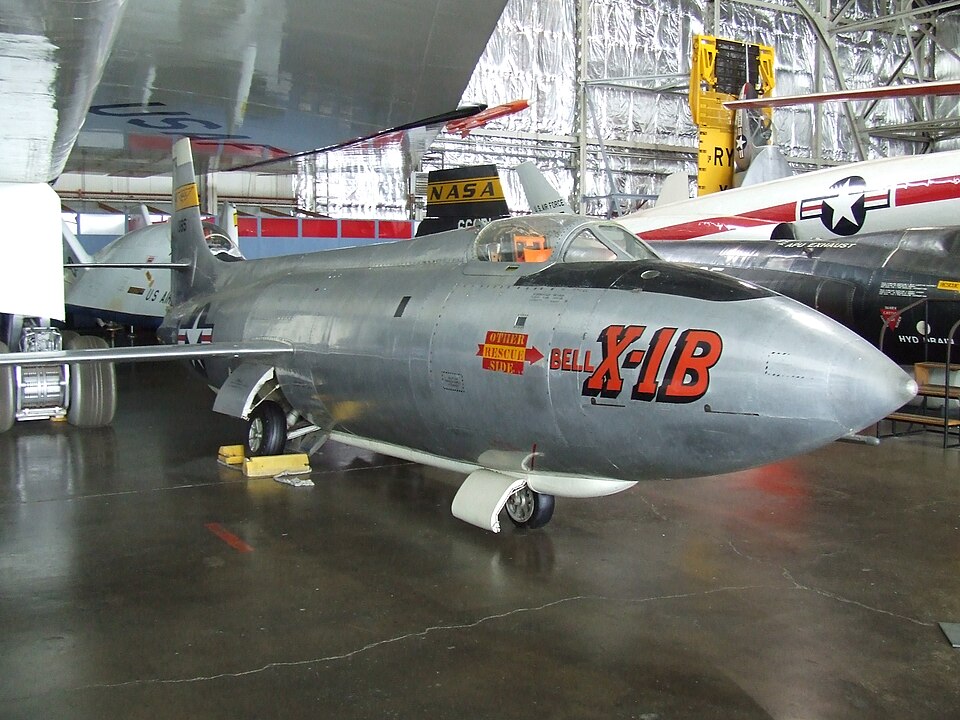
Fun Fact: The Bell X-1 was shaped like a .50 caliber bullet on purpose. Engineers already knew bullets traveled at supersonic speeds without breaking apart, so they used that shape as a model.
How Lessons Spread Beyond Military Jets
The ripple effects reached far beyond fighters and experimental aircraft. Commercial aviation changed too. The lessons from supersonic research influenced the design of faster airliners, better engines, and improved safety systems across the entire industry. Even the Concorde, which carried paying passengers at twice the speed of sound, was built on knowledge that came directly from those early experimental programs.
For pilots and engineers, this era produced a new discipline: supersonic aerodynamics. Universities built programs around it. Defense agencies funded decades of research. And a handful of extraordinarily brave test pilots flew machines that nobody fully understood yet. They gathered data that made everything safer and faster for everyone who came after. If you are curious about the smaller side of commercial aviation that benefited from this research, our guide on the best regional aircraft shows how design lessons trickled down.
Where Planes That Break the Sound Barrier Made History
The history of supersonic aircraft is not just written in technical manuals. It is written in specific places, specific dates, and the names of people who were willing to climb into untested machines and find out what happened next.
The Morning It All Began
On October 14, 1947, at Muroc Army Air Field in California, Chuck Yeager climbed into the Bell X-1 experimental aircraft. He had two broken ribs at the time. He flew anyway. After being dropped from a B-29 bomber at altitude, the Bell X-1 reached a speed just past Mach 1, and the sound barrier fell.
Yeager named the aircraft Glamorous Glennis, after his wife. The flight lasted only a few minutes, but it changed aviation permanently. What followed in the years and decades after that morning was a cascade of faster, higher, and more capable aircraft, each one pushing the boundary a little further.
Why It Matters: That single short flight unlocked everything that came after. Every supersonic fighter, every reconnaissance jet, and every supersonic airliner traces its lineage back to that one orange rocket plane in the desert.
Locations That Defined the Supersonic Era
Here are the places and moments that shaped supersonic history:
- Edwards Air Force Base, California became the heart of American supersonic research. It hosted test flights for the X-1, F-100, F-104, and SR-71 programs across multiple decades.
- The North Atlantic, from 1976 onward became the route where the Concorde carried passengers at Mach 2. London to New York became a trip of just a few hours.
- The Soviet Union, in 1968 saw the Tu-144 become the first commercial aircraft to exceed the speed of sound, beating the Concorde to that milestone by a few months.
- The Pacific Ocean, in 1961 was where a Douglas DC-8 commercial airliner briefly exceeded the speed of sound in a controlled dive, making it one of the few civil transport aircraft to ever do so.
- The Mojave Desert, in 2023 marked the first flight of the XB-1 demonstrator from Boom Supersonic, signaling that the era of supersonic passenger travel may be coming back.
The geography of supersonic history is almost entirely desert and ocean. Deserts because the early test programs needed remote, flat land far from populated areas. Oceans because the sonic boom made supersonic travel over populated land politically and legally complicated. Those two constraints shaped where supersonic aviation developed and where it is heading next. For a sense of how today's giants compare, take a look at our breakdown of the biggest passenger plane in the world.
Top 10 Planes That Break the Sound Barrier and Made History
These ten aircraft each made history in their own way. Some were rocket-powered research machines. Some were frontline fighter aircraft. Some carried passengers across oceans. All of them crossed the line that once seemed impossible.
1. Bell X-1
The experimental Bell X-1 is where the list has to start. This small, orange, rocket-powered plane was built by Bell Aircraft and designed to answer one question. Could a piloted aircraft exceed the speed of sound and survive?
On October 14, 1947, Chuck Yeager became the first person to officially break the sound barrier in level flight. Dropped from a B-29 at altitude over Edwards Air Force Base, Yeager fired the X-1's four-chamber rocket engine and pushed past Mach 1. The instruments confirmed it. The first supersonic flight by a piloted aircraft in level flight was done.
Yeager became the first person to accomplish what many engineers considered fatal. The sound barrier turned out to be survivable, controllable, and repeatable. It was not a wall. It was a door. If you love older aircraft and the stories behind them, our list of the best vintage aircraft to restore is a great companion read.
2. F-86 Sabre
The Sabre was North American Aviation's swept-wing jet fighter and one of the most important military aircraft of the early Cold War. It became the first U.S. jet fighter used extensively in combat during the Korean War.
While the F-86 was not designed as a supersonic aircraft, skilled test pilots discovered that in a steep dive it could briefly go past Mach 1. Some accounts suggest a controlled dive during a test flight first demonstrated this capability. The result gave the Air Force important early data on transonic and supersonic handling. The aircraft design lessons from the Sabre directly influenced every American fighter jet that followed.
Pro Tip: When studying early jets, watch for the move from straight wings to swept wings. That single design change is one of the clearest visual markers between subsonic and transonic-capable aircraft.
3. F-100 Super Sabre
The F-100 Super Sabre was the first U.S. fighter jet designed to reach supersonic speed in level flight as a standard production aircraft, not just in a dive. North American Aviation built it as the direct successor to the F-86, and it delivered on that promise with a top speed above Mach 1.
The Super Sabre served as a workhorse for the U.S. Air Force through the 1950s and 1960s. It was among the first jets to break Mach 1 routinely as part of everyday flight operations rather than record attempts. Its service life stretched across multiple conflicts, and it helped define what a supersonic jet could actually do under real conditions. To see how today's American fighters compare, our roundup of the best US fighter jets traces that lineage forward.
4. MiG-19
The Soviet Mikoyan-Gurevich MiG-19 was the USSR's answer to the F-100 and the first Soviet production aircraft capable of supersonic speed in level flight. It entered service in the mid-1950s and gave Soviet aviation a genuine supersonic fighter that could match Western designs.
The MiG-19 used twin engines and a swept wing to achieve its performance. Its development pushed Soviet aeronautical engineers into supersonic aerodynamics research that would eventually produce some of the fastest military jets ever built. The aircraft also exported widely, giving multiple nations their first experience operating a supersonic-capable fighter.
5. F-104 Starfighter
Lockheed's F-104 Starfighter was unlike anything flying when it appeared in the mid-1950s. Its wings were so thin and short that ground crews had to handle them carefully to avoid getting cut. The design was driven entirely by the need to reduce drag at supersonic speeds. The team stripped everything away, made the wings as small as physics would allow, and let the engine do the rest.
The result was a jet that could reach about Mach 2 and set multiple speed records during its career. It earned the nickname "missile with a man in it." The F-104's extreme design choices made it very fast and notoriously unforgiving. It served with air forces across NATO and beyond. Its ability to handle close-in combat is also part of why it shows up in our look at the best dogfighting jets from across the jet age.
Heads Up: The F-104's tiny wings made it incredibly fast but also unforgiving in slow flight. New pilots transitioning to it had to relearn approach and landing technique completely.
6. SR-71 Blackbird
The SR-71 Blackbird is widely considered the fastest air-breathing manned aircraft ever built, and it still holds that reputation today. Developed by Lockheed's Skunk Works division, the Blackbird could cruise at speeds above Mach 3 at altitudes above 80,000 feet. At that speed, the airframe heated to temperatures that would melt conventional aluminum, so the aircraft was built primarily from titanium.
The SR-71 was a reconnaissance platform, not a fighter. Its defense was its speed. If a missile was fired at it, the standard response was simply to accelerate. No aircraft in regular service has matched its top speed since it was retired. Its jet engines were engineering masterpieces, designed to operate efficiently across a speed range that no other engine of its era could handle.
7. Concorde
The Concorde is the most famous supersonic airliner ever built and the only one to operate commercially for an extended period in Western aviation. Built jointly by the United Kingdom and France, it entered passenger service in the mid-1970s and flew until the early 2000s.
Concorde carried up to around 100 passengers at speeds above Mach 2, cutting transatlantic flight times in half. The audible sonic boom it produced was powerful enough to rattle windows on the ground, which is a key reason it was restricted from flying over land at supersonic speeds. The Concorde's retirement left a gap in civil aircraft capability that has not been filled since. It remains the benchmark for commercial supersonic travel and one of the greatest engineering achievements in aviation history.
Keep in Mind: Concorde's restriction to overwater supersonic flight was not a technical limitation. It was a regulatory one. The aircraft could go supersonic over land. Laws in most countries simply did not allow it.
8. Douglas DC-8
The Douglas DC-8 holds a distinction that surprises most people. In the early 1960s, a DC-8 airliner became one of the first civil aircraft to go faster than the speed of sound when a crew executed a controlled dive during a test flight. The aircraft reached just past Mach 1 during a research dive intended to gather aerodynamic data.
The DC-8 went supersonic not as a design goal but as a research exercise. The fact that a standard commercial airliner could briefly cross Mach 1 and return to subsonic cruise without damage said something important about how far commercial aircraft design had advanced. The flight was never repeated intentionally, but the data gathered was valuable. It showed that speeds near Mach 1 were survivable for aircraft not specifically designed for them. Fans of unique commercial aircraft might also enjoy our piece on planes that carry cars, which highlights another corner of unusual airliner design.
9. Tupolev Tu-144
The Soviet Tu-144 was the first commercial supersonic transport to fly and the first to exceed Mach 1, beating the Concorde to both milestones. It first flew in late 1968, a few months before the Concorde's maiden flight, and entered passenger service in the late 1970s.
The Tu-144's career as a passenger carrier was short and troubled. Mechanical reliability issues and the crash of a demonstrator at the Paris Air Show in the early 1970s damaged the program's reputation. It was withdrawn from passenger service after only a brief run but continued flying as a cargo and research aircraft into the 1990s. Despite its troubled history, the Tu-144 proved that supersonic airliners could be built outside of Western Europe.
10. XB-1 (Boom Supersonic)
The XB-1 from Boom Supersonic is the most recent aircraft on this list and the one pointing toward the future. This small demonstrator aircraft completed its first supersonic flight in 2023, making Boom one of the first companies to build and fly a privately funded supersonic jet designed specifically to demonstrate technology for a new generation of supersonic passenger travel.
The XB-1 is a scaled technology demonstrator for Boom's planned Overture airliner. Overture is designed to carry passengers at speeds well above Mach 1, in roughly the same corridor where Concorde operated. The XB-1 program showed that the aerodynamic and propulsion concepts behind the Overture design actually work. When Overture enters service, it will mark the return of supersonic flight by a civilian airliner for the first time since Concorde's retirement.
Quick Tip: If supersonic passenger travel returns, expect ticket prices to start out closer to business class than economy. Early supersonic service has historically been priced for premium travelers first.
How These Aircraft Compare at a Glance
Below is a quick comparison to help you see how these ten aircraft stack up against each other.
| Aircraft | Top Speed | First Broke Mach 1 | Notable Fact |
| Bell X-1 | Around Mach 1.06 | 1947 | First aircraft in level supersonic flight |
| F-86 Sabre | Mach 1+ in dive | Late 1940s | First operational fighter to do it |
| F-100 Super Sabre | Around Mach 1.3 | Early 1950s | First U.S. production supersonic fighter |
| MiG-19 | Around Mach 1.3 | Mid-1950s | First Soviet supersonic fighter |
| F-104 Starfighter | About Mach 2 | Mid-1950s | Called "missile with a man in it" |
| SR-71 Blackbird | Above Mach 3 | Mid-1960s | Fastest air-breathing aircraft ever |
| Concorde | Around Mach 2.04 | Late 1960s | Only long-running supersonic airliner |
| Douglas DC-8 | Just past Mach 1 | Early 1960s | Airliner that went supersonic in a dive |
| Tu-144 | Above Mach 2 | Late 1960s | First supersonic transport to fly |
| XB-1 | Above Mach 1 | 2023 | First privately funded supersonic demonstrator |
What It Takes to Pilot a Plane Through the Sound Barrier
Flying a supersonic aircraft is not just a matter of pushing a throttle forward. It requires specialized training, physical conditioning, and an understanding of how the aircraft behaves at speeds where conventional flying skills no longer apply.
Training and Preparation
Pilots who fly supersonic jets typically come from military flight programs. They learn to manage high-speed flight in stages, starting with subsonic jets and working up through transonic and supersonic regimes. Civilian pilots interested in fast aircraft usually start with simpler trainers. If you are early in your flying journey, our guide on the best planes for new pilots is a more practical place to begin than dreaming about the SR-71.
Key skills required for supersonic flight include:
- Managing aircraft trim through the transonic zone, where control behavior changes rapidly.
- Reading and trusting flight instruments rather than visual cues at high altitude.
- Handling pressure suit operations for very high-altitude flight.
- Responding to engine compressor stalls and unstable airflow at high Mach numbers.
- Planning fuel consumption carefully, since afterburner use drains fuel quickly.
Physical Demands on the Body
Supersonic flight puts unique stresses on the human body. At Mach 1, the main challenges are managing control inputs and reading instruments accurately. At higher Mach numbers, things get harder. Heat builds up inside the cockpit. Pressure suits become essential. G-forces during turns can push the pilot's body to its limits.
Good to Know: Pilots flying at very high altitudes wear pressure suits similar to those worn by astronauts. The cockpit environment at 80,000 feet is closer to space than to typical airliner cruising altitudes.
The Cost and Future of Supersonic Aviation
Building, operating, and maintaining a supersonic aircraft is one of the most expensive undertakings in all of aviation. The numbers involved are eye-watering even by aerospace standards.
Why Supersonic Aircraft Cost So Much
The high cost of supersonic aircraft comes from several factors stacked on top of each other:
- Specialized materials. Titanium and high-temperature alloys are far more expensive than the aluminum used in conventional aircraft.
- Advanced engines. Engines that perform well across both subsonic and supersonic speed ranges are extremely complex to design and manufacture.
- Extensive flight testing. Certifying a supersonic aircraft requires years of test flights and data collection.
- Regulatory approval. Supersonic aircraft must meet noise, emissions, and safety standards that often require new regulatory frameworks.
- Limited production runs. Few supersonic aircraft are built compared to subsonic airliners, so fixed costs are spread across fewer units.
Why It Matters: Concorde was retired partly because operating costs were extremely high relative to ticket revenue. Any new supersonic airliner has to solve that economic puzzle, not just the engineering one.
What the Next Decade Could Bring
Several companies are working to bring supersonic flight back to civilian aviation. Boom Supersonic is the most visible, but others are exploring technologies aimed at reducing the intensity of sonic booms enough to allow overland supersonic flight. If those efforts succeed, the regulatory restrictions that held Concorde back could be loosened for a new generation of aircraft.
The future of supersonic aviation likely depends on three things: cheaper materials, quieter sonic booms, and engines that burn fuel more efficiently. Progress on all three fronts is happening right now.
Conclusion
The ten planes that break the sound barrier on this list each represent a turning point. From Chuck Yeager climbing into the Bell X-1 with broken ribs to Boom Supersonic's engineers watching the XB-1 punch past Mach 1 in 2023, every aircraft here expanded what aviation could do. The X-1 showed jets could go supersonic. The SR-71 showed they could go beyond anything anyone expected. And now a new generation of aircraft is picking up where Concorde left off. The sound barrier was never really a wall. It was a question. These ten aircraft answered it, each in their own way.
For more aviation history, aircraft guides, and in-depth coverage of the planes shaping the future, head over to Flying411 and keep exploring.
Frequently Asked Questions
Can a regular passenger jet accidentally break the sound barrier?
Standard commercial jets are designed to fly well below Mach 1 during normal operations. However, in a steep dive or under unusual circumstances, some aircraft have briefly approached or exceeded Mach 1. The Douglas DC-8 is the most documented case of a commercial airliner intentionally going supersonic during a controlled research dive in the early 1960s. It was a deliberate test, not an accident.
Why did the United States stop pursuing supersonic passenger aircraft after the Concorde era?
The United States never operated the Concorde, which was a British-French aircraft. American supersonic transport programs were cancelled in the early 1970s primarily due to environmental concerns about sonic booms over land, high development costs, and shifting political priorities. The ban on supersonic flight over U.S. land is still a major regulatory challenge for new supersonic airliner programs today.
How does flying at very high Mach numbers affect a pilot's body differently than flying at Mach 1?
At Mach 1, the primary challenge is managing control inputs through the unstable transonic zone. At Mach 3 and beyond, heat becomes the dominant physical stress. The airframe of the SR-71 reached very high temperatures in some areas during cruise. Pilots wore full pressure suits and operated in a sealed cockpit environment similar to a spacesuit. The physical experience is less about G-forces and more about surviving a hostile thermal environment.
Why are sonic booms restricted over land in most countries?
A sonic boom strong enough to rattle windows and startle people on the ground is produced continuously as long as an aircraft flies at supersonic speed. Over populated areas, this creates noise pollution on a massive scale, affecting many people at once. International agreements and domestic regulations in most countries prohibit overland supersonic flight by civil aircraft for this reason. New technology aims to reduce boom intensity enough to eventually change those rules.
What does it cost to develop a new supersonic aircraft today?
Developing a new supersonic aircraft from scratch is generally said to run into the billions of dollars. Boom Supersonic has reportedly raised over a billion dollars for its Overture program and XB-1 demonstrator combined. The costs come from specialized materials, advanced engine development, extensive flight testing, regulatory certification, and the sheer complexity of designing an airframe that performs well across both subsonic and supersonic speed ranges.
Are there any active military aircraft that fly faster than the SR-71?
No publicly known operational aircraft today flies faster than the SR-71 did in regular service. Some experimental and unmanned platforms have reached higher speeds in testing, but for piloted, in-service aircraft, the SR-71's sustained cruise speed remains the high-water mark.
Will supersonic passenger flights ever be common again?
The honest answer is maybe. Several companies are working hard to bring supersonic passenger travel back. The biggest challenges are reducing sonic boom intensity enough to allow overland supersonic flight, controlling fuel costs, and meeting modern environmental rules. If those problems are solved, supersonic travel could return as a premium option, though it is unlikely to become as cheap as standard airline tickets in the near term.