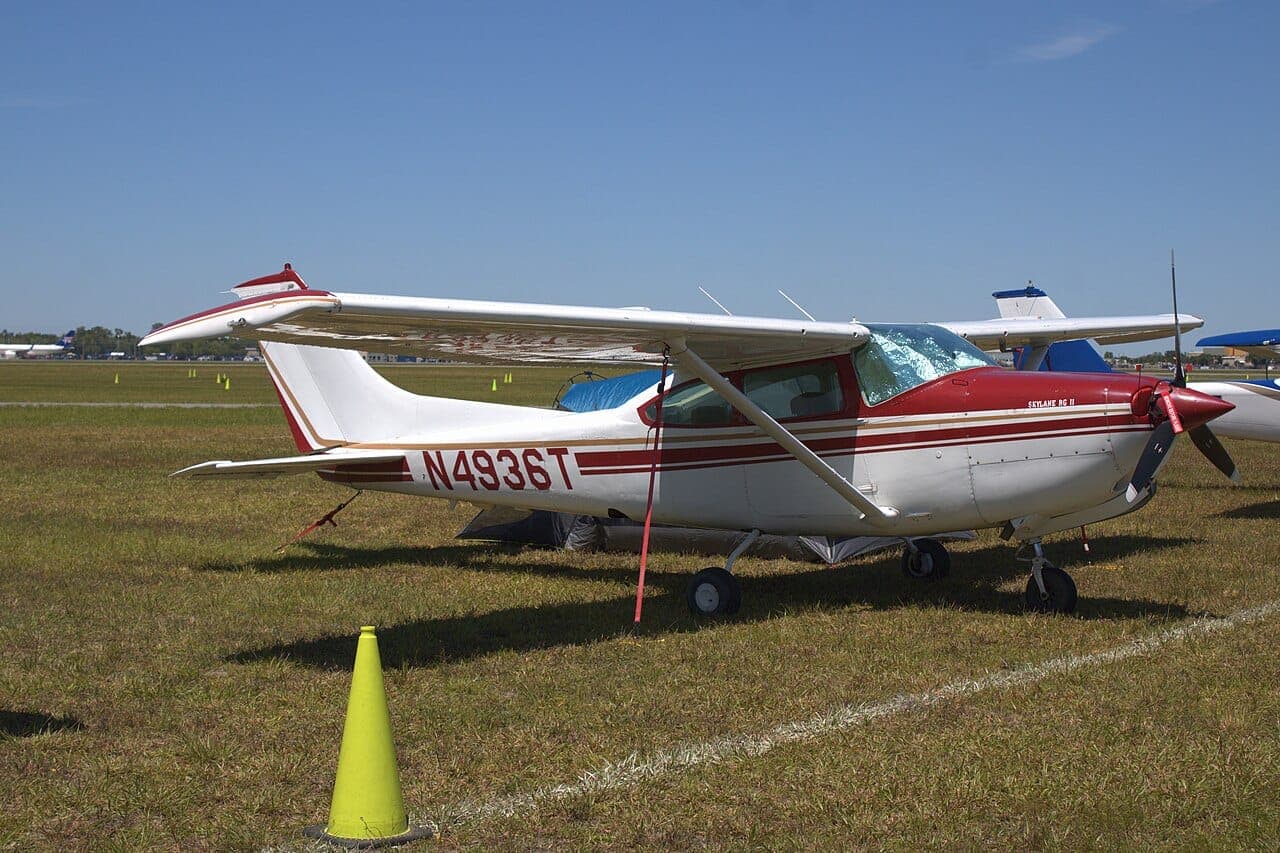
The biggest single cost gap between these two airplanes is not fuel, and it is not the hangar. It is 500 hours of engine life. Lycoming publishes a 2,000-hour TBO for the O-540-J3A5D in the Piper Dakota. Continental publishes 1,500 hours for the O-470-R and O-470-S that power Skylanes built through 1980. On a $42,000 overhaul-and-install bill, that difference alone is about $7 an hour before you have burned a drop of avgas.
That one number is why a straight Piper PA-28-236 Dakota vs Cessna 182 Skylane cost comparison does not have a clean answer. Pick the right Skylane and the gap closes to almost nothing. Pick the wrong one and you are funding a shorter engine life on a heavier airframe. Here is where the money actually goes.
The Short Answer
Hour for hour, these two land within about $10 of each other, and which one is cheaper depends almost entirely on which Skylane you compare. A Dakota beats a pre-1981 Skylane on engine reserve because of that 2,000-hour Lycoming, and it beats most 182s on climb and short-field manners at the same horsepower. But a 182R or later, with the 2,000-hour O-470-U, erases the engine advantage and gives you back two cabin doors, more fuel, more gross weight and a parts-and-mechanic network that no Piper single can match. Buy the Dakota if you want the stronger engine and the cleaner airframe story and you do not mind owning an airplane fewer than a thousand people built. Buy the Skylane if you value liquidity, loading flexibility and the certainty that any shop in the country has seen one before.
Getting In: Price, Scarcity and Comps
Piper built the PA-28-236 Dakota from 1979 to 1994, and total production came in under a thousand airframes. Cessna has built more than 23,000 Skylanes since 1956 and still builds them today. That ratio drives almost everything about the ownership experience that is not fuel.
Fewer airframes means fewer comps. When you go to value a Dakota, you may be looking at a handful of similar airplanes nationwide, and when you sell it you are waiting for the specific buyer who wants one. The Skylane is the Toyota Camry of general aviation: nobody calls it thrilling, but every mechanic has worked on one, every part is on a shelf somewhere, and there is always another buyer.
As of November 2026, Flying411 had six Cessna 182s listed, with asking prices from $125,000 to $415,000 and a median of $185,000, spanning model years 1962 to 2008 with a median total time of 5,250 hours. Those are asking prices on live listings, not sale prices, and the spread tells you something useful on its own: the 182 badge covers forty-six years of very different airplanes, from a carbureted 1960s 182 with round gauges to a glass-panel 182T. Dakota comps are thinner by nature, so budget more time for the search and more weight on the individual airplane's logs than on the model's reputation.
Why It Matters: With a type this scarce, condition premium matters more than model-year premium. A well-kept 1980 Dakota with fresh paint, no corrosion and a mid-time engine will cost you less over five years than a cheaper one that needs a panel and a paint job, because there is no deep pool of cheap used parts to soften the blow.
Flying411 keeps Skylane and Piper PA-28 listings in one place, so you can compare airframe hours, engine time and panel fit before you start making phone calls.
Fuel, Speed and What You Actually Burn
Both airplanes are six-cylinder, roughly 230-horsepower, fixed-gear, constant-speed-prop singles, and they burn fuel like it. Plan on 13 to 14 gallons an hour at a normal 65 to 75 percent cruise in either one. Lean-of-peak operation with an engine monitor can pull a couple of gallons off that in both types, though the carbureted O-470 is less cooperative about it than a fuel-injected Lycoming.
Speed is close enough that it rarely decides a purchase. The Dakota books around 144 knots true at 75 percent power; a 182 books around 140. Over a 500-mile leg that is about eight minutes. Where the Dakota genuinely separates itself is climb: Piper publishes 1,110 feet per minute at sea level, against roughly 865 to 925 fpm for the various Skylanes depending on model and gross weight. On a hot day out of a high-elevation field with four people aboard, you feel those two hundred feet per minute.
Fuel capacity goes the other way. The Dakota carries 72 usable gallons, which is a lot. But a 182R with the long-range tanks carries 88 usable, and a 182T carries 87. If your mission is long legs with a light load, the Skylane simply goes farther before you need a fuel stop.
Edge: Draw. The Dakota climbs better and cruises marginally faster; the Skylane carries more fuel. Burn rates are effectively identical.
| Specification | Piper PA-28-236 Dakota | Cessna 182 Skylane |
| Production years | 1979–1994 | 1956–1986, 1996–present |
| Approximate number built | Under 1,000 | More than 23,000 |
| Engine | Lycoming O-540-J3A5D, 235 hp | Continental O-470-R/S/U, 230 hp (through 1986); Lycoming IO-540-AB1A5, 230 hp (182S/T) |
| Published TBO | 2,000 hours | 1,500 hours (O-470-R, -S); 2,000 hours (O-470-U, IO-540) |
| Maximum gross weight | 3,000 lb | 2,950 lb (182P/Q); 3,100 lb (182R, 182S/T) |
| Typical useful load | About 1,350–1,400 lb | About 1,300–1,350 lb (182R); about 1,100–1,150 lb (glass-panel 182T) |
| Usable fuel | 72 gal | 75 gal standard / 88 gal long range (182R); 87 gal (182T) |
| Cruise, 75% power | About 144 kt | About 140 kt |
| Typical fuel burn | 13–14 gph | 13–14 gph |
| Rate of climb, sea level | 1,110 fpm | About 865–925 fpm |
| Cabin doors | One (right side) | Two |
| Main landing gear | Oleo struts | Tubular spring steel |
Engines, TBO and Hourly Reserves
The Dakota's O-540-J3A5D is a parallel-valve, low-compression Lycoming running 8.5:1 pistons. That is about as unstressed as a 235-horsepower engine gets, and the type has a long reputation for making TBO and beyond with normal use. At a realistic $40,000 to $48,000 for a quality field overhaul with accessories and installation in 2026, spread across 2,000 hours, you are setting aside roughly $20 to $24 an hour.
The Skylane depends on which engine you get. The O-470-R and O-470-S in Skylanes through the 182P carry a 1,500-hour recommended TBO in Continental's service information. The O-470-U fitted to the 182Q (1977) and later carries 2,000 hours. A comparable overhaul runs in the same $38,000 to $46,000 range, so the per-hour reserve is around $25 to $30 on the 1,500-hour engines and $19 to $23 on the 2,000-hour ones. The 182S and 182T use a Lycoming IO-540-AB1A5 with a 2,000-hour TBO, which puts those airplanes on the same footing as the Dakota.
Remember that TBO is a recommendation, not a limit, for a Part 91 owner. What actually ends an engine is a camshaft that spalled during three years of once-a-month flying, not a number in a service letter. Both of these engines punish low utilization the same way.
Keep in Mind: Add a propeller reserve on top. Hartzell and McCauley both recommend overhaul at calendar intervals as well as hour intervals, and a two-blade constant-speed overhaul lands in the $4,000 to $6,000 neighborhood. Budget roughly $5 an hour on either airplane. Our guide on how much to set aside per flight hour walks through engine, prop and avionics reserves separately.
Edge: Dakota over any pre-1981 Skylane. Draw against a 182R, 182S or 182T.
Maintenance, ADs and the Prebuy
Neither type is maintenance-hungry by the standards of a retractable or a twin, but they fail in different places.
The Skylane's most famous prebuy finding is firewall damage. The 182 is nose-heavy with a heavy engine out front, and decades of student and low-time-owner arrivals have left a meaningful share of the fleet with wrinkled firewalls, bent nose gear bulkheads or sloppy repairs in that area. Any 182 prebuy that does not include a careful look behind the engine and under the carpet in front of the rudder pedals is not a prebuy. Cessna also issued Supplemental Inspection Documents for the 100-series airframes; they are not mandatory for Part 91 operators in the United States, but a shop that has run them gives you a far better picture of the airframe's real condition. And AD 2011-10-09 requires recurring inspection of the seat rails and locking pins on Cessna 100-series singles, which is cheap but has to be in the logs.
The Dakota's headline concern is the one it does not have. The much-discussed Piper wing spar inspection, AD 2020-26-16, applies to certain fixed-gear and retractable-gear PA-28 and PA-32 models, including the PA-28-235. The PA-28-236 Dakota is not on its applicability list. If you are weighing a Dakota against other Pipers, our explainer on the PA-28 wing spar AD sets out exactly which models are caught. What a Dakota does want is attention to the oleo struts on all three gear legs, which need servicing and eventually seals, and to fuel tank senders and the stabilator trim system. Cessna's tubular spring steel main gear has no struts to service at all, which is a genuine, if small, running saving.
Annual inspection costs are similar, with most owners reporting $2,000 to $3,500 for a clean routine annual on either type at an independent shop, before squawks. The real difference is what happens when something breaks. Skylane parts come off the shelf; Dakota parts sometimes come off a salvage yard or on back order, and a two-week wait for a cowling piece costs you flying days even if the part is cheap.
Edge: Skylane, on parts availability and shop familiarity. The Dakota's cleaner AD picture does not fully offset a 23,000-airframe support network.
Flying411 keeps maintenance, ownership and model-comparison guides in one place, so you can price an annual and a prebuy before you put down a deposit.
Insurance, Loading and the Real Hourly Number
Insurance on either airplane is driven far more by your hours, your ratings and the hull value than by the badge on the tail. Both are fixed-gear singles in the same horsepower class, both sit in the underwriters' comfort zone, and a VFR private pilot with a few hundred hours and an instrument rating will see broadly similar quotes. Where the 182 pulls ahead slightly is breadth of market: more carriers write them, more carriers understand them, and a 182 is an easier airplane to get covered as a low-time owner-pilot.
Loading is where the two really diverge. The Dakota, with a 3,000-pound gross and a useful load commonly around 1,350 to 1,400 pounds, will carry full fuel and three adults with bags without much drama, and its center-of-gravity envelope is forgiving. A 182R does about the same. A late glass-panel 182T, however, has gained several hundred pounds of empty weight over the years, and real-world useful loads near 1,100 pounds are common. That is a genuine surprise for buyers who assume "newer Skylane" means "more airplane." If this is the question you are wrestling with, our breakdown of the 182P, Q, R, S and T model years goes through it variant by variant.
Here is a worked hourly model at 100 hours a year, with 100LL at $6.50 a gallon, a $450-a-month hangar and $2,200 to $2,500 of hull and liability coverage. Change those three inputs and the totals move a lot — this is a framework, not a quote.
| Cost item (100 hr/year) | Dakota | 182R (O-470-U) | 182P/Q (O-470-R/S) |
| Fuel, 13.5 gph at $6.50 | $88 | $85 | $85 |
| Oil and filters | $3 | $3 | $3 |
| Engine reserve | $22 | $21 | $28 |
| Propeller reserve | $5 | $5 | $5 |
| Annual inspection | $28 | $30 | $30 |
| Unscheduled maintenance | $20 | $20 | $22 |
| Insurance | $22 | $24 | $22 |
| Hangar | $54 | $54 | $54 |
| Subscriptions, charts, misc. | $6 | $6 | $6 |
| Estimated total per hour | About $248 | About $248 | About $255 |
Good to Know: Fly 50 hours a year instead of 100 and every one of those totals jumps by roughly $105 an hour, because hangar, insurance and the annual do not care how much you fly.Utilization moves the needle far more than the choice between these two airplanes. If you want to build the model with your own numbers, start with our walkthrough on how to calculate aircraft operating cost per hour.
Edge: Draw between a Dakota and a late Skylane. Dakota by a small margin over an early 182.
Which One Should You Buy?
The family cross-country owner flying 100 to 150 hours a year. Take the Skylane, and specifically a 182R or later with the 2,000-hour engine. Two doors matter more than you think when you are loading kids and bags, the long-range tanks let you skip a fuel stop on most trips, and when you eventually sell, the airplane moves. You are paying nothing extra per hour for all of that.
The owner based at a short, hot or high field. Take the Dakota. Over a thousand feet per minute at sea level with a 3,000-pound gross is real performance, and the semi-tapered PA-28 wing behaves predictably when you are working the numbers at a 6,000-foot-elevation strip on a July afternoon. You give up a cabin door and a bit of parts convenience to get it.
The first-time owner stepping up from a 172 or a Cherokee. Either works, but the honest answer is whichever specific airplane has the better logbooks, the fresher engine and the panel you want. At this price point, condition beats model. If you are still deciding whether you need 230 horsepower at all, our comparison of the Cessna 172 and Cherokee 180 covers the tier below, and the 182 versus 206 comparison covers the tier above.
Pro Tip: Before you commit to either, price a hangar at your home field. In many metro areas the hangar line is longer than the time it will take you to find and buy the airplane, and an outside tie-down on a 1980 airframe is the single most expensive decision in this entire analysis — corrosion costs more than any engine.
Flying411 keeps asking prices, model years and total times for comparable singles in one place, so you can see what the market is actually offering instead of guessing from a book value.
Picking by Mission, Not by Badge
Run the numbers honestly and the Piper PA-28-236 Dakota vs Cessna 182 Skylane question is not a cost question at all. The hourly totals land within a rounding error of each other once you match engine TBOs, and both are beaten senseless on cost per hour by the one variable neither manufacturer controls: how often you fly. What separates them is shape of mission. The Dakota is the better climber with the more durable engine and a cleaner AD history. The Skylane is the better hauler with the better parts network, the easier resale and the second door. Decide which of those you will notice every month, and buy that airplane in the best condition you can find. If you want another data point in the same horsepower class, the Mooney M20J against the 182 shows what trading cabin space for speed does to the same budget.
When you are ready to compare listings, visitFlying411and see what is on the market today.
Frequently Asked Questions
Is the Dakota faster than a Cessna 182?
Marginally. Piper publishes about 144 knots true at 75 percent power for the Dakota, against roughly 140 knots for a Skylane. That is a few minutes on a typical trip, and real-world differences shrink further depending on rigging, paint, antennas and how each airplane is leaned. Neither buys the other a meaningful time advantage.
Does the Piper wing spar AD apply to the PA-28-236 Dakota?
No. AD 2020-26-16 targets retractable-gear PA-28R and PA-32R models that exceed a calculated factored service hours threshold. The fixed-gear Dakota is not on the applicability list. Still have your prebuy mechanic confirm the AD status of any specific airplane, since model-specific ADs and service bulletins change over time.
Which Skylane engine should I look for if I want the longest TBO?
The O-470-U, fitted to the 182R from 1981 to 1986, carries a 2,000-hour recommended TBO, as does the Lycoming IO-540-AB1A5 in the 182S and 182T. The earlier O-470-R and O-470-S are published at 1,500 hours. On a 100-hour-a-year airplane that is roughly $700 a year in reserve, which is not nothing.
How much should I actually budget per hour to own either one?
At 100 hours a year with a hangar, expect something close to $250 an hour all in, including reserves. At 50 hours a year the same airplane costs well over $300 an hour, because fixed costs spread across half the flying. Build your own figure using your real hangar rent, your real insurance quote and current avgas at your field — those three inputs swing the answer more than the choice of airframe.