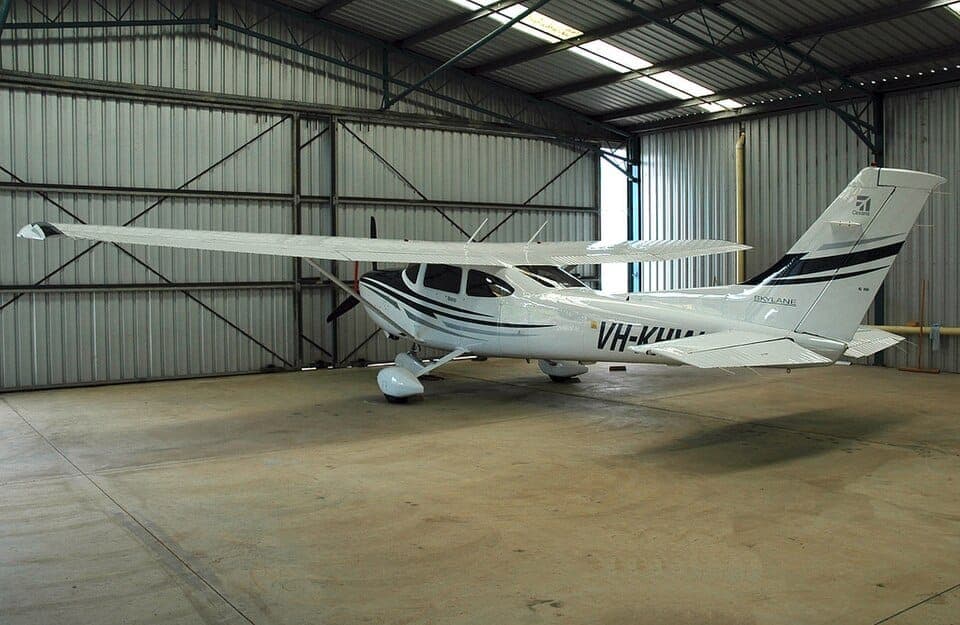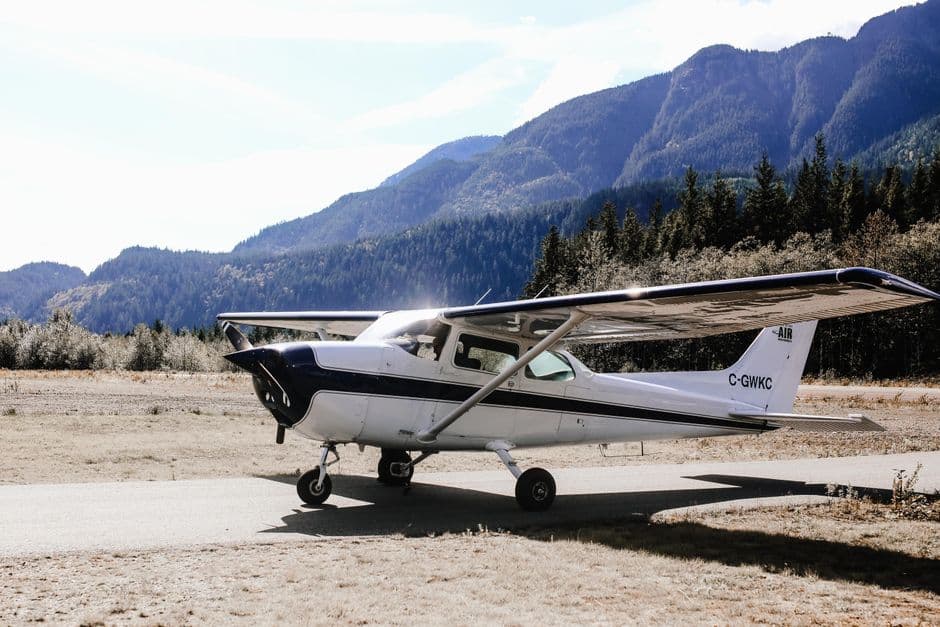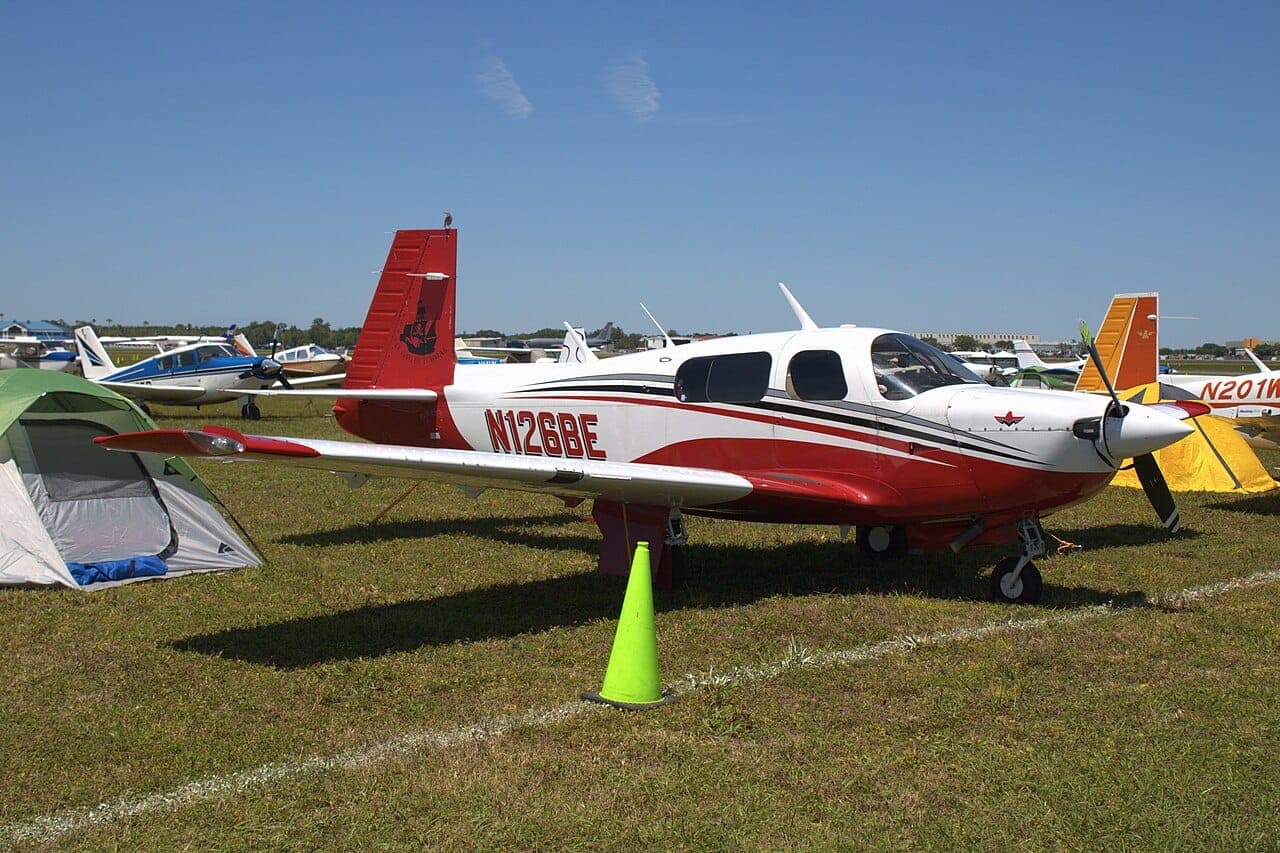
A Mooney M20J holds about 155 knots true on roughly 10.5 gallons an hour. A Cessna 182 holds about 140 knots and drinks about 13.5. That is a three-gallon-an-hour gap in favour of the airplane with the folding legs, and at 2025-level avgas prices it is worth close to $20 every hour you fly. Most buyers assume retractable gear is the expensive choice. The fuel column says otherwise before you have paid a single maintenance bill.
So the real question in Mooney M20J vs Cessna 182 ownership is not whether the gear costs money — it does — but whether it costs more than the fuel, speed and time it buys back. That answer changes depending on how many hours you fly, what your insurer thinks of your logbook, and whether your home field is paved.
What the Retractable Gear Actually Costs
There are three real costs attached to a retractable gear system, and only one of them is maintenance.
The first is training and endorsements. Under 14 CFR 61.31(e), an airplane with retractable gear, flaps and a controllable-pitch propeller is a complex airplane and needs a logbook endorsement from an instructor. The M20J qualifies. Interestingly, at exactly 200 horsepower it is not high performance, because 61.31(f) only bites above 200 hp. The 182, with its 230-hp engine, needs the high-performance endorsement instead. Both airplanes require a signature; neither one is free to step into.
The second is insurance. Brokers consistently price retractable singles at a higher rate per $100 of hull value than fixed-gear equivalents, and underwriters typically want to see meaningful retract time — commonly 10 to 25 hours in make and model, plus dual with an instructor — before they will write a new M20J owner at a sensible number. A 300-hour private pilot moving into a Skylane usually gets a quote in a week. The same pilot moving into a Mooney usually gets a list of conditions first.
The third is the gear itself. The M20J uses an electrically driven actuator, a no-back spring, and rubber shock discs in place of the oleo struts you would find on a Bonanza or a 210. Mooney's maintenance manual calls for a retraction and rigging check at annual, and shops normally bill a few hours of labour for it. The shock discs compress with age rather than hours; owners and type club mechanics commonly report replacement every 10 to 20 years at somewhere between $3,000 and $6,000 installed, because the job means pulling the gear apart.
Heads Up: The shock disc job is age-driven, not hour-driven. An M20J that flew 40 hours a year for a decade is more likely to need it than one that flew 150, and a pre-buy that only looks at total time will miss it entirely.
Fuel Burn Is Where the Mooney Earns It Back
The M20J was built around drag reduction. Its 200-hp Lycoming IO-360 and streamlined airframe allow it to achieve roughly 15 nautical miles per gallon in cruise, compared with about 10 for the Cessna 182 under the assumptions used here. On a 500-nautical-mile trip, cruising at 155 knots versus 140 knots, the Mooney saves approximately 14 gallons of fuel and arrives about 21 minutes sooner, excluding climb, descent and wind.
Run that over a year. At 100 hours, the Mooney saves roughly 300 gallons, which is somewhere near $1,950. That number alone covers the insurance differential and most of the extra annual labour for the gear. At 150 hours it covers all of it with change left over.
Why It Matters: Fuel is the single biggest variable cost in both airplanes, and it is the one line item that scales directly with how much you fly. The more hours you put on, the more the retractable airplane's efficiency works in your favour — which is the opposite of what most first-time buyers expect.
Flying411 keeps Mooney and Cessna listings in one place, so you can compare equipment, engine time and asking price across both airframes without jumping between sites.
Maintenance: The Line Items That Really Differ
Both airplanes are 1960s-to-1990s aluminium singles with constant-speed props, and the bulk of an annual inspection looks identical on either. The differences sit in a handful of known, predictable items.
What costs money on an M20J
Fuel tank resealing is the big one. Mooney wings are wet — sealant directly on the structure, no bladders — and sealant eventually lets go. A full strip and reseal of both tanks is commonly quoted in the $6,000 to $12,000 range depending on shop and whether patch repairs are attempted first. It is the most expensive surprise in Mooney ownership and the first thing an experienced pre-buy inspector goes looking for.
Beyond that: the gear retraction check and rigging, shock discs as above, and the fact that the whole empennage pivots on a jackscrew for pitch trim, which is a system your mechanic needs to understand. Mooney work is faster and cheaper at a shop that sees Mooneys. It is slower and more expensive everywhere else.
What costs money on a 182
Seat rails. AD 2011-10-09 requires repetitive inspection of the seat rails and locking pins on most Cessna 100-series singles, the 182 included, and worn rails mean parts and labour. Nose gear damage is the other classic — the 182 is nose-heavy, and a few firm arrivals wrinkle the firewall. Any Skylane pre-buy should include a careful look behind the instrument panel at the firewall and the nose gear attach structure.
Set those aside and the fixed gear genuinely is simpler. Spring steel legs, no actuator, no squat switch, no emergency extension procedure. Shops quote 182 annuals at roughly $2,000 to $3,500 for a clean airplane with no squawks, and M20J annuals at roughly $2,500 to $4,500. The gap is real but it is a few hundred dollars a year, not thousands.
Keep in Mind: The expensive annual on either airplane is almost never the inspection. It is the corroded part, the leaking tank or the tired engine the inspection finds. Both types reward buying the best-maintained example you can find rather than the cheapest.
Engine Reserves and Overhaul Math
This is where a lot of cost-per-hour comparisons go wrong, because the retractable airplane actually comes out ahead.
Under Lycoming's July 2026 Service Instruction No. 1009BF, qualifying factory-new or factory-rebuilt IO-360 engines may have a recommended TBO of 2,600 hours, while overhauled engines generally retain a 2,000-hour baseline, subject to applicable engine-specific requirements and extensions. For an M20J using a 2,000-hour planning interval, an illustrative $32,000–$42,000 overhaul produces a reserve of approximately $16–$21 per flight hour, before installation and other expenses not included in the quote.
The 182 depends on which one you buy. The Continental O-470-U used in later Cessna 182Q models has a recommended TBO of 2,000 hours for qualifying earlier engines and 2,200 hours for eligible engines with serial number 1006000 or later. Earlier O-470 variants have different intervals, commonly 1,500 or 1,700 hours depending on the model and serial number. Verify the specific engine's eligibility before calculating an overhaul reserve. Overhaul quotes for a six-cylinder O-470 commonly run $38,000 to $48,000. At 2,000 hours that is roughly $21 an hour. At 1,500 hours it is closer to $29. The 1997-and-later 182S/T uses a 230-hp Lycoming IO-540 at a 2,000-hour TBO, and that one costs more again to overhaul because it is a bigger engine.
Two more cylinders means two more cylinders to replace, and six-cylinder top-end work has never been cheap. If you want the full method for building these numbers for a specific airplane, our guide on how to calculate aircraft operating cost per hour walks through it, and how much to set aside per flight hour covers prop and avionics reserves most owners forget.
Good to Know: TBO is a manufacturer recommendation, not a legal limit, for privately operated Part 91 aircraft. It is still the right number to reserve against — the cash requirement does not disappear because the regulation is silent.
The One Cost Only the Mooney Has: Gear-Up Risk
Gear-up landings are the signature retractable accident. They rarely injure anyone and they reliably cost a fortune. A propeller strike means an engine teardown inspection — Lycoming's Service Bulletin 533 covers the recommended action after a sudden stoppage or prop strike — plus belly skin repair, flap damage, antennas and a new prop. Claims in the $25,000 to $40,000 range are routine, and the airplane carries the damage history forever.
Your insurance pays for the repair. You pay for it afterwards in premiums and at resale. The Skylane simply cannot have this accident, and for some buyers that is worth more than every fuel saving in the article.
Pro Tip: Mooney owners who fly a written GUMPS check on downwind and again on short final, out loud, every single time, have a measurably better record than those who fly from memory. The habit costs nothing and it is the cheapest insurance you will ever buy.
Mission Fit: Load, Runway and Cabin
The numbers so far favour the Mooney. The mission often does not.
Useful load is the first divide. An M20J at 2,740 lb gross typically has 950 to 1,050 lb of useful load, with a 120-lb baggage limit. A 182Q at 2,950 lb gross usually offers around 1,150 to 1,250 lb, and the 182 carries 200 lb of baggage across its two compartments. With four adults and full fuel, the Mooney is over gross and the Skylane often is not. That is the single most common reason buyers walk away from the Mooney.
Runway is the second. Book takeoff over a 50-foot obstacle at sea level and gross is roughly 1,400 feet for the 182 and about 1,500 for the M20J, which sounds close — but the Mooney sits low, has small tires and does not love grass, gravel or anything with a lip. The 182 is a working airplane that lands on ranch strips without comment. If your field is 2,400 feet of turf, this comparison is over.
Cabin width is near enough identical — both sit around 42 to 44 inches at the shoulders — but the 182 is far taller inside and much easier to climb into. The Mooney is a snug, low, fast machine. People either love it or they hit their head once and never forget it.
If load and field length dominate your thinking, the better comparisons are 172 vs 182 vs 206 on the Cessna side, or Cessna 210 vs A36 Bonanza if you want a retractable that hauls.
Flying411 keeps complex and fixed-gear singles side by side in one search, so you can compare useful load and equipment before you book a pre-buy.
What the Market Is Asking
As of October 2026, Flying411 had 4 Mooney M20 aircraft listed across all variants, asking $60,000 to $190,000 with a median of $92,000, model years 1964 to 1988 and a median total time of 2,950 hours. Over the same period we had 6 Cessna 182s listed, asking $125,000 to $415,000 with a median of $185,000, model years 1962 to 2008 and a median total time of 5,250 hours.
These are asking prices on live listings, not sale prices or valuations, and the Mooney figures cover the whole M20 family rather than the J specifically. Still, the pattern matches what owners see: Skylanes command a premium that has very little to do with how they fly and a lot to do with how many people want one. Mooney buyers pay less up front and front-load more of their risk into the pre-buy.
If you are weighing older Mooney airframes against the J, our M20F buyer's guide and the M20K 231 vs 252 vs Encore breakdown cover the rest of the family. On the Cessna side, 182 vs Cirrus SR22 is the comparison most Skylane shoppers eventually run.
Key Takeaways
Retractable gear does cost more per hour in the places you expect — insurance, annual labour, the occasional shock disc or actuator job — but in the M20J those extras add up to roughly $10 to $15 an hour, and the airplane gives back close to $20 an hour in fuel while flying 15 knots faster. Run the totals at 100 hours a year and the two airplanes land within a few dollars of each other per hour, with the Mooney meaningfully cheaper per nautical mile travelled. The costs that actually separate them are not gear-related at all: the Mooney's wet-wing fuel tanks and the 182's thirstier six-cylinder engine. Where the Skylane genuinely wins is payload, baggage, unimproved runways and the fact that it cannot land gear-up. Decide on mission first, then let the hourly numbers confirm the choice rather than make it.
| Dimension | Mooney M20J (201) | Cessna 182 (182Q, O-470-U) |
| Engine / power | Lycoming IO-360-A3B6D, 200 hp | Continental O-470-U, 230 hp |
| Recommended TBO | Generally 2,000 hours for overhauled engines; up to 2,600 hours for qualifying factory-new or factory-rebuilt engines | 2,000–2,200 hours for eligible O-470-U engines; earlier O-470 models vary |
| Typical cruise / burn | ~155 kt on ~10.5 gph | ~140 kt on ~13.5 gph |
| Efficiency | ~15 nm per gallon | ~10 nm per gallon |
| Typical useful load | 950–1,050 lb | 1,150–1,250 lb |
| Baggage limit | 120 lb | 200 lb (two compartments) |
| Endorsement required | Complex, 14 CFR 61.31(e) | High performance, 14 CFR 61.31(f) |
| Typical annual inspection | $2,500–$4,500 | $2,000–$3,500 |
| Known big-ticket item | Fuel tank reseal, $6,000–$12,000 | Seat rail AD 2011-10-09; firewall/nose gear |
| Engine overhaul (2025 quotes) | $32,000–$42,000 | $38,000–$48,000 |
| Engine reserve per hour | ~$19 | ~$21 (~$29 at 1,500-hr TBO) |
| Fuel cost per hour @ $6.50/gal | ~$68 | ~$88 |
| Illustrative total, 100 hr/yr | ~$225 per hour | ~$230 per hour |
| Illustrative cost per nautical mile | ~$1.46 | ~$1.67 |
| Asking price (Flying411, Oct 2026) | $60,000–$190,000, median $92,000 (all M20 variants, 4 listings) | $125,000–$415,000, median $185,000 (6 listings) |
Totals assume $6.50-a-gallon avgas, $350-a-month hangar, mid-range insurance and a $20-an-hour unscheduled maintenance reserve. Swap in your own hangar and fuel numbers — those two move the result more than anything else on the list.
Which One Should You Buy
Buy the M20J if you fly two people a long way, often, from paved runways, and you want the lowest cost per mile in a certified piston single. Buy the 182 if you fly four people, carry things, use short or soft fields, or you simply do not want to think about the gear handle for the rest of your flying life. The honest answer to Mooney M20J vs Cessna 182 is that retractable gear does not cost much more per hour — it costs more per year in fixed charges and pays it back in fuel, and only if you actually fly. At lower annual utilization, the Skylane's simpler fixed landing gear may help offset its higher fuel consumption. As annual flight hours increase, the Mooney's lower fuel burn and greater cruise speed become more valuable. The actual break-even point depends on insurance, maintenance, fuel prices, utilization and the condition of each aircraft, so owners should calculate the comparison using their own costs rather than relying on a fixed annual-hour threshold.
When you are ready to compare listings, visitFlying411and see what is on the market today.