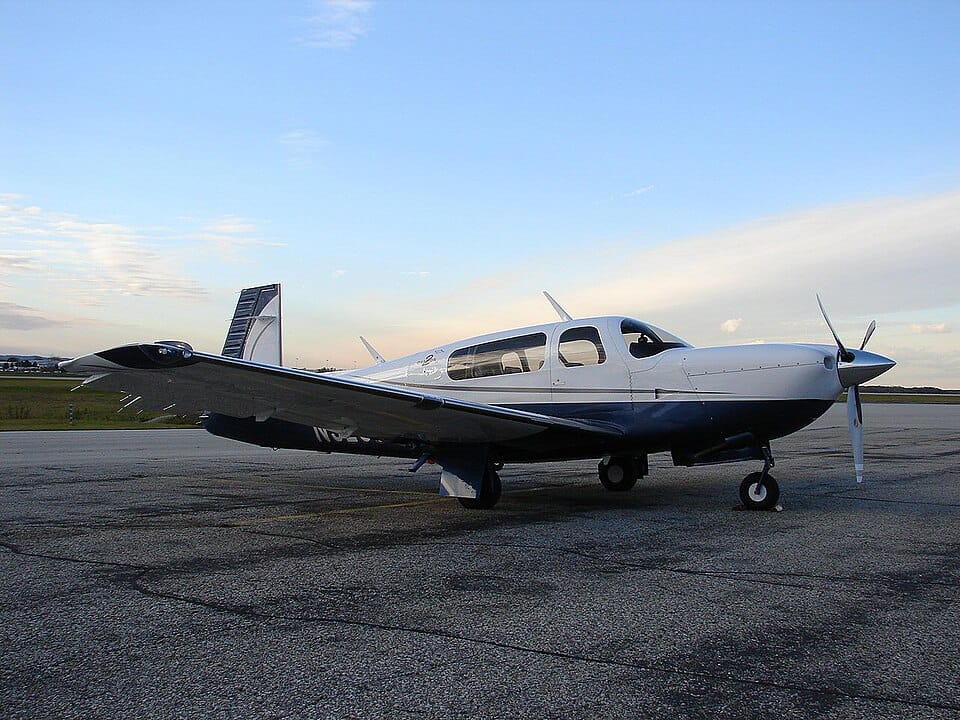
The Mooney M20F Executive remains one of the more affordable ways to get a 200-hp, retractable-gear traveling airplane capable of roughly 150-knot cruise speeds. Compared with the later M20J 201, an M20F can cost substantially less while offering similar cabin space, fuel capacity, and operating economy. The tradeoff is age: fuel-tank condition, corrosion, engine history, and decades of modifications can matter far more than the asking price. This guide covers what to inspect, what major repairs can cost, and when paying more for an M20J makes sense.
Key Takeaways
The M20F Executive gives you a stretched four-seat Mooney cabin, a 200-hp Lycoming IO-360, and roughly 150 to 155 knots true on about 10 gallons per hour, usually for well under six figures. The two big-ticket items that decide whether a given airplane is a good buy are the integral wet-wing fuel tanks, which owners report cost roughly $10,000 to $16,000 to strip and reseal in both wings, and the engine, where a full IO-360 overhaul event commonly lands somewhere between $40,000 and $60,000 once you include the propeller, hoses, baffles, and accessories. The M20J is faster by about 10 to 15 knots on the same fuel because of Roy LoPresti's drag cleanup, not because of a bigger engine, and it typically trades for $40,000 to $80,000 more. Buy the F if you want the most airplane per dollar and you are willing to fund a tank job and an engine. Buy the J if you want the speed and a newer airframe and you would rather pay it up front.
| Quick answer | M20F Executive | M20J 201 |
| Production years | Roughly 1966–1977 | 1977 onward |
| Engine | Lycoming IO-360-A1A, 200 hp | Lycoming IO-360-A1B6D, A3B6D, or A3B6, 200 hp |
| Typical cruise | ~150–155 KTAS | ~160–165 KTAS |
| Typical fuel burn | ~9.5–10.5 gph | ~9–10 gph |
| Usable fuel | About 64 gallons | About 64 gallons |
| Gross weight | 2,740 lb | 2,740 lb on earlier aircraft; 2,900 lb on certain later M20Js |
| Recommended TBO | Up to 2,600 hr factory-new/rebuilt; generally 2,000 hr after overhaul | Up to 2,600 hr factory-new/rebuilt; generally 2,000 hr after overhaul |
| Best for | Value-focused buyers who budget for tanks and engine | Buyers paying up front for speed and a newer airframe |
What the M20F Actually Is
Mooney gave its 1960s models marketing names: the 180-hp M20C was the Ranger, the 200-hp short-body M20E was the Super 21, and the M20F was the Executive 21. The F is the important one for buyers, because Mooney stretched the fuselage about ten inches over the E and put that length where it counts, in rear-seat legroom and the baggage area. That stretched body is the same basic cabin the M20J would later use.
Underneath the skin, the M20F is built around a welded steel-tube cabin structure with an all-metal wing and aluminum-skinned airframe. Earlier M20 and M20A aircraft used wooden wing structures, but Mooney had moved to an all-metal wing before the M20F entered production.
Fun Fact: The forward-swept-looking tail is an optical illusion. The leading edge is swept back like any other airplane; it is the trailing edge that is vertical, which is what fools your eye on the ramp.
How fast is it, really?
Book numbers and hangar talk drift apart fast on forty-year-old airplanes. A clean, rigged M20F with tight gear doors and decent paint will true about 150 to 155 knots at 75 percent power in the mid-altitudes, burning roughly 10 gallons an hour. A tired one with a soft engine and mismatched fairings might give you 145. With about 64 gallons usable, that is a genuine four-and-a-half-hour airplane with reserves, which in practical terms means most of the country in two legs.
Think of it like a small diesel sedan. It is not the roomiest thing in the parking lot, but it goes a long way on very little, and it does it at a speed that makes a 600-nautical-mile trip a morning rather than a day.
The Fuel Tanks: The Single Biggest Variable
Mooney wings are wet. There is no separate tank and no rubber bladder from the factory; the wing structure itself is sealed with a fuel-proof compound, and the fuel sits directly against aluminum and rivets. That saves weight and buys capacity. It also means that when the sealant ages, the wing weeps.
You spot it as blue staining on the underside of the wing, along the wing root, or as a damp smell in the cabin after the airplane sits. Almost every M20F on the market has either had a tank job, needs one, or will need one. Pretending otherwise is the most expensive mistake a first-time Mooney buyer makes.
Reseal or bladders?
There are three realistic paths, and they are not equal.
| Option | Typical reported cost | What you get |
| Spot patch / local repair | ~$1,500–$4,000 | Fast and cheap, but often chases the leak to the next weak seam within a season or two |
| Full strip and reseal, both wings | ~$10,000–$16,000 | Old sealant removed to bare metal and rebuilt; specialist shops offer multi-year warranties |
| STC'd bladder installation | ~$17,000–$25,000 installed | Rubber cells inside the wing; ends the reseal cycle but costs a little useful load and a couple gallons of capacity |
Costs move with shop rates and region, so treat those as ranges rather than quotes. The key distinction is that a proper strip-and-reseal by a shop that does nothing but Mooney tanks is a repair with a paper trail and a warranty, while a patch is a bandage. Bladders appeal to owners who never want to think about it again, and they are common on airplanes based in humid climates or flown infrequently.
Heads Up: "Tanks resealed" in a listing means very little on its own. Ask who did the work, in what year, at what tach time, whether both wings were done, and whether any warranty is transferable. A five-year-old professional reseal is a real asset. A fifteen-year-old patch is a liability wearing a nice sentence.
Why It Matters: On an airplane whose market value may be $80,000 to $110,000, a tank job is 10 to 20 percent of the purchase price. That is not a maintenance item, it is a negotiating position.
Flying411 keeps Mooney listings, specs, and ownership guides in one place, so you can compare an M20F with fresh tanks against one that still needs them before you book a prebuy.
The Lycoming IO-360 and What an Overhaul Costs
The M20F runs the parallel-valve Lycoming IO-360-A1A, a fuel-injected, 200-horsepower four-cylinder. Under the current Lycoming Service Instruction No. 1009BF, qualifying factory-new or factory-rebuilt IO-360-A-series engines have a recommended operating-hour TBO of 2,600 hours, while overhauled engines generally retain a 2,000-hour TBO.
This is a well-understood engine with deep parts support, which is one of the quiet arguments for the airplane. If you are weighing it against other powerplants, our comparison of the Lycoming O-360 versus IO-360 explains what fuel injection buys you, and the piece on Continental IO-360 versus Lycoming IO-360 clears up the confusion between two engines that share a number and almost nothing else.
What should I budget for the engine event?
Owners consistently report field overhauls of a parallel-valve IO-360 landing in the mid-$30,000s to around $50,000, with Lycoming factory rebuilt or factory overhauled exchange engines sitting above that. But the engine is only part of the bill. A realistic "engine event" budget also includes:
- Propeller overhaul or exchange, commonly $4,000 to $8,000 for a two-blade constant-speed unit
- New engine mounts, hoses, and baffle seals
- Fuel servo and injector overhaul or flow-matching
- Magneto overhaul or replacement, starter, alternator
- Shop labor for removal, installation, and the inevitable discovery items
Add it up and $45,000 to $60,000 is an honest planning number. Spread over 2,000 hours, that is roughly $22 to $30 per hour that should be going into an engine reserve from day one, whether or not you actually set the cash aside.
Pro Tip: Fuel-injected Lycomings reward attention to the fuel system. Rough starts, uneven EGTs, and poor lean-of-peak behavior often trace to dirty nozzles or a servo that has drifted, not to a sick cylinder. See our Lycoming fuel injector guide and the walkthrough on fuel servo adjustment before you condemn anything expensive.
Good to Know: Ask your mechanic to confirm compliance status on the Lycoming service documents that have driven airworthiness directives, including the connecting rod bushing inspections tied to Lycoming Mandatory Service Bulletin 632 and the crankshaft actions affecting certain serial-number ranges. A logbook that shows someone already chased these down is a logbook written by an owner who cared.
Prebuy Inspection: Where Mooney Money Hides
The M20 airframe is strong and, when dry, remarkably long-lived. The risk is that the things that kill value are hidden under carpet, under paint, and inside the tail cone. A generic annual is not a prebuy. Use a shop that knows Mooneys specifically.
What has to come apart?
At minimum, insist on these:
- The steel tube cage. Floorboards and interior come out so the inspector can see the tubing under the seats and at the wing spar carry-through. Surface rust is common and manageable; pitted or scaled tubing is a serious, sometimes airplane-ending finding.
- The empennage structure and trim jackscrew. Because the whole tail pivots for trim, the truss, jackscrew, and their attach points are flight-critical. Look for corrosion, play, and correct lubrication.
- Fuel tank condition. Wings defueled or nearly so, undersides inspected for staining, and a straight answer about reseal history.
- Landing gear. A full retraction test on jacks, plus a check of the rubber shock discs. Aged discs let the airplane sit low and transmit every seam in the runway. A full set replacement is labor-intensive and commonly runs several thousand dollars.
- Gear-up history. Mooneys are low and slick and land fast; belly damage repairs are not rare. Look for propeller strike sundown inspections on the engine, skin patches, and antenna scarring.
- Logbook continuity. Missing years are missing money. Our guide to reading aircraft maintenance records covers what a complete history should look like.
Keep in Mind: The M20 series is covered by FAA Type Certificate Data Sheet 2A3. Pull it and check that the airplane in front of you actually matches its type design: engine model, propeller model, placards, and weight limits. Field-approved modifications and old STCs sometimes outlive their paperwork.
Quick Tip: Join the Mooney Aircraft Pilots Association before you buy, not after. The type club's model-specific guidance and proficiency programs are the cheapest insurance you will ever purchase, and insurers often look kindly on formal type-specific training in a complex retractable.
M20F vs M20J: Where the Money Goes
The M20J, sold as the 201, arrived for the 1977 model year and used essentially the same stretched fuselage and same 200 horsepower. What changed was drag. A redesigned cowling with a smaller inlet area, a one-piece raked windshield, flush riveting in key areas, better wheel well and gear door fit, and cleaned-up fairings turned roughly 150 knots into roughly 160 to 165. The airplane's name came from the 201 mph it could hit.
| Consideration | M20F | M20J |
| Typical asking price | Often high five figures to around $120,000 | Commonly $120,000 to $200,000+ for later variants |
| Speed per gallon | Good | Notably better |
| Airframe age | 1966–1977 | 1977–1998, so more late-model choices |
| Panel condition | Usually a mix of original and retrofit | More often already modernized |
| Fuel tank issue | Same wet wing, same problem | Same wet wing, same problem |
| Parts and support | Shared across the M20 family | Shared across the M20 family |
Notice the row that does not change. Buying a J does not buy you out of the fuel tank question. Both airframes use integral wet wings, and a 1979 J with original sealant is on exactly the same clock as a 1968 F.
Can you turn an F into a J?
Partly. There are long-standing speed modification packages for the F that include a 201-style windshield, cowl closure and cooling improvements, gear door tightening, and assorted fairings. Owners typically report gaining somewhere in the range of 5 to 10 knots depending on how many mods are installed and how carefully the airplane is rigged afterward. That is real, but it costs real money, and it does not change the airframe's age or its logbooks.
The arithmetic usually looks like this: if you find a solid F with recently resealed tanks, a mid-time engine, and a decent panel, you are buying a lot of capability cheaply and you can spend selectively. If you find an F with weeping tanks, a runout engine, and a 1970s panel, the deferred maintenance can exceed the price difference to a good J, and you will have spent two years in a shop to get there.
Flying411 keeps M20F and M20J listings side by side with the ownership cost guides, so you can see what the speed difference actually costs in dollars rather than in forum opinions.
What It Costs to Own Per Year
Set aside the purchase price and the airplane still asks for money every twelve months. For an M20F flown around 100 hours a year, plan for something along these lines, with wide regional variation:
| Item | Typical annual range |
| Annual inspection (healthy airplane, no major squawks) | $2,500–$5,000 |
| Hangar or tiedown | $1,200–$7,000 |
| Insurance, complex retractable single | $1,500–$4,000 depending on pilot time |
| Fuel at ~10 gph | Varies directly with local fuel price and hours flown |
| Engine reserve | $2,200–$3,000 at 100 hours per year |
| Prop, avionics, and airframe reserve | $1,000–$2,500 |
Insurance deserves special mention. Retractable gear plus a low-time pilot is the combination underwriters price hardest. Expect a requirement for a meaningful number of dual hours in make and model before solo, and expect that a tailored quote improves substantially after your first hundred hours in type. Our overview of aircraft insurance costs walks through what actually moves a premium.
Heads Up: Any airplane you fly in airspace that requires it needs ADS-B Out under 14 CFR 91.225. Most M20Fs still flying have been equipped, but confirm it with paperwork, not with a listing photo of a panel.
Who the M20F Suits
This airplane is a traveling machine first. It has a snug cabin, a low seating position, and an entry that takes practice, but it will carry two people, their bags, and full fuel a very long way for less fuel than almost anything else at that speed. With a typical useful load near 1,000 pounds, full tanks leave you roughly 600 pounds for people and baggage, which is comfortably three adults or two adults with a real load of luggage. Watch the aft baggage limit, usually 120 pounds, and run the numbers rather than eyeballing it.
It is not the right airplane for someone who wants to haul four full-size adults with full fuel, who needs a wide cabin, or who lands on rough grass regularly. The low-slung gear and the tight prop clearance make it a pavement airplane in most owners' hands. And it is not the airplane for a buyer with no maintenance reserve, because when a Mooney asks for money it tends to ask in five-figure increments.
Fun Fact: Mooney owners talk about the "speed brakes on the floor" because the airplane is so clean that it does not want to slow down. Planning your descent and speed early is the single biggest adjustment for pilots stepping out of a fixed-gear trainer.
Flying411 keeps engine guides, prebuy checklists, and current listings in one place, so a buyer can research the IO-360 and the airframe without leaving the tab they started in.
Conclusion
The right way to shop a Mooney M20F is to stop comparing sticker prices and start comparing the condition of two specific line items: the fuel tanks and the engine. An F with a documented professional reseal and 600 hours since major overhaul at $110,000 is very likely a better buy than one at $75,000 with weeping wings and 1,900 hours on the Lycoming, because the cheaper airplane is carrying $50,000 to $75,000 of deferred cost that will come due on the shop's schedule, not yours.
Against the M20J, the F trades roughly 10 to 15 knots and a newer airframe for a meaningfully lower entry price, and it does not escape the wet-wing question either way. If you have the cash and want the speed with less project risk, buy the J. If you want the most capability per dollar and you can fund a tank job and an engine when they arrive, the F is one of the best-value four-seat travelers in general aviation. Get a Mooney-specific prebuy, read the logbooks like a skeptic, and price the tanks before you shake hands.
When you are ready to compare listings, visitFlying411and see what is on the market today.
Frequently Asked Questions
How much does a Mooney fuel tank reseal cost?
Shops that specialize in Mooney wet wings generally quote somewhere around $10,000 to $16,000 to strip and reseal both wings, with regional and shop-rate variation. Spot patches run far less, roughly $1,500 to $4,000, but frequently leak again elsewhere within a season or two. STC'd bladder installations are the most expensive option, often $17,000 to $25,000 installed, and they trade a small amount of useful load and capacity for the end of the reseal cycle.
What is the TBO on the Mooney M20F's engine?
Lycoming's current Service Instruction No. 1009BF lists a 2,600-hour operating TBO for qualifying factory-new or factory-rebuilt IO-360-A-series engines and generally 2,000 hours for overhauled engines. Applicability depends on the engine's history, configuration, and compliance with the conditions and notes in the service instruction.
Is the M20F faster than a Cessna 182 or Piper Arrow?
On the same fuel, generally yes. A clean M20F trues around 150 to 155 knots on roughly 10 gallons per hour, which is faster than a typical 200-hp Arrow and meaningfully more efficient than a 230-hp Skylane at similar speeds. The tradeoff is cabin width, useful load, and runway manners; the Cessna carries more and lands shorter, and the Mooney gets there sooner on less.
Should I buy an M20F or stretch to an M20J?
Compare the total, not the asking price. Take the F's price and add whatever the tanks, engine, propeller, and panel will realistically need in the next three years. If that total approaches a good J, buy the J and start flying. If the F already has fresh tanks and a healthy engine, it is usually the better value and you keep the difference.
What are the biggest prebuy red flags on an M20F?
Corrosion in the welded steel tube cage under the floorboards, corrosion or play in the empennage truss and trim jackscrew, undocumented or repeated fuel tank patching, gaps in the logbooks, and evidence of an unreported gear-up. Any one of those can turn a bargain into a project. Have the interior pulled, and use a shop that inspects Mooneys regularly.
Is the M20F hard to insure for a low-time pilot?
Harder than a fixed-gear trainer, but far from impossible. Underwriters typically want a specified number of dual hours in make and model plus a retractable-gear checkout, and premiums drop noticeably once you have a hundred hours in type. Formal type-specific training through the Mooney type club's proficiency program helps both your quote and your survival odds in a fast, slick airplane.