Most shoppers treat these as two different airplanes. They are not. The MU-2 Marquise vs Solitaire decision comes down to roughly six feet of fuselage and about 1,100 pounds of maximum takeoff weight, because both share the same wing, the same Garrett TPE331-10 engines, the same four-blade props, the same systems and the same FAA type certificate, A2PC.
That matters to your wallet in a way buyers often get backwards. Since the engines are identical, the short body does not meaningfully lower your biggest recurring cost. What it changes is purchase price, cabin volume, payload and how long the airplane sits on the market when you sell it. Pick wrong and you either pay to haul seats you never fill, or you buy a cabin that runs out of room the first time four adults bring golf clubs.
What Actually Separates the Two
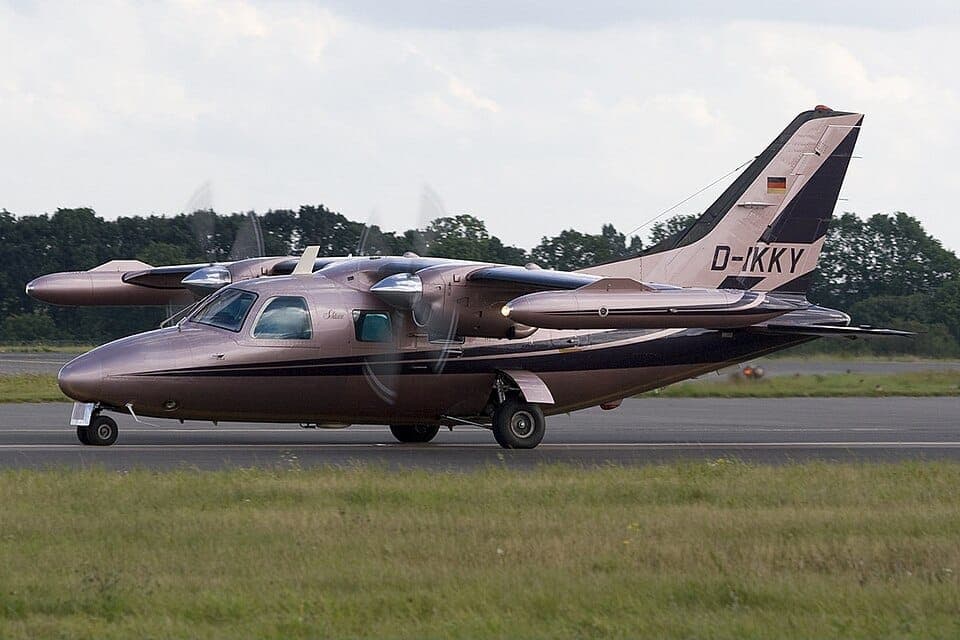
The Marquise is the MU-2B-60, the long-body model. The Solitaire is the MU-2B-40, the short body. Both are the final production versions, built in the 1979 to 1986 window at Mitsubishi's San Angelo, Texas plant before the line closed. Both carry the same TPE331-10-501M engines, so a Solitaire is a Marquise with about six feet of cabin removed and a lower gross weight.
Dimensionally the Marquise measures about 39 feet 5 inches long against roughly 33 feet 3 inches for the Solitaire. The wing, including the tip tanks, spans about 39 feet 2 inches on both. Maximum takeoff weight is 11,575 pounds for the Marquise and 10,470 pounds for the Solitaire.
Everything else that defines the MU-2 is common to both: a high wing, full-span double-slotted Fowler flaps, spoilers instead of ailerons for roll control, tip tanks, and main gear that folds into fuselage pods rather than the wing. That design is why the airplane carries so much speed on so little wing, and why it demands a pilot who flies it by the book rather than by feel carried over from a Baron.
Fun Fact: Because the MU-2 uses spoilers for roll, the entire trailing edge is available for flaps. That is how an airplane cruising near 300 knots still gets in and out of runways that would embarrass a light jet.
Cabin, Payload and How You Will Actually Load It
This is the real decision. The Marquise cabin is typically arranged for seven passengers with a usable aft baggage area behind the rear seats, plus a nose compartment. The Solitaire usually seats five or six in the back, and the baggage space behind them is modest. Both airplanes are flown single pilot by most owners, so the cabin numbers are passenger numbers, not crew-plus-passenger numbers.
Typical equipped useful load runs around 4,100 to 4,300 pounds on a Marquise and roughly 3,700 to 3,900 pounds on a Solitaire, depending on avionics, interior and whether the airplane carries de-ice boots and radar. Fill either one with fuel and you are left with somewhere in the neighborhood of 1,400 pounds of people and bags in the long body and a few hundred pounds less in the short body. Neither airplane is a flying truck once the tanks are full, which is normal for a pressurized turboprop twin of this vintage.
Center of gravity is the quiet difference
The short body's cabin is clustered more tightly around the wing, which sounds forgiving but is not. With fewer seat rows, each loaded seat and each bag in the back has an outsized effect on where the center of gravity ends up. Think of it like a short wheelbase pickup versus a long bed: the short one reacts more to what you put in the back. Run an actual weight and balance for your real missions before you buy either airplane, not after.
Keep in Mind: Neither model fits a standard T-hangar. You need a box hangar with a door wide enough for a 39-foot span and deep enough for the airframe. In many markets that hangar is harder to find than the airplane.
Flying411 keeps Mitsubishi MU-2 listings in one place, so you can compare cabin configuration, useful load and engine status across long and short bodies without chasing six different brokers.
Speed, Range and Runway
Same engines, same wing, different weight. The Solitaire is a touch quicker at a given power setting because it is lighter and shorter, but the difference is small enough that both are honestly described as 300-knot airplanes. Owners typically flight-plan 280 to 300 knots true in the low-to-mid twenties and burn somewhere around 85 to 95 gallons per hour total, with the long body sitting at the high end of that band.
Range is not where the extra fuselage pays, because both airplanes carry the same 403 gallons of usable fuel. Book figures vary by source, roughly 1,100 to 1,400 nautical miles for the Marquise and 1,200 or more for the Solitaire, and with sensible IFR reserves most owners plan shorter than that. In practical terms, either airplane does a transcontinental trip in two legs; what the Marquise adds is the payload to carry more people on each one.
Field performance favors the short body by a few hundred feet, but both are genuinely short-field airplanes for their speed class thanks to those full-span flaps. If your home base is a 3,000-foot strip, either will work at realistic weights, and either will outperform most entry-level jets into the same runway. For context on that trade, our roundup of the 9 Best Planes for Short Flights covers where short-runway capability actually changes trip planning, and the 11 Best Twin-Engine Planes for Long-Distance Flying piece puts MU-2 range in company with its rivals.
Cost to Run: Where the Two Are Nearly Identical
Here is the part that surprises buyers shopping on sticker price. The TPE331-10 carries a 5,400-hour time between overhauls with hot section inspections at 1,800-hour intervals, or a 5,000-hour overhaul interval with one hot section inspection at 2,500 hours, and those intervals are the same whether the engine is bolted to a long body or a short one. Overhaul on a TPE331-10 is a six-figure event per engine, and shops have been quoting well above $300,000 each in recent years. Many owners enroll in Honeywell's Maintenance Service Plan to convert that into an hourly rate, which smooths the cash flow but does not make the number smaller.
Propellers, de-ice, pressurization, gear and avionics work are common to both. Fuel differs by maybe five percent. So if you buy a Solitaire expecting it to be the cheap MU-2 to operate, you will be disappointed: it is a slightly cheaper MU-2 to operate and a noticeably less capable one to load.
Pro Tip: Price these airplanes on engine and prop time remaining, not on body length. Take hours remaining to hot section and overhaul on each engine, multiply by a realistic reserve rate, and subtract the shortfall from the asking price. A Marquise with 1,200 hours to HSI on both sides is often the better buy than a cheaper Solitaire sitting 300 hours from a hot section.
Our Mitsubishi MU-2 Buyer's Guide walks through the full ownership budget, including the items that catch first-time turbine owners off guard.
Training, Insurance and SFAR 108
No MU-2 conversation is complete without this. After the FAA's MU-2B safety evaluation concluded that the type's accident record traced to training rather than a design defect, the agency issued Special Federal Aviation Regulation No. 108, now codified in 14 CFR Part 91, Subpart N. It requires model-specific initial training from an approved program, annual recurrent training, and use of the MU-2B checklist and flight manual procedures. The rule also requires an operable autopilot for single-pilot operations.
The SFAR applies identically to the Marquise and the Solitaire, and it recognizes model differences, so moving between a short body and a long body means differences training rather than starting over. Insurance underwriters follow the SFAR closely; expect them to want current training and, for a low-time turbine pilot, a mentor requirement for the first stretch of hours.
Heads Up: The annual recurrent requirement is not optional and there is no grandfather clause for experience. Budget the training cost and the two or three days off work every year, for every pilot who will fly the airplane. If that does not fit your life, the MU-2 is the wrong airplane regardless of which body you pick.
The Mitsubishi MU-2 Owners and Pilots Association runs an active type community and an annual proficiency seminar, and Mitsubishi's North American product support organization still backs the type. That support network is one of the better arguments for buying an MU-2 at all, and it covers both models equally.
Availability, Parts and Resale
Mitsubishi built roughly 700 MU-2s across all variants between 1963 and 1986. Long bodies outnumber short bodies in the surviving fleet, and Marquise listings consistently outnumber Solitaire listings by a wide margin. That cuts two ways.
For the Marquise, more airframes means more comparable sales to price against, more shops that have seen your exact configuration, and a faster sale when you exit. For the Solitaire, thin supply means you may wait months for a good one to appear, and you may wait months to sell it. Buyers who want the short body usually want it specifically, which is a small pool.
Airframe parts are largely common between the two, so parts availability is not a reason to prefer one. Fuselage-specific items and interior panels are the exception, and those are the pieces where a short body can take longer to source. The same-airframe, different-mission pattern shows up elsewhere in aviation too, as in our look at the Robinson R44 Cadet versus Raven, where the stripped version saves less than buyers expect.
Good to Know: Because the two share a type certificate and nearly all systems, a prebuy inspection at an MU-2 specialist costs about the same for either model. Do not skip it to save a few thousand dollars on an airplane whose engines are worth more than many whole airframes.
Flying411 keeps turboprop twin listings in one place, so you can compare asking prices, avionics packages and time remaining before overhaul across the whole MU-2 fleet at once.
Key Takeaways
The Marquise and the Solitaire are the same airplane in two lengths, with the same engines, the same overhaul economics and the same SFAR 108 training burden, so the short body does not deliver the operating savings buyers expect from it. The Marquise buys you roughly 400 more pounds of typical useful load, two to three more usable seats, real baggage room and about 300 nautical miles more book range, which is why it dominates the fleet and sells faster when you are done with it. The Solitaire earns its place when you routinely fly two to four people on legs under about 800 nautical miles, want the lowest acquisition number in the family, and value a slightly quicker, slightly shorter-field airplane. In either case, engine and propeller status drives the real cost of ownership far more than body length does. Buy the best-maintained example with the most time remaining, and let the fuselage length be the tiebreaker rather than the headline.
Marquise vs Solitaire: Head to Head
| Dimension | MU-2 Marquise (MU-2B-60) | MU-2 Solitaire (MU-2B-40) |
| Body style / production | Long body, final run 1979–1986 | Short body, final run 1979–1986 |
| Length | About 39 ft 5 in | About 33 ft 3 in |
| Wingspan (with tip tanks) | About 39 ft 2 in | About 39 ft 2 in |
| Max takeoff weight | 11,575 lb | 10,470 lb |
| Typical equipped useful load | About 4,100–4,300 lb | About 3,700–3,900 lb |
| Typical passenger seating | 6–7 in the cabin | 5–6 in the cabin |
| Engines | Two Garrett/Honeywell TPE331-10-501M | Two Garrett/Honeywell TPE331-10-501M |
| Engine TBO / hot section | 5,400 hr TBO, HSI at 2,700 hr | 5,400 hr TBO, HSI at 2,700 hr |
| Planning cruise speed | 280–300 kt true | 280–300 kt true, marginally quicker when light |
| Fuel burn, high cruise | About 90–95 gph total | About 85–90 gph total |
| Book range | About 1,500 nm | About 1,200 nm |
| Type certificate | FAA A2PC | FAA A2PC |
| Training rule | SFAR 108 / 14 CFR Part 91 Subpart N, annual recurrent | SFAR 108 / 14 CFR Part 91 Subpart N, annual recurrent |
| Market depth | Majority of the surviving fleet; more listings, faster resale | Small minority of roughly 700 MU-2s built; thin supply, slower resale |
Making the Call
If you are undecided, default to the Marquise. The cabin and payload are worth more over a decade of ownership than the acquisition savings on a short body, and the deeper market protects you on both ends of the transaction. Choose the Solitaire deliberately, not by accident: short legs, light loads, a tight hangar, or a specific airplane whose engine time and avionics make it the better value on the day you are shopping.
Either way, the MU-2 Marquise vs Solitaire question is settled by your mission profile and by the maintenance status of the two specific airplanes in front of you, not by a spec sheet. Run your real passenger loads and your real legs, price the engines honestly, and the answer usually becomes obvious.
Flying411 keeps Marquise and Solitaire listings in one place, so you can compare engine hours, equipment and seller detail before you book a prebuy inspection.
When you are ready to compare listings, visitFlying411and see what is on the market today.