Few machines in modern warfare are as feared or as fascinating as the attack helicopter. These heavily armed rotorcraft have shaped the outcome of conflicts for decades, from the jungles of Vietnam to the deserts of the Middle East. They hover low, strike hard, and vanish before the enemy can respond.
But not every country fields the same aircraft. Some nations build their own from scratch. Others buy from allies. A few operate aging fleets while quietly developing next-generation replacements. The list of attack helicopters by country tells a story about military priorities, alliances, industrial capability, and strategic vision.
This guide covers the major attack helicopter fleets across the globe — who operates them, what they fly, and why it matters.
Key Takeaways
Attack helicopters are specialized combat aircraft used to provide close air support, destroy armored vehicles, and escort ground troops. The United States operates the largest dedicated attack helicopter fleet in the world, with the AH-64 Apache as its primary platform. Russia holds second place, fielding the Mil Mi-28 and Ka-52 Alligator. China, India, and several NATO allies also maintain significant fleets. Globally, attack helicopters are estimated to be in active service with more than 70 countries, according to various defense sources.
| Country | Primary Attack Helicopter(s) | Fleet Size (Approx.) |
| United States | AH-64 Apache, AH-1Z Viper | Largest globally |
| Russia | Ka-52, Mi-28, Mi-24/35 | Second largest |
| China | Z-10, Z-19 | Substantial and growing |
| India | AH-64E, HAL Prachand, Mi-35 | Among the largest in Asia |
| Turkey | T129 ATAK, AH-1W/Z | Sizable NATO fleet |
| Egypt | AH-64D, Ka-52, Mi-24 | Largest in Africa |
| Israel | AH-64D/E Apache | Highly advanced, proven in combat |
| South Korea | AH-64E, AH-1S | Strong regional fleet |
| Taiwan | AH-64E, AH-1W Super Cobra | Key deterrent force |
| Algeria | Mi-24, Mi-28 | Third largest in Africa |
If you are passionate about helicopters and aviation, Flying411 is a fantastic resource for in-depth articles, guides, and aviation knowledge that keeps enthusiasts and professionals informed.
What Makes a Helicopter an "Attack Helicopter"?
Before diving into the list, it helps to understand exactly what separates an attack helicopter from other military rotorcraft.
An attack helicopter is a helicopter built primarily to engage and destroy ground targets. Its core jobs include close air support (CAS) for troops on the ground, anti-tank missions against armored columns, and armed escort for transport helicopters.
Key features that define attack helicopters:
- Tandem seating (pilot in back, gunner in front, or vice versa)
- Armored cockpit capable of withstanding small-arms and cannon fire
- Integrated fire control systems with advanced targeting optics
- Weapons including autocannons, rocket pods, and guided anti-tank missiles
- Some variants carry air-to-air missiles for self-defense
Good to Know: The term "gunship" is often used interchangeably with attack helicopter, though technically some gunships are fixed-wing aircraft like the AC-130.
Understanding how a helicopter engine works gives you a strong foundation for appreciating just how demanding it is to build a rotorcraft that can absorb battle damage, carry heavy weapons, and still maneuver at low altitude.
A Brief Look at Attack Helicopters
The attack helicopter's story begins in the early days of the Cold War.
During the Korean War in the early 1950s, military planners began experimenting with armed rotorcraft. But it was the Vietnam War that truly launched the dedicated attack helicopter as we know it today. The United States introduced the Bell AH-1 Cobra in 1967 — the world's first purpose-built attack helicopter.
Fun Fact: The Bell UH-1 "Huey," widely used in Vietnam, is said to be one of the most produced helicopter designs in aviation history, alongside the Soviet Mil Mi-8.
The Soviet Union, watching events in Vietnam closely, developed the Mil Mi-24 Hind in the late 1960s. This massive gunship could carry troops AND engage targets with heavy firepower — a unique combination that no other attack helicopter matched at the time.
Since then, attack helicopter programs have spread across the globe. Nations in Europe, Asia, the Middle East, and Africa now operate a wide variety of platforms, from domestically developed aircraft to imported Western and Russian designs.
Pro Tip: If you want a broader view of how rotary-wing combat aviation has evolved, check out this overview of the top 10 US military helicopters to see how American designs have driven global trends.
Attack Helicopters by Country: A Region-by-Region Breakdown
North America
United States
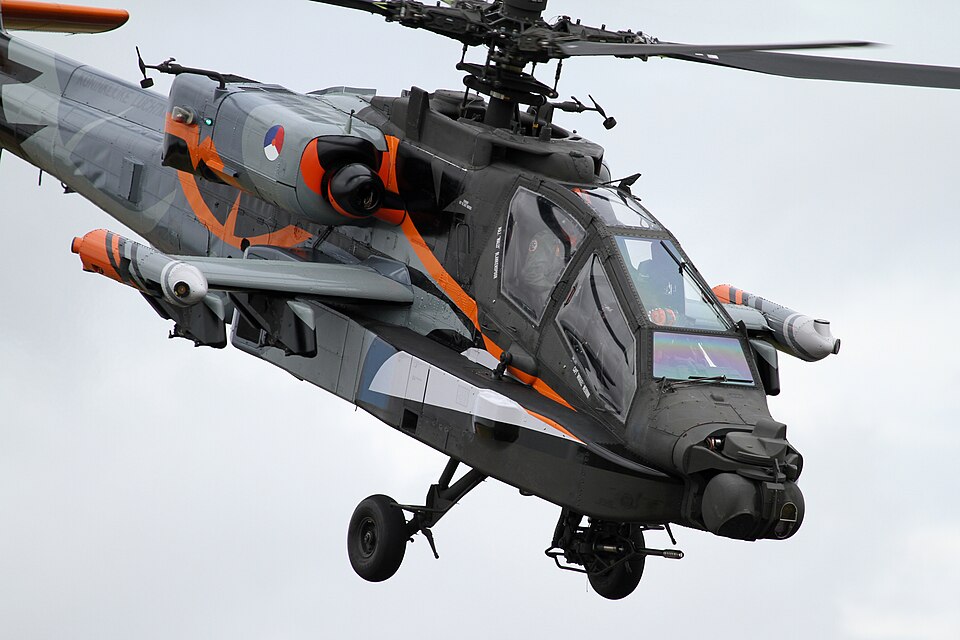
The United States operates the largest dedicated attack helicopter force in the world. Its primary platform is the Boeing AH-64 Apache, now in its most advanced AH-64E Guardian variant. The U.S. Army has operated hundreds of Apaches over decades of combat, from Operation Desert Storm to Afghanistan. The Apache carries a 30mm M230 chain gun, AGM-114 Hellfire missiles, and 70mm Hydra unguided rockets.
The Bell AH-1Z Viper, used by the U.S. Marine Corps, is the other major American attack helicopter. It is a twin-engine, tandem-seat platform derived from the original AH-1 Cobra lineage, now heavily upgraded with modern avionics and weapons systems.
Why It Matters: The U.S. leads global attack helicopter development. Its platforms set the standard that allies and rivals both measure themselves against.
Europe
France and Germany
Both countries jointly developed and operate the Eurocopter Tiger (now Airbus Helicopters Tiger). This aircraft features a composite airframe — said to be composed largely of advanced materials including carbon laminates and Kevlar — making it lightweight yet durable. France operates an armed reconnaissance variant while Germany fields an anti-tank version.
Germany has announced plans to retire its Tiger fleet by around the late 2030s, though France continues to operate and upgrade its fleet.
Italy
Italy fields the Leonardo AW129 Mangusta (Italian for "Mongoose"), which holds the distinction of being Western Europe's first domestically designed and built attack helicopter. The Mangusta is a capable anti-armor platform and has seen operational deployment in conflict zones.
United Kingdom
The British Army operates the AgustaWestland Apache AH1 and has transitioned to the newer AH-64E standard. The UK's fleet was originally built under license from Boeing, with modifications including more powerful Rolls-Royce engines and folding blades for naval ship compatibility.
Greece and the Netherlands
Both countries operate variants of the AH-64 Apache, making it one of the most widely fielded Western attack helicopters among NATO allies.
Keep in Mind: European defense budgets and procurement priorities vary widely. Some NATO nations operate smaller attack helicopter fleets but invest heavily in electronic warfare and precision munitions to compensate.
Russia and Post-Soviet States
Russia maintains one of the world's largest and most varied attack helicopter fleets.
Mil Mi-24 Hind — The Mi-24 is arguably the most recognized attack helicopter outside of the United States. With a production count said to exceed 2,600 units and operators in over 50 countries, it remains in active service with Russia and dozens of other nations. It is unique for its ability to carry both troops and weapons simultaneously.
Mil Mi-28 Havoc — Russia's dedicated anti-armor and close air support platform. The Mi-28NM is the latest variant, featuring an all-weather, night-capable fire control system and upgraded avionics.
Kamov Ka-52 Alligator — Russia's most advanced attack helicopter in current service. The Ka-52 uses a coaxial rotor design (two rotors spinning in opposite directions on the same axis), which eliminates the need for a tail rotor. It features an armored titanium cockpit capable of withstanding cannon fire, and notably includes ejection seats — an unusually rare feature for a rotary-wing aircraft.
Fun Fact: Before ejecting from a Ka-52, explosive charges are said to detonate to blow off the rotor blades — allowing the crew to eject safely without being struck.
For a detailed look at the most powerful and capable platforms Russia and other nations operate, Flying411's guide to the top attack helicopters in the world is worth reading.
Asia-Pacific
China
China has invested heavily in domestic attack helicopter development over recent decades.
CAIC Z-10 — China's primary dedicated attack helicopter, developed with reported input from Russian design bureaus. It features a sleek airframe with stealth-conscious design elements and carries a 23mm cannon along with anti-tank missiles and rockets.
Harbin Z-19 — A lighter scout and attack helicopter complementing the Z-10. It is a more compact platform optimized for reconnaissance and lighter strike roles.
China also acquired a number of AH-64E Apaches, though primarily for evaluation and some operational use.
Heads Up: Chinese military helicopter data is often less transparent than Western fleet figures. Published numbers vary by source and should be treated as approximate.
India
India operates one of Asia's most diverse attack helicopter forces.
- AH-64E Apache Guardian — Acquired from Boeing, these serve with both the Indian Air Force and Army. They saw early operational deployment near the Himalayan border during tensions with China.
- HAL Rudra — An indigenous armed variant of the HAL Dhruv utility helicopter, fitted with guns, rockets, and anti-tank guided missiles. Designed especially for high-altitude operations.
- HAL Prachand (LCH) — India's purpose-built Light Combat Helicopter, developed specifically to address the high-altitude combat limitations exposed during the Kargil War of 1999. It is designed to operate effectively at altitudes where most conventional attack helicopters struggle.
- Mil Mi-35 — The export variant of the Mi-24V, operated by Indian Army Aviation.
Pro Tip: India's indigenous helicopter programs — including the Rudra and Prachand — are worth watching. They represent a growing domestic defense industrial capacity that could rival imports within the next generation.
South Korea
South Korea operates AH-64E Apaches and Bell AH-1S Cobras, making it one of the better-equipped attack helicopter operators in East Asia. Its military focuses heavily on anti-armor capability given the threat posed by North Korean armored forces.
Japan
Japan's Ground Self-Defense Force has operated AH-64D Apaches and Bell AH-1S Cobras. Japan's helicopter procurement has faced scrutiny in recent years over cost and fleet size debates, but it remains a capable force.
Taiwan
Taiwan operates a significant deterrent force of AH-64E Apaches and AH-1W Super Cobras. Taiwan's Apaches have gained attention for their striking tiger shark-inspired paint schemes. Given the island's strategic position, these helicopters are a central element of its defense posture.
Middle East
Israel
Israel operates one of the most battle-tested attack helicopter forces in the world. The Israeli Air Force (IAF) flies AH-64A and AH-64D Apaches, acquired beginning in 1990. Israeli Apaches have been deployed in numerous conflicts across the region and have accumulated significant combat hours. Israel also operates the Bell AH-1 Cobra in earlier operational contexts.
Saudi Arabia
Saudi Arabia fields AH-64D Apaches and has been one of the largest export customers for American attack helicopters. Its fleet has seen operational use during regional conflicts.
United Arab Emirates
The UAE operates AH-64D and AH-64E Apaches alongside other rotary-wing platforms, fielding a modern and well-maintained force.
Turkey
Turkey stands out as the only NATO country to develop and produce a largely indigenous attack helicopter: the TAI/AgustaWestland T129 ATAK. Based on the AW129 Mangusta, the T129 was redesigned and optimized for Turkish operational requirements, particularly for mountainous and "hot and high" terrain conditions.
Good to Know: Turkey's T129 ATAK program faced export complications due to its use of American-licensed engines, illustrating how arms export controls can shape even domestically developed platforms.
Turkey also operates older AH-1W Super Cobras and has pursued additional procurement to expand its fleet.
Iran
Iran's attack helicopter force is built largely around older American platforms acquired before the Islamic Revolution, including Bell AH-1J SeaCobras. These aging aircraft have been maintained through domestic means since international sanctions block foreign parts. Iran has also developed the Shahed 285, a domestically produced light attack and reconnaissance helicopter.
Keep in Mind: Iran's operational readiness rates are difficult to verify given limited public information, but the country's engineering community has shown a consistent ability to keep older platforms airborne well beyond their intended service lives.
Africa
Egypt
Egypt fields the largest and most varied attack helicopter force on the African continent. It operates AH-64D Apaches (with upgrades delivered in cooperation with Lockheed Martin), Ka-52 Alligators, and older Mi-24 Hinds. This diversity reflects Egypt's policy of procuring from multiple global suppliers.
Algeria
Algeria relies heavily on Russian-supplied equipment. Its attack helicopter force includes Mi-28 Havocs and Mi-24 Hinds, making it one of the better-equipped attack helicopter operators in Africa.
South Africa
South Africa operates the Denel AH-2 Rooivalk, a domestically developed attack helicopter. The Rooivalk was designed and built by South African engineers, making South Africa one of the few countries outside of Europe, the US, Russia, China, and India to have successfully produced a purpose-built attack helicopter. Fewer than a dozen units are in operational service.
Fun Fact: The Rooivalk is said to be one of the most domestically self-sufficient attack helicopter programs in the developing world, born out of South Africa's need to develop its own defense industry during the arms embargo of the apartheid era.
The Most Widely Operated Attack Helicopters in the World
Some platforms have become true global standards, adopted by dozens of countries across multiple continents.
| Helicopter | Origin | Estimated Operators | Primary Role |
| Boeing AH-64 Apache | USA | 17+ nations | Anti-armor, CAS |
| Mil Mi-24/35 Hind | Russia/USSR | 50+ nations | Multi-role, CAS, troop transport |
| Bell AH-1 Cobra (various) | USA | 15+ nations | Anti-armor, CAS |
| Kamov Ka-52 Alligator | Russia | Russia, Egypt | Anti-armor, all-weather CAS |
| Eurocopter Tiger | France/Germany | France, Germany, Spain, Australia | Anti-armor, armed reconnaissance |
| CAIC Z-10 | China | China | Anti-armor, CAS |
| T129 ATAK | Turkey | Turkey | Mountain CAS, anti-armor |
The Mil Mi-24 arguably holds the record as the most manufactured dedicated attack helicopter in history, with well over 2,000 units produced across variants — a number that has not been surpassed by any other attack platform.
Looking for more context on which rotorcraft stands above the rest? Flying411's in-depth breakdown of the most powerful helicopter in the world explores performance, firepower, and capability across platforms.
Why Countries Choose Different Attack Helicopters
Not every country can afford to design its own attack helicopter. And not every country wants to. The choice between importing foreign platforms, licensing production, or developing indigenous designs depends on several interconnected factors.
Budget and Industrial Capacity
Countries with large defense budgets and advanced aerospace industries — the US, Russia, France, Germany, Italy, China — can develop their own platforms. Nations with smaller defense budgets typically buy existing designs, often through Foreign Military Sale (FMS) programs or direct commercial purchases.
Strategic Alliances
Alliance membership strongly shapes procurement. Most NATO countries that operate dedicated attack helicopters fly either the Apache or the Tiger. Russian-aligned militaries typically operate Mi-24/35 or Mi-28 variants. This creates logistical coherence: shared parts, shared training, shared doctrine.
Terrain and Climate
Operating environment matters enormously. India developed the HAL Prachand specifically because existing attack helicopters struggled to perform at Himalayan altitudes. Turkey optimized the T129 for mountainous hot-and-high conditions. Egypt chose a dual-supplier approach that gives it both Western precision and Russian robustness.
Why It Matters: Choosing the wrong attack helicopter for your terrain can result in operational failure regardless of how capable the aircraft is on paper.
Export Restrictions
The United States, in particular, applies strict export controls on military systems. Several countries — including Turkey — have faced complications when their domestic programs incorporated licensed American components, limiting export potential and sometimes delaying deliveries.
For a broader look at how different helicopter categories serve global militaries, Flying411's guide to the best transport helicopter in the world offers useful context on how attack and utility aircraft work together on the modern battlefield.
Attack Helicopters and Modern Warfare
The battlefield has changed dramatically since the Cold War era that gave rise to dedicated attack helicopter programs. Today, attack helicopters face new threats.
Drones and UAVs have proliferated at a staggering pace. Low-cost first-person-view (FPV) drones in conflicts like the Russia-Ukraine war have targeted helicopters with increasing effectiveness. This has forced commanders to rethink how and where attack helicopters operate.
Heads Up: Despite the rise of UAVs, the attack helicopter has not become obsolete. Its ability to loiter, communicate with ground troops in real time, and engage targets with precision in complex environments still offers capabilities that current drone technology has not fully replicated.
Man-portable air defense systems (MANPADS) — shoulder-fired surface-to-air missiles — have always posed a threat to low-flying helicopters. Modern attack helicopters address this with:
- Radar warning receivers
- Missile approach warning systems
- Infrared countermeasure systems (flares, directed IR jamming)
- Armored cockpits and self-sealing fuel tanks
Modern attack helicopters integrate real-time data networking, allowing them to share targeting information with ground forces and other aircraft simultaneously. This situational awareness capability is considered just as important as raw firepower in today's combat environments.
To understand how private and civilian helicopter aviation fits into the broader rotorcraft ecosystem, Flying411's resource on the world's best helicopters for private use provides a useful contrast between military and civilian rotorcraft design priorities.
Conclusion
The list of attack helicopters by country reads like a map of global power, priorities, and partnerships. The United States leads in sheer numbers and technology, with the AH-64 Apache serving as the global benchmark. Russia fields a sprawling and battle-tested fleet. China is building fast. And nations from Turkey to South Africa are proving that domestic innovation can produce capable platforms on their own terms.
These aircraft are not just machines. They are expressions of how countries choose to defend themselves, project force, and deter adversaries. As drone technology evolves and the battlefield keeps changing, the attack helicopter will continue to adapt — just as it has for the past several decades.
For anyone who wants to keep learning about military and civilian aviation, Flying411 is one of the best places to start — whether you are tracking the latest in defense technology or exploring what it means to take to the skies.
Frequently Asked Questions
Which country has the most attack helicopters in the world?
The United States operates the largest dedicated attack helicopter fleet in the world. Its primary platform is the AH-64 Apache, with hundreds in active service with the U.S. Army alone, alongside the AH-1Z Viper used by the Marine Corps.
What is the most widely used attack helicopter globally?
The Mil Mi-24 Hind is said to be the most manufactured dedicated attack helicopter in history, with operators in more than 50 countries. The Boeing AH-64 Apache is the most widely used Western attack helicopter, with operators across more than 17 allied nations.
Does India have its own attack helicopter?
Yes. India has developed the HAL Prachand (also called the Light Combat Helicopter, or LCH), a purpose-built attack helicopter designed for high-altitude operations. India also operates the HAL Rudra, an armed variant of the HAL Dhruv utility helicopter.
What makes the Ka-52 Alligator different from other attack helicopters?
The Ka-52 Alligator uses a coaxial rotor system — two rotors stacked on the same axis spinning in opposite directions — which eliminates the need for a tail rotor. It also features an armored titanium cockpit and ejection seats, which are rare in helicopters.
Are attack helicopters becoming obsolete due to drones?
Most defense analysts say no. While drones have taken on many roles previously assigned to attack helicopters, the attack helicopter still offers capabilities that current drone technology has not fully replicated — including complex close air support, real-time crew decision-making, and sustained loiter capability in heavily contested environments. The two are increasingly seen as complementary rather than competing systems.