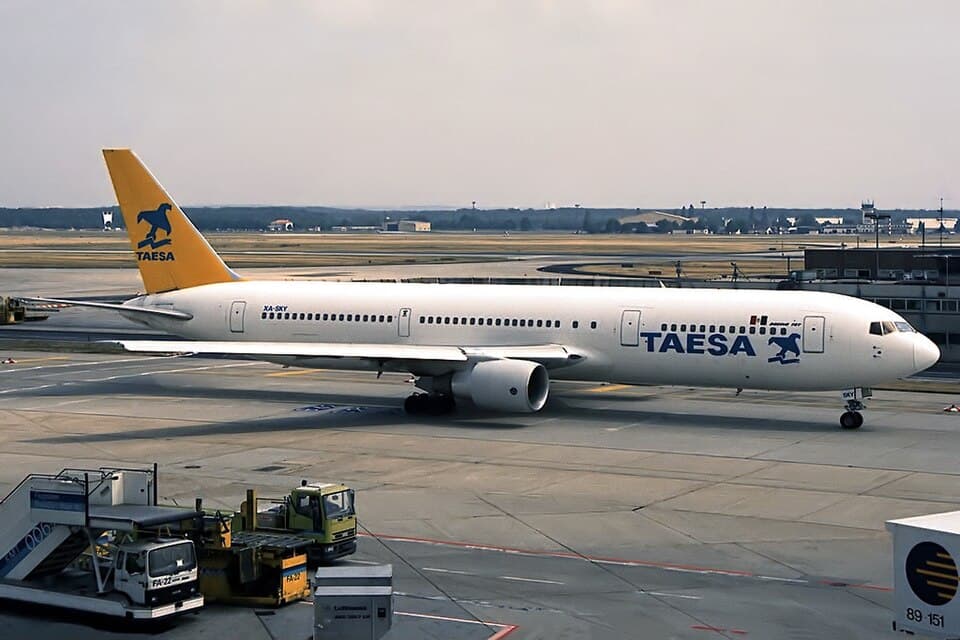
Somewhere over the Atlantic right now, a Boeing 767 is flying with no passengers on board and a floor stacked with pallets from nose to tail. It might be carrying phone parts, salmon, engine components, or a few thousand pairs of sneakers. The 767 has quietly become one of the hardest-working freight haulers in the sky, and the question people ask most often is a simple one: how much cargo can a Boeing 767 carry?
The answer depends on which 767 you mean, how far it is flying, and what kind of freight is going in the door. A jet packed with dense machinery hits its weight limit long before the floor fills up. A jet packed with pillows fills the floor and never comes close to its weight limit. Both planes are "full." Neither one is full in the same way.
That gap between weight and space is where the whole story of air freight lives.
Key Takeaways
A Boeing 767 freighter can carry roughly 115,000 to 127,000 pounds of cargo, which is about 52 to 58 metric tons, spread across a main deck and a lower hold with a combined volume near 15,500 cubic feet. The main deck holds up to 24 standard pallets. The lower hold adds up to 30 smaller containers. Passenger 767s carry far less, since freight rides only in the belly under the cabin.
| Question | Short Answer |
| Typical freighter payload | About 115,000 to 127,000 lb (52 to 58 metric tons) |
| Total cargo volume (767-300F) | Roughly 15,500 cubic feet (about 438 cubic meters) |
| Main deck pallets | Up to 24 standard 88 x 125 inch pallets |
| Lower hold containers | Up to 30 LD2 containers |
| Range at full payload | Around 3,200 nautical miles |
| Passenger 767 belly cargo | Usually a small fraction of freighter capacity |
| Main deck cargo door | Roughly 11 by 8.5 feet |
| Freighter versions | 767-300F, 767-300BCF, 767-300BDSF, 767-200SF |
Flying411 keeps a running view of the commercial and general aviation market, from airframes and engines to certified parts, so numbers like these stay tied to real listings instead of guesswork.
What "Cargo Capacity" Means on a Boeing 767
Cargo capacity sounds like one number. It is really two, and they fight each other.
The first number is weight. Every aircraft has a maximum takeoff weight, and everything on board counts toward it: the empty airframe, the crew, the fuel, and the freight. Load more fuel and you must load less cargo. There is no way around the math.
The second number is volume. This is how much physical space exists inside the hull. You can fill every cubic foot with foam packing peanuts and still be thousands of pounds under your weight limit.
Freight planners call the balance point density. Cargo that averages around 6 to 8 pounds per cubic foot tends to fill a 767 by weight and volume at roughly the same time. That is the sweet spot.
Good to Know: Air freight is priced on "chargeable weight," which compares real weight against volume. A box of ping pong balls gets billed as if it were much heavier than it is, because it eats space the carrier cannot sell twice.
Structural Payload vs. Revenue Payload
You will see two payload figures quoted for the same aircraft, and they are not errors.
- Structural payload is the maximum the airframe is certified to hold. It is a limit set by the floor, the frames, and the landing gear.
- Revenue payload is what the operator can realistically carry on a paying flight after fuel, crew, and reserves are accounted for.
Structural payload for a 767 freighter sits near 127,000 pounds. Revenue payload on a long ocean crossing often lands closer to 100,000 pounds or less. Both are honest numbers. They just answer different questions.
Meet the 767 Family: Which Versions Haul Freight
Boeing has built the 767 in several lengths since the early 1980s, and only some of them end up moving boxes. Here is how the freight-capable lineup breaks down.
767-300F
The purpose-built factory freighter. It uses the 767-300ER airframe with a reinforced floor, a large main deck cargo door, no windows, and no passenger systems. It entered service in the mid-1990s and became the backbone of express carriers around the world. This is the version people usually mean when they ask about 767-300F cargo capacity.
767-300BCF and 767-300BDSF
These are converted aircraft. A used passenger 767-300ER goes into a shop, the seats and galleys come out, a cargo door goes in, the floor gets rebuilt, and the windows get plugged. The BCF is Boeing's own program. The BDSF comes from Israel Aerospace Industries. Both land within a few tons of the factory freighter on capacity.
767-200SF
A shorter, older conversion built on the 767-200 airframe. It carries meaningfully less than the -300 versions, usually in the range of 90,000 pounds, and it shows up mostly in regional and niche operations.
767-400ER
The longest 767, but it was never offered as a freighter. Its wider fuselage sections and different structure made a cargo version hard to justify. It stayed a passenger jet.
Fun Fact: The 767 was designed with a seven-abreast cabin and a belly sized for the smaller LD2 container, a size that exists largely because of this aircraft. That design choice from the 1970s still shapes how freight gets packed today.
How Much Cargo a Boeing 767 Can Carry: 8 Numbers That Define the Load
Here are the figures that matter most when someone asks about Boeing 767 freighter payload. Treat them as strong planning numbers rather than exact values for any single tail, since weights vary by engine choice, conversion program, and how the aircraft was originally built.
1. Maximum Structural Payload: Around 127,000 Pounds
The 767-300F is generally quoted with a structural gross payload near 127,000 pounds, or roughly 57 to 58 metric tons. That is the hard ceiling the airframe is built to accept. Very few flights operate right at it, because fuel for a long leg eats into the same budget.
2. Typical Revenue Payload: About 115,000 Pounds
On a normal commercial mission, operators plan around 115,000 pounds of paying freight. That figure appears in most Boeing payload-range charts as the design point. It is the number a freight forwarder can count on for a long-haul booking.
3. Total Cargo Volume: Roughly 15,500 Cubic Feet
Combine the main deck and the lower hold and you get somewhere close to 15,500 cubic feet, or about 438 cubic meters. To put that in everyday terms, it is comparable to the inside of a small house. This 767 cargo volume figure is the one that matters for lightweight freight like apparel, packaging, and e-commerce parcels.
4. Main Deck Volume: About 11,900 Cubic Feet
The main deck alone accounts for roughly 11,900 cubic feet. It is a single open tube with a flat, reinforced floor and roller systems that let a loaded pallet slide into position with modest effort.
5. Main Deck Pallets: Up to 24
The standard count is 24 pallets at 88 by 125 inches. That is the industry-standard base size used across most widebody freighters. Some configurations trade the last position for a crew rest area or a rigid barrier arrangement.
6. Lower Hold Containers: Up to 30 LD2s
Below the floor, the 767 takes up to 30 LD2 containers, plus a bulk area for loose items. Operators often mix in a few pallet positions in the forward hold instead, depending on the freight profile.
7. Cargo Door Opening: Roughly 11 by 8.5 Feet
The main deck door measures about 134 by 103 inches. That opening sets the real limit on oversized items. A crate that fits by weight but not through the door is simply not going on the plane.
8. Range at Full Payload: Around 3,200 Nautical Miles
With a full revenue load, a 767-300F covers roughly 3,200 nautical miles. That comfortably handles transatlantic runs and most Asia-to-Pacific hops with a stop. Push the range further and the payload comes down.
Why It Matters: Payload and range trade against each other on every single flight. Two identical 767s can leave the same airport on the same day carrying loads that differ by 20,000 pounds, purely because one is flying twice as far.
Aircraft values move with capability, and payload is a big part of that. Flying411's aircraft valuation tools help owners see where a specific airframe stands in the current market.
What Fills the Space: Pallets, Containers, and Odd Loads
Freight does not go into an aircraft loose. It goes into unit load devices, known as ULDs, which are standardized pallets and containers built to lock into the aircraft floor.
The 767 uses two main families:
- Main deck pallets: Flat aluminum bases measuring 88 by 125 inches, wrapped in netting and strapped down.
- LD2 containers: Smaller contoured boxes shaped to match the curve of the lower fuselage.
Common cargo you will find on a 767 freighter:
- Express parcels and e-commerce packages
- Perishables such as seafood, flowers, and fresh produce
- Pharmaceuticals in temperature-controlled containers
- Automotive and industrial spare parts
- Electronics and semiconductor equipment
- Live animals, including horses and breeding stock
- Aircraft components, including engines in specialized cradles
- Mail and government shipments
Some 767s are equipped with climate control on the main deck, which opens the door to live animals and sensitive pharmaceutical loads. Those flights command higher rates and demand more careful planning.
Heads Up: Bulky machinery often gets rejected for a 767 not because of weight but because of shape. If a crate cannot clear the door frame or clear the ceiling curve at the sidewall, it waits for a nose-loading freighter instead.
Payload vs. Range: The Trade Every Operator Makes
This is the part most people miss. A payload-range chart looks intimidating, but the idea behind it is simple.
Picture a scale with a fixed limit. On one side, fuel. On the other side, freight. The airframe can only lift so much total. Add a thousand pounds of fuel to reach a farther airport and you give up a thousand pounds of paying cargo.
Here is roughly how it plays out:
| Mission Type | Approximate Distance | Payload Outlook |
| Regional feeder run | Under 1,500 nmi | Weight limit rarely reached; volume fills first |
| Transatlantic express | 3,000 to 3,500 nmi | Near full revenue payload |
| Long transpacific leg | 4,500+ nmi | Payload reduced noticeably or a fuel stop added |
Operators also work around temperature and airport elevation. A hot day at a high-altitude airport thins the air, cuts engine performance, and forces the load planner to leave freight behind. Freight schedulers on those routes often build overnight departures for exactly this reason.
The wider trade-offs behind twin-engine widebody efficiency show up in comparisons like the 777 and 787 matchup, where range, payload, and fuel burn get balanced in similar ways.
How the 767 Compares to Other Freighters
The 767 sits in the medium widebody slot. It is bigger than a narrowbody freighter and much smaller than a 747. That middle ground is exactly why it works so well.
| Aircraft | Rough Payload | Deck Style | Best Use |
| Boeing 737-800BCF | About 50,000 lb | Narrow single aisle | Regional and domestic feeder routes |
| Boeing 757-200F | About 70,000 lb | Narrow single aisle | Medium range express |
| Boeing 767-300F | About 115,000 to 127,000 lb | Widebody main deck | Medium to long haul express |
| Boeing 777F | About 220,000 lb | Widebody main deck | Long haul heavy freight |
| Boeing 747-400F | About 240,000 lb | Widebody with nose door | Outsize and very heavy freight |
The 767's advantage is that it fills quickly. A carrier can run two or three 767 flights a day on a lane where a 747 would fly half empty once. Frequency wins in the express business, and frequency favors medium widebodies.
Comparisons between the giants tell a different story. The size gap between the A380 and 747 shows what happens when aircraft are built for volume above all else, and Boeing's decision on why the 747 was retired shows how the market drifted toward smaller, more frequent lifts.
Pro Tip: When comparing freighters, look at cubic feet per pound of payload, not just payload alone. That ratio tells you which aircraft suits your freight density before you ever look at a rate sheet.
Passenger 767s and Belly Cargo
Not every 767 hauling freight is a freighter. Passenger 767s carry cargo too, and it adds real money to the flight.
On a passenger 767-300ER, freight rides only in the lower hold. That space holds up to about 30 LD2 containers and offers roughly 4,000 cubic feet before you subtract room for passenger bags. Once suitcases take their share, the leftover freight capacity often lands in the range of 10 to 20 tons, depending on route, fuel, and how full the cabin is.
A few things that shrink belly cargo fast:
- A full cabin means more checked bags
- Long routes mean more fuel and less spare lift
- Hot or high airports cut available takeoff weight
- Oversized bags and sporting equipment eat container space
Belly freight is a bonus for an airline, not a business model. Dedicated freighters exist because the cargo customer needs guaranteed space that does not vanish when a flight sells out.
Keep in Mind: During periods when passenger flying drops sharply, belly capacity disappears with it. Air cargo rates react quickly, and that pressure is part of what has kept converted freighters in steady demand.
From Passenger Jet to Freighter: How Conversions Work
A 20-year-old passenger 767 has plenty of airframe life left. Converting it into a freighter gives it a second career that can run for another decade or more.
The passenger to freighter conversion process is involved. In broad strokes:
- Strip the interior. Seats, galleys, lavatories, overhead bins, and cabin linings all come out.
- Cut the cargo door. A large opening goes into the forward left fuselage, with heavy surrounding structure added.
- Rebuild the floor. The passenger floor cannot handle pallet loads, so a stronger freighter floor system replaces it.
- Plug the windows. Metal plugs go in where the windows were, which is why converted freighters look slightly dimpled up close.
- Add the handling system. Rollers, locks, and guides let ground crews move pallets by hand or by power.
- Install a 9G barrier. A rigid barrier protects the cockpit and any supernumerary seats from shifting cargo.
- Recertify the aircraft. New weight and balance data, new manuals, and a fresh airworthiness sign-off.
The 767-300BCF and its IAI counterpart both land close to factory freighter capability. The converted aircraft usually carries a slightly lower structural payload, but the difference rarely changes what an operator can book.
Conversion economics are their own topic. The step-by-step conversion process and the cost breakdown for P2F work both go deeper, and there are solid reasons the 767 is a favorite conversion candidate among cargo operators.
Quick Tip: Conversion candidates get judged on records as much as hours. A clean maintenance history often matters more than a low airframe time number, since maintenance records shape resale value in a big way.
What a 767 Freighter Costs to Own and Operate
Prices swing with market conditions, so treat everything here as directional rather than a quote.
Used 767-300ER passenger airframes suitable for conversion have grown pricier as cargo demand stayed strong. Conversion work adds a substantial sum on top. Factory-new 767-300Fs sit well above converted aircraft on price, and Boeing has signaled that freighter production will wind down later this decade under new emissions and noise standards.
Operating costs break into two buckets:
- Direct costs: Fuel, crew, maintenance, landing fees, and navigation charges
- Indirect costs: Insurance, hangar, administration, training, and ground handling
Fuel dominates the direct side. The 767's twin-engine layout gives it a real advantage over older three and four engine freighters, which is a big reason it replaced so many DC-8s, 707s, and DC-10s in cargo fleets. The breakdown of direct and indirect operating costs shows how the pieces fit together.
Parts and support add another layer. Because 767s are common, the parts market is deep, and buyers work with both new and used serviceable inventory. The differences between used serviceable and OEM parts affect budgets meaningfully over an aircraft's life, and proper traceability documentation keeps everything airworthy and resellable.
Good to Know: A widebody freighter's value tracks its remaining engine and airframe life closely. Understanding how commercial aircraft appraisals work helps owners avoid surprises when it comes time to sell.
Ready to put a real number on an airframe, engine, or parts package? Flying411 connects buyers, sellers, and certified aviation professionals in one place.
Who Flies 767 Freighters and Why
The operator list reads like a who's who of global logistics. Large express carriers built enormous 767 fleets because the aircraft matched their network shape almost perfectly. Regional cargo airlines, charter operators, and ACMI providers fill out the rest.
What keeps them buying:
- Payload that fits real freight demand without excess capacity
- Two-crew cockpit and twin-engine economics
- Range that covers most intercontinental express lanes
- A deep pool of conversion candidates
- Widely available parts, tooling, and trained mechanics
- Airport compatibility at fields too small for a 747
The aircraft also ages well. With disciplined maintenance, a 767 airframe can log decades of service, and questions about longevity mirror what people ask about narrowbodies, such as how long a 737 typically lasts. Scheduled inspections keep the clock honest, and maintenance check intervals drive much of the cost planning.
Fun Fact: The 767 family has been in production since the early 1980s, and military versions including aerial tankers have kept the line alive long after most passenger orders dried up. Few airliner designs have found that many second acts.
Conclusion
So, how much cargo can a Boeing 767 carry? A freighter version handles roughly 115,000 to 127,000 pounds across about 15,500 cubic feet, with 24 pallets up top and 30 containers below. Passenger versions carry far less, since freight is limited to the belly. The real answer on any given day comes down to distance, fuel, temperature, and what the freight weighs per cubic foot.
That balance is the reason the 767 has lasted. It is big enough to matter and small enough to fill, which is a rare combination in aviation.
Whatever you are buying, selling, or servicing, the right numbers make the difference. Start at Flying411 and let the market come to you.
FAQs
Can a Boeing 767 carry a shipping container?
Standard 20-foot ocean containers do not fit through the main deck cargo door of a 767. Air freight uses its own container sizes, primarily LD2s and 88 by 125 inch pallets built to match the fuselage shape.
How many crew members fly on a 767 freighter?
Two pilots operate the aircraft, since the 767 was designed around a two-crew glass cockpit. Some flights add supernumerary seats for a loadmaster or additional personnel behind the cargo barrier.
Do 767 freighters carry dangerous goods?
Many do, under strict regulatory rules covering packaging, labeling, quantity limits, and stowage location. Certain items remain forbidden on any aircraft regardless of the operator.
Is the 767 freighter still in production?
Boeing has announced that 767 freighter production will end later this decade in connection with upcoming emissions and noise standards. Existing aircraft and conversion programs are expected to keep the type flying for years afterward.
What replaced the 767 in passenger service?
The 787 Dreamliner took over most of the 767's passenger routes for airlines seeking newer technology and lower fuel burn. Many retired passenger 767s went on to become freighters rather than heading straight to scrap.