The already-equipped airplane is almost always the cheaper airplane. That is the short version of the whole debate over buying a well-equipped airplane versus buying a cheap one and upgrading the panel, and it surprises people, because the sticker shock runs the other way. The equipped airplane asks more money up front. The bargain airplane looks like a deal until you price the work.
What makes the difference is simple: the used market does not pay you back dollar for dollar for avionics, so the seller who already paid for the panel has eaten most of that loss on your behalf. You still have reasons to go the other way, and some of them are good ones. But you should know which side of the math you are standing on before you write a deposit check.
Is it cheaper to buy a plane with a good panel or upgrade a cheap one?
In most cases, buying the equipped airplane costs less total cash. The price gap between two otherwise identical airplanes — same model, same year, same engine time, one with a modern touchscreen navigator and digital autopilot and one with 1970s radios — tends to be smaller than the cost of doing that work yourself.
Think of it the way you would a house. A kitchen remodel might cost $60,000, and the appraiser adds perhaps half of that to the home's value. The seller who remodeled last year absorbed the rest. Avionics behave the same way, and they depreciate faster than kitchens do, because the technology moves.
So the honest starting assumption is this: if you can find the airplane you want with the panel you want already in it, and the airframe and engine check out, buy that one. The upgrade path is the exception, not the default — and the rest of this article is about when the exception applies.
What does a panel upgrade actually cost in 2026?
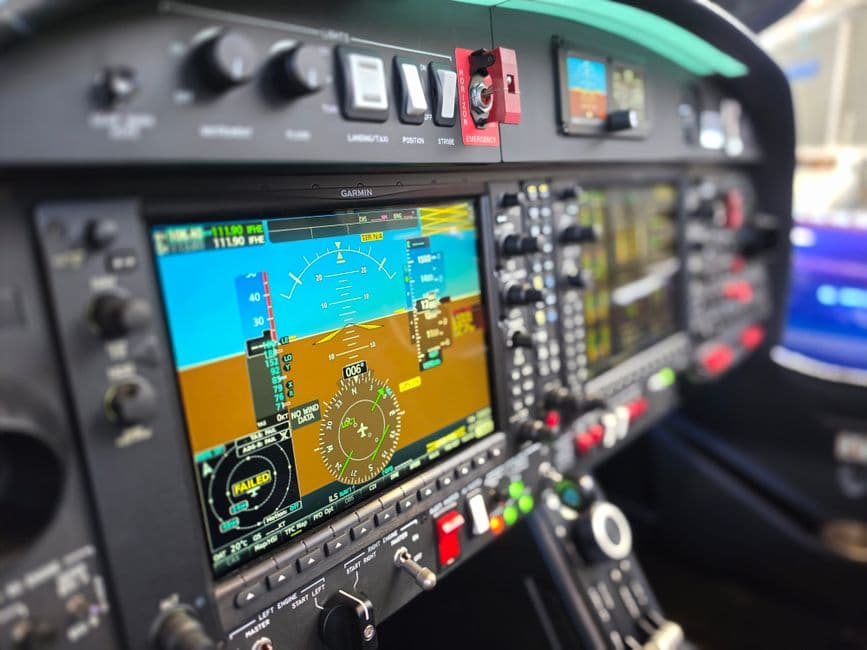
A full modern panel in a four-seat piston single commonly lands between $70,000 and $130,000 installed, depending on how much you replace and how much custom metalwork the shop has to do. Individual boxes are cheaper than that, which is how owners talk themselves into a project that grows.
The figures below reflect typical installed quotes from certified avionics shops in 2025 and 2026, including labor, wiring, trays, antennas, panel fabrication and paperwork. Shop labor itself is commonly quoted between about $110 and $175 an hour, and labor is usually the larger half of any serious job. Treat these as planning ranges, not quotes — your airplane's existing wiring is the single biggest variable, and nobody knows how bad it is until the panel comes out.
| Upgrade | Typical installed cost, 2025–26 | What drives the number |
| ADS-B Out transponder (e.g. Garmin GTX 345 class) | $6,500 – $9,500 | Required since January 1, 2020 under 14 CFR 91.225 in most controlled airspace |
| Single digital attitude indicator (G5 class) | $5,000 – $8,000 | Backup battery, pitot-static recertification, panel cutting |
| Two-display digital instrument pair (GI 275 class) | $14,000 – $22,000 | Autopilot interface and ADAHRS configuration add cost |
| GPS navigator, single box (GTN 650Xi or IFD440 class) | $22,000 – $32,000 | Antenna, indicator, CDI switching, database setup |
| Large-screen navigator (GTN 750Xi or IFD540 class) | $32,000 – $45,000 | Often requires a full panel rebuild to fit |
| Two-axis digital autopilot with trim (GFC 500 class) | $22,000–$34,000 as an illustrative installed range, excluding any separately required flight-display upgrades | Servo count, compatible G5, GI 275 or G3X Touch flight display, STC eligibility, trim configuration and rigging |
| Certified glass PFD/MFD pair (G3X Touch class) | $30,000 – $50,000 | Panel fabrication, sensor plumbing, backup instruments |
| Engine monitor, primary replacement | $5,000 – $9,000 | Probe count, whether it replaces original gauges |
| Audio panel with Bluetooth | $4,500 – $7,500 | Usually bundled into a larger job |
| Complete panel rebuild, glass plus autopilot plus navigator | $70,000 – $130,000 | Includes wiring harness, placards, weight and balance, paperwork |
Two cost traps hide inside those ranges. The first is approval. Many popular avionics retrofits use an Approved Model List Supplemental Type Certificate (AML-STC), which identifies the aircraft eligible for installation. If your specific model is not covered, the shop must determine whether another approved installation method is available. Some major alterations may qualify for an FAA field approval, while others require a separate STC or additional engineering approval. FAA Form 337 documents qualifying major alterations, but filing the form does not itself guarantee approval. The second is discovery. Shops routinely find corroded grounds, cracked instrument panels, cloth-insulated wire or a previous owner's creative splices once the panel is open, and that work gets billed.
Heads Up: Parts and labor for avionics work are taxable in many states, and some states charge use tax on the installed value even when the shop is out of state. On a $90,000 job, a 6% rate is $5,400 you did not budget.
How much of an avionics upgrade do you get back when you sell?
Plan on recovering roughly a third to maybe two-thirds of what you spend, and less as the years pass. Appraisal guides add avionics value as an adjustment at a fraction of installed cost, and brokers price from the airframe and engine first.
There is a ceiling effect, too. A 1977 Cessna 172N with a $110,000 panel is still a 1977 172N. Buyers shopping that part of the market have a number in their heads, and a spectacular panel moves that number up — but it does not move it up by $110,000. The same money spent on a Bonanza or a Cirrus sits inside a higher-value airframe and tends to come back a little better, because the buyer pool for those airplanes expects modern equipment.
Where the equipped airplane wins quietly is time on market. Owners and brokers consistently report that a used single with IFR-capable GPS, ADS-B, a working digital autopilot and clean logs sells in weeks, while the same model with a 1980s radio stack sits for months and eventually sells on price. If you ever need to move the airplane quickly, equipment is liquidity.
Flying411 keeps used piston singles from across the market in one place, so you can compare how two examples of the same model are priced once you account for the panel.
Can I finance a panel upgrade, or does it have to be cash?
Avionics already installed in an aircraft can be included in its financed purchase price, subject to the lender's valuation and loan terms. Owners can also obtain financing for later avionics upgrades through certain aircraft lenders, although these loans typically depend on the aircraft's post-upgrade appraised value, available equity and loan-to-value limits. Some installation expenses may still need to be paid out of pocket.
When the equipped airplane costs $70,000 more, a buyer putting 15% down finances roughly $59,500 of that over 15 or 20 years at the lender's rate. When you buy the cheap airplane instead, the $90,000 upgrade is generally cash out of pocket, or a short-term unsecured loan at a much higher rate. Some lenders will refinance an aircraft after a major upgrade and let you pull equity back out, but they will lend against the appraised value — which, as above, is not your receipt total.
Older airframes complicate this further. Lenders set age limits and loan-to-value rules that tighten with aircraft age, which we cover in Can You Finance a 1970s Airplane?. If the bargain airplane is a 1968 model and the equipped one is a 1998 model, the financing terms may differ more than the prices do.
What does the math look like on a real example?
Run two 1970s Skylanes side by side and the pattern shows up fast. Airplane A has mid-time engine, decent paint, and a modern panel: touchscreen navigator, digital autopilot, glass primary display, ADS-B. Airplane B is the same year with similar engine time and the original stack plus a bolt-on ADS-B box, and it asks $70,000 less.
Buy Airplane B and build it to match Airplane A, and you are looking at a navigator, a glass display or digital instrument pair, a two-axis autopilot, an audio panel and a new panel structure — call it $85,000 to $110,000 installed in 2026, plus sales or use tax, plus two to four months of hangar rent, insurance and loan payments on an airplane you cannot fly. Your all-in number lands $20,000 to $45,000 above what Airplane A would have cost, and your resale value is now roughly the same as Airplane A's. That is the gap you are paying for the privilege of choosing your own boxes.
Now change one variable. Suppose Airplane B's asking price is $110,000 below Airplane A's, because Airplane A is unusually expensive for the model and Airplane B is priced to move. Suppose further that you only want a navigator, a single digital attitude indicator and an autopilot — a $50,000 job, not a $100,000 one. Now the upgrade path wins by a wide margin, and you end up with exactly the panel you wanted. The decision is not philosophical. It is arithmetic, and it turns on two numbers: the price gap and the scope of work you actually need.
Pro Tip: Before you make an offer on the bargain airplane, get a written quote from the shop you would actually use, for the exact scope you want, with your N-number and serial number on it. A phone estimate and a real quote routinely differ by 30%.
When does buying the cheap airplane and upgrading actually win?
The upgrade path wins when the airplane you want does not exist with the panel you want, or when the equipped examples carry equipment you would rather not inherit. Both happen more often than you would expect.
Here is where it genuinely makes sense:
- Thin markets. If you are shopping a Grumman Tiger, a Maule, a Bellanca or any model with a few dozen for sale nationwide, you take the best airframe and build the panel. There is no shopping your way around it.
- You are keeping it a long time. Depreciation on avionics only matters when you sell. Over fifteen years of ownership, the recovery percentage stops being the point and the flying does.
- The equipped airplane's gear is old. A panel full of 1990s and early-2000s boxes is not the same as a modern one. Owners report that repair support for older GPS navigator generations has thinned out considerably, and a non-WAAS unit cannot fly LPV approaches at all.
- You can stage the work. Doing the navigator this year and the autopilot in two years spreads the cash and lets you fly between projects. You pay a bit more in total labor, but you never have a six-figure bill at once.
- The cheap airplane is the better airplane. A low-time engine, no corrosion history and complete logs are worth more than any avionics stack. Hardware you can buy. A clean airframe you cannot.
What should get my money before the panel does?
Engine, corrosion and paperwork — in that order — all come before avionics. A panel upgrade is the most visible way to spend money on an airplane and usually not the most important one.
An overhaul on a typical four-cylinder or six-cylinder piston single runs well into five figures and is a certainty, not a possibility, on a high-time engine. Corrosion repair on a coastal airplane can be open-ended. Missing logbooks permanently reduce value in a way no amount of glass offsets. Those are the items that decide whether the airplane is a good buy at all, and our guide to what small planes cost to buy and own is a useful reality check on how the rest of the budget stacks up.
There is one more reason to settle the airframe questions first. If you put a $90,000 panel in an airplane and then discover it needs a spar inspection or an engine, you have invested in something you may need to sell at a loss. The panel does not make the airplane airworthy. It makes it pleasant.
Flying411 lists engine times, avionics and total time together on each aircraft, so you can see at a glance whether a low asking price reflects the panel or the engine.
How long will my airplane be in the shop, and what does that cost me?
Budget two to four months of downtime for a full panel rebuild, and expect the schedule to slip. Owners regularly report a quoted six-week job running three to four months once parts backorders and discovery work enter the picture.
Downtime is a real cost even though no one invoices you for it. Hangar rent continues. Insurance continues. If the airplane is financed, the payment continues. A common hangar-and-insurance figure of $600 to $900 a month means a four-month install quietly adds $2,400 to $3,600 to the project, before you count the rental time or lost currency.
There is also a scheduling problem. Good avionics shops in 2025 and 2026 have been booked several months out, so the realistic sequence is: close on the airplane, fly it for a season, then take your slot. That is fine — it just means you should not plan your first long trip around equipment that is still in a shop's queue.
How do I check that an existing panel was installed properly?
Ask for the paperwork before you ask about the boxes. A modern panel with no supporting documentation is a liability, not an asset, and sorting it out later falls on you.
The file should contain, at minimum: logbook entries describing the work, FAA Form 337 for any major alteration, the STC paperwork or permission letter showing your serial number is covered, an updated weight and balance, and the Airplane Flight Manual Supplements for every installed system. Autopilot and GPS navigator supplements matter — without the AFMS in the airplane, the equipment is not legally usable for the operations it was approved for.
Then look at the practical details. Is the GPS navigator WAAS-capable, so it can fly LPV approaches? Are the databases current, and what does the subscription cost each year? Does the autopilot actually couple in flight, including on an approach, and did you watch it do so during the test flight? Is the installation neat behind the panel, with service loops and labeled wiring, or is it a bundle of zip ties? For buyers weighing older hardware against new, our piece on used avionics for a Cessna 172 covers which legacy boxes are still worth owning.
Good to Know: Raising your insured hull value after a big upgrade raises your premium, and underinsuring the airplane means you eat the difference after a gear-up or a hangar incident. Call your broker with the new value before the airplane leaves the shop, not at renewal.
Does the answer change depending on the airplane?
Yes, and mostly along two lines: how many of that model are for sale, and how much the airframe is worth to begin with.
On high-production trainers and cruisers — 172s, 182s, Cherokees, Archers — there are enough listings that you can genuinely shop for the panel you want, so buying equipped is usually right. Our SR22 versus 172 comparison is a good illustration of how differently two popular singles are equipped from the factory, and how that shapes what you find used.
On faster, more specialized airplanes, equipment also carries more weight with buyers, because the mission involves weather and distance. A fast single flown hard in the system needs a capable autopilot far more than a weekend 150 does — see our rundown of the fastest single engine piston planes for where that mission sits. At the other end, on genuinely inexpensive airframes, the arithmetic turns hostile fast: a $40,000 airplane cannot absorb a $60,000 panel, which is worth remembering when browsing affordable small aircraft. Spend proportionally. A sensible rule many owners use is to keep avionics spending under about a third of the airplane's value.
Flying411 gathers listings across models and price bands in one place, so you can test the price gap between an equipped example and a bargain one before you commit to either path.
At a Glance
The default answer to buying a well-equipped airplane versus buying a cheap one and upgrading the panel is to buy equipped, because the used market pays back only about a third to two-thirds of installed avionics cost and the previous owner has already taken that hit. A full modern panel in a four-seat piston single runs roughly $70,000 to $130,000 installed in 2026, avionics bought with the airplane get financed on the airplane loan while later upgrades usually come out of your pocket, and two to four months of downtime costs you hangar, insurance and payments while the airplane sits. The upgrade path still wins in thin markets where your model rarely appears equipped, when you plan to keep the airplane a decade or more, when the equipped examples carry aging non-WAAS gear, or when the cheaper airplane simply has the better engine and airframe — and engine, corrosion and complete logbooks should always get your money before the panel does. Price the exact scope with a written shop quote, compare it against the real price gap between two specific airplanes, and let the arithmetic decide.
When you are ready to compare listings, visitFlying411and see what is on the market today.