Two jets. One contract. And a choice that shaped the skies for decades. In the late 1990s, Boeing and Lockheed Martin went head to head in one of the largest fighter competitions the world had ever seen. The prize was the Joint Strike Fighter contract, a deal linked to thousands of aircraft and hundreds of billions of dollars.
The Boeing X-32 vs X-35 matchup came down to two very different ideas about what a modern fighter should be. One looked like a proper fighter jet.
The other looked like it had run face-first into a wall. Yet looks turned out to be one of the smaller parts of the story. The jet that won pulled off something in a single flight that no aircraft had ever done before.
Key Takeaways
The Boeing X-32 lost to the Lockheed Martin X-35 because the X-35 proved it could do more with less risk. Both jets were built for the same demanding job, but Lockheed's design pulled off a short takeoff, a supersonic dash, and a vertical landing all in one flight. The X-32 could not match that in a single setup. The X-35 also had far more room to grow, which is why it went on to become the F-35 Lightning II we know today.
| Detail | Boeing X-32 | Lockheed Martin X-35 |
| Maker | Boeing | Lockheed Martin |
| Vertical lift system | Direct-lift thrust vectoring (Harrier-style) | Shaft-driven lift fan |
| Switching flight modes | Needed changes on the ground | Switched in flight |
| Look | Bulky chin intake, delta wing | Sleek, conventional fighter shape |
| Prototypes | Two (X-32A, X-32B) | Two airframes (X-35A/B, X-35C) |
| Outcome | Lost the competition | Won, became the F-35 |
At Flying411, we spend our days around aircraft of every kind, from single-engine trainers to the jets that end up in history books. Stories like this one are part of what makes aviation so fun to follow.
The Joint Strike Fighter Program: Where It All Started
Before there was an F-35, there was a competition. And a big one. The United States wanted to stop building a different fighter for every job. Instead, it wanted one family of jets that could serve several branches of the military at once. That idea grew out of an early 1990s effort and rolled into what became the Joint Strike Fighter, or JSF, program.
The plan was bold. One shared design would be built in three closely related versions. Each version would fit the needs of a different customer. The goal was to save money by using common parts, common tooling, and a common production line.
In November 1996, Boeing and Lockheed Martin each won a contract to build two concept demonstrator aircraft. These were not full fighter prototypes. They were proof-of-idea planes, which is why they carried the "X" label used for experimental aircraft. Boeing got the X-32 name. Lockheed Martin got the X-35 name.
Good to Know: The Joint Strike Fighter was a joint effort between the United States and the United Kingdom. The Royal Navy and Royal Air Force needed a jump-jet replacement too, so the vertical landing version mattered to more than one country.
What the Pentagon Really Wanted
The JSF program asked for three main flavors of the same jet. That was a tall order for any single design.
- A conventional takeoff and landing (CTOL) version for the Air Force. This is the classic runway jet.
- A carrier version for the Navy, with beefier landing gear and bigger wings for catapult launches and hard, arrested landings.
- A short takeoff and vertical landing (STOVL) version for the Marine Corps and the British. This one had to lift off from short decks and land straight down, like the older Harrier jump jet it was meant to replace.
That STOVL requirement was the hard part. Landing a heavy, fast jet straight down, then flying it supersonic, is one of the toughest tricks in aviation.
Two Companies, Two Very Different Bets
Here is where the two rivals split. Boeing bet on simplicity. Its plan was to build a single airframe that could handle all three roles with as few changes as possible. Fewer parts meant lower cost and easier upkeep, at least on paper.
Lockheed Martin bet on performance. Its design used a clever and more complex vertical lift system that promised better results and more room to improve later. Both bets were reasonable. Only one would win.
Meet the Boeing X-32
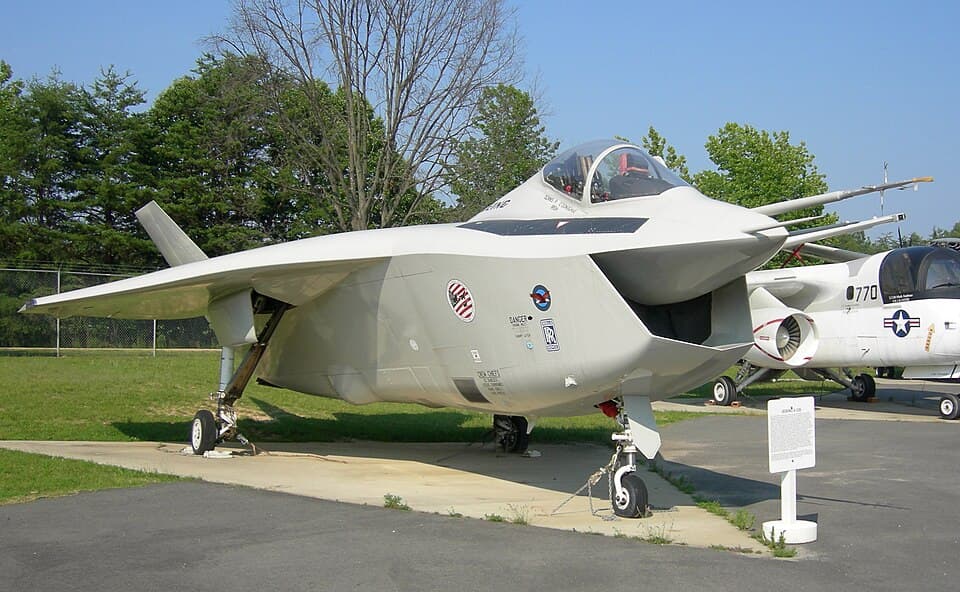
The Boeing X-32 is the jet people remember for its face. It had a large, gaping air intake set low under the nose, a bulky forward body, and a big one-piece delta wing made of carbon fiber. It was not pretty. Boeing was fine with that. The company cared more about cost and function than good looks.
Boeing built two versions of the demonstrator. The X-32A handled conventional flying and Navy carrier approach testing. The X-32B handled the tricky short takeoff and vertical landing work. Both shared the same basic body and wing, which was central to Boeing's money-saving idea.
If you enjoy seeing how different aircraft solve the same problem, comparing these designs is a bit like putting a light plane against a jumbo jet. The starting goal is shared, but the engineering answers land miles apart.
The Direct-Lift STOVL System
For vertical flight, Boeing used a direct-lift thrust vectoring system. In plain terms, the engine sat toward the front of the jet, and its thrust was pointed straight down through nozzles placed near the plane's center of gravity. Push enough hot thrust downward, and the jet rises.
This approach was inspired by the Harrier jump jet, which had used a similar idea for years. The upside was simplicity. Fewer moving parts can mean cheaper builds and easier maintenance over a jet's life. Boeing leaned hard into that promise.
The downside showed up in the details. Pointing hot engine exhaust down near the aircraft could stir up trouble.
Heads Up: The X-32's direct-lift setup was prone to a problem sometimes called a pop stall, where hot exhaust gets pulled back into the engine during hover. Hot air is thin air, and thin air means less thrust. That is a serious issue for a jet trying to hang in the sky at low speed.
The Face Only an Engineer Could Love
There is no polite way around it. The X-32 was widely teased for its appearance. The chin intake gave it an odd, wide-mouthed grin, and the chunky body did it no favors. It became something of a punchline in aviation circles.
Boeing's engineers knew the jet was not a beauty queen. Their point was that fighters are bought to fly, fight, and survive, not to look good in photos. That argument had real merit. Still, in a program with this much money and pride on the line, optics carried more weight than pure logic might suggest.
Meet the Lockheed Martin X-35
The Lockheed Martin X-35 looked the way most people picture a modern stealth fighter. Sleek nose, clean lines, a trim body, and a shape that borrowed heavily from Lockheed's earlier work on the F-22 Raptor. Next to the X-32, it simply looked the part.
Lockheed built its demonstrators around three variants too. The first airframe started as the X-35A for conventional flight, then was rebuilt into the X-35B for the vertical landing tests. A separate X-35C served as the carrier version, with larger wings and stronger gear for deck operations.
The company's pitch was clear. Its design shared a common shape across all three versions while still hitting the tough marks the program demanded. That balance of commonality and capability turned out to be a big deal.
The Shaft-Driven Lift Fan
The X-35's secret weapon was its shaft-driven lift fan. Instead of just pointing engine exhaust down, Lockheed placed a large fan behind the cockpit. A drive shaft connected that fan to the main engine through a clutch. When it was time to hover, the clutch engaged, the shaft spun the fan, and the fan pushed a huge column of cool air straight down.
This design, credited to Lockheed engineer Paul Bevilaqua and developed with Rolls-Royce, had a few smart advantages:
- Cooler airflow. The fan pushed cool air, not scorching exhaust, which reduced heat problems near the ground and inside the engine.
- More total lift. The fan added lifting power on top of what the engine alone could produce.
- Less engine strain. Spreading the work helped the engine run cooler and last longer.
Both jets, by the way, were powered by an engine derived from the same Pratt & Whitney family that powers the F-22. The core engine was not the deciding factor. What each team built around it was.
Why It Matters: The Marine Corps needed a true jump-jet replacement, and that made STOVL a make-or-break test. A jet that could not hover cleanly, with margin to spare, was not going to win the Marine side of the contract. Vertical lift was not a side feature. It was the whole ballgame for one of the biggest customers.
The X-Missions That Made History
Then came the moment that likely sealed the deal. On July 20, 2001, the X-35B took off in a short run of less than 500 feet, climbed and pushed past the speed of sound, then came back and landed straight down. All in one flight.
No aircraft had ever done a short takeoff, a level supersonic dash, and a vertical landing in a single sortie before. It was a first in aviation history, and it proved the lift fan idea was not just clever on paper. It worked, and it worked with margin. Over a short and tidy test run, the X-35B racked up vertical takeoffs, short takeoffs, vertical landings, and supersonic flights, showing the concept was mature and ready.
Boeing X-32 vs X-35: The Nine Differences That Decided It
When you line up the Boeing X-32 vs X-35 side by side, the two jets were closer on raw numbers than people assume. Both were fast, both were stealthy for their time, and both flew well. The gap showed up in how they got the job done and how much risk each carried. Here are the nine differences that shaped the outcome.
- Vertical lift design. The X-32 vectored hot engine thrust straight down, Harrier-style. The X-35 used a shaft-driven lift fan that pushed cool air. The fan approach was more complex but delivered cleaner, stronger lift.
- Switching flight modes. This one hurt Boeing. The X-32 needed a ground crew to reconfigure it between vertical-lift mode and high-speed mode. The X-35 could switch between modes in the air, without landing or wrenching.
- Airframe and wing. The X-32 rode on one large carbon-fiber delta wing meant to serve every role. The X-35 used a cleaner trapezoidal wing shape tuned for speed and stealth, closer to a production fighter's layout.
- Commonality across versions. Both teams aimed for shared parts. Lockheed's three versions kept a more consistent aerodynamic shape, which made the family feel more finished and easier to scale.
- Speed. Here the jets were close. Both reached roughly the Mach 1.6 range in testing, so top speed was not the tiebreaker many expected it to be.
- Hover behavior. The X-32 wrestled with hot-gas issues and needed thicker, cooler sea-level air for safe hovering during testing. The X-35 hovered cleanly, even in the hot, high desert around Edwards Air Force Base.
- How production-ready it looked. The X-32's demonstrator shape was not a close match for the jet Boeing planned to actually build. That raised questions about low-speed handling and carrier work. The X-35 looked much closer to a real, deployable fighter.
- Room to grow. Evaluators saw the X-35 as more scalable, with space to add future weapons, sensors, and upgrades. That long view mattered for a jet expected to serve for decades.
- Looks and optics. It should not have mattered as much as engineering, yet it did, at least a little. The X-35 looked like a next-generation fighter. The X-32 looked like a cartoon. In a high-profile program, perception carried weight.
Keep in Mind: The X-32 was not a bad aircraft. Its lead test pilot even said the carrier-approach handling felt solid enough that he would have taken it to a ship. The loss came down to margins, maturity, and risk, not a single fatal flaw.
If military designs like these spark your curiosity, it is worth looking at how smaller fighter aircraft tackle the same balance of speed, weight, and mission in a lighter package.
Why Lockheed's X-35 Won the F-35 Contract
Put simply, the X-35 offered more of what the program wanted with fewer unknowns. On October 26, 2001, Lockheed Martin was awarded the System Development and Demonstration contract. The X-35 had won.
A few reasons stood out to the people making the call:
- It proved mature STOVL. The lift fan did the hard thing, cleanly, in front of everyone. That single-flight demonstration was hard to argue with.
- It carried less risk. The X-35 had fewer question marks around low-speed handling, carrier suitability, and production readiness.
- It could grow. The Pentagon saw more headroom to add technology over the coming decades, which is exactly what a long-lived fighter needs.
- It flew as one aircraft. No ground reconfiguration between modes meant a simpler path to a real, deployable jet.
Boeing's cost-first vision was sound in theory. In practice, asking one airframe to do everything forced compromises that Lockheed's approach sidestepped. When the trade-offs piled up, the X-35 came out ahead.
Flying411 connects buyers and sellers across the aviation world, and our marketplace lists everything from used airplanes and helicopters to overhauled engines and certified parts. It is a handy place to see how real aircraft values and options stack up.
What Happened to the Boeing X-32
Losing the biggest fighter contract in a generation could have crushed Boeing. It did not. The company took the loss in stride and treated the X-32 program as a valuable investment. Lessons learned during the effort fed into later work, including the F/A-18 Super Hornet and unmanned combat aircraft research.
Only two X-32 prototypes were ever built. Both survived, and both ended up on display rather than in the scrapyard. They stand today as reminders of a bold idea that came up just short.
Pro Tip: If you want to see these jets in person, the surviving X-32 airframes live in museum collections, and the history-making X-35B is displayed at the Smithsonian's Steven F. Udvar-Hazy Center near Washington, D.C. Seeing the lift fan up close makes the engineering click in a way photos never quite manage.
Boeing, of course, remained a giant in aviation long after this contest. The company's civil and military catalog runs deep, and a look at some of Boeing's best-known aircraft shows just how wide that reach goes. The X-32 loss was a setback, not the end of the story.
Ready to get closer to aviation yourself? Browse listings, connect with certified professionals, and start your search on Flying411 today.
From X-35 to F-35 Lightning II
The X-35 did not stay an X-plane for long. It evolved into the F-35 Lightning II, the operational fighter now flying for the U.S. Air Force, Navy, and Marine Corps, along with many allied nations.
The move from demonstrator to real weapon system brought changes. The forward fuselage was stretched to make room for mission avionics, the inlets were reworked, and the tail surfaces shifted slightly to keep balance. The final family kept the three-version plan:
- F-35A for conventional runway operations.
- F-35B for short takeoff and vertical landing, carrying that famous lift fan.
- F-35C for carrier duty, with bigger wings and a stronger structure.
Fun Fact: The production jet was officially named the F-35 Lightning II on July 7, 2006. The name honored two earlier Lightnings, including the World War II era P-38 and a British jet that shared the title.
Today the F-35 is one of the most widely produced stealth fighters in the world. The path to that status ran straight through the X-35's win over the X-32.
For anyone curious how modern Boeing jets are flown and maintained on the civilian side, it is interesting to read up on how pilots train on Boeing jets, which shows how much has changed since these X-planes first flew.
Could the X-32 Have Been the Better Bet?
Here is a fair question that aviation fans still argue about. Did the Pentagon pick the right jet?
Some analysts make a strong case for the X-32. Its simpler design promised lower manufacturing costs and easier upkeep, qualities that look attractive during a long, drawn-out conflict when fleets need to stay flying and affordable. Boeing's single-airframe philosophy was built for exactly that kind of pragmatism.
There is also the fact that the F-35 program has faced years of cost overruns and delays. Critics argue that some of those same challenges, like sensor fusion and software, would have hit any winner. From that angle, the X-32's focus on simplicity looks wiser in hindsight.
But the X-32 had real, documented problems. Its hover margins were thin. Its demonstrator did not closely match the planned production jet. And it needed hands-on reconfiguration between modes, which is not what you want from a frontline fighter. Those were not small notes. They were core to the mission.
The honest answer is that we will never fully know. What we do know is that the X-35 did the hard things first, cleanly, and with room to grow. Given the information on the table in 2001, the choice made sense. Comparisons like this are part of what makes aviation so endlessly interesting, in the same way that debating two giants of the sky keeps enthusiasts talking for hours.
Conclusion
The story of the Boeing X-32 vs X-35 is really a story about trade-offs. One team chose simplicity and cost. The other chose performance and growth. Both built capable, fascinating jets, and both pushed aviation forward. In the end, the X-35's clean, single-flight demonstration of short takeoff, supersonic speed, and vertical landing gave it the edge. That win became the F-35 Lightning II, a fighter now flying around the globe. The X-32, for its part, earned a quieter kind of fame as the underdog with the unforgettable face.
Love the winners, the underdogs, or just a good aviation story well told? There is always more to see at Flying411, where the world of aircraft, parts, and services comes together in one place.
FAQs
Was the Boeing X-32 a bad aircraft?
No, the X-32 was a capable jet that met many program goals, and its test pilots praised its handling. It lost mainly on margins, maturity, and risk rather than any single failure.
How many X-32 and X-35 prototypes were built?
Boeing built two X-32 demonstrators, the X-32A and X-32B. Lockheed Martin also built two airframes, one that flew as both the X-35A and X-35B and a separate X-35C carrier version.
Did the X-32 ever fly supersonic and land vertically in one flight?
No, the X-32 was not able to combine supersonic flight and vertical landing in a single configuration. It needed ground reconfiguration between modes, which was a key reason it fell behind the X-35.
What is the main difference between the X-32 and X-35 lift systems?
The X-32 vectored hot engine thrust straight down, similar to the Harrier. The X-35 used a shaft-driven lift fan behind the cockpit that pushed cool air, giving cleaner and stronger vertical lift.
Is the F-35 based on the X-32 or the X-35?
The F-35 Lightning II is based on the winning Lockheed Martin X-35. The design was refined for production, but its core concepts, including the lift fan, came directly from the X-35.