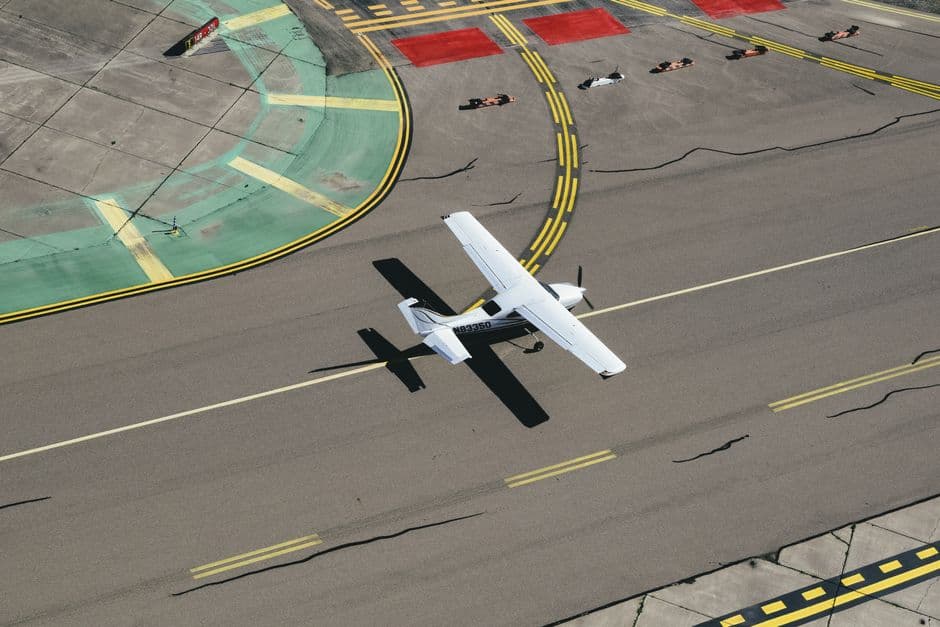
Shooting drone photos of an airplane you are trying to sell is a non-recreational operation under FAA rules. If you are wondering whether you need a Part 107 license to fly a drone for photos of an aircraft you are selling, the answer is yes if you intend to operate independently. You may also operate under the direct supervision of a qualified remote pilot in command who can immediately take control of the drone. The recreational exception does not cover flights specifically intended to produce marketing photos, even when you own the airplane, receive no payment, or already hold a commercial pilot certificate.
That is the short version. The longer version matters more, because the certificate is only the first of about five things standing between you and a legal aerial photo on an airport ramp. Here is how it actually works.
Do I really need a Part 107 license just to take photos of my own airplane?
Yes, if you intend to conduct the flight independently. The FAA draws the line at purpose, not at payment. Flying strictly for recreation falls under the limited recreational exception in 49 U.S.C. 44809. A flight specifically intended to produce marketing photos falls under 14 CFR Part 107 and must be conducted by, or under the direct supervision of, a qualified remote pilot with a small UAS rating.
The agency has used almost exactly this example for years. Its own guidance says that taking drone photos of your house to put it on the market is not recreational flying, because the flight supports a commercial transaction. An airplane is no different from a house in that respect. You are producing marketing material for an asset you intend to sell, and the FAA treats that as a non-recreational operation from the first takeoff.
A few corollaries catch people out. Your airline transport pilot certificate does nothing for you here; the remote pilot certificate is a separate credential under a separate part of the regulations. The fact that your buddy is pressing the sticks does not change anything either, unless a certificated remote pilot in command is supervising and can immediately take the controls. And "I'll shoot it for fun and decide later whether to use the pictures" is not a strategy the FAA has ever accepted — purpose is judged at the time of flight.
Good to Know: The same logic applies to a broker, a dealer, or a friend who shoots the photos as a favor. If the flight exists to help sell the airplane, it is a Part 107 operation regardless of whose name is on the bill of sale and whether money changes hands.
Why doesn't the recreational drone exception cover this?
Because the exception has eight conditions, and "flown strictly for recreational purposes" is the first one. Congress wrote that language deliberately. Under 44809, a recreational flyer also has to follow the safety guidelines of an FAA-recognized community-based organization, keep the aircraft within visual line of sight, give way to manned aircraft, get authorization before flying in controlled airspace, stay at or below 400 feet in uncontrolled airspace, and carry proof of passing The Recreational UAS Safety Test, known as TRUST.
TRUST is free and takes about half an hour online. It is not a license, and it is not a substitute for Part 107. If an inspector asks why you were hovering over a Bonanza on the ramp with a camera running and you answer "I'm listing it next week," the recreational exception has already evaporated.
Think of it the way you would think of a home kitchen. Nobody needs a permit to bake cookies for your own family. The moment you set up a table and sell them, you are in a different regulatory world — same oven, same recipe, different purpose. The FAA applies that test to drones almost word for word.
What does getting a Part 107 certificate actually involve?
One knowledge test, one online application, and a background check. You must be at least 16 years old, able to read, speak, write and understand English, and in a physical and mental condition to operate safely. There is no medical certificate and no flight test.
The exam is the Unmanned Aircraft General — Small (UAG) knowledge test, a 60-question multiple-choice test given at an FAA-approved PSI testing center. You need 70 percent to pass. The subject matter is roughly what a student pilot studies, narrowed down: airspace classes and chart symbols, weather products and reports, loading and performance, radio phraseology, aeronautical decision-making, emergency procedures, and the operating rules in Part 107 itself. If you already fly airplanes, you know most of the airspace and weather material; what you will have to learn is the regulation itself.
After you pass, you apply through IACRA using FAA Form 8710-13, the TSA runs a security vetting, and a temporary certificate is typically available within days once processing completes. The plastic card follows by mail. From then on you take free online recurrent training every 24 calendar months to keep your privileges current.
Pro Tip: Existing Part 61 pilots with a current flight review can skip the paid test entirely and take the free online "Part 107 Small UAS Initial" course through the FAA Safety Team site instead. If you hold a pilot certificate and have flown a flight review within the last 24 calendar months, that route costs nothing but an afternoon.
What does it cost, and is hiring a drone pilot cheaper?
For a single airplane sale, hiring someone is almost always cheaper and faster than certificating yourself. Getting your own ticket makes sense if you expect to shoot several aircraft, or you already fly and qualify for the free online course.
| Item | Typical cost (as of 2025) | Notes |
| UAG knowledge test at a PSI center | $175 per attempt | Waived if you hold a Part 61 certificate with a current flight review and take the free online course |
| Study materials or prep course | $0 to about $200 | The FAA publishes a free study guide and sample questions |
| IACRA application and certificate issue | No charge | Includes TSA security vetting |
| Drone registration | $5 per aircraft, valid 3 years | Under Part 107 every drone is registered individually, regardless of weight |
| Remote ID broadcast module for an older drone | Roughly $200 to $300 | Not needed if the drone has standard Remote ID built in |
| Recurrent training every 24 calendar months | Free | Online, through the FAA Safety Team site |
| LAANC airspace authorization | Free | Through an FAA-approved service provider |
| Further coordination or on-airport airspace authorization | Free; processing time varies, so apply well in advance | Submitted through FAA DroneZone |
| Drone liability insurance | On-demand hourly policies, or a few hundred dollars a year for $1 million of liability | LAANC further coordination for eligible off-airport flights; FAA DroneZone for on-airport operations requiring authorization |
| Hiring a certificated operator for a one-airplane shoot | Commonly a few hundred dollars in most U.S. markets | Confirm the operator holds a current Part 107 certificate and carries liability coverage |
Weigh that against the airplane. On a $90,000 Skylane, a few hundred dollars for photography is a rounding error next to what weak photos cost you in showings that never happen. On a $28,000 project airplane, your phone and a stepladder may be the right answer.
Flying411 keeps listings for comparable airframes in one place, so you can compare how other sellers are presenting the same model before you decide what your photos need to accomplish.
Can I legally fly a drone at an airport at all?
Yes, but where the airport sits in the airspace system decides how much paperwork you do first. Under 14 CFR 107.41, you may not operate in Class B, Class C, Class D, or the surface area of Class E airspace without authorization from air traffic control. Most of that authorization now flows through LAANC — the Low Altitude Authorization and Notification Capability — which issues near-instant approvals through FAA-approved service providers.
LAANC uses UAS Facility Maps, which show the maximum altitudes at which automated airspace authorizations may be granted near participating airports. A zero-foot grid does not automatically prohibit drone operations. For eligible off-airport flights, Part 107 pilots may submit a further coordination request through LAANC, including requests in zero-foot grids. However, controlled-airspace authorizations for operations on airport property, including ramp photography, must be requested through FAA DroneZone rather than LAANC. Apply well in advance and coordinate separately with airport management.
At a non-towered field in Class G airspace, Part 107 requires no airspace authorization at all. You still have to obey everything else, and two rules deserve particular attention on an airport: 107.37 requires you to yield right of way to all manned aircraft, and 107.43 prohibits any operation that interferes with operations and traffic patterns at an airport, heliport, or seaplane base. A drone hovering 60 feet over the transient ramp while somebody is on short final is a 107.43 problem even if the airspace itself is wide open.
Our breakdown of the FAA advisory circular on drone operations in controlled airspace walks through the authorization process in more detail, including what the facility maps are actually telling you.
Do I need permission from the airport or the FBO too?
Almost always, and it is a separate permission from the FAA's. The FAA controls the airspace above the field. The airport sponsor controls the ground — the ramp, the taxiway edges, the grass between them — through leases, minimum standards, and local rules. Plenty of airports prohibit drone launches from airport property outright, or route them through the airport manager.
Call the airport manager and your FBO before you plan the shoot, not the morning of. Expect to be asked for your remote pilot certificate number, your drone's registration, any required FAA airspace authorization, and proof of liability insurance. For on-airport operations requiring controlled-airspace authorization, apply through FAA DroneZone. Some fields will want a NOTAM issued or will simply give you a window between traffic. A tower may ask you to keep a radio on the field frequency and will want a phone number for the remote pilot in command.
A short, polite call also protects your reputation in a way the regulations never will. The other tenants on that ramp own expensive airplanes, and the sight of an unannounced quadcopter 20 feet from a turbine inlet generates complaints that follow you.
Heads Up: If your airplane is parked in a hangar you lease, moving it onto the ramp for photos may itself trigger a conversation with the FBO about ramp fees and positioning. Bundle that into the same phone call.
What rules apply while I'm actually shooting?
The operating limits in Part 107 Subpart B govern the whole flight. Under standard Part 107 rules, the drone must remain within visual line of sight and below a maximum groundspeed of 87 knots, or 100 mph. The altitude limit is generally 400 feet above ground level, although flight within a 400-foot radius of a structure may extend up to 400 feet above its uppermost point, subject to applicable airspace restrictions. Weather minimums include three statute miles of flight visibility from the control station, at least 500 feet below clouds, and at least 2,000 feet horizontally from clouds.
Registration is non-negotiable. Under Part 107, drones must be registered individually, even those weighing less than 250 grams, and the registration number must be displayed on the exterior. The Remote ID compliance deadline was September 16, 2023, although the FAA exercised enforcement discretion through March 16, 2024. Operators generally comply by using a Standard Remote ID drone, installing a compliant broadcast module, or operating within an FAA-Recognized Identification Area under its applicable restrictions. The FAA may also authorize specific deviations from Remote ID requirements.
Under 14 CFR Section 107.39, drone operations over people are restricted unless those individuals are directly participating in the flight, are protected by an adequate covered structure or stationary vehicle, or the operation meets an applicable Subpart D category or FAA waiver. On an airport ramp, keep line crew, prospective buyers and other bystanders outside the flight path. Simply briefing someone does not make them a direct participant in the drone operation. Night flying is permitted under Section 107.29 when the pilot meets the applicable training requirements and the drone has suitable anti-collision lighting visible for at least three statute miles.
Flying411 keeps selling guides, valuation articles and live aircraft listings in one place, so you can compare what a well-presented listing looks like against the one you are about to publish.
Will my aircraft insurance cover the drone flight?
No. Your airplane's hull and liability policy covers the airplane, not an unmanned aircraft you are operating nearby, and most policies carry exclusions that make that explicit. If your drone contacts a wingtip, a hangar door, or a person, you are exposed personally unless you bought coverage for the drone operation.
Drone liability coverage is easy to buy and cheap relative to the risk. On-demand policies sell by the hour through several carriers; annual policies with $1 million of liability commonly run a few hundred dollars. If you hire an operator, ask for a certificate of insurance naming you as an additional insured, and ask your FBO whether they want to be named as well. Many do.
Why this matters more for a seller than for a hobbyist: you are flying a camera around an airplane you are about to transfer to somebody else. A dent put in the leading edge during the photo shoot becomes a discrepancy in the pre-buy, a price concession, and sometimes a dead deal. For related exposure after the deal closes, read our guide on how to handle the tax side of an aircraft sale alongside your liability planning.
What happens if I skip the certificate and just fly?
The FAA can pursue civil penalties, and if you hold a pilot certificate it can also take action against that certificate. Enforcement for drone violations ranges from a counseling letter or remedial training for a first, low-harm mistake to substantial civil penalties for operations near manned traffic, over people, or in controlled airspace without authorization. The agency has publicized cases well into five figures where operators repeatedly flew in controlled airspace without clearance.
For a pilot who is also selling an airplane, the certificate exposure is the part that should sting. An enforcement action tied to a drone flight follows you into your next insurance renewal and your next medical application. It is a bad trade for a photo.
There is also a commercial cost. Buyers notice things. An aerial photo of an airplane on a towered field, posted by a seller with no remote pilot certificate, tells a sharp buyer something about how that seller treats rules in general — and the pre-buy inspection is the moment that impression gets expensive. Sellers already fight uphill on credibility when a runout engine or thin logbooks are part of the story; do not add to the pile for free.
Do aerial photos actually help sell an airplane?
Less than most sellers think. Buyers shopping a used airplane want evidence, not art: a clean three-quarter view from ground level in good light, straight-on shots of each side, close-ups of paint and glass, the panel from the pilot's seat, the interior from both doors, the engine compartment with the cowl off, the logbooks stacked and photographed open, and honest pictures of every flaw you know about.
An aerial adds one thing that ground shots cannot: the top of the airplane. Wing walk condition, the state of the paint on the upper surfaces, and the overall ramp presence of a big twin or a turboprop all photograph better from 50 feet up than from a ladder. That is a real benefit, and for a six-figure airplane it is worth the hassle. For a $45,000 trainer, a borrowed stepladder and an overcast afternoon will do nearly as much.
Spend the money where it changes the price. A fresh appraisal, a clear decision about whether to overhaul before selling, and organized, scanned records move buyers more than any camera angle. If you are still weighing how to sell at all, our comparison of trade-in versus private sale lays out which route rewards the extra marketing effort.
Quick Tip: Shoot in the first hour after sunrise. The ramp is empty, the light is soft enough to show paint condition honestly, and you are far less likely to conflict with traffic — which makes the airport manager's answer to your request a much easier yes.
At a Glance
If the photos exist to help sell the airplane, the flight is non-recreational. If you need a Part 107 license to fly a drone for photos of an aircraft you are selling, you must obtain a remote pilot certificate to operate independently or fly under the direct supervision of a qualified remote pilot. The TRUST test and an existing aircraft pilot certificate do not substitute for Part 107 certification. Getting certificated generally involves a knowledge test, an IACRA application, TSA vetting and free recurrent training every 24 calendar months. Eligible Part 61 pilots, excluding student pilots, may take the free online initial training course instead. Register the drone, comply with Remote ID and follow the applicable operating limits. Controlled-airspace authorization is required under 14 CFR Section 107.41, and on-airport authorization requests must go through FAA DroneZone rather than LAANC. Coordinate separately with airport management and the FBO, verify your insurance coverage, and never interfere with airport traffic or aircraft operations. For most sellers, hiring a qualified drone operator and focusing on honest ground-level photos and clean maintenance records is the practical answer.
Flying411 keeps single-engine, twin and turbine listings in one place, so you can compare asking prices, photos and equipment across the whole market before you set your own number.
When you are ready to compare listings, visitFlying411and see what is on the market today.