Flying a drone in the United States sounds simple. You pull it out of the box, charge the battery, and lift off. But the moment your drone leaves the ground, you are operating inside the national airspace system, and the FAA has a lot to say about that. In 2024 alone, the FAA estimated that drone pilots logged over 38 million flights across the country and every single one of those flights came with a rulebook attached.
Most pilots are surprised by how detailed the rules really are. It is not just "don't fly near airports." There is a full system of airspace classes, authorization tools, registration requirements, and safety rules that apply to every flight. The good news is that the FAA has published clear guidance to help you understand all of it. Once you know the basics, it gets a lot easier to navigate.
The starting point for that guidance is an official document called an advisory circular. It explains what the rules mean in plain language and walks you through how to follow them. Understanding what that document says, and how it applies to your flights, is exactly what this breakdown covers.
Key Takeaways
The FAA Advisory Circular on Drone Operations in Controlled Airspace tells pilots that flying in controlled airspace near airports requires prior authorization from the FAA. Both commercial and recreational pilots must use tools like LAANC or DroneZone to get that authorization before flying. All drones 0.55 lbs and over must also broadcast Remote ID during flight. Flying without authorization can lead to serious fines and loss of your drone pilot certificate.
| Topic | Key Detail |
| Governing Rule | 14 CFR Part 107 (Small UAS Rule) |
| Main Advisory Circular | AC 107-2A (updated 2022) |
| Controlled Airspace Classes | Class B, C, D, and surface Class E |
| Authorization Tools | LAANC (near-instant) or FAADroneZone (manual) |
| Max Altitude | 400 ft AGL in most cases |
| Class G Airspace | No prior authorization needed |
| Remote ID Enforcement | Full enforcement since March 16, 2024 |
| Recreational Flyer Rule | Must use LAANC or DroneZone for controlled airspace |
| Fines for Violations | Up to $75,000 per violation under 2024 FAA Reauthorization Act |
What Is an FAA Advisory Circular?
If you have spent any time researching drone rules, you have probably seen the term advisory circular come up. But what exactly is it?
An advisory circular (shortened to AC) is an official document published by the FAA. It explains how to follow the rules that already exist in aviation law. It is the FAA's way of saying, "Here is exactly what the regulation means, and here is how to do it right."
One thing to understand right away: advisory circulars are not laws by themselves. They do not create new rules. What they do is explain the rules already written in the Code of Federal Regulations. When an AC uses the word "must," it is pointing back to a regulation that already applies to you. Think of the AC as the instruction manual and the regulation as the actual law.
For drone pilots, the most important advisory circular is AC 107-2A. It was first published in 2016 as AC 107-2 and has been updated since, most recently in 2022. That update added important new guidance on Remote ID requirements, which are now fully enforced.
Here is what AC 107-2A covers:
- Remote pilot certification: who needs one and how to get it
- Drone registration and marking: rules for registering your aircraft with the FAA
- Airworthiness: keeping your drone in safe operating condition
- Operational rules: altitude limits, speed limits, visual line of sight requirements
- Airspace authorization: how and when you need permission to fly
- Remote ID: broadcasting your drone's identity during flight
There is also a separate advisory circular for recreational flyers, AC 91-57D. This one explains the rules under 49 USC § 44809, the law that covers hobby and recreational drone flying. If you fly just for fun, that document is your go-to reference.
Advisory circulars are not optional reading for serious pilots. They represent the FAA's official interpretation of the rules, and they are referenced in FAA knowledge tests. Drone pilots who understand the ACs are much better prepared to pass their exams, plan safe flights, and avoid enforcement actions.
The bottom line: advisory circulars are the clearest explanation of drone rules that the FAA publishes. Reading them is one of the best things any pilot can do before taking to the skies.
How Airspace Is Divided for Drone Pilots
One of the first things the small UAS rule teaches you is that not all airspace is treated the same. The FAA divides U.S. airspace into several classes, and each one has its own set of rules. As a drone pilot, knowing which class you are flying in determines what you need to do before you ever lift off.
Here is a simple breakdown of the airspace classes that matter most for UAS pilots:
Class A sits above 18,000 feet mean sea level. Almost no drone operations happen here. It requires instrument flight rules and is essentially off-limits for small UAS.
Class B is the busiest airspace. It surrounds the nation's largest and most active airports, including places like LAX, JFK, and O'Hare. This airspace is shaped like an upside-down wedding cake and extends from the surface up to 10,000 feet. Flying here requires prior authorization from the FAA before every flight.
Class C surrounds moderately busy airports. It typically runs from the surface up to 4,000 feet. Operations in controlled airspace here also require FAA authorization.
Class D covers smaller towered airports. It generally runs from the surface up to 2,500 feet. The same rule applies: you need authorization before flying.
Class E is a bit more complex. Some Class E airspace starts at the surface and is designated specifically for an airport. That surface-area Class E requires authorization just like Class B, C, and D. Other Class E airspace starts at higher altitudes and does not require authorization for drone flights below 400 feet. This distinction trips up a lot of pilots.
Class G airspace is uncontrolled. No prior ATC permission is needed for drone flights here up to 400 feet AGL. This is where the majority of recreational drone flights take place, over fields, parks, and open areas away from airports.
To figure out what class of airspace you are flying in, you use tools like the UAS facility map on the FAA website or a LAANC-enabled app. These maps show the maximum altitude the FAA may authorize around specific airports. A grid showing "0" means no automatic approval is available, so you will need to go through a manual process.
Understanding airspace classification is not just trivia. It directly determines what steps you need to take before your flight. Get this right, and the rest of the authorization process becomes much easier.
The Difference Between Controlled and Uncontrolled Airspace
Here is the question that trips up a lot of new drone pilots: what exactly makes airspace "controlled"?
Controlled airspace is any airspace where air traffic control (ATC) provides services to aircraft. That includes Class B, C, D, and the surface area of Class E airspace designated for an airport. In these areas, flights are monitored and coordinated to keep manned aircraft and drones from conflicting with each other. Flying a recreational drone in any of these areas without permission is a federal violation.
Uncontrolled airspace (which in the U.S. is Class G airspace) is airspace where ATC services are not provided. You do not need to contact anyone or get permission before flying here, as long as you stay at or below 400 feet AGL and follow the other rules of the small UAS rule. This is where most hobbyists do the bulk of their flying.
Now here is where it gets important for planning your flights.
What You Need for Controlled Airspace
Before flying in Class B, C, D, or surface Class E, you must get airspace authorization. There are two main ways to do that:
- LAANC (Low Altitude Authorization and Notification Capability): This is an automated system that gives drone pilots near-instant authorization in controlled airspace. It works through FAA-approved apps and is available at over 726 airports across the U.S. You submit your flight details, and in most cases you get approval within minutes. Both Part 107 commercial pilots and recreational flyers can use it.
- DroneZone: This is the FAA's manual authorization portal. You use it when the airport you want to fly near is not covered by LAANC, or when you need to request a flight above the altitude shown on the UAS facility map. Manual reviews can take days or even weeks, so plan ahead.
What You Do Not Need for Class G
In Class G airspace, authorization is not required before takeoff. However, you still need to follow all the other rules: maintain visual line of sight with your aircraft, keep your drone under 55 lbs and at or below 400 feet, and make sure your drone registration is current.
The Remote Pilot Certificate and Recreational Rules
A remote pilot certificate is required for all commercial flights under Part 107. If you are flying commercially and you skip the authorization step, you are out of compliance and putting your certificate at risk.
For a recreational flyer, the rules are similar but the path is slightly different. Recreational pilots must follow the guidelines of a community-based organization recognized by the FAA, complete the TRUST safety test, and use LAANC or DroneZone for any flight in controlled airspace. One important note: recreational pilots cannot apply for waivers like commercial pilots can. Their options are more limited.
A Word on Operations Over People
Even in uncontrolled airspace, operations over people have their own rules. Under Part 107, flying directly over people who are not part of your operation requires your drone to meet specific safety standards. This is a separate layer of rules from airspace authorization and applies no matter what class of airspace you are in.
Getting clear on the line between controlled and uncontrolled airspace is one of the most practical skills a drone pilot can develop. It determines your pre-flight checklist, your authorization steps, and your legal exposure on every single flight.
What the FAA Advisory Circular Says About Flying Your Drone in Controlled Airspace
So you have done the reading, you know your airspace classes, and now you want the practical answer: what does the advisory circular actually tell pilots to do? Let's walk through it step by step.
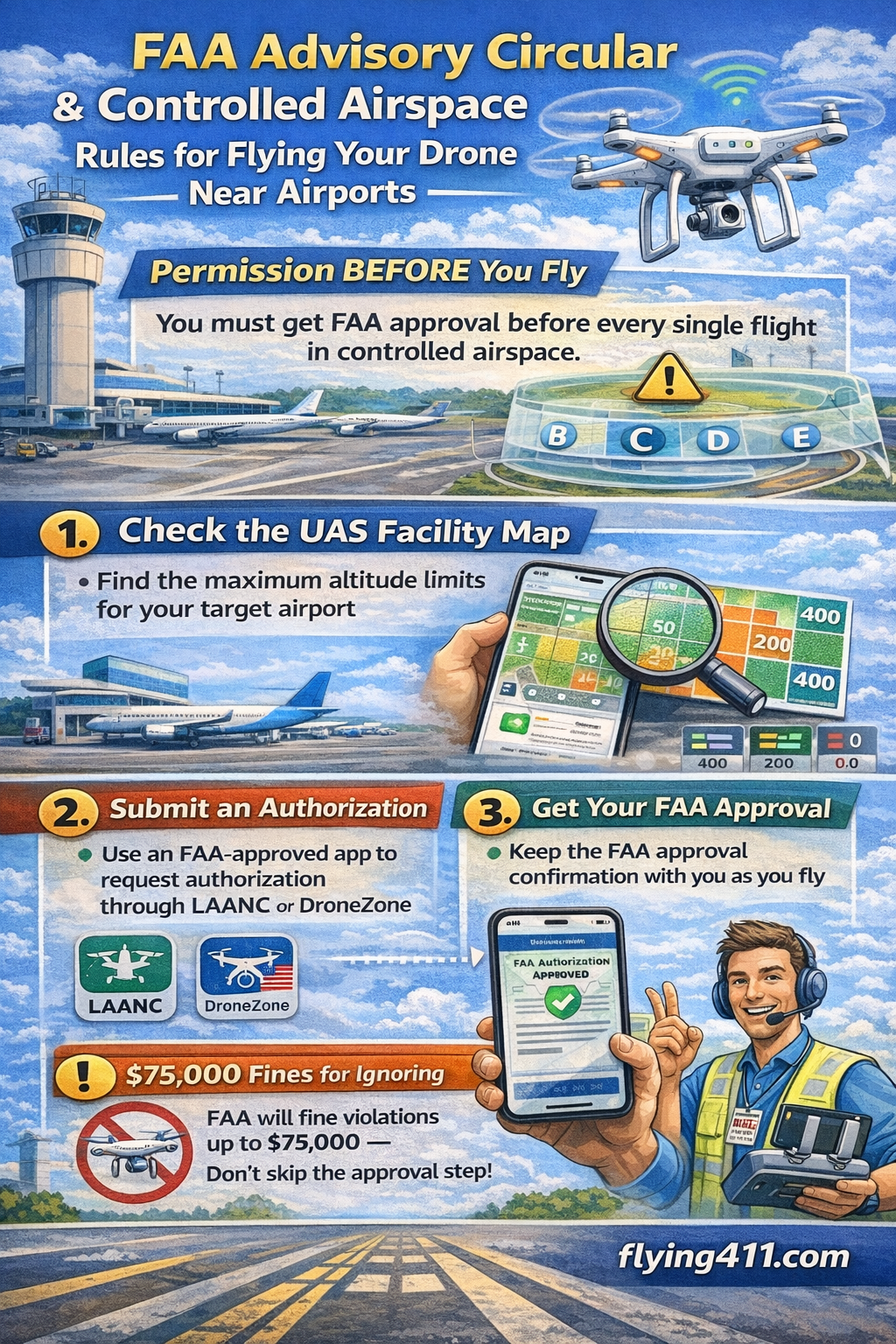
The core rule is simple. Flying a drone in controlled airspace requires permission from the FAA before every single flight. Not after. Not during. Before. That rule applies to commercial pilots, hobbyists, photographers, and inspectors alike. The AC makes this very clear, and the regulation behind it, 14 CFR § 107.41, backs it up with real enforcement teeth.
You Need Prior Authorization Every Time
Prior authorization is the foundation of legal drone operations near airports. If you are flying in Class B, C, D, or the surface area of Class E airspace designated for an airport, you must have active authorization in place before your aircraft lifts off.
The small UAS rule does not give pilots a pass for short flights, test runs, or one-minute hover sessions. The rule applies regardless of how long you plan to fly or how close the airport is. The FAA's position is consistent: airspace authorization protects manned aircraft and the people on the ground, and there are no informal workarounds.
Here is the good news. Getting airspace authorization has become a lot faster thanks to LAANC, the Low Altitude Authorization and Notification Capability. LAANC is a system built through a partnership between the FAA and private technology companies. Pilots use FAA-approved apps to submit a request, and in most cases, approval comes back in minutes. LAANC is available at over 726 airports across the country and works for both commercial and recreational pilots.
Before you submit any authorization request, your first stop should be the UAS facility map. This tool shows the maximum altitude the FAA may authorize around a specific airport, broken into grid squares. Each square has a number (50, 100, 200, or 400) that tells you your automatic approval ceiling. If the map shows zero for your area, LAANC cannot auto-approve your request. You will need to submit a further coordination request or use DroneZone, the FAA's manual authorization portal.
DroneZone is also the right tool when your target airport is not LAANC-enabled, when you need to request an altitude above the LAANC ceiling, or when you are applying for a Part 107 waiver. Manual DroneZone requests should be submitted at least 60 days in advance. Plan accordingly.
Rules for Part 107 Pilots
If you hold a remote pilot certificate and fly under Part 107, the AC gives you the clearest set of rules and the most operational flexibility.
Your drone registration must be active and current. All UAS weighing between 0.55 and 55 lbs must be registered with the FAA. The registration number must be marked on the aircraft and accessible during flight. Registration costs $5 and lasts three years. Skipping this step puts your operation out of compliance before you even launch.
One rule that catches pilots off guard is the visual line of sight requirement. You must be able to see your drone with your own unaided eyes throughout the entire flight. A camera feed on your phone does not count as maintaining visual line of sight. A spotter standing next to you and watching the aircraft can help, but the remote pilot in command is still responsible for safety at all times. This rule exists to protect the broader national airspace system and the manned aircraft sharing that space with you.
Part 107 also sets clear standards for how pilots must interact with air traffic control in certain situations. Understanding your full range of responsibilities as a pilot and aircraft operator matters here. The Compliance Rules: What Is the Responsibility of Aircraft Owner guide covers those accountability layers in detail for pilots who want the complete picture.
Rules for Recreational Flyers
A recreational flyer flies under a different legal framework from a Part 107 commercial pilot. The governing law is 49 USC § 44809. The related advisory circular is AC 91-57D, and it applies specifically to hobbyists and model aircraft operators.
One of the most important requirements for recreational pilots is following the safety guidelines of a community-based organization recognized by the FAA. The Academy of Model Aeronautics, commonly called the AMA, is the best-known example. Following CBO guidelines is a condition of flying recreationally without a Part 107 certificate.
Here is something that surprises many new recreational drone pilots: the airspace authorization requirement applies to them too. Flying for fun does not exempt anyone from getting approval before entering controlled airspace. Recreational pilots must use LAANC or DroneZone for every flight in Class B, C, D, or surface Class E airspace, same as commercial pilots.
The key limitation for recreational flyers is that they cannot apply for waivers. A commercial pilot can request permission to fly beyond visual line of sight or in other non-standard scenarios. A recreational pilot has no such option. If your flying goals grow beyond what recreational rules allow, earning a Part 107 certificate is the next step. For a full breakdown of what that path looks like and what other license options exist in aviation, the Pilot License Types and Requirements: Full Breakdown Guide walks through every certification level from student pilot to airline transport pilot.
Operations Over People Are a Separate Matter
Getting your airspace authorization sorted does not automatically clear you to fly a drone directly over crowds. Operations over people have their own distinct set of rules under Part 107, and they apply in every airspace class, including Class G airspace where no authorization is otherwise needed.
The Part 107 framework divides drones into four categories for this purpose:
- Category 1: Drone weighs 0.55 lbs or less with no exposed rotating parts that could cut skin
- Category 2: Drone meets specific injury-risk standards, no Declaration of Compliance required from operator
- Category 3: Drone meets a separate injury-risk standard and can fly over people under specific operational conditions
- Category 4: Drone holds an FAA airworthiness certificate, similar to manned aircraft standards
Your aircraft must qualify for the category that matches your intended operation. Flying a Category 3 drone over an open crowd without meeting the required conditions is a violation, even if your airspace authorization is valid. The two sets of rules work independently, and both must be satisfied.
What Happens When Pilots Skip the Steps
The FAA has significantly stepped up enforcement of airspace rules. Real fines from recent years include $36,770 for flying near emergency aircraft during a wildfire, $20,371 for unauthorized flight in restricted airspace, and $14,790 for flying near a stadium during the Super Bowl. Under the FAA Reauthorization Act of 2024, the most serious violations can now result in fines up to $75,000 per incident.
The point is not to scare anyone away from flying. Drones are incredible tools, and the authorization process is genuinely fast for most operations. The point is that skipping the steps carries real consequences. A quick LAANC check before launch takes about three minutes and keeps your flying career intact.
FAA Drone Rules That Apply No Matter Where You Fly
Some rules follow you into every airspace class. These are the baseline requirements for all drone pilots under Part 107:
- Weight limit: Your drone must weigh under 55 lbs total
- Altitude: Stay at or below 400 feet AGL, unless flying within 400 feet of a structure (then you can fly up to 400 feet above the structure's highest point)
- Speed: Maximum 100 mph (87 knots)
- Visual line of sight: You or a visual observer must be able to see the drone at all times
- Daylight only: Flights must happen during daylight or civil twilight, and anti-collision lighting is required for twilight operations
- Yield to manned aircraft: Always give way to crewed aircraft
- No careless or reckless operation: You are responsible for the safety of every flight
- Incident reporting: Any crash that results in serious injury or property damage over $500 must be reported to the FAA within 10 days
These rules apply in Class G, Class B, Class C, and Class D airspace. Everywhere. Airspace authorization addresses where you can fly. These rules address how you must fly.
How to Stay Compliant as the Rules Keep Changing
Drone regulations are not static. The FAA updates its rules regularly, and what was allowed two years ago may require a waiver today. Staying current is part of being a responsible pilot.
Here are the best habits to build:
- Check the UAS facility map before every flight: airspace designations can change, and new restrictions appear regularly
- Renew your recurrent training every 24 months: Part 107 pilots must complete recurrent training to keep their certificate active
- Monitor FAA NOTAMs: Notices to Airmen can temporarily restrict airspace for events, emergencies, or military operations
- Keep your drone registration current: registrations expire every three years and cost $5 to renew through the FAA
- Follow the FAA's B4UFLY app: this free tool shows real-time airspace conditions and restrictions at your current location
- Watch for BVLOS rule changes: the FAA is working on a new Part 108 framework for beyond visual line of sight operations, which will significantly expand what commercial operators can do
The regulatory environment for drones is expanding. The FAA's goal is to integrate more drone operations into the national airspace safely, and new tools and approvals are coming. Keeping up with those changes keeps you ahead of the curve and out of trouble.
Conclusion
Flying a drone in the United States is one of the most accessible forms of aviation ever created. But it comes with real responsibilities, and the rules around FAA Advisory Circular on Drone Operations in Controlled Airspace are some of the most important ones to understand. From knowing your airspace class to getting authorized through LAANC before your flight, these steps are not optional; they are what separate a safe, legal operation from a very costly mistake.
The good news is that the FAA has built solid tools to make compliance easier. LAANC gives you near-instant approvals. The UAS facility map shows exactly where you can fly and at what altitude. And advisory circulars like AC 107-2A lay out the rules in plain language. You have everything you need to do this right.
Stay curious, stay current, and always pre-check your airspace before you fly. For more detailed guides, tools, and resources for pilots and drone operators across general aviation, visit Flying 411 your go-to source for everything aviation.
Frequently Asked Questions
Can I fly my drone in a national park?
No. The National Park Service banned drone takeoffs, landings, and operations inside national parks in 2014 under 36 CFR 1.5. This applies regardless of airspace class. You must get special permission from the park's superintendent, which is rarely granted.
Do I need a drone pilot license to fly recreationally?
No formal license is required for recreational flying. However, you must pass the free TRUST (The Recreational UAS Safety Test) and carry proof of completion when you fly. You also need to register your drone if it weighs 0.55 lbs or more.
What is a FRIA and who can fly there?
A FRIA (FAA-Recognized Identification Area) is a designated location, usually a flying club or school, where drones without Remote ID can legally operate. FRIAs are approved by the FAA and sponsored by community-based organizations. You must stay within the FRIA boundaries during your entire flight.
Can I fly my drone over private property?
There is no specific federal law prohibiting flight over private property from an airspace standpoint. However, state and local laws vary, and hovering over someone's property repeatedly could raise privacy and harassment concerns. Always be respectful and check local ordinances before flying near private land.
What happens if a TFR is active over my flight area?
A Temporary Flight Restriction (TFR) grounds all aircraft including drones in the affected airspace unless you have specific authorization. Flying in an active TFR is a serious violation. Always check for TFRs using the FAA's TFR map or a LAANC-enabled app before every flight.