You're sitting at your gate, boarding pass in hand, when the departure board flickers. Your flight disappears. Every flight disappears. The airport just shut down and nobody saw it coming. It happens more often than most people realize, and when it does, the ripple effect moves fast. Airlines scramble. Crews get stuck. Thousands of stranded passengers fill the terminal with questions nobody can answer yet.
But behind the scenes, a very organized and surprisingly complicated response kicks into gear. Airlines don't just sit and wait. They have playbooks, backup crews, and teams of specialists working around the clock to untangle the mess. The challenge is that the mess doesn't stay in one place.
A single shutdown can send problems spreading across an entire airline network within hours. In fact, when the FAA's NOTAM system failed on January 11, 2023, every domestic departure in the United States was grounded at once — delaying more than 6,900 flights and disrupting nearly 2.9 million passengers in a single day.
The story of what happens next involves a lot of moving parts, literally. Aircraft are sitting on runways in the wrong cities. Crew members have run out of legal flying time. Passengers need hotels, meals, and new flights. And every minute costs money. Understanding how airlines handle all of this gives you a much clearer picture of why recoveries take as long as they do and what you can expect as a traveler the next time a closure turns your travel plans upside down.
Key Takeaways
When an airport suddenly closes, airlines activate their Operations Control Center to manage the situation. They reposition aircraft, call in reserve crew, rebook passengers, and in severe cases cancel large blocks of flights just to reset the network. Passengers may be entitled to rebooking and meals depending on the cause, but hotels and cash compensation depend on the airline's policy and whether the disruption was within the airline's control.
| Key Takeaway | Quick Detail |
| Who manages the response | The airline's Operations Control Center (OCC) |
| Main crew challenge | FAA duty time limits force mandatory rest even mid-disruption |
| How crew get repositioned | Via deadhead flights, flying as passengers on assignment |
| How aircraft get repositioned | Ferry flights, aircraft swaps, or re-routing |
| What passengers are owed | Refunds are guaranteed; meals/hotels depend on the airline and cause |
| Worst-case airline move | Canceling hundreds of flights to "reset" the network |
| How long recovery takes | Hours to several days depending on scope |
Airports Don't Always Close With Warning
Most people think of an airport closing the way they think of a store closing. A sign goes up, doors lock, everyone knows ahead of time. Real life in aviation doesn't work that way. Airports can go from fully operational to completely shut down in a matter of minutes, and the reasons vary widely.
Weather is the most common trigger. A fast-moving storm, heavy snow, dangerous wind shear, or thick fog can make it impossible to land or take off safely. But here's something most travelers don't know. Even a storm in a completely different city can close your airport. If aircraft that were supposed to fly into your city are stuck elsewhere, your airport loses its incoming flights. No planes arrive, so no planes depart.
Beyond weather, airports can close for reasons that have nothing to do with the sky at all:
- Security threats -- A credible threat, a suspicious package, or a breach of the secure area can trigger an immediate lockdown
- Military activity or VIP movement -- When the President travels, the FAA issues a Temporary Flight Restriction (TFR) that can make entire airports unusable for a window of time
- Physical damage -- Runway damage, a disabled aircraft blocking the taxiway, or even a reported drone strike can make operations unsafe
- System failures -- In January 2023, a damaged file in the FAA's NOTAM system triggered a nationwide ground stop, delaying more than 6,900 flights in a single day
- Airspace conflicts -- Geopolitical events can close entire regions of airspace, forcing aircraft to reroute around them or stay on the ground
When any of these events happen, pilots and airlines find out through a system called a NOTAM, which stands for Notice to Air Missions. NOTAMs are urgent messages that go out to all aviation personnel, alerting them to hazards, restrictions, or changes to airports and airspace. A TFR works similarly, carving out restricted zones where aircraft are not allowed to fly.
The key thing to understand is timing. Some closures come with a few hours of warning. Others are instant. A security incident, a sudden storm, or a physical threat to the runway can flip the switch with almost no notice at all. And unlike a delayed flight, a full airport shutdown doesn't come with a clear end time. That uncertainty is what makes the airline response so difficult to manage and so important to get right.
One Closure Can Disrupt Hundreds of Flights
When one airport closes, the problem almost never stays in that city. Airlines operate interconnected networks where every flight feeds into the next. Aircraft fly point-to-point routes. Crew members work multi-day trip sequences that span several cities. Baggage, fuel, maintenance teams, and gate assignments are all lined up in advance. Pull one piece out, and the whole chain starts to wobble.
Think of it this way. A plane leaving Chicago is supposed to arrive in Atlanta, where it will then fly to Dallas. If Chicago closes, that Atlanta flight never happens. The Dallas flight doesn't happen either. The crew that was supposed to work the Dallas leg is now waiting at a gate with nothing to fly. Meanwhile, passengers on all three routes are stuck, and the aircraft that was supposed to cycle through those cities is sitting idle.
This is called the cascading effect, and it's the main reason why a single disruption can spiral into something much larger:
- Every delayed or canceled arrival means a delayed or canceled departure somewhere else
- Crew members who were supposed to take over a flight are now in the wrong city
- Aircraft that were supposed to be serviced at a hub maintenance facility miss their slot
- Connecting passengers miss their next flights, triggering a second wave of rebooking requests
- Gate availability shrinks as parked aircraft pile up with no clearance to move
The most dramatic example of this in recent memory is the Southwest Airlines meltdown in December 2022. Winter Storm Elliott pushed the airline's scheduling system past its breaking point. Southwest's crew-tracking software couldn't reassign crew members fast enough to keep up with the volume of changes. The airline lost track of where its crews were. What started as weather-driven delays turned into more than 16,700 cancellations over ten days, roughly 2 million stranded passengers, and over $820 million in losses, plus a $140 million government fine.
That wasn't just a weather story. It was a network collapse story. The storm started the chain reaction, but the real damage came from the airline's inability to recover its crew positions fast enough.
Larger airlines with bigger hub networks and more reserve resources tend to recover faster. Smaller carriers with leaner operations can struggle more when a key airport goes down, simply because they have fewer backup options available. But no airline is immune. When an airport closes without warning, every carrier in that network feels it, and some just feel it harder and longer than others.
Crew Have Legal Time Limits, and Closures Blow Right Through Them
Here's something most passengers never think about. Pilots and flight attendants can't just keep working indefinitely. The FAA sets strict rules on how long crew members can be on duty before they must stop and rest. These rules exist for good reason, as fatigue is a serious safety risk in the air. But those same rules become a major operational problem the moment an airport shuts down unexpectedly.
Every crew member works within what's called a flight duty period, which is the total window of time they're allowed to be on active duty from the moment they report for work. Under FAA Part 121 rules, which govern commercial airline operations:
- Crew members must receive a minimum of 10 consecutive hours of rest before a new duty period begins
- This 10-hour minimum cannot be reduced, even during declared irregular operations
- A crew member who reaches the end of their duty period must stop, regardless of what's happening at the airport
- If a crew member reports feeling too fatigued to fly safely, they have the legal right to decline the assignment
So here's what that looks like in practice. A crew is sitting at a stranded terminal, waiting for their airport to reopen. Their duty clock is still running. The airport reopens, but their legal flying window has expired. They've "timed out." The aircraft is ready. The gate is open. But that crew cannot legally operate the flight. A replacement crew must be found before that plane moves an inch.
This is often the passenger's biggest source of frustration because it looks like nothing is wrong. The plane is right there. The weather has cleared. But the airline is scrambling to find a legal crew, and that process takes time.
When crew time out at a diverted or stranded airport, airlines have a few options:
- Fly in a fresh crew via deadhead, repositioning rested crew members as passengers on an incoming flight
- Source local crew if any are available and qualified for that aircraft type
- Continue to hold the aircraft until the original crew completes their mandatory rest period
The rest requirement also means that even after a closure ends, the aviation recovery doesn't happen all at once. Crews need time to rest before they're legal to fly again. That's why an airport that reopens at noon might not see fully normal operations until the following morning or later.
This crew timing issue is often the hidden reason why a flight stays canceled or delayed long after the original problem has been resolved. The shutdown is over. The skies are clear. But the people who fly the planes are legally required to sleep first.
How Airlines Respond When an Airport Suddenly Shuts Down
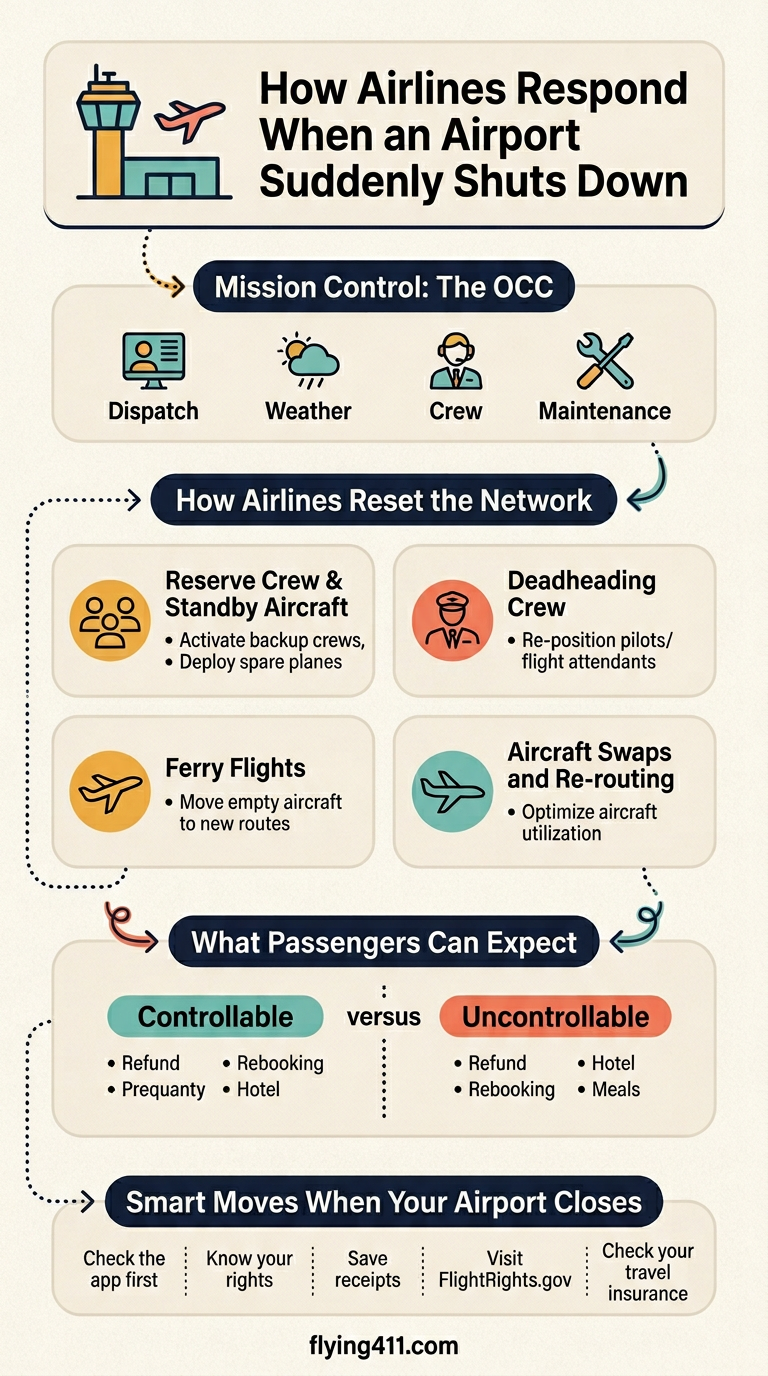
When an airport closes without warning, the first place that springs into action isn't the gate. It's the airline's Operations Control Center, or OCC. Think of it as mission control for the entire airline network. The OCC runs 24 hours a day, seven days a week. It's staffed by dispatchers, meteorologists, crew controllers, and maintenance coordinators. The moment a shutdown hits, this team starts making decisions fast.
The goal is straightforward: get aircraft, crew, and passengers back into position as safely and quickly as possible. The methods to get there, though, are anything but simple.
Activating Reserve Crew and Standby Aircraft
Every airline keeps a pool of reserve crew members, pilots and flight attendants who are on call specifically for situations like this. When a major disruption hits, the OCC calls in reserves to cover stranded routes and replace crew members who have timed out on their duty periods.
Airlines also maintain standby aircraft at key hub airports that can be deployed when a scheduled plane gets stuck somewhere else. These aren't just sitting around collecting dust. They're maintained, fueled, and ready to go on short notice.
Deadheading Crew Back Into Position
When reserve resources run thin, airlines move crew members through a process called deadheading. This means putting a pilot or flight attendant on a flight as a passenger, on company assignment, to get them to the city where they're needed next.
A few important things to know about deadheading:
- The crew member is not working that flight. They're riding it to reach their next assignment
- It's a confirmed, paid seat, not standby
- Deadhead time counts toward the crew member's duty period limits
- Most airline contracts pay crew members between 50% and 75% of their normal hourly rate during a deadhead segment
This is one of the less obvious costs airlines absorb during a major closure. Repositioning crew takes time, confirmed seats, and money, all at once.
Ferry Flights: Moving Aircraft Without Passengers
Sometimes the aircraft itself needs to move before anything else can happen. A ferry flight is an unscheduled repositioning flight that carries no revenue passengers, just the crew needed to move the plane. Ferry flights are expensive and not used lightly. But in a severe closure, they're sometimes the only way to get the right plane to the right place.
Aircraft Swaps
The OCC may reassign a different aircraft to cover a stranded route if one is available and nearby. This sounds simple, but it requires matching the right aircraft type to qualified crew. Pilots are certified on specific aircraft models. A captain certified on a Boeing 737 cannot simply jump into an Airbus A320 without proper training and certification. So the swap has to line up on both ends, the right plane and the right people.
Re-Routing Around Closed Airspace
When the closure involves airspace rather than a single airport, airlines may reroute flights around the restricted area entirely. This adds flight time, burns more fuel, and can push crew members closer to their legal duty limits. Some long-haul flights in this situation may require an extra crew member, or an unplanned fuel stop at an intermediate airport.
For context on how serious in-flight situations are managed, including what happens when systems fail at altitude, What Happens If a Plane Loses Power: A Simple Guide for Passengers breaks down exactly what pilots do and why the outcome is almost always safe.
Canceling in Bulk to Reset the Network
In the most severe cases, airlines make the difficult decision to cancel a large block of flights on purpose. The goal is to stop the growing backlog, get crew and aircraft back to their home bases, and rebuild the schedule from a clean starting point.
This is what happened during Southwest's December 2022 meltdown. The airline eventually canceled over 50% of all its flights across three straight days, not because of the storm alone, but to physically move crew members back to where the schedule needed them to be. It's a last resort. But sometimes a controlled reset is faster than trying to untangle thousands of individual problems at once.
Throughout all of this, the OCC stays in constant contact with air traffic control, airport authorities, ground handlers, and maintenance teams. The experience stranded passengers have at the gate depends heavily on how well that coordination works behind the scenes.
What Passengers Can Expect, and What Airlines Are Required to Do
Standing in a packed terminal with a canceled flight and a very long service desk line is nobody's idea of a good time. Knowing your rights before that happens is genuinely useful, and unfortunately, not many travelers do.
The Key Legal Split: Controllable vs. Uncontrollable
US airlines draw a clear line between disruptions they caused and ones they didn't. A cancellation due to a maintenance problem, crew scheduling error, or IT failure is considered "controllable" by the airline. A closure caused by weather, a security event, or a military TFR is generally considered "uncontrollable."
That one word, controllable, changes almost everything about what you're owed.
Here's how it breaks down for domestic travel:
| Situation | What You're Entitled To |
| Any cancellation or major change | Full refund if you choose not to travel |
| Controllable cancellation | Free rebooking + meal voucher (all top 10 US airlines) |
| Controllable overnight delay | Hotel + ground transport (9 of top 10 US airlines) |
| Weather or security closure | Refund guaranteed; meals/hotels at airline discretion |
| Cash compensation | Not required under current US law |
Rebooking: What the Airlines Have Committed To
All 10 major US airlines have committed to free rebooking on their own flights when the airline is at fault. Six of those will also rebook you on a competing carrier if their own flights aren't available within a reasonable timeframe. You can check exactly what your airline has promised at FlightRights.gov, a real government website that's actually helpful.
For passengers on flights that touch European routes or operate under EU-based carriers, EC 261 rules may apply. Under those rules, qualifying passengers can receive up to 600 euros in cash compensation when the airline is at fault, plus mandatory meals, accommodation, and transport to the hub or hotel. US law currently has no equivalent cash compensation requirement. A proposed rule that would have changed was officially withdrawn in November 2025.
What You Should Actually Do When Your Airport Closes
Don't wait in line first. Pull out your phone and open the airline's app. Most airlines unlock rebooking options digitally faster than they update the gate agents. Here's a practical checklist:
- Check the app immediately -- many waivers and rebooking options appear there first
- Visit FlightRights.gov to see exactly what your airline has committed to
- Save every receipt -- meals, hotels, transportation -- even if the airline isn't required to cover them right now
- Ask about vouchers -- many airlines offer goodwill meal or hotel vouchers during weather closures even when they aren't required to
- Document everything -- screenshots of cancellation notices, times, and any communication from the airline are useful if you need to file a claim later
One more thing worth knowing. Aviation closures are classified as "extraordinary circumstances" under most travel insurance policies. If you have trip interruption or travel delay coverage, a sudden airport closure may be exactly the kind of event your policy is designed for. It's worth checking your coverage before your next trip, not after the departure board goes dark.
For travelers curious about how different types of aircraft operate in non-commercial settings, How Do Private Planes Work at Airports? A Simple Guide to Private Jet Operations covers how private aircraft move through airports very differently than commercial flights, including during disruptions.
The aviation system is built to recover. It doesn't always move as fast as passengers hope. But knowing how the process works and what you're actually owed puts you in a much stronger position the next time a closure turns your travel day upside down.
Conclusion
Airport closures are one of those travel situations that feel completely random, but they're actually something airlines prepare for constantly. The moment a stranded aircraft and crew situation develops, a trained team starts working to untangle it. Reserve crews get called up. Aircraft get repositioned. Deadhead flights get booked. And in the worst cases, hundreds of flights get canceled just to give the network a chance to breathe and reset.
As a traveler, the most useful thing you can do is understand how the system works. Know the difference between what airlines are required to give you and what they offer as a courtesy. Know that crew rest rules are a real operational constraint, not an excuse. And know that the delay on the board often reflects a problem that started several cities away.
For more guides on how aviation works, from how aircraft are maintained to what pilots deal with on every flight, visit Flying411. We keep it simple, accurate, and useful for anyone who flies.
Frequently Asked Questions
What is a "ground stop" and how is it different from an airport closure?
A ground stop is a temporary FAA measure that holds flights at their departure airport to manage traffic flow into a specific area. It doesn't fully close an airport but prevents new aircraft from departing for a set destination. A full airport closure stops all arrivals and departures at that location.
Can an airline leave passengers on a plane during an airport closure?
Airlines must follow FAA tarmac delay rules. For domestic flights, passengers must be allowed to deplane after three hours on the tarmac. For international flights, the limit is four hours. Airlines that violate these rules face significant fines from the DOT.
What happens to checked baggage when a flight is canceled due to a closure?
Checked bags are typically held at the originating airport or returned to baggage claim. If you are rebooked on a new flight, most airlines will transfer your bags automatically. Always confirm with the airline that your bags are accounted for before leaving the airport.
Is travel insurance worth it if you're worried about airport closures?
Travel insurance that includes trip interruption or travel delay coverage can reimburse you for meals, hotels, and rebooking costs that airlines aren't required to cover, especially during weather or airspace-related closures. It's worth comparing policies before any major trip.
Do airline crew members get paid while they are stranded waiting for an airport to reopen?
Yes. Crew members continue to be compensated during disruptions based on their contract terms. Time spent waiting at a stranded airport counts toward their duty period. Once they time out, mandatory rest kicks in, and the airline is responsible for providing hotel accommodations while they wait.