A missile strike happens in the Middle East. Within hours, a flight from London to Singapore is taking a completely different path. It adds two to three extra hours. It burns thousands more gallons of fuel. The passengers may not even know why. All they know is that a flight attendant just told them there is an unplanned stop in Athens.
This is what happens when middle east airspace closes. It does not only affect flights going to or from the region. It hits flights that were never planning to land there at all. The 2026 Middle East conflict grounded over 52,000 flights in its first three weeks alone, stranding more than 100,000 passengers within just the first 72 hours.
The Middle East sits in the middle of one of the world's busiest flight paths. That path connects Europe to Asia. When it closes, the impact spreads across the entire global aviation network.
The good news is that airlines are not caught off guard. They have systems, teams, and backup plans ready. Knowing how those systems work explains why a flight from Frankfurt to Bangkok might detour over Turkey or Egypt, and why that detour costs far more than just a little extra time.
Key Takeaways
When Middle East airspace closes, airlines use real-time safety notices called NOTAMs to find out which countries have shut their skies. Operations teams then plan new routes around the closed areas. They pick either a northern path over the Caucasus or a southern path through Egypt and Saudi Arabia. These detours add hours to flights and raise fuel costs. Airlines also need permission to fly over any new country on the new route. That takes time to arrange. After the airspace reopens, recovery can take several more days as planes and crews get moved back into place.
| Key Takeaway | Detail |
| What triggers a closure | Military conflict, missile strikes, or government order |
| How airlines find out | NOTAMs (Notice to Airmen) issued by aviation authorities |
| Two main detour paths | Northern (via Caucasus/Turkey) or Southern (via Egypt/Saudi Arabia/Oman) |
| Extra time added | 2 to 5 hours depending on the route |
| Extra fuel burned | Thousands of additional gallons per flight |
| Who is most affected | Gulf-based carriers like Emirates, Qatar Airways, and Etihad |
| Recovery time | Days, even after airspace reopens |
The Middle East Is a Bridge in the Sky
The Middle East is one of the most important regions in global aviation. Flights between Europe and Asia have gone through this region for decades. It is the most direct path. It saves airlines hours of flying time. That means millions of dollars in fuel savings every year.
Three major airport hubs sit at the center of this system:
- Dubai International Airport, the busiest international airport on the planet
- Hamad International Airport in Doha
- Zayed International Airport in Abu Dhabi
These airports are not just large. They are the connecting points for hundreds of flights every day. Carriers like Qatar Airways, Etihad Airways, and Emirates built their business around this location. A passenger flying from London to Sydney, or from Paris to Mumbai, often connects through one of these three airports.
Aviation consultant Tony Stanton called the Middle East a "high-capacity bridge" between Europe and Asia. Half a million passengers pass through Gulf hubs each day. Many of them are making connecting flights. They are not just local travelers. They are people moving between continents.
The countries that sit in this key zone include Iran, Iraq, Kuwait, Bahrain, and the UAE. Their airspace is not just national territory. It is shared infrastructure that the whole world depends on. Iran's airspace sits above some of the heaviest flight paths on Earth. When any of these countries close their skies, thousands of flights are affected right away.
The Middle East is not just a destination. It is a pass-through zone. A middle east flight operated by a European carrier may carry no passengers going anywhere near the region. But that plane still needs to cross the airspace to reach its destination. When that path closes, every carrier using it has to find a new way around.
Here is what the impact looks like in practice:
- Europe to South Asia routes get longer by 2 or more hours
- Europe to Australia flights may need extra refueling stops
- Cargo routes are disrupted, which delays shipments
- Airline schedules fall apart as planes end up in the wrong cities
The Middle East became this important through decades of investment by Gulf states. They built world-class airports and airlines. That investment made the region essential to global travel. When conflict hits, the whole world feels it.
How Airlines Know When Airspace Is Closed
Airlines do not learn about airspace closures the same way most people learn about news. They do not check their phones. There is a formal global system built for this. It is called the NOTAM system. NOTAM stands for Notice to Airmen.
A NOTAM is an official alert from a government aviation authority. It tells pilots, dispatchers, and operations teams about anything that could affect a flight. That includes a closed runway, a broken navigation aid, or an entire country shutting its airspace to civilian aircraft.
Here is how the process works:
- A government or military authority closes its airspace
- That authority contacts its national aviation office
- The aviation office sends a NOTAM through the ICAO network
- The NOTAM goes out to aviation databases and flight planning systems worldwide
- Airline dispatchers get the NOTAM almost right away
ICAO is the International Civil Aviation Organization. It sets global standards for this process. Every country in international aviation is connected to the same network. So when Iran closes its airspace, a dispatcher at British Airways in London and one at Air India in Mumbai get the same alert at the same time.
Every major airline has an Operations Control Center, also called an OCC. It runs 24 hours a day. It is staffed by:
- Dispatchers who track every flight in the network
- Weather experts who monitor conditions on all routes
- Maintenance teams watching each plane's status
- Security and communications staff
When a NOTAM comes in, the OCC team gets to work fast. They do not wait. They start planning new routes right away. Flight plans get updated. Fuel loads get adjusted. Crew schedules get reviewed. All of this happens before most passengers even check the departure board.
Some airlines use risk-monitoring tools to spot trouble early. They watch conflict zones around the world. They plan backup routes before a closure is even official. So when a situation gets bad, the new flight plan is already ready to go.
Another key tool is the ESCAT system. ESCAT stands for Emergency Security Control of Air Traffic. When it is turned on, air traffic control takes full charge. Flights may be told to land right away, hold in place, or avoid entire sections of the sky.
The February 2026 airspace closures showed how fast this system moves. Within hours of strikes beginning, NOTAMs went out for Iran, Iraq, Kuwait, Bahrain, and parts of the UAE. Airlines were already planning new routes. Planes already in the air changed course in real time.
Airlines Can't Just Pick Any Route They Want
Here is something many people do not know. An airline cannot just pick a new path on a map and go. Every country controls its own airspace. To fly through another country's airspace, an airline needs permission. Every single time. No exceptions.
This is called an overflight permit. Without one, a plane cannot legally, or safely, enter that country's airspace. Air traffic controllers will not accept the flight plan. The plane simply cannot go that way.
Aviation analyst Tony Stanton put it clearly. He said airlines need permission to fly over each country's airspace. They can only use airspace that is open and managed by air traffic control.
So when the Middle East closes, an airline looking for a new corridor has to take these steps:
- Find out which new countries the detour would cross
- Apply for overflight permits from each of those countries
- Wait for approval, which can take minutes or hours
- Update the flight plan with the new route
- Recalculate how much fuel is needed
- Make sure the crew has enough legal flying hours left
For countries like Saudi Arabia and Oman, which sit on the southern bypass route, the permit process became very important during the 2026 disruption. Oman opened its airspace as a key stop, but airlines still needed proper approval to use it. For flights into UAE airports, airlines had to get a No Objection Certificate from the UAE's aviation authority. Response times were sometimes under 60 minutes. But that still adds time to an already complex process.
The northern detour through Turkey and the Caucasus has its own permit challenges. Planes going through Azerbaijan, Armenia, or Afghanistan need clearances from each country. Afghanistan charges a flat fee for overflight permits. Even during a global crisis, the paperwork keeps coming.
There is also a capacity problem. A corridor that normally handles a small share of traffic suddenly gets flooded with extra flights. All of them are trying to use the same narrow path at the same time. Air traffic controllers in those countries have to manage a surge they did not expect. Delays stack up. Holding patterns form. Airlines load extra fuel in case planes end up waiting longer than planned.
Gulf-based carriers like Etihad Airways and Qatar Airways face the hardest version of this problem. Their hubs in Abu Dhabi and Doha sit inside the restricted zones. They cannot reroute around the problem. Their entire operation depends on flights moving in and out of those airports. When the surrounding airspace closes, they cannot safely send planes out or bring them in. Operations freeze until at least some access is restored.
British Airways and other European carriers face a different version. They need to get passengers east of the closed zone. Their normal paths are blocked. So they reroute, often adding fuel stops in cities like Athens, Jeddah, or Singapore, and file new permit requests while their teams work through the night.
Canceled flights and cancellation notices pile up fast. Not because airlines are unprepared. But because some situations cannot be rerouted at all. A flight from London to Doha has no detour. Doha is the destination, and it is inside the closed zone. In those cases, canceled flights are the only safe answer.
Things change fast. One NOTAM can open a corridor. Another can close it two hours later. Airlines make decisions in real time with incomplete information. They balance safety, crew hours, aircraft locations, and costs all at once.
How Airlines Reroute Flights Around a Closed Middle East
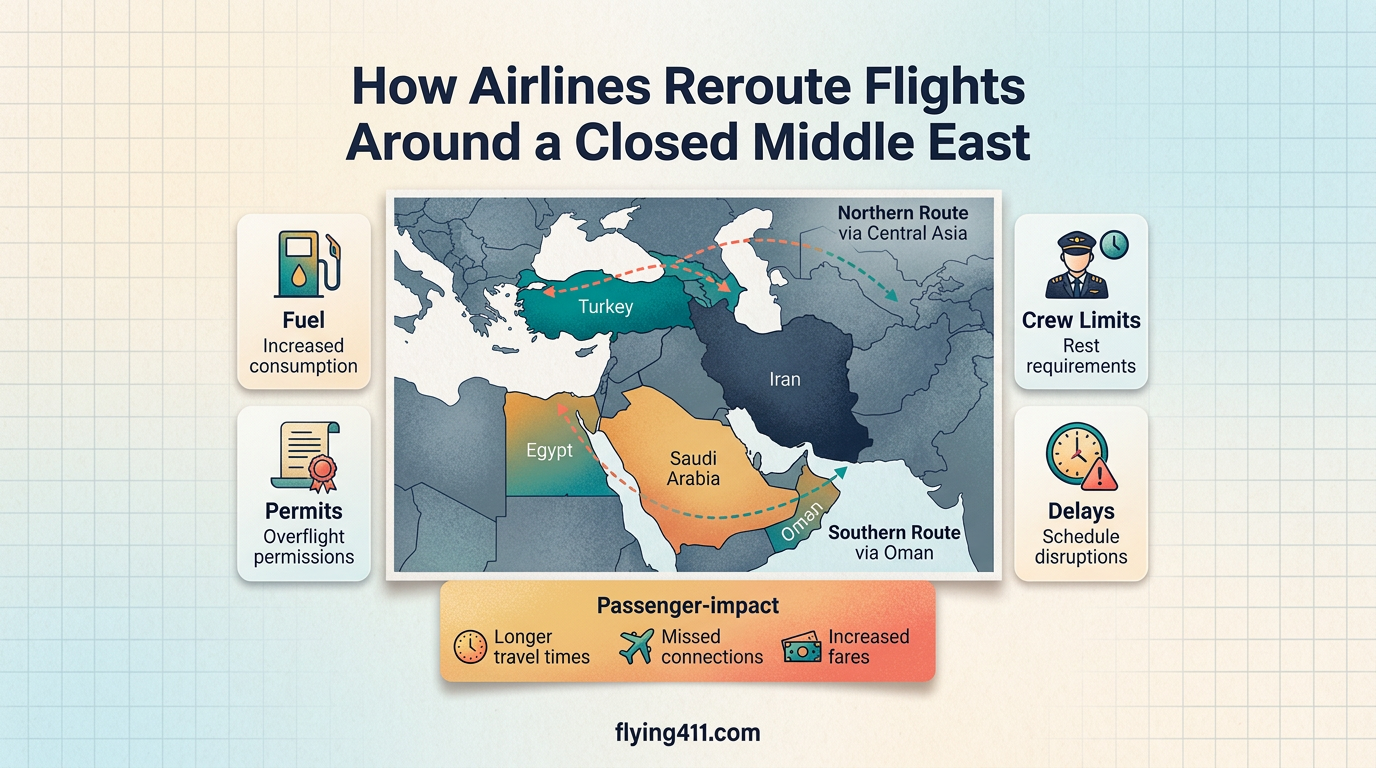
When middle east airspace shuts down, airlines move fast. Operations teams start running new route plans before most passengers hear about the closure. But getting a plane safely from one city to another via a totally different path is far harder than drawing a new line on a map.
The Two Main Bypass Routes
There are two main paths airlines use when the Gulf corridor is blocked.
- Northern Route: Flights reroute up through Turkey, then across the Caucasus region through Armenia and Azerbaijan. From there, planes head east through Central Asia, sometimes over Afghanistan or Tajikistan, before heading south toward their destinations. Istanbul has become a key city on this path. Turkish Airlines saw a big jump in passenger numbers as airlines started routing through its hub to avoid the Gulf.
- Southern Route: Flights head south through Egypt, then cross Saudi Arabia and Oman before heading east. Oman became a critical stop during the February 2026 closures. Muscat's airport sits just outside the most restricted zones. It became a natural place for refueling and repositioning, for both regular flights and repatriation flights trying to operate safely.
Neither route is easy. Both are longer. Both burn more fuel. Both need permits, crew schedule changes, and new fuel plans, all on short notice.
The choice between the two routes depends on several things:
- Which countries have already approved overflight permits
- The fuel range of the specific aircraft being used
- How many flying hours the crew has left
- Where the flight is going and what airports are along the new path
- Current safety conditions along each corridor
What Real Airlines Actually Did
Looking at what airlines actually did during recent closures helps explain how rerouting works in practice.
British Airways stopped flights to several Gulf destinations. Long-haul flights on Asia routes were sent through other corridors with added fuel stops. Managing those stops meant coordinating meals, ground crews, rest periods, and airport slots, all across multiple time zones at once.
Qatar Airways had a very hard situation. Its hub at Hamad International Airport in Doha sits inside the restricted zone. When Bahrain, Kuwait, and nearby airspace closed, Qatar Airways could not reroute. There was nowhere to fly from. Dozens of wide-body jets were moved out of Doha to aircraft storage in Europe.
Etihad Airways in Abu Dhabi had the same problem. The airline told passengers not to go to the airport unless contacted directly. Even as the UAE began allowing limited flights through tightly controlled paths, the airline said conditions were changing hour by hour.
Japan Airlines Flight JL43, Tokyo to London, shows how long these detours can last. Before Russia closed its airspace in 2022, that flight went west over Russia. For three years now, it has flown east over the Pacific, Alaska, and Canada. That adds 2.4 hours and burns about 5,600 extra gallons of fuel per flight. A short-term fix became a long-term change.
Qantas changed its Perth-to-London service during the 2026 airspace closures to add a fuel stop in Singapore on the way to the UK. The longer route meant the aircraft could not carry enough fuel to go non-stop. The flight was even given a new flight number to show the change. United Airlines set up Athens as a temporary refueling and crew-change city for flights that used to go through the Gulf.
The Fuel and Crew Problem
More distance means more fuel. That sounds simple. But the real challenge goes deeper.
- Long-haul aircraft carry backup fuel for emergencies. But a big detour may need so much extra fuel that the plane has to carry fewer passengers or less cargo to stay within its weight limit
- Pilots and cabin crew have legal limits on how many hours they can fly. A three-hour detour can push a crew past their limit before the plane lands
- When a crew hits their limit mid-route, the airline has to find replacement crew at an airport that may have no one on standby
- Repatriation flights add more pressure. Governments request urgent evacuation flights at the same time airlines are trying to fix their own networks
Airlines pull reserve crews off standby. They swap aircraft types to match range needs. They sometimes cancel lower-priority flights to free up staff and planes for the most critical routes. It is controlled triage. No one likes it. But it keeps the most important flights moving.
What This Means for Passengers
If you are traveling during a Middle East disruption, here is what to expect:
- Flight times extended by 2 to 5 hours, sometimes more
- Unplanned fuel stops in cities you did not expect to visit
- Missed connections as schedules fall apart
- Cancellation notices for flights going into or out of the closed zone
- Fewer seats on alternate routes as more passengers chase fewer options
The scale of disruption can be huge. During the February 2026 crisis, 350 flights were recorded as canceled flights in India in a single day. That included 57 flights at Mumbai airport alone. Over one million passengers were affected worldwide in the first few days. Many of those passengers had no plans to go near the Middle East. They just happened to be on routes that pass through the region.
Planes set for Singapore ended up parked in Doha. Crews planned for London departures were stuck in Abu Dhabi. The global airline network is one connected system. When one major part goes down, the effects spread everywhere.
When Airspace Reopens, the Work Is Not Over
Most travelers do not expect this. When a government lifts an airspace closure and says the sky is open again, flights do not go back to normal right away. The reopening is often the start of a new phase of disruption, not the end of one.
An airline runs on many moving parts: planes, crews, gates, slots, meals, and maintenance schedules, all working together across hundreds of cities. A major closure throws all of those parts out of place at once. Opening the sky again gives airlines permission to fly. It does not put the pieces back where they belong.
What Airlines Actually Face After Reopening
Here is what happens when airspace remains restricted or only partly open:
- Aircraft are in the wrong cities. Planes that were supposed to be at Dubai International Airport are sitting in Athens, Muscat, or Teruel, Spain. Getting them back requires ferry flights, meaning planes fly with no passengers just to move the aircraft. Those flights still take time, fuel, and crew.
- Crews are scattered. Pilots and flight attendants who were stuck in affected regions, or who flew long detour routes, need rest before they can fly again legally. A pilot who just finished an eight-hour rerouted middle east flight cannot jump onto the next departure. Rest rules do not bend for airline schedules.
- Hub timing is broken. Carriers like Qatar Airways and Etihad Airways run their hubs on timed waves, meaning big groups of flights arrive together and depart together in a tight window. If one wave is missed, many connecting flights cannot operate. Getting that timing back takes several full flight cycles, which means multiple days of reduced service.
- Permits and corridors need to be renewed. Emergency overflight permits issued during a crisis are sometimes short-term. As airspace remains only partly open, airlines have to reapply through the normal process. Some routes allowed during the crisis may not be available during the recovery period.
The Recovery Timeline Is Longer Than Most Expect
Wide-body long-haul aircraft usually fly just one or two routes per day. Each plane that is out of place means one full day of lost schedule before things are fixed. Multiply that across hundreds of planes and many carriers, and recovery takes a long time.
During the 2026 crisis, analysts predicted that even a full reopening of Iran and nearby airspace would take five to seven days before airline networks were stable. That is exactly what happened. Even as the UAE reopened corridors, Etihad Airways told passengers to stay home unless the airline called them. British Airways kept its suspension notices up and ran reduced schedules. Air traffic data showed Gulf flights running at a fraction of normal for over a week after partial reopening started.
Nine Qatar Airways wide-body jets that were moved to Teruel Airport in Spain during the crisis had to be checked, serviced, crewed, and flown back to Doha before they could carry passengers again. That process takes several days per plane.
What Passengers Should Do During Recovery
If a closure has disrupted your travel plans, here is advice that actually helps:
- Do not go to the airport based on a reopening headline. Check with your airline directly before you leave home.
- Ask about your specific flight number, not just the general route.
- Ask about rebooking options, refund policies, and hotel help if your trip has been interrupted.
- If your ticket connects through a Gulf hub like doha or abu dhabi, treat any reopening news as early and build in extra flexibility.
- Watch for secondary delays. Your flight might be running, but the aircraft or crew may be coming from somewhere else, which causes its own delays.
The Bigger Picture
Cancellation and delay waves during recovery can sometimes be worse than the first days of a closure. The number of affected travelers is larger. The delays are spread across more routes. Canceled flights in the first days are easy to see. The ripple effects in the recovery phase are harder to spot but hit just as many people.
Understanding this pattern of closure, reroute, disruption, and recovery helps any traveler handle airline chaos with a clear head. It is also a reminder of how much skill goes into keeping global aviation running safely when things get hard.
Conclusion
Middle East airspace closures show how connected the world's flight network really is. A conflict in one region can ground flights on the other side of the planet. It can strand crews in cities they never planned to visit. It can send fuel costs soaring for airlines that had planned every detail.
Airlines are not making it up as they go. They have tested systems, including NOTAMs, OCCs, permit pipelines, and bypass routes, that kick in the moment a closure is announced. The process is not perfect. It cannot stop all disruption. But it does keep passengers safer and flights moving in conditions that would otherwise shut global aviation down.
If your travels take you near the Gulf region, keep an eye on airspace news. And if you want to stay up to date on everything in aviation, from route changes to aircraft operations and airline news, Flying411 has you covered.
Frequently Asked Questions
What is the difference between a flight cancellation and a reroute during an airspace closure?
A cancellation means the flight does not operate at all. This usually happens when the destination or departure airport is inside the closed zone with no safe option. A reroute means the flight still goes but takes a different path to avoid restricted airspace. It often adds time and a fuel stop.
Can a plane turn around mid-flight if airspace closes while it is already in the air?
Yes. If airspace closes while a plane is already flying and it would need to enter that airspace to keep going, the crew and dispatchers work together to divert to a safe airport. This happened during major Middle East closures, with some planes turning back or landing in alternate cities.
Do passengers get compensation when a flight is rerouted due to an airspace closure?
It depends on the region and the airline. In the EU, airspace closures caused by military conflict are often treated as outside airline control. This can limit what passengers can claim under EC 261. But airlines must still offer rebooking or a refund if the original flight is canceled.
How does an airspace closure affect cargo flights differently than passenger flights?
Cargo flights face the same rerouting issues but have more timing flexibility. They are not tied to passenger connection schedules. But longer routes still cost more in fuel and delay time-sensitive goods, including medical supplies, electronics, and fresh food.
Why do some airlines cancel flights while others just reroute during the same closure?
It depends on where the airline's hub is, how far their planes can fly, and what permits they have. An airline whose hub is inside the closed zone has no choice but to stop flights. An airline based outside the zone may be able to reroute, if the detour fits the range and permits are approved.