Time is money. And for the world's most powerful executives, heads of state, and ultra-high-net-worth travelers, a private jet isn't just a status symbol — it's a precision tool for reclaiming hours that commercial aviation simply can't give back. Shaving two or three hours off a transatlantic flight can mean the difference between closing a deal and missing it entirely.
But not all private jets are built equal when it comes to speed. Some are engineered to push the very limits of what's physically possible for a civilian aircraft, flirting with — and in some cases, briefly crossing — the sound barrier during testing. So which machines sit at the very top of the speed charts?
This guide breaks down the 7 fastest private jets in the world today, covering top speeds, range, passenger capacity, and what makes each one extraordinary. Whether you're evaluating options for purchase, dreaming big, or just curious about what's possible at 51,000 feet, you're in the right place. These aren't just fast planes — they're marvels of engineering that happen to have lie-flat beds and fine dining on board.
Key Takeaways
The fastest private jet currently in service is the Bombardier Global 8000, which carries a top speed of around Mach 0.94 — making it the quickest civilian aircraft since the Concorde retired. Most of the fastest jets in the world cluster between Mach 0.90 and Mach 0.935, a range significantly quicker than any commercial airliner. Speed in private aviation is measured in Mach numbers, where Mach 1 equals the speed of sound (roughly 761 mph at sea level). The jets on this list combine blistering pace with long-range capability and cabin luxury, making them the ultimate tools for global, time-sensitive travel.
| Jet | Top Speed | Range | Approx. New Price |
| Bombardier Global 8000 | Mach 0.94 | 8,000 nm | ~$78M |
| Gulfstream G700 | Mach 0.935 | 7,750 nm | ~$80M |
| Cessna Citation X+ | Mach 0.935 | 3,460 nm | Used market only |
| Gulfstream G800 | Mach 0.935 | 8,200 nm | ~$72.5M |
| Bombardier Global 7500 | Mach 0.925 | 7,700 nm | ~$75M |
| Gulfstream G650/G650ER | Mach 0.925 | Up to 7,500 nm | ~$65M+ |
| Dassault Falcon 8X | Mach 0.90 | 6,450 nm | ~$54M used |
Speaking of fast decisions — Flying411 is your go-to resource for expert aviation guidance. From understanding aircraft specs to navigating the buying process, Flying411 makes private aviation accessible and clear.
What Does "Fast" Actually Mean for a Private Jet?
Before counting down the list, it helps to understand how speed is measured in aviation — because "fast" isn't as straightforward as it sounds.
Mach speed is the primary benchmark. Mach 1 equals the speed of sound, which is roughly 761 mph at sea level but decreases at higher altitudes. Most high-speed private jets cruise between Mach 0.85 and Mach 0.90 for efficiency, but their maximum operating speeds can push significantly higher.
Good to Know: The speeds listed in manufacturer specs and brochures refer to maximum operating speed — not typical cruise speed. Real-world cruise speeds are usually 5–10% lower to conserve fuel and keep passengers comfortable.
There's also a difference between cruise speed and maximum speed. A jet might be certified to fly at Mach 0.935, but pilots typically hold it at Mach 0.85 or 0.90 for long-range missions. For this list, we're focused on certified maximum speeds — the headline performance figures.
Here's a quick reference for context:
- Commercial airliners (e.g., Boeing 737): Mach 0.78–0.82
- Most private jets: Mach 0.78–0.88
- Top-tier business jets: Mach 0.90–0.935+
- Speed of sound (Mach 1): ~761 mph at sea level
The jets on this list are all operating in that elite Mach 0.90–0.94 band. That's a meaningful gap over commercial travel — enough to cut hours off intercontinental routes.
Fun Fact: During test flights, the Bombardier Global 8000 is said to have briefly exceeded Mach 1.0 — becoming one of the only civilian aircraft to break the sound barrier since the Concorde was retired in 2003.
Why Speed Matters More Than Ever in Private Aviation
The demand for fast, long-range jets has grown considerably over the past decade. The world is more interconnected, deal timelines are tighter, and the ultra-wealthy increasingly operate on a truly global stage.
A jet that can fly New York to London in under six hours — instead of eight — doesn't just save time. It changes what's possible in a given day. You can attend a morning meeting in Manhattan, land in London for an afternoon session, and still be back in the U.S. by morning.
Why It Matters: Faster private jets also tend to fly higher, above 45,000–51,000 feet. At those altitudes, they avoid most commercial air traffic and weather systems, reducing delays and turbulence for passengers.
Speed also affects physiological comfort. Shorter flight times mean less exposure to pressurized cabin air, reduced jet lag, and lower overall fatigue. Passengers on the fastest jets arrive noticeably more refreshed — which, for high-stakes business travel, is more than a nice-to-have.
For those comparing fixed-wing aircraft vs. rotary-wing aircraft, long-range speed is one of the clearest advantages that fixed-wing jets hold — particularly in the ultra-long-range category.
The 7 Fastest Private Jets in the World
Here's the full breakdown of the fastest private jets flying today, ranked by certified top speed.
1. Bombardier Global 8000 — Mach 0.94
The current title holder. The Bombardier Global 8000 is widely recognized as the fastest private jet in the world available for purchase, with a certified top speed of around Mach 0.94. During test flights, it is reported to have surpassed Mach 1.0, making it a genuinely remarkable achievement in civilian aviation.
The Global 8000 combines that headline speed with a range of approximately 8,000 nautical miles — enough to connect New York with Hong Kong, or Los Angeles with Dubai, nonstop. It's powered by GE Passport engines engineered for both performance and fuel efficiency.
Inside, the cabin is configured across up to four living zones, including a private suite with a full-size bed. Up to 19 passengers can travel in what Bombardier describes as the most advanced cabin environment in business aviation.
| Spec | Detail |
| Top Speed | Mach 0.94 |
| Range | ~8,000 nm |
| Engines | GE Passport |
| Passengers | Up to 19 |
| Approx. Price | ~$78M |
| Max Altitude | 51,000 ft |
Pro Tip: The Global 8000 is also certified to use Sustainable Aviation Fuel (SAF), and reportedly conducted some of its record speed tests using SAF — a first in business aviation history.
2. Gulfstream G700 — Mach 0.935
The largest cabin at this speed class. The Gulfstream G700 received FAA certification in March 2024 and began customer deliveries in April of that year. It's Gulfstream's current flagship — the longest-range model the company offers with the largest cabin in its lineup.
Its certified top speed of Mach 0.935 ties it with the Citation X+ for the second-fastest position, but the G700 brings a range of roughly 7,750 nautical miles and a five-zone cabin that seats up to 19 passengers. During testing, the aircraft reportedly pushed as high as Mach 0.99 — just short of the sound barrier.
The G700 is powered by Rolls-Royce Pearl 700 engines, which also deliver improved fuel efficiency compared to previous Gulfstream models. The cockpit features Gulfstream's Symmetry Flight Deck with active control sidesticks and touchscreen avionics.
| Spec | Detail |
| Top Speed | Mach 0.935 |
| Range | ~7,750 nm |
| Engines | Rolls-Royce Pearl 700 |
| Passengers | Up to 19 |
| Approx. New Price | ~$80M |
| Max Altitude | 51,000 ft |
Keep in Mind: As of 2025, buyers placing a new G700 order face a significant wait time. Current backlog reportedly extends deliveries into 2026 and beyond for new orders.
3. Cessna Citation X+ — Mach 0.935
The speed record holder that's no longer in production. The Cessna Citation X+ holds a special place in aviation history. During 2014 test flights, it set multiple city-pair speed records and was officially recognized as the fastest civilian aircraft in the world at the time — with a certified top speed of Mach 0.935.
What makes the Citation X+ unusual is that it achieves this speed in a mid-size airframe. Its range of around 3,460 nautical miles is more limited than the ultra-long-range jets above, but for point-to-point domestic or transatlantic sprints, it remains one of the quickest options in the sky.
Production ended in 2018, but a healthy pre-owned market keeps these jets flying. It's powered by Rolls-Royce AE 3007C2 turbofan engines and seats up to 12 passengers.
| Spec | Detail |
| Top Speed | Mach 0.935 |
| Range | ~3,460 nm |
| Engines | Rolls-Royce AE 3007C2 |
| Passengers | Up to 12 |
| Status | Pre-owned only |
| Max Altitude | 51,000 ft |
Fun Fact: During a two-day coast-to-coast speed demonstration in 2014, Citation X+ pilots reportedly set a speed record on every single leg of the trip — from Wichita to Seattle to Miami and back.
4. Gulfstream G800 — Mach 0.935
The long-range specialist. The Gulfstream G800 received FAA and EASA certification in April 2025, with the first delivery completed in late August 2025. It was designed from the outset to be Gulfstream's ultimate range machine — flying up to 8,200 nautical miles on a single fuel load.
It shares the G700's wing and Rolls-Royce Pearl 700 engines, which means it achieves the same Mach 0.935 top speed. The cabin is slightly smaller than the G700's (10 feet shorter), more comparable in size to the G650 — but the range advantage over many competitors is significant.
The G800 is the direct replacement for the G650, which ended production in early 2025.
| Spec | Detail |
| Top Speed | Mach 0.935 |
| Range | ~8,200 nm |
| Engines | Rolls-Royce Pearl 700 |
| Passengers | Up to 19 |
| Approx. Price | ~$72.5M |
| Max Altitude | 51,000 ft |
Good to Know: The G800's range of 8,200 nm means it can theoretically connect city pairs like Singapore to New York or Los Angeles to Sydney nonstop — a genuinely rare capability.
5. Bombardier Global 7500 — Mach 0.925
The proven ultra-long-range workhorse. In service since 2018, the Bombardier Global 7500 has established itself as one of the most capable private jets ever built. Its top speed of Mach 0.925 places it just behind the G700 and Global 8000, but its range of up to 7,700 nautical miles keeps it firmly in the conversation for the world's longest nonstop routes.
The Global 7500 is powered by GE Passport engines and features a four-zone cabin with hand-crafted Nuage seating, a full kitchen (not just a galley), and a dedicated crew suite. It seats up to 19 passengers and can carry more than 20 pieces of luggage.
It's worth noting that the G650ER held the record for the farthest-fastest business aviation flight before the Global 7500 eventually surpassed it in 2019.
| Spec | Detail |
| Top Speed | Mach 0.925 |
| Range | ~7,700 nm |
| Engines | GE Passport |
| Passengers | Up to 19 |
| Approx. Price | ~$75M |
| Max Altitude | 51,000 ft |
Why It Matters: The Global 7500 is one of a handful of private jets with a true full-size kitchen on board — not just a catering galley. For ultra-long missions, that distinction matters enormously.
6. Gulfstream G650 / G650ER — Mach 0.925
The gold standard that set the bar. For over a decade, the Gulfstream G650 and its extended-range variant, the G650ER, defined what an ultra-long-range private jet could be. Both carry a top speed of Mach 0.925 and a range of up to 7,500 nautical miles, making them competitive even in today's market.
Production on the G650 ended in February 2025, with the last example completed at Gulfstream's Appleton facility. The G800 is its official successor. But the pre-owned market for G650s remains strong — these aircraft have a well-earned reputation for reliability, performance, and resale value.
The G650ER is said to hold multiple city-pair speed records, including the farthest-fastest flight in business aviation history (since surpassed). Up to 19 passengers can travel in its cabin, configured across multiple living areas with Gulfstream's signature panoramic oval windows.
| Spec | Detail |
| Top Speed | Mach 0.925 |
| Range | Up to 7,500 nm (G650ER) |
| Engines | Rolls-Royce BR725 |
| Passengers | Up to 19 |
| Status | Pre-owned (G650) / G800 succeeds it |
| Max Altitude | 51,000 ft |
Pro Tip: If you're looking for ultra-long-range performance at a more accessible price point, a pre-owned G650 or G650ER can offer near-flagship capability for considerably less than a new G700 or Global 8000.
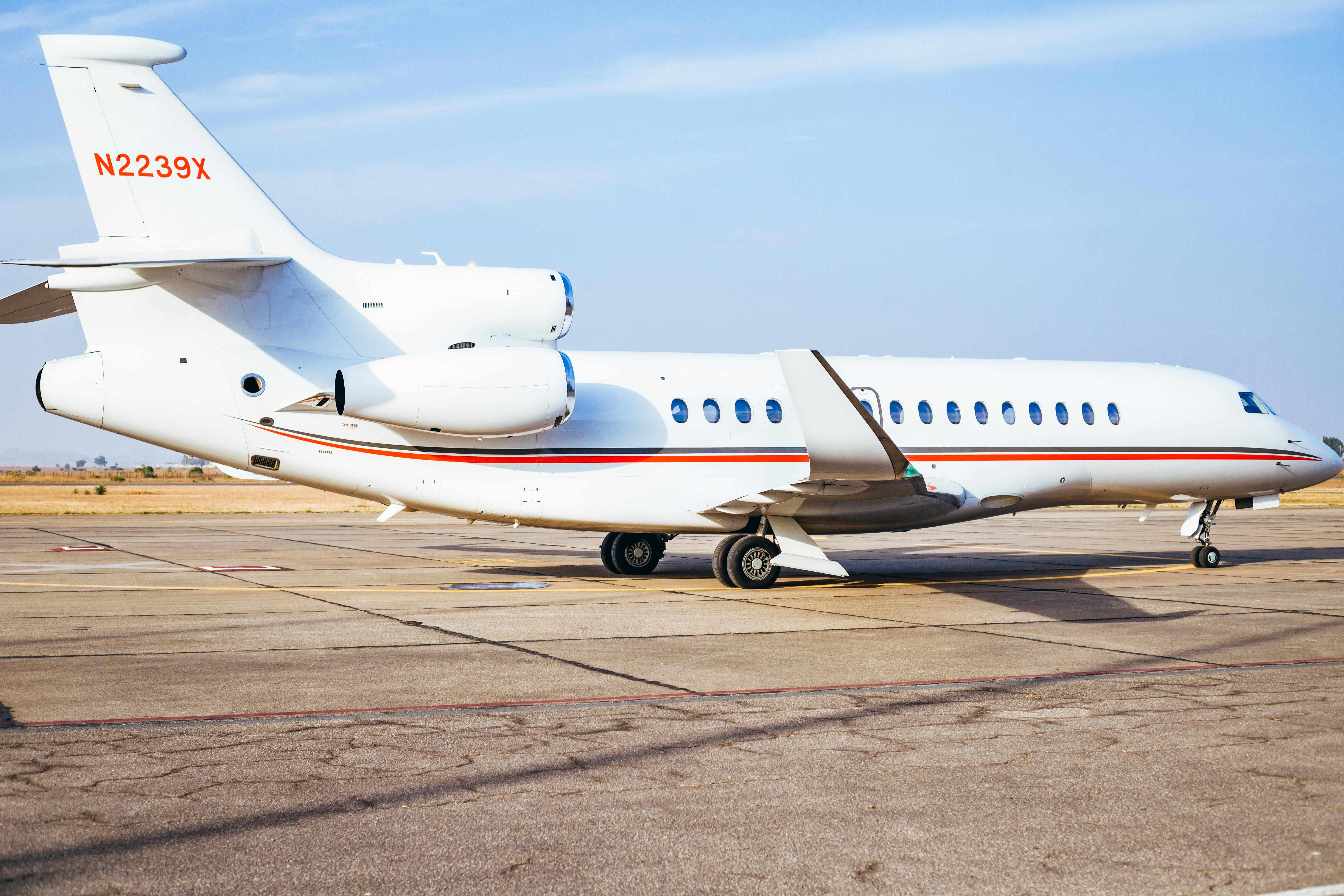
7. Dassault Falcon 8X — Mach 0.90
The tri-engine contender from France. The Dassault Falcon 8X rounds out this list with a top speed of around Mach 0.90 and a range of approximately 6,450 nautical miles. What makes the 8X stand apart isn't just raw speed — it's the combination of its unique tri-engine configuration, short-field performance, and operational versatility.
Powered by three Pratt & Whitney PW307D engines, the 8X can operate from shorter runways than most jets on this list. This makes it a genuine option for airports with restricted runway lengths, such as London City Airport. It can seat up to 16 passengers in a three-lounge cabin configuration.
The 8X also features Dassault's FalconEye Combined Vision System, which provides enhanced situational awareness in low-visibility conditions. Its fly-by-wire digital flight controls draw directly from Dassault's military fighter jet heritage.
| Spec | Detail |
| Top Speed | ~Mach 0.90 |
| Range | ~6,450 nm |
| Engines | 3x Pratt & Whitney PW307D |
| Passengers | Up to 16 |
| Approx. Used Price | ~$54M |
| Max Altitude | 51,000 ft |
Fun Fact: Dassault's expertise in designing fighter jets — including the legendary Mirage series — directly influenced the fly-by-wire technology and aerodynamic efficiency of the Falcon 8X.
How These Jets Compare: Speed vs. Range vs. Cabin
Speed is only one dimension of what makes a private jet exceptional. For most buyers and charter clients, the real decision comes down to balancing three factors: top speed, range, and cabin size.
Here's how the top 7 stack up across all three:
| Jet | Top Speed | Range | Cabin Zones | Best For |
| Global 8000 | Mach 0.94 | 8,000 nm | 4 | Speed + ultra-long-range |
| Gulfstream G700 | Mach 0.935 | 7,750 nm | 5 | Largest cabin at top speed |
| Citation X+ | Mach 0.935 | 3,460 nm | 2 | Domestic/regional speed |
| Gulfstream G800 | Mach 0.935 | 8,200 nm | 4 | Maximum range |
| Global 7500 | Mach 0.925 | 7,700 nm | 4 | Long-range + full kitchen |
| G650/G650ER | Mach 0.925 | 7,500 nm | 3–4 | Proven reliability + value |
| Falcon 8X | ~Mach 0.90 | 6,450 nm | 3 | Short-field + efficiency |
The Citation X+ is interesting because it achieves top-tier speed in a much smaller, more economical airframe. For purely domestic routes or medium-haul missions, it can outpace far more expensive jets on a cost-per-mile basis.
On the other end, the Global 8000 and G800 combine extreme range with near-maximum speed — making them the choice for travelers who need to go far and fast without stopping.
Ready to explore which of these jets fits your mission profile? Flying411 offers clear, expert guidance on aircraft selection, acquisition, and ownership — without the jargon.
What's on the Horizon: Supersonic Private Jets
The jets on this list are fast — but none are truly supersonic in commercial operation. That could change within the next decade.
Boom Overture, a supersonic passenger jet currently in development, has attracted significant attention from major airlines and private operators. It is designed to cruise at around Mach 1.7, which would cut transatlantic flight times to roughly three and a half hours. Deliveries are currently targeted for the late 2020s, though timelines for supersonic programs have historically been prone to adjustment.
Aerion AS2, another supersonic business jet concept, attracted early enthusiasm before its developer ceased operations in 2021. That setback underscores how technically and financially demanding supersonic aviation remains.
For now, the Mach 0.90–0.94 band represents the realistic ceiling for production private jets. The aircraft on this list are operating as close to that ceiling as engineering, certification, and passenger comfort currently allow.
Heads Up: Supersonic flight over land is currently restricted in the U.S. and many other countries due to the sonic boom it produces. Any future supersonic private jet would likely be limited to overwater routes unless regulations evolve.
For aviation enthusiasts curious about different aircraft categories and how they compare, the debate between rotary-wing aircraft vs. helicopters offers another fascinating lens on how mission requirements shape aircraft design. And for those interested in military performance benchmarks — particularly how jets designed for military applications differ from civilian ones — exploring U.S. Navy planes vs. Air Force aircraft offers useful context on just how much performance private jets have borrowed from military engineering.
The Real Cost of Flying at Mach 0.935
Speed at this level comes with a significant price tag — not just for acquisition, but for ongoing ownership.
A new Gulfstream G700, for example, carries a base price of around $79–80 million. With customization, the total can reach $100 million or more. Annual fixed ownership costs — covering crew, hangar, insurance, and management — can run over $1 million per year. Variable costs (fuel, maintenance, engine programs) add thousands more per flight hour.
Here's a rough ownership cost breakdown for a jet in this class, based on approximately 300 flight hours per year:
| Cost Category | Annual Estimate |
| Crew salaries & training | ~$800K+ |
| Hangar & storage | ~$180K+ |
| Hull & liability insurance | ~$175K+ |
| Fuel (per hour, ~500 gal/hr) | ~$3,000–3,500/hr |
| Maintenance (5-year avg.) | ~$1,600–2,000/hr |
| Engine program | ~$1,700–2,000/hr |
| Total annual (300 hrs) | ~$3–3.5M+ |
These numbers can vary significantly depending on the aircraft model, base location, how heavily it's used, and whether it's placed in a charter program to offset costs.
Quick Tip: Many ultra-high-net-worth owners place their jets in a managed charter program when not in use. This can meaningfully offset annual operating costs — sometimes by $500K or more per year — while keeping the aircraft flight-ready.
Charter rates for jets in this performance class typically run $12,000–$20,000+ per hour, making ownership the more economical path for those flying more than 200–250 hours annually.
If you're evaluating the ownership vs. charter equation for a high-performance jet, Flying411 can connect you with trusted experts who've helped hundreds of aviation clients navigate exactly this decision. Reach out today and get clarity on what works best for your mission.
Conclusion
The fastest private jets in the world aren't just transportation — they're among the most sophisticated machines ever built for civilian use. From the Bombardier Global 8000's record-setting Mach 0.94 pace to the Dassault Falcon 8X's tri-engine versatility, each aircraft on this list represents a different answer to the same question: how do you fly faster, farther, and more comfortably than anyone else?
For buyers, the best fastest private jet isn't necessarily the one with the highest top speed — it's the one that best matches your routes, passenger count, and ownership goals. Speed matters, but so do range, cabin comfort, and total cost of operation.
The market for ultra-high-performance business jets has never been more competitive or more innovative. And with supersonic aircraft on the horizon, the ceiling for what's possible in private aviation may be about to move again.
For expert guidance on which aircraft fits your lifestyle and mission, Flying411 is the resource built for aviation enthusiasts and buyers who want clear, honest information — not a sales pitch.
FAQs
What is the fastest private jet in the world in 2025?
The Bombardier Global 8000 is currently considered the fastest production private jet, with a top speed of around Mach 0.94. It also holds the distinction of being the fastest civilian aircraft since the Concorde retired.
How fast is Mach 0.935 in miles per hour?
Mach 0.935 translates to roughly 710–720 mph depending on altitude, as the speed of sound varies with air temperature and pressure. At cruising altitude (around 40,000–51,000 feet), the speed of sound is slightly lower than at sea level.
Can private jets break the sound barrier?
In commercial passenger service, no — it's not permitted and would cause disruptive sonic booms over populated areas. However, during test flights, aircraft like the Bombardier Global 8000 are reported to have briefly exceeded Mach 1.0 in controlled conditions.
Is the Citation X+ still being manufactured?
No. Cessna (now part of Textron Aviation) ended production of the Citation X+ in 2018. However, a well-maintained pre-owned market exists, and the aircraft remains one of the fastest civilian jets ever built.
What makes Gulfstream and Bombardier jets so fast?
Both manufacturers invest heavily in aerodynamic efficiency, advanced engine technology, and lightweight composite materials. Jets like the G700 and Global 8000 also fly at very high altitudes — up to 51,000 feet — where thinner air creates less drag, allowing higher speeds for a given thrust output.