The United States military operates some of the most advanced aircraft in the world. But not all military planes are the same — not even close. The Navy and the Air Force each fly their own fleets, built for very different jobs in very different places.
The US Navy planes vs Air Force debate is one that aviation fans love to dig into. Both branches are powerful. Both fly fast, sophisticated machines. But the way they use their aircraft — and why their planes look and work the way they do — tells a fascinating story about how America defends itself from sea and sky.
One branch operates from aircraft carriers bobbing in the ocean. The other launches from massive land bases around the world. That difference alone shapes almost everything: the design of the planes, how pilots train, and what missions they fly. If you've ever wondered what really sets these two branches apart, you're about to find out.
Key Takeaways
US Navy planes and Air Force aircraft are both built for combat and national defense, but they serve different environments and missions. Navy aircraft are designed to take off and land on carriers at sea, which makes them shorter, tougher, and more compact. Air Force jets operate from land bases and are often built for longer range, higher altitude, and greater payload capacity. Each branch has its own legendary aircraft, training pipelines, and operational strengths — and together, they form one of the most capable combined air forces in history.
| Comparison Point | US Navy | US Air Force |
| Operating Base | Aircraft carriers & shore bases | Land-based airfields |
| Famous Fighters | F/A-18 Super Hornet, F-35C | F-22 Raptor, F-35A |
| Famous Bombers | None (carrier-limited) | B-2 Spirit, B-52 Stratofortress |
| Role Focus | Fleet defense, maritime strike | Air superiority, strategic bombing |
| Pilot Training | Naval Air Station Pensacola | Joint Base San Antonio |
| Aircraft Design | Folding wings, reinforced landing gear | Larger, longer-range airframes |
| Unique Capability | Carrier landings (arrested gear) | Stealth & long-range bombing |
Flying411 covers everything from military aviation history to tips for civilian pilots — it's a great resource whether you're a curious reader or someone dreaming of earning their wings.
A Tale of Two Branches: How the Navy and Air Force Came to Be
To understand why Navy and Air Force planes are so different, it helps to know a little history.
The U.S. Air Force didn't always exist as its own branch. For most of World War II, military aviation was handled by the Army Air Forces. It wasn't until 1947 that the Air Force became an independent branch under the National Security Act. From that point on, it took ownership of strategic bombing, air superiority, and long-range missions.
The Navy, on the other hand, had been flying aircraft since the early days of aviation. Naval aviation dates back to around 1911, when the first pilot was trained to fly for the Navy. Carrier-based aviation became central to U.S. strategy during World War II, especially in the Pacific, where aircraft carriers replaced battleships as the dominant force.
Fun Fact: The Battle of Midway in 1942 is widely considered a turning point in carrier warfare. Navy dive bombers helped sink four Japanese carriers in a single day — without the opposing ships ever getting within gun range of each other.
These different histories shaped two very distinct aviation cultures — and two very different types of planes.
Why Environment Changes Everything
Carriers vs. Runways
The single biggest difference between Navy and Air Force aircraft comes down to where they take off and land.
Air Force pilots operate from long, paved runways on land bases. They have plenty of room to roll out, and their planes can be big, heavy, and built for endurance. A B-52 Stratofortress, for example, has a wingspan of around 185 feet. That would never fit on a carrier.
Navy pilots, on the other hand, launch from carrier flight decks that are roughly 1,000 feet long — about the length of three football fields. A steam or electromagnetic catapult hurls the plane into the air in about two seconds. Landing is just as intense: a tailhook on the back of the plane catches one of several arresting wires stretched across the deck.
Good to Know: Missing all the wires on a carrier landing is called a "bolter." Pilots must immediately go to full throttle and try again — there's no room to brake and stop.
Wing Design and Structural Differences
Because of carrier life, Navy aircraft are built tougher. They absorb brutal landing forces every time they touch down. Their landing gear is heavier and sturdier. Many Navy jets also have folding wings — a practical feature that lets planes fit in the carrier's tight below-deck hangars.
Air Force jets don't need folding wings. They can be sleeker and optimized purely for performance. This is one reason Air Force fighters often have a slight aerodynamic edge in certain flight profiles — they're not carrying the extra weight of reinforced carrier equipment.
Famous US Navy Aircraft
The Navy's fleet is built around carrier-based aviation, which means most front-line jets have to be small enough to operate from a ship. Here are some of the most well-known.
F/A-18 Super Hornet
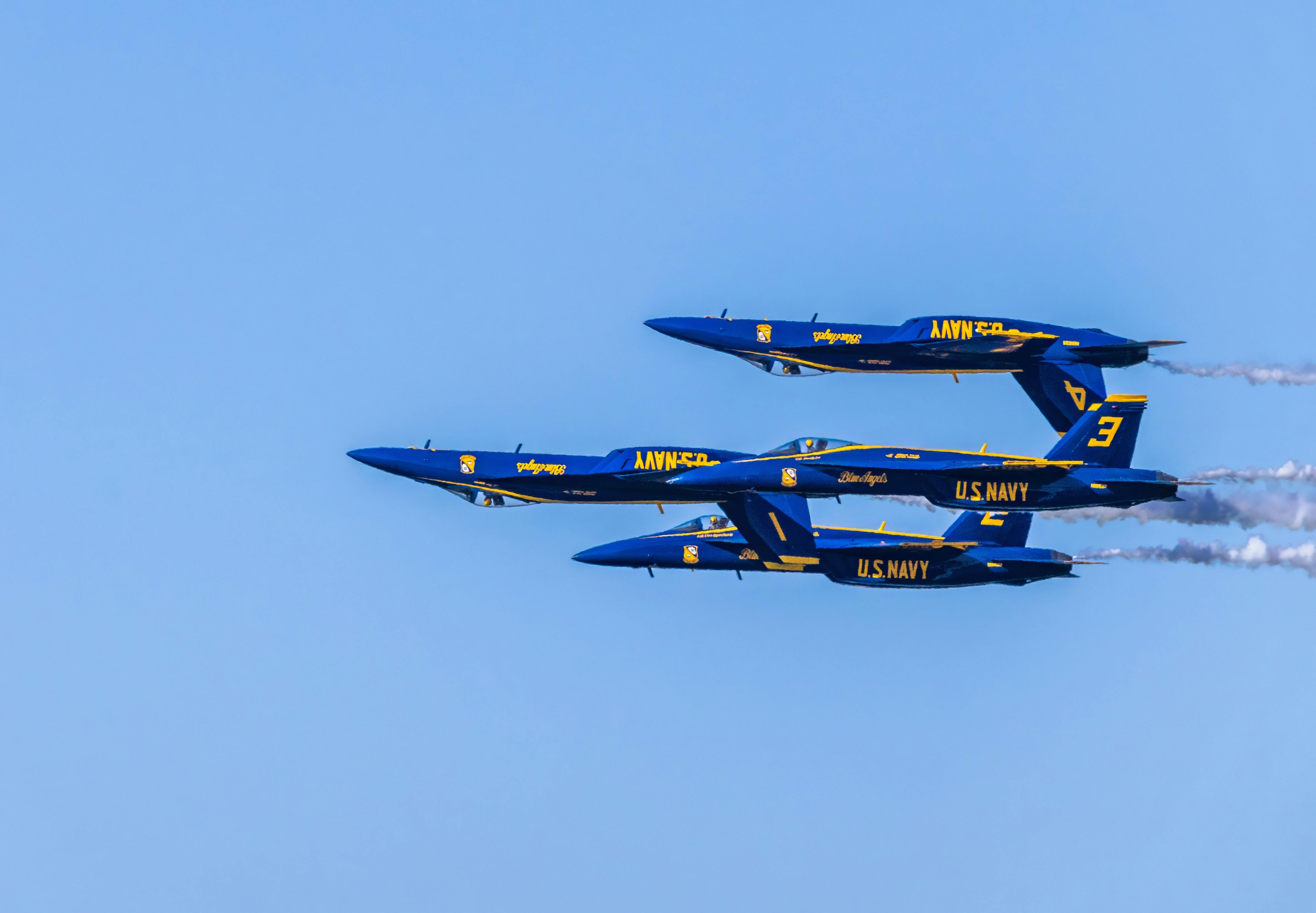
The F/A-18 Super Hornet is the workhorse of today's Navy fleet. It's a twin-engine, multi-role jet that can dogfight, drop bombs, and fly off a carrier. The "F/A" designation tells you it can do two jobs: fighter (F) and attack (A). Carriers typically deploy squadrons of Super Hornets as their primary strike aircraft.
F-35C Lightning II
The F-35C is the Navy's version of the joint F-35 program. The "C" variant has larger wings for better low-speed handling during carrier landings, and its landing gear is reinforced for arrested landings. It brings stealth technology to the carrier fleet for the first time.
EA-18G Growler
The Growler is a specialized electronic warfare aircraft based on the Super Hornet airframe. Instead of missiles, it's loaded with jamming equipment that disrupts enemy radar and communications. It's often described as one of the most valuable aircraft in any carrier air wing.
P-8 Poseidon
Not all Navy planes fly from carriers. The P-8 Poseidon is a maritime patrol aircraft based on the Boeing 737 commercial airliner. It hunts submarines, tracks surface ships, and conducts long-range surveillance missions from land bases. If you've ever wondered how fast a commercial plane flies, the P-8 is a great example of how a commercial design gets pushed to military limits.
Why It Matters: The P-8 Poseidon replaced the older P-3 Orion and represents a modern approach to maritime patrol — combining commercial reliability with advanced sensors and weapons.
MH-60 Sea Hawk
Helicopters are a crucial part of naval aviation. The MH-60 Sea Hawk (a naval variant of the Army's Black Hawk) operates from destroyers and cruisers to hunt submarines, rescue downed pilots, and resupply ships at sea.
Famous US Air Force Aircraft
The Air Force operates a wider variety of aircraft types, including strategic bombers that the Navy simply doesn't fly. Here's a look at some of its most iconic jets.
F-22 Raptor
The F-22 is widely considered one of the most capable air superiority fighters ever built. It combines supercruise (supersonic flight without afterburner), extreme maneuverability, and stealth into a single airframe. The Air Force operates a relatively small fleet of them, and the aircraft has never been exported to any foreign nation.
F-35A Lightning II
The F-35A is the Air Force's conventional takeoff and landing version of the F-35. Compared to the Navy's F-35C, it has smaller wings optimized for land-based operations and doesn't need the heavy-duty landing gear for carrier life.
B-2 Spirit
The B-2 is a stealth strategic bomber capable of delivering both conventional and nuclear weapons. Its flying-wing design and radar-absorbing materials make it nearly invisible to enemy radar. The Air Force operates a small number of these aircraft — if you're curious how many B-2 bombers are in the fleet, the answer might surprise you with how few carry such an enormous strategic responsibility.
B-52 Stratofortress
The B-52 has been flying since the 1950s and is still in active service today. It's a long-range, heavy bomber capable of carrying an enormous weapons payload. The Air Force has modernized its engines and avionics over the decades, and the B-52 is expected to remain in service well into the 2040s or beyond.
Fun Fact: The B-52 has been in continuous service longer than almost any other military aircraft in history. Some of the crew flying today weren't born when the plane first entered service — and neither were their parents.
A-10 Thunderbolt II
The A-10 — nicknamed the "Warthog" — is a ground attack aircraft built around its massive 30mm Gatling cannon. It flies low and slow to support troops on the ground, and it's famous for being able to take severe battle damage and still fly home. The Air Force has debated retiring it for years, but it keeps surviving budget cuts.
C-17 Globemaster III
Bombers and fighters get the headlines, but the Air Force also operates a massive airlift fleet. The C-17 Globemaster III can carry tanks, helicopters, and hundreds of troops anywhere in the world within hours. It's the backbone of American strategic airlift.
If military aviation has sparked your interest in flying, Flying411 has in-depth guides on how to become a pilot — from your first discovery flight to earning your wings.
US Navy Planes vs. Air Force: The Core Differences Explained
This is the heart of the comparison. When you put Navy and Air Force aviation side by side, these are the key differences that define each branch.
1. Mission Focus
The Navy's primary air mission is fleet defense and power projection from the sea. Its aircraft protect carrier strike groups, strike land targets along coastlines, and conduct anti-submarine warfare.
The Air Force focuses on air superiority, strategic bombing, and global reach. It can project power deep into enemy territory, suppress air defenses, and support ground troops anywhere in the world.
2. Aircraft Carrier Operations
Only the Navy operates from carriers. This shapes every aspect of naval aircraft design — from wing size to landing gear strength to the tailhook. Air Force planes are never designed with carrier ops in mind (with rare exceptions in joint programs like the F-35).
3. Aircraft Size and Range
Air Force jets tend to be larger and longer-ranged. Without the constraints of carrier storage, they can carry more fuel, more weapons, and more sophisticated sensors. Navy jets are optimized for compactness and carrier compatibility first.
4. Bomber Presence
The Air Force operates dedicated strategic bombers — the B-2, B-52, and the newer B-21 Raider. The Navy doesn't. Carrier decks can't support the size of a strategic bomber, so the Navy relies on its fighters and attack aircraft for strike missions.
5. Electronic Warfare
Both branches take electronic warfare seriously, but the Navy's EA-18G Growler fleet is among the most specialized EW platforms in the world. Air Force jets handle some EW tasks, but not with the same dedicated airframe approach.
6. Pilot Training Pipelines
Navy pilots train at Naval Air Station Pensacola in Florida, where they learn carrier landing skills from early in their training. It's considered one of the most demanding flight training programs in the world. Air Force pilots train through the Joint Base San Antonio system in Texas among other locations.
Pro Tip: Carrier landing qualification is sometimes called the hardest skill in military aviation. Pilots land on a moving, pitching deck at night, guided only by a set of lights called the Fresnel Lens Optical Landing System (FLOLS).
7. Joint Programs and Cooperation
The F-35 program is a perfect example of how the branches overlap. Lockheed Martin built three variants: the F-35A for the Air Force, the F-35B for the Marines (short takeoff/vertical landing), and the F-35C for the Navy. Same basic design, different configurations for different operating environments.
8. Budget and Fleet Size
The Air Force and Navy both receive substantial defense funding, and both operate hundreds of aircraft. The Air Force generally operates a larger number of total aircraft, including its massive tanker and airlift fleets. The Navy's fleet is smaller in total numbers but deeply specialized around the carrier strike group model.
9. Global Presence
Air Force bases are spread across the world, giving it global reach from fixed locations. Navy carriers can position themselves anywhere on the ocean — often within striking distance of any coastline on earth. In that sense, the Navy offers a form of flexibility the Air Force can't replicate.
How Navy and Air Force Pilots Are Different
The planes are different. The missions are different. And the pilots, in some ways, are different too.
Both groups go through rigorous selection and training. But Navy pilots face the unique challenge of carrier qualification — learning to land on a moving ship. This creates a culture of extreme precision and risk management that shapes every Navy aviator.
Air Force pilots, depending on their aircraft, may fly very different missions: long sorties in bombers, high-altitude reconnaissance, or close air support in the A-10. The diversity of Air Force airframes means pilots can specialize in ways that differ significantly from the carrier-centric Navy world.
Keep in Mind: Both Navy and Air Force pilots go through undergraduate pilot training that includes basic flight skills, instrument flying, and formation flying before they specialize in their assigned aircraft.
Working Together: Joint Operations
Despite their differences, the Navy and Air Force operate together constantly. Joint task forces combine carrier air wings with land-based Air Force assets to maximize coverage and punch. During major operations, you might have F-22s sweeping for enemy fighters while Super Hornets strike coastal targets and B-52s hit inland infrastructure.
The two branches also share intelligence, refueling assets (Air Force tankers routinely refuel Navy jets), and logistics networks. Their rivalry — and it is a friendly rivalry — makes both branches sharper.
Good to Know: Air Force KC-135 and KC-46 tankers regularly refuel Navy jets during extended operations, extending the range of carrier-based aircraft far beyond what they could achieve on their own.
Conclusion
The debate over US Navy planes vs Air Force aircraft isn't really about which branch is better — it's about understanding two different answers to the same question: how do you project air power in a complex world?
The Navy took the ocean and turned it into a runway. The Air Force built a global network of bases and developed aircraft capable of reaching almost anywhere on earth. Both approaches work. Both are necessary. And together, they form a combined air arm that has no equal.
Whether you're watching an F/A-18 catch a wire on a carrier deck or tracking a B-2 glide silently over enemy territory, you're seeing the product of decades of engineering, strategy, and incredible human skill. Military aviation is endlessly fascinating — and if it's sparked a deeper curiosity about flight in you, Flying411 is a great place to keep exploring.
FAQs
What is the main difference between Navy and Air Force planes?
Navy planes are built to operate from aircraft carriers at sea, which means they need reinforced landing gear, folding wings, and tailhooks. Air Force planes operate from land bases and are generally larger, longer-ranged, and not built for carrier use.
Does the Navy have bombers like the Air Force?
No. The Navy doesn't operate dedicated strategic bombers. Its carriers can't support aircraft of that size. Strike missions from the Navy are handled by multi-role fighters like the F/A-18 Super Hornet and F-35C.
Which branch has better fighter jets — Navy or Air Force?
Both branches fly advanced fighters. The Air Force's F-22 Raptor is widely considered one of the top air superiority fighters in the world. The Navy's F/A-18 Super Hornet and F-35C are also highly capable multi-role aircraft. It's less a matter of "better" and more a matter of different design priorities.
Can Air Force pilots land on aircraft carriers?
Not without specific carrier landing training. Carrier landings require specialized skills — including arrested landings using a tailhook — that aren't part of standard Air Force pilot training. Some Air Force pilots have trained for carrier ops in special circumstances, but it's rare.
How does fuel capacity compare between Navy and Air Force jets?
Air Force jets generally carry more fuel since they're built for longer range without a carrier nearby. Navy jets typically carry less internal fuel but rely on Air Force or Navy tanker aircraft for aerial refueling during extended missions. For a sense of how much fuel large aircraft can carry, the numbers involved in fueling a 747 give a useful frame of reference.
Do Navy and Air Force pilots go through the same training?
Both branches share some early training elements, but they diverge significantly. Navy pilots train at NAS Pensacola and must qualify for carrier landings. Air Force pilots train at Joint Base San Antonio and other bases, and their training tracks vary widely depending on their assigned aircraft type.