Some aircraft are so unusual that catching one in the air feels like spotting a ghost. The thunder of four radial engines, the silhouette of a quad-jet on final approach, or the high whine of a rotary biplane circling a grass strip can stop conversations cold at any airport fence. Most of these machines were built for a world that no longer exists, yet a small number of them still take to the sky thanks to dedicated owners, volunteer crews, and a few stubborn airlines refusing to let go.
The list of rare planes flying right now is shorter than you might think, but it stretches across roughly a century of aviation history. From WWI biplanes built of wood and fabric to four-engine jumbo jets fading from passenger service, the survivors share one thing in common. Every flight is a small miracle of engineering, money, and devotion.
The strangest part is how often you can see them with your own eyes if you know where to look.
Key Takeaways
Rare planes flying right now include vintage WWII warbirds like the B-29 Superfortress, Avro Lancaster, and B-17 Flying Fortress, plus shrinking commercial fleets such as the Boeing 747 and Airbus A340. Most are kept airworthy by museums, civilian groups, or a handful of remaining airlines, and many appear at airshows or on specific routes throughout the year.
| Aircraft | Era | Why It's Rare | Where You Might See It |
| B-29 Superfortress | WWII | Only two airworthy worldwide | US airshows, summer tours |
| Avro Lancaster | WWII | Among the last two flying examples | Canada and the UK |
| B-17 Flying Fortress | WWII | Very small number still airworthy | US airshow circuit |
| P-38 Lightning | WWII | Fewer than a dozen flyable | Major US airshows |
| P-47 Thunderbolt | WWII | Roughly a dozen flying worldwide | Specialty warbird events |
| Hawker Hurricane | WWII | About a dozen airworthy | UK Battle of Britain events |
| Fokker Dr.I (reproductions) | WWI | Almost no original flyers | Old Rhinebeck, NY airshows |
| Boeing 747 (passenger) | Modern | Production ended, fleets shrinking | Lufthansa and a few others |
| Airbus A340 | Modern | Quadjet phased out by twins | Lufthansa, Mahan Air, others |
Flying411 connects pilots, owners, and enthusiasts with the aviation world they love, from rare aircraft listings to trusted maintenance and inspection professionals.
What Counts as a "Rare" Plane Flying Today?
The word "rare" gets thrown around a lot in aviation, so it helps to set some ground rules. A rare plane flying right now usually fits into one of three buckets.
The first is vintage warbirds, mainly aircraft from World War II that survived the postwar scrapyards. Most were melted down for aluminum once the fighting ended. The few that made it into civilian hands as crop dusters, fire bombers, or executive transports are the great-great-grandparents of today's airshow stars.
The second is even older aircraft from World War I and the early Golden Age of aviation. Original flyable examples from this era are almost extinct, so most "WWI warbirds" you see in the air today are accurate reproductions, sometimes powered by original engines.
The third is commercial aircraft fading out of service. These are not vintage in the warbird sense, but they have become rare in their own way. The Boeing 747 and Airbus A340, both four-engine widebodies, were once the kings of long-haul flying. Today, most airlines have replaced them with more efficient twin-engine jets.
Good to Know: A "rare" plane is not always old. A Boeing 747-8, the latest variant of the jumbo jet, only finished production in 2023. It is already considered a rare passenger aircraft because so few airlines still fly it.
Why So Few Are Left in the Air
Rarity in aviation almost always comes down to four forces working together: time, money, parts, and politics.
Time is the most obvious one. Most warbirds are pushing 80 years old. They were not designed to last that long, and metal fatigue, corrosion, and worn-out parts catch up to every aircraft eventually. Many of the engines used during WWII are no longer in production, so finding spare cylinders or magnetos can be a multi-year hunt.
Money is the second factor. Restoring a four-engine bomber to airworthy condition can swallow tens of thousands of volunteer hours and millions of dollars. Even keeping one in the air after restoration is wildly expensive. Avgas burns by the gallon per minute, insurance is steep, and certified mechanics with the right experience are rare themselves.
Parts and politics close the loop. Many wartime designs used materials that are now restricted, and modern aviation regulations sometimes require special permits or limited operating categories for these old machines.
Why It Matters: Every rare aircraft still flying represents a chain of decisions made by real people, often over decades. When one is grounded permanently, that chain ends.
9 Rare Planes Flying Right Now
These nine aircraft sit somewhere between flying museums and stubborn old workhorses. Each one is genuinely uncommon to see, and each tells a different story about how aviation got to where it is today.
1. Boeing B-29 Superfortress (Fifi and Doc)
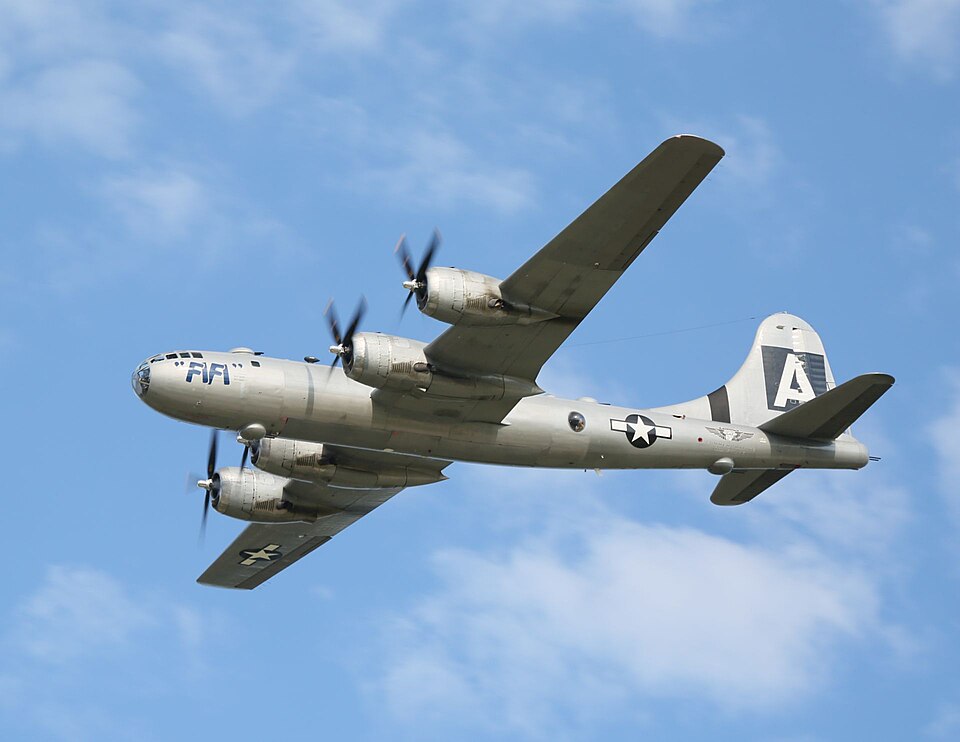
The B-29 was the largest and most expensive aircraft program of WWII. Boeing and its partners built nearly 4,000 of them, yet only two are airworthy in the entire world today.
Those two are Fifi, operated by the Commemorative Air Force out of Texas, and Doc, restored in Wichita, Kansas, after sitting on a Navy bombing range for decades. Both tour the United States during the warmer months and offer paid rides to the public. Fifi was the only flying B-29 in the world for more than 40 years until Doc returned to the sky in 2016.
Spotting a B-29 in the air is unlike anything else. Four big radial engines, a glassed-in nose, and a roar you can feel in your chest. Most aviation fans plan their summer airshow schedule around B-29 tour stops.
Fun Fact: The B-29 was so advanced for its time that it cost more to develop than the Manhattan Project.
2. Avro Lancaster "Vera"
The Avro Lancaster was Britain's heavy bomber backbone during WWII, and only a handful are even still around. As of recent years, just two examples are kept in flying condition: one in Canada (nicknamed "Vera," operated by the Canadian Warplane Heritage Museum) and one in the UK with the Royal Air Force's Battle of Britain Memorial Flight.
Vera is the last airworthy Canadian-built Lancaster, rolled off the assembly line in Ontario in 1945. The two airworthy Lancasters even crossed the Atlantic to fly together in 2014 for a special tour. That kind of formation is unlikely to happen again any time soon.
The Lancaster has a deep, almost musical four-engine drone, and the airframe is so massive that you tend to hear it before you see it. To preserve the airframe, the Canadian crew strictly limits its annual flight hours.
3. Boeing B-17 Flying Fortress
More than 12,000 B-17s were built during WWII. Today, only a small handful are airworthy, with most kept in the United States and one based in Europe. The exact count shifts every year as airframes go in for long-term maintenance or new restorations near completion.
Famous airworthy B-17s include Sentimental Journey, Aluminum Overcast, and the UK-based Sally B. Recent years have been hard on the surviving fleet. Two prominent flying examples were lost to crashes in 2019 and 2022, which made the few remaining flyers even more precious.
The B-17 has a distinct profile with its sharp tail fin and waist gun blisters. Hearing one fly over a small town is the kind of moment that stops kids and grandparents in their tracks.
Heads Up: Warbird flight schedules can change fast due to weather, maintenance, or one-time events. Always confirm with the operator before driving hours to see a specific aircraft fly.
4. Lockheed P-38 Lightning
The P-38 has one of the most striking shapes of any WWII fighter. Twin booms, a center pod for the pilot, and twin turbo-supercharged engines that gave it serious range. It served as a fighter, bomber escort, and reconnaissance aircraft, and it was the type that shot down Admiral Yamamoto.
Fewer than a dozen P-38s are flyable worldwide, and dedicated specialty shops handle most of the restoration work. The famous "Glacier Girl," recovered from beneath the ice in Greenland, is one of the better-known examples. P-38s are notoriously complex to restore due to their twin engines and intricate systems.
If you ever see a P-38 banking against a blue sky, look at the wingtips. The way they trail vortex lines on humid days is something other fighters simply cannot match.
Pro Tip: P-38 appearances are often the headline act at airshows, so they tend to fly later in the program. Stake out a spot early and bring sun protection.
5. Republic P-47 Thunderbolt
The "Jug" was one of the heaviest single-engine fighters of WWII, built around the massive Pratt & Whitney R-2800 radial engine. Despite over 15,000 being built, barely a dozen are flyable today. Restoration shops willing to take on Thunderbolt projects are extremely rare.
The P-47 made its name as a ground-attack workhorse in Europe, soaking up incredible damage and still flying home. That same toughness makes airworthy examples a treat to see at airshows. The Thunderbolt has a barrel-shaped fuselage and an oversized propeller that makes it instantly recognizable.
When a P-47 starts up, you feel it before you hear it. It is one of the loudest WWII fighters still flying.
6. Hawker Hurricane
The Spitfire usually gets the spotlight, but the Hurricane shot down a higher number of Luftwaffe aircraft during the Battle of Britain. About a dozen Hurricanes are airworthy today, with most based in the UK and a few in private collections elsewhere.
Notable flyers include Hurricane LF363, often associated with the Battle of Britain Memorial Flight, and PZ865, said to be the last Hurricane ever built. Both regularly take part in UK commemorative events alongside Spitfires.
The Hurricane has a more rugged, blocky look than the elegant Spitfire. It was easier to repair in the field, which is part of why it racked up such impressive combat numbers during 1940.
Keep in Mind: UK airshows often pair Hurricanes and Spitfires in formation flights. If you can plan a trip around one of these events, you get two iconic types in a single day.
7. Fokker Dr.I Triplane (Reproductions)
No original Fokker Dr.I triplanes are still airworthy. The plane Manfred von Richthofen flew has been gone since long before living memory. What you can see today are accurate flying reproductions, most famously at the Old Rhinebeck Aerodrome in upstate New York.
Old Rhinebeck has built and flown several Dr.I reproductions over the decades. Some use original-style rotary engines, while others use more modern radial engines for reliability during weekend airshow performances. Either way, the aircraft you see floating across that grass strip is closer to the real thing than almost anywhere else on earth.
The triplane's three short, stacked wings make it look almost unreal in the air. It climbs steeply, turns tightly, and burbles along on a small rotary engine that smells faintly of castor oil.
Quick Tip: Old Rhinebeck runs themed weekend airshows from mid-June through mid-October. The WWI Sunday show is the one to see if early aviation is your thing.
8. Boeing 747 (Passenger Service)
The "Queen of the Skies" is becoming a rare bird in passenger flying. Boeing delivered the very last 747 in early 2023, ending a 54-year production run. Cargo carriers still rely on hundreds of 747s, but only a small group of airlines still fly them with passengers in the back.
Lufthansa is by far the biggest passenger 747 operator, using the type on long routes from Frankfurt to cities around the world. A few other airlines, including Korean Air and Air China, still operate small numbers. The classic "hump" upper deck remains an unmistakable silhouette at major airports.
If riding a 747 is on your bucket list, the window is closing. Each year, more of them rotate out of passenger service and into freighters, museums, or scrap.
9. Airbus A340
The A340 was Airbus's answer to the Boeing 777 and McDonnell Douglas MD-11. Built with four engines for safety on long ocean crossings before twin-engine jets had the range, the A340 sold a respectable number but was eventually overtaken by more efficient twins like the A350.
Production ended in 2011, and as of recent fleet trackers, only a small number remain in scheduled passenger service across roughly seven airlines. Lufthansa, Mahan Air in Iran, and a few European and Asian carriers still keep the type in their long-haul fleets. Some governments and VIP operators also use A340s as private and charter aircraft.
The A340-600 stretched variant was the world's longest passenger aircraft for a time. Watching one rotate off a runway with all four engines spooled up is a sight you will not get from a modern twinjet.
Fun Fact: The A340 has a strong safety record despite its age, with no fatal accidents in scheduled commercial service.
Flying411's marketplace connects you with listings for new and used airplanes, helicopters, jets, and turboprops, including everything from light pistons up through turbine aircraft from major manufacturers.
Where to See Rare Planes in the Sky
Spotting these aircraft is easier than you might think if you know which events and locations to target. The big airshows tend to attract the warbirds, while specific airports give you reliable chances at the rare commercial types.
For warbirds, a few well-known events are at the top of the list:
- EAA AirVenture in Oshkosh, Wisconsin is a magnet for warbirds every July, and you can often spot multiple B-17s, B-25s, P-51s, and even occasional B-29 visits in one place.
- Reno Air Races (in its modern form) has historically drawn rare warbirds and racers in dramatic numbers.
- The annual Flying Legends event at Duxford in the UK is one of the best European gatherings of WWII fighters and bombers.
- Warbirds Over Wanaka in New Zealand is a top southern hemisphere event with rare types like Spitfires, Mustangs, and the occasional Yak fighter.
- Old Rhinebeck Aerodrome's weekend airshows (June through October) are the place to see flying WWI reproductions in their natural habitat.
For commercial rarities like the 747 and A340, you have to think more like a plane spotter:
- Frankfurt Airport (FRA) is a 747 and A340 hotbed thanks to Lufthansa's continued use of both types.
- Tehran Imam Khomeini Airport (IKA) sees Mahan Air's rare A340s, including one of the last A340-200s.
- Major international hubs like Los Angeles, JFK, and Hong Kong still see occasional 747s, mostly cargo but sometimes passenger.
Pro Tip: Most warbird operators publish tour schedules on their websites. Sign up for email lists from groups like the Commemorative Air Force or the Canadian Warplane Heritage Museum to get advance notice of stops near you.
What Keeps a Rare Plane Airworthy
Behind every rare plane flying right now is a small army of people doing unglamorous work. The casual airshow visitor sees a polished bomber thunder down the runway. They rarely see the late nights, the donations, the scavenged parts, and the painstaking inspections that came first.
Several common ingredients keep these aircraft in the air:
- Volunteer crews who handle everything from washing aluminum to operating the radios on tour stops.
- Specialized restoration shops that focus on specific types, like the small group of facilities that work on P-38s or Spitfires.
- Donated funding from members, ride-along passengers, and aviation enthusiasts.
- Type clubs and warbird associations that share parts, knowledge, and best practices.
- Strict maintenance limits, including capped annual flight hours, to stretch out the life of irreplaceable airframes.
- Original blueprints and drawings, often donated by manufacturers, to ensure restorations are accurate.
- Patience, since major projects sometimes span 20 years or more from acquisition to first flight.
Good to Know: Many warbird groups offer paid "ride-along" experiences. Aside from being unforgettable, the fee directly funds the maintenance and fuel that keeps the aircraft flying.
The same care applies on a smaller scale to the commercial rarities. Lufthansa keeps its 747-8s in the air partly because the aircraft suits specific high-demand routes that twin-jets cannot fill as comfortably. Mahan Air operates A340s partly out of necessity, given the limits placed on certain other types in its market.
Ready to take the next step in your own aviation journey? Browse the Flying411 marketplace for new and used aircraft, parts, engines, and trusted aviation services.
Conclusion
The list of rare planes flying right now is short, fragile, and worth every effort it takes to see them in person. Each surviving B-29, Lancaster, P-38, or 747 represents a chapter of aviation history that almost did not make it this far. Some are kept aloft by museums and volunteers, others by airlines stretching their last few four-engine workhorses across long-haul routes, and a few by passionate restorers who refuse to let an extinct type stay extinct.
If aviation history matters to you, the time to see these aircraft is now, not later. Schedules thin out every year, and the gap between "still flying" and "static display" closes quietly, often without notice.
Whether you're hunting for your first warbird, your next charter aircraft, or a certified mechanic to keep your current plane in the air, Flying411 is the place where the aviation world comes together.
FAQs
What is the rarest plane currently flying in the world?
There is no single answer, but most aviation historians point to types where only one or two airworthy examples remain. Aircraft like the B-29 Superfortress (only two flying) and certain one-of-a-kind warbird survivors are strong contenders for that title.
Can the public actually fly in a rare warbird?
Yes, in many cases. Groups like the Commemorative Air Force and the Canadian Warplane Heritage Museum sell ride-along seats on aircraft like the B-29, B-25, and Lancaster. Spots usually book out quickly and prices reflect the cost of operating these old airframes.
Are any World War I planes still flying with original parts?
Original WWI airframes are almost all in museums, but some flying reproductions use period-correct or original engines. Old Rhinebeck Aerodrome in New York is widely considered one of the best places to see authentic WWI-style aircraft in the air.
Why is the Boeing 747 still flying if it's so old?
The 747 still suits a narrow but useful set of long, high-demand routes, especially for Lufthansa, and remains popular in cargo operations because of its huge payload capacity. Production ended in 2023, but many existing aircraft still have years of service left.
How can I find rare aircraft for sale or aviation services to support my own aircraft?
Online aviation marketplaces are usually the best starting point, since they list new and used aircraft, engines, and parts in one place. Many of these platforms also connect owners with mechanics, avionics specialists, and other certified aviation professionals.