A retired CRJ-200 can look unusually cheap compared with purpose-built business jets, but the purchase price tells very little about what it actually costs to operate. The airplane brings airline-scale engines, inspection requirements, crew obligations and support costs into a corporate flight department. For buyers considering one as an employee shuttle, engine status and maintenance history matter far more than the asking price.
That gap is exactly why the question keeps coming up. If an energy company needs to move 40 crew members to a remote field twice a week, or a manufacturer wants to shuttle staff between two plants 600 miles apart, a used CRJ-200 corporate shuttle looks like the cheapest seat-mile money can buy. The airframe is cheap because the airlines are done with it, not because there is anything wrong with the way it flies.
The honest answer is that the purchase price is the least interesting part of the deal. Buying a retired regional jet is a bit like buying a ten-year-old city bus for the price of a used pickup — the acquisition is the cheap part, and everything after it is priced like a bus. The two line items that decide whether the math works are the General Electric CF34-3B1 engines hanging on the aft fuselage and the shape of the airframe's inspection and life-limited-part status.
This article walks through what a CRJ-200 actually costs to buy and run in a corporate role, what a CF34-3B1 shop visit does to a budget, how good the parts supply really is now that the program sits with MHI RJ Aviation Group, and when a different airplane is the smarter answer.
Key Takeaways
A used CRJ-200 can be a viable corporate shuttle, but only in a narrow set of missions: high seat counts, predictable routes under about 1,500 nautical miles, runways of 6,000 feet or longer, and an operation flying enough hours to absorb fixed costs. Acquisition is genuinely cheap by business-jet standards, sometimes low seven figures or less for an airline-configuration airframe, but engine status dominates the deal — a CF34-3B1 heavy shop visit is commonly quoted in the seven figures per engine, which can exceed what you paid for the airplane. Parts supply for the airframe is good because hundreds of CRJ100/200s have been parted out, while the pinch points are engine life-limited parts, landing gear, and 1990s-era Pro Line 4 avionics. Regulations matter too: a 50-seat CRJ used for noncommon-carriage corporate transportation will generally fall under Part 125 rather than ordinary Part 91, and its seating capacity also prevents it from fitting the normal Part 135 on-demand category without reconfiguration or a different operating structure. If your passenger count is closer to 12 than 40, a Challenger 850 or a Legacy-class jet will almost always cost less to own over five years.
| Question | Short answer |
| Is the purchase price really that low? | Yes. Airline-config CRJ200s have traded from the mid-six figures to low seven figures depending on engine, gear and inspection status. |
| What drives the real cost? | CF34-3B1 engine shop visits, landing gear overhauls, heavy structural checks and avionics upgrades. |
| Are parts available? | Airframe used serviceable material is plentiful. Engine LLPs, gear and legacy avionics are the tight spots. |
| Crew required? | Two type-rated pilots (CL-65) plus at least one flight attendant when carrying more than 19 passengers under Part 91. |
| Best mission | 30-50 seat scheduled employee shuttles, 300-1,200 nm, paved runways 6,000 ft+, near sea level. |
| Worst mission | Small executive groups, hot-and-high airports, short runways, transoceanic trips. |
What the CRJ-200 Actually Is
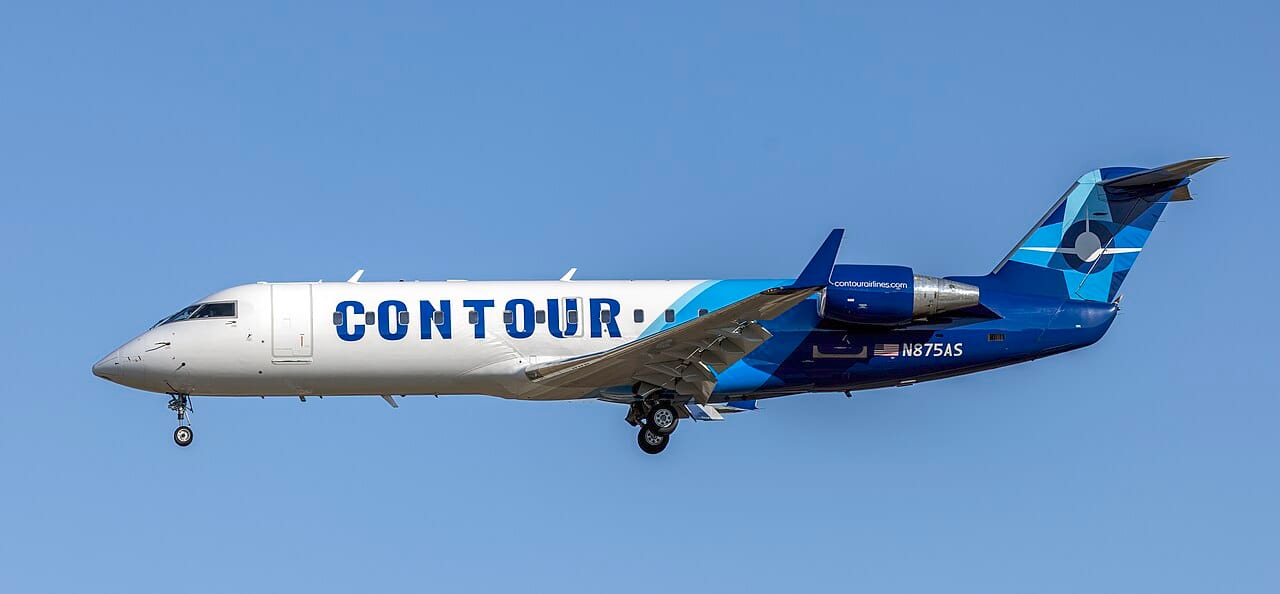
The CRJ-200 is not a clean-sheet airliner. It is a stretched, re-engined descendant of the Challenger 600 business jet, which is why it shares FAA type certificate data sheet A21EA with the Challenger family. Bombardier listed it as the CL-600-2B19. Roughly a thousand CRJ100/200-series aircraft were built before production ended in the mid-2000s, and the fleet has been leaving airline service steadily ever since as 50-seat economics soured.
Typical numbers: 50 passenger seats in airline layout, a cabin a little over six feet tall and roughly eight feet wide, a service ceiling of 41,000 feet, and long-range cruise around Mach 0.74 with high-speed cruise in the Mach 0.78 to 0.80 range. Range depends on configuration and operating conditions, but MHIRJ currently lists the CRJ200 at about 1,400 nautical miles. Individual ER or LR aircraft may show different planning figures depending on weight, fuel configuration and payload. The underfloor and aft baggage volume is enormous by business-jet standards, on the order of 500 cubic feet, which is a real advantage for crew-change flights where everyone brings a duffel and a hard hat.
Good to Know: The CRJ has no leading-edge slats. That is the single most important design fact for a corporate buyer, because it shows up as higher approach speeds and long takeoff distances. Plan on roughly 6,000 feet of runway at heavy weights at sea level, and considerably more as elevation and temperature climb.
Why did airlines dump them?
Fuel burn per seat. A CRJ200 burns in the neighborhood of 2,300 to 2,800 pounds per hour in cruise — call it 350 to 420 gallons — which is fine spread across 50 paying passengers and punishing spread across 50 seats flying half empty. Regional carriers replaced them with 70- and 76-seat jets that burn only modestly more. That collapse in demand is what created the cheap airframe supply corporate buyers are now looking at, and it is also a warning: the airplane is inexpensive because it only makes sense when the seats are full.
Why It Matters: A corporate shuttle that reliably carries 35 to 45 people is using the CRJ-200 the way it was designed to be used. A corporate shuttle that carries nine executives is paying airline fuel bills to move a light-jet payload.
Purchase Price: Why the Number Looks Too Good
Airline-configuration CRJ200s have changed hands for figures that startle people used to business-jet pricing. Depending on engine time remaining, landing gear status, where the airframe sits in its heavy inspection cycle and whether it is airworthy or stored, deals have ranged from the mid-six figures for a run-out, long-parked airframe to low seven figures for a well-maintained aircraft with time on the engines. Part-out candidates go for even less, because the buyer is pricing the components, not the airplane.
The factory corporate version — the Challenger 800 and its successor the Challenger 850, both built on the same CL-600-2B19 airframe — plays in a completely different market. Those come with an executive interior, extra fuel for roughly 2,800 nautical miles with a small load, and used asking prices generally in the mid-single-digit to low-double-digit millions. That is the trade: you pay many times the airframe price to get a finished corporate airplane instead of a project.
| Path | Typical acquisition | What you still owe |
| Airline-config CRJ200, high-time engines | Mid-six figures | Two engine shop visits, gear, heavy check, avionics |
| Airline-config CRJ200, mid-life engines | Low seven figures | Interior, cosmetics, deferred check items |
| CRJ200 with corporate interior conversion | Varies widely | Verify the STC paperwork and weight and balance |
| Factory Challenger 800/850 | Mid-single to low-double-digit millions | Normal business-jet maintenance and reserves |
Heads Up: A very low asking price on a stored airframe is a statement about condition, not a bargain. Aircraft that have sat outdoors for years accumulate corrosion, seized components, time-expired rubber and hydraulic issues, and the return-to-service bill routinely dwarfs the purchase price. Ask how long it has been parked, whether it was preserved to the manufacturer's storage instructions, and who has been turning the engines.
The gap between what sellers ask and what airplanes actually trade for is wider in this corner of the market than almost anywhere else, because the pool of buyers is small. Our guide to asking price versus actual sale price explains why that gap exists, and the used aircraft price negotiation playbook applies directly here — on a transport-category airplane, every discrepancy you document is leverage measured in six figures.
Flying411 keeps transport-category and business-jet listings in one place, so you can compare a bargain airline-configuration CRJ200 against a finished Challenger 850 before you commit to a conversion project.
CF34-3B1 Engine Costs: The Line Item That Decides Everything
The CRJ-200 is powered by two General Electric CF34-3B1 turbofans, each producing roughly 8,700 pounds of takeoff thrust per GE's published figures, with automatic power reserve available if an engine fails during takeoff. The CF34-3 is a well-understood, reliable engine family derived from the military TF34 and used across the Challenger line as well — which is part of why support exists at all.
How often does a CF34-3B1 need a shop visit?
There is no fixed calendar TBO in the piston-engine sense. The CF34-3 is maintained on condition under an approved maintenance program, with removal driven by performance deterioration, hardware distress found on borescope, or life-limited parts running out of cycles. In practice, operators and MROs plan around heavy shop visits in the range of every 5,000 to 8,000 hours, with the spread depending enormously on how the engine is operated. Short regional hops with derated takeoffs are gentler than constant full-thrust departures from hot, high airports.
What does a shop visit cost?
This is the number that ends most CRJ-200 dreams. A performance-restoration or heavy shop visit on a CF34-3 series engine is commonly quoted in the seven figures per engine, and workscopes that require replacement of life-limited rotating parts push higher still. Two engines coming due at once can exceed the acquisition cost of the airframe by a wide margin. Hourly maintenance reserve programs for the CF34-3 are typically quoted in the low hundreds of dollars per engine flight hour, which is the cleanest way to think about it: budget the shop visit as an ongoing per-hour cost whether or not you enroll in a program.
Pro Tip: Before you spend a dollar on a pre-purchase inspection, get the engine records and read the life-limited parts status sheets. Cycles remaining on LLPs, not hours since last shop visit, is the honest measure of what an engine is worth. An engine with 4,000 hours since overhaul but a disk approaching its cycle limit is a run-out engine wearing a nice haircut.
Is buying green time a strategy?
Sometimes. Some operators deliberately buy airframes with a couple of thousand hours of usable engine time, fly the mission hard for three or four years, and then part the aircraft out rather than fund shop visits. That can work if your utilization is high and your finance and tax structure tolerates a short life. It fails badly if the mission is low-utilization, because you pay the calendar-driven inspection costs without burning the engine time you paid for.
Keep in Mind: The APU is its own budget line. The CRJ uses a Honeywell GTCP36-series unit, and on a shuttle operation that boards passengers in heat or cold with the engines off, the APU runs constantly. APU overhauls are not trivial.
Parts Availability in the Post-Bombardier Era
Support for the CRJ program transferred from Bombardier to Mitsubishi Heavy Industries in 2020, and the CRJ type certificates, parts business and service network now sit with MHI RJ Aviation Group. That transition worried a lot of operators at the time. In practice, the CRJ200 is one of the better-supported out-of-production jets you can buy, for a simple reason: the fleet was large, and a great many airframes have been retired and disassembled. Used serviceable material for structure, interior, flight controls, wheels, brakes and common line-replaceable units is broadly available.
| Category | Supply outlook | Notes for buyers |
| Airframe structure and interior | Good | Many teardown aircraft; USM widely traded |
| Common LRUs and accessories | Good | Shared with Challenger 604 in some cases |
| CF34-3 engine modules | Adequate | Shop capacity and LLP lead times are the constraint |
| Landing gear | Tighter | Overhaul slots and exchange units can be scheduled months out |
| Pro Line 4 avionics | Obsolescence risk | CRT displays and legacy boxes; plan for upgrades |
The catch with used serviceable material on a transport-category aircraft is paperwork. Every part needs traceability that your maintenance provider and your insurer will accept, and on a Part 91 corporate operation you are the one holding the risk. Read our explainer on what 8130-3 tags, trace and back-to-birth records actually prove, and the companion piece on verifying traceability and certification of used parts. The same judgment calls that show up on a light single — covered in used versus overhauled parts — get much more expensive when the part came off a retired airliner.
Fun Fact: Because the CRJ descends from the Challenger 600, a corporate flight department already flying a Challenger 604 will find some overlap in systems philosophy, ground support equipment and even a few component part numbers. It is one of the few places where the airline world and the business jet world literally share hardware.
Flying411 keeps aircraft listings, engine and parts resources in one place, so you can compare an airframe's engine status against what a CF34-3 shop visit and a set of life-limited parts will actually cost you.
Operating a 50-Seat Corporate Jet Under Part 125
The regulatory picture surprises first-time buyers more than the maintenance picture does.
What crew do you need?
A 50-seat corporate CRJ normally operates with two pilots under a Part 125 program, with CL-65 qualification and recurrent training built into the operator's approved requirements. Part 125 also requires at least one flight attendant when carrying more than 19 but fewer than 51 passengers. A 40-passenger shuttle therefore requires at least two pilots and one flight attendant.
Can you charter it out to offset costs?
Not easily. Standard Part 135 on-demand operations are generally limited to airplanes with 30 passenger seats or fewer and a maximum payload capacity of 7,500 pounds or less, so a 50-seat CRJ200 does not simply go onto a conventional Part 135 charter certificate.
What about the airframe inspection program?
The CRJ200 is maintained on a continuous, task-based program with letter checks, structural inspection requirements from the manufacturer's aging-aircraft and corrosion prevention documents, and a running stack of airworthiness directives. Ask for a complete AD compliance status list, the current status of every calendar and cycle-limited item, and the date of the last heavy check. An airplane freshly out of a heavy check is worth substantially more than the price difference suggests.
Quick Tip: Hire a CRJ-experienced technical representative to review records before you make an offer, not after. On a 50-seat jet, records review is where deals are won and lost, and it is cheap relative to the exposure. Our library on what buyers should check in maintenance records is a reasonable starting framework even for transport-category aircraft.
Running the Real Numbers
Here is how to think about a CRJ-200 shuttle budget. Variable cost per hour is dominated by fuel and engine reserves. At 350 to 420 gallons per hour, fuel alone at typical contract Jet A pricing lands in the four-figure range per hour. Add engine and APU reserves, airframe maintenance reserves, landing gear accruals and navigation charges, and most operators find direct operating cost sits in the low thousands per flight hour. Fixed costs — hangar, insurance for 50 souls on board, three crew salaries and training, subscriptions, and the maintenance program management — are where a low-utilization operation gets hurt.
| Cost driver | Character | How to control it |
| Fuel | Largest variable cost | Fill at the cheap end of the route; fly long-range cruise |
| Engine shop visits | Largest lifecycle cost | Buy engine status carefully; consider an hourly program |
| Crew and training | Largest fixed cost | Right-size the roster to actual trip demand |
| Heavy checks and structure | Lumpy, calendar-driven | Buy post-check; budget the next one from day one |
| Insurance | Liability-heavy | Low hull value helps; high passenger count does not |
Why It Matters: A CRJ-200 shuttle beats buying 40 airline tickets twice a week only when the routes are ones the airlines serve badly, the schedule has real value to the business, and utilization is high enough — several hundred hours a year at minimum — to spread the fixed costs. Below that, chartering somebody else's 50-seat jet is usually cheaper and always simpler.
When a Different Airplane Wins
If your typical load is eight to fourteen people, stop looking at CRJ-200s. A Challenger 850 gives you the same airframe with a finished cabin, more range and a maintenance program somebody has already built. An Embraer Legacy 600 or 650 delivers similar cabin volume with better range. A Challenger 604 shares the engine family and drops you into a mainstream business-jet support network.
If your loads are 30 to 50 people on short, repeated sectors into shorter runways, a used turboprop — Dash 8, ATR, or a Saab 2000 — will burn far less fuel and get into fields the CRJ cannot. You give up speed and cabin altitude comfort. For an hour-long crew change, that trade often favors the turboprop.
The CRJ-200's sweet spot is narrow but real: high headcount, jet speed required, sectors of 300 to 1,200 nautical miles, adequate runways, and an operator with the technical depth to manage a transport-category airplane. Energy, mining, sports teams and large multi-site manufacturers are exactly the profiles that make it work.
Good to Know: Engine selection logic scales all the way down the aviation ladder. The same reasoning that makes a CF34-3B1 shop visit the deciding factor on a CRJ-200 is what makes buyers weigh powerplants on small aircraft too — see our comparison of the Rotax 912 versus Continental O-200. Different money, identical question: what does this engine cost per hour over its whole life?
Flying411 keeps buying guides, cost breakdowns and live listings in one place, so you can size a shuttle mission against the airplanes that actually fit it instead of the one with the lowest sticker.
Conclusion
A used CRJ-200 corporate shuttle is viable, but it is an operations project rather than an airplane purchase. The type is proven, the airframe parts supply is genuinely healthy thanks to a large retired fleet and MHI RJ's continued support, and the acquisition cost can look almost accidental. What it asks in return is discipline: verify life-limited part status on both CF34-3B1 engines before anything else, budget seven figures per engine for the next heavy shop visit, confirm where the airframe sits in its heavy check and structural inspection cycle, plan for three crew members and a CL-65 training bill, and be honest about whether the seats will be full.
Do that arithmetic first and you will know quickly which side of the line your mission falls on. Forty passengers twice a week on a route the airlines ignore? The numbers can work. Ten executives and a hope of charter income? Buy a different airplane.
When you are ready to compare listings, visitFlying411and see what is on the market today.
Frequently Asked Questions
How much does a used CRJ-200 cost to buy?
Airline-configuration aircraft have traded anywhere from the mid-six figures for stored, run-out airframes to the low seven figures for aircraft with meaningful engine time and a recent heavy check. Factory corporate versions — the Challenger 800 and 850 — sell in the mid-single-digit to low-double-digit millions. Always price the engine and landing gear status, not the airframe.
What is the TBO on a CF34-3B1?
There is no fixed TBO. The CF34-3 family is maintained on condition, with removals driven by performance deterioration, borescope findings and life-limited part cycle limits. Most operators plan heavy shop visits somewhere in the 5,000 to 8,000 hour range, with the spread driven by how hard the engine is operated.
Can I fly a 50-seat CRJ-200 under Part 91?
A CRJ-200 can be used for private corporate transportation, but a 50-seat noncommon-carriage operation will generally be conducted under Part 125 rather than ordinary Part 91. That means an approved operating program, two-pilot flightcrew requirements and at least one flight attendant when carrying more than 19 passengers. Standard Part 135 on-demand operations are generally limited to airplanes configured with 30 passenger seats or fewer and a payload capacity of 7,500 pounds or less.
Are CRJ-200 parts still available now that Bombardier sold the program?
Yes. MHI RJ Aviation Group holds the type certificates and provides factory support, and the large number of retired CRJ100/200 airframes keeps used serviceable material flowing. The tighter areas are engine life-limited parts, landing gear overhaul slots and the original Pro Line 4 avionics, where obsolescence eventually forces an upgrade decision.
How much runway does a CRJ-200 need?
Plan on roughly 6,000 feet at heavy weights at sea level on a standard day, and more as temperature and field elevation rise. The CRJ has no leading-edge slats, so hot-and-high performance is one of its real weaknesses. Check actual performance charts for your specific routes before you buy.
Would a turboprop be cheaper for the same mission?
For short sectors, usually yes. A Dash 8 or ATR moves a similar number of people on far less fuel and handles shorter, rougher fields. You trade about 100 knots of cruise speed and some cabin comfort for that. If your typical leg is under about 400 nautical miles, run the turboprop numbers side by side before committing to a jet.