Nature figured out flight long before humans ever did. Birds were soaring, diving, and gliding for millions of years before the first engineer ever picked up a pencil. So when people finally started building flying machines, it made perfect sense that they looked up at the sky for answers. The shapes they copied, the curves they borrowed, and the movements they studied all came from one place.
Some of the most remarkable planes that look like birds are proof that the best design ideas were already flying around long before the first engine ever roared to life.
Bird-inspired aviation design has shaped everything from wing curvature to fuel efficiency in ways engineers are still building on today. The nine aircraft ahead will make you do a double take.
Key Takeaways
Some of the most groundbreaking aircraft ever built were directly shaped by the way birds fly. Engineers studied bird wings, body shapes, and flight patterns to solve real problems like drag, fuel use, and stability. These nine planes that look like birds stand out because their bird-like shapes were not accidents. They were intentional answers to some of aviation's hardest challenges, from stealth to long-range solar flight.
| Aircraft | Bird Resemblance | Primary Reason for Design |
| Scaled Composites Stratolaunch | Giant albatross | Extreme wingspan for high-altitude launch |
| Northrop Grumman B-2 Spirit | Soaring raptor | Stealth and low radar profile |
| Solar Impulse 2 | Soaring albatross | Ultra-long wingspan for solar efficiency |
| Lockheed SR-71 Blackbird | Peregrine falcon | Speed and streamlined shape |
| NASA Ptera | Pterosaur and bird hybrid | Wing morphing research |
| Airbus Bird of Prey | Bird of prey in a dive | Aerodynamic efficiency testing |
| Joby Aviation S4 | Hummingbird | Vertical lift and hover capability |
| Aerospatiale/BAC Concorde | Seabird in a glide | Supersonic slender fuselage |
| Boeing X-48 | Blended wing bird | Lift efficiency and fuel savings |
Flying411 covers the aviation world from every angle, with engineering deep dives, buyer guides, and stories that make sense whether you fly often or just love watching planes overhead.
Why Nature Built the First Flying Machines Long Before We Did
Birds have been solving the problem of flight for a very long time. Long before any aircraft rolled down a runway, birds were already using wings, feathers, and hollow bones to stay airborne with remarkable efficiency. They did not need equations or wind tunnels. Evolution handled all of that over millions of years. When humans finally started chasing the same dream, they had a living library of answers right above their heads.
The earliest people who wanted to fly did not look at the clouds and imagine engines. They looked at birds. Ancient myths like the story of Icarus told of humans strapping on wings and trying to reach the sky. Those stories were not just imagination. They reflected a genuine fascination with bird flight that stretched across cultures and centuries.
Here are some of the key things birds solved that engineers would later spend lifetimes trying to figure out:
- Lift. Bird wings are curved on top and flatter on the bottom, which forces air to move faster over the top surface. That difference in speed creates lower pressure above the wing and higher pressure below it. That pressure gap is what pushes the bird upward.
- Drag reduction. Birds tuck their legs, fold their feathers tight, and streamline their entire body during high-speed flight. Every part of a bird's body is shaped to let air slide past with as little resistance as possible.
- Stability. Birds adjust their wings constantly during flight. They spread them wider to slow down and pull them closer to accelerate. That constant adjustment keeps them balanced even in gusty conditions.
- Energy efficiency. Many large birds barely flap their wings during long trips. They ride thermal currents and glide, using the environment to stay airborne instead of burning energy constantly.
Fun Fact: The idea of a glider that catches rising air and stays up without an engine did not come from an engineer's imagination. It is said to have come from people watching eagles and vultures circle for hours without a single wing beat.
Otto Lilienthal, a German aviation pioneer, understood this deeply. He studied birds with scientific care and built gliders in the 1890s that used bird-like curved wings to generate lift. His work directly influenced the people who came after him, including the Wright Brothers, who would later achieve the first powered flight in 1903. What birds had figured out over millions of years of evolution, humans were only beginning to understand.
What Biomimicry Means and Why Bird-Inspired Aircraft Keep Showing Up
Biomimicry is the practice of copying designs found in nature to solve human problems. The word sounds technical, but the idea is simple. If something in nature works really well, study it and use it. Birds fly better than anything humans have ever built, so it makes sense to look at how they do it.
Aviation has been borrowing from birds since the very beginning. The curved shape of a bird's wing, called an airfoil, is the same basic shape used on most commercial airplanes flying today. That curve is not decorative. It is functional. It controls how air moves around the wing and determines how much lift the aircraft can generate. Engineers did not invent that shape. They copied it.
Bird-Inspired Features You Can Spot on Modern Aircraft
Bird-inspired design keeps showing up in aerospace development for a few clear reasons:
- Wingtip efficiency. Many birds have feathers at the tips of their wings that spread out like fingers. This reduces a type of drag called induced drag, which forms when high-pressure air below the wing curls up and over the wingtip. Modern aircraft use devices called winglets that do exactly the same job.
- Body shape. Birds have narrow, tapered bodies that push through the air without creating much resistance. Engineers call this a low-drag fuselage shape. It is used in everything from fighter jets to passenger airliners.
- Wing flexibility. Birds adjust the shape of their wings mid-flight by tensing or relaxing different muscle groups. Researchers studying this ability have built experimental aircraft with flexible wings that can change shape during flight to improve efficiency.
- Weight reduction. Birds have hollow bones that are very light without sacrificing strength. Lightweight materials used in modern aircraft, including carbon fiber composites, follow the same principle. Less weight means less fuel burned and better performance overall.
Why It Matters: According to researchers at the Royal Veterinary College, studying how eagles control their wing shape during flight has directly informed experimental aircraft wing designs aimed at improving air resistance handling and stability.
The reason bird-like aircraft keep appearing is simple. When you study bird flight carefully and try to build something that does the same things, the result tends to look like a bird. The shape is not a stylistic choice. It is the logical outcome of solving the same problem birds already solved.
How the Shape of a Bird Became the Blueprint for Modern Flight
The connection between bird shapes and aircraft shapes is not a coincidence. It is the result of engineers asking a very specific question. How do birds stay in the air so well, and how do we copy that? The answers, worked out over more than a century of research, produced aircraft that share a striking visual resemblance to the animals that inspired them.
The Wright Brothers are the most famous example of engineers who studied birds closely. They spent years watching birds in flight, particularly buzzards, and noticed how the birds twisted the tips of their wings to control balance. That observation led directly to the invention of wing warping, a system that allowed their airplane to bank and turn by twisting the wingtips. Without that specific observation, controlled powered flight might have taken much longer to achieve.
Leonardo da Vinci sketched flying machines centuries before the Wright Brothers ever took off. His drawings included machines with flapping wing mechanisms inspired by bats and birds. He studied how wings generated lift and tried to translate that into mechanical designs. His notebooks show a deep understanding of how wing shape and movement create the conditions for flight.
Bird-Body Features That Became Aviation Blueprints
A few specific traits keep showing up across both bird anatomy and aircraft design:
- Swept-back wings. Falcons and swifts pull their wings back for high-speed dives. Swept-back wing designs on jet aircraft follow the same logic, reducing drag at high speeds.
- Tapered wingtips. Many birds have wings that narrow toward the tip. This shape improves efficiency by managing how air moves off the end of the wing.
- Streamlined bodies. A bird's body is narrowest at the head and tail, with the widest point in the middle. This teardrop shape moves through air with very little resistance, and most aircraft fuselages follow the same general profile.
- High-lift features at low speeds. Birds spread their wing feathers wide during landing to create more surface area and slow down safely. High-lift flap systems on commercial aircraft do the same thing during approach and landing.
Modern aerodynamic design tools like computer fluid simulations let engineers test bird-inspired shapes with a level of precision that early pioneers like Lilienthal could only dream of. Engineers can now fine-tune bird-like shapes in a digital wind tunnel to a degree of accuracy that would have been unthinkable not that long ago. The result is a generation of aircraft that are faster, more efficient, and more capable than anything that came before. Many of them, when seen from the right angle, look exactly like the birds that inspired them.
Pro Tip: Curious about what keeps these bird-like machines flying when something goes wrong? You might enjoy reading about the best planes for new pilots to see how learner-friendly aircraft handle stability and recovery.
9 Planes That Look Like Birds That Stopped the Aviation World Cold
These nine aircraft do not just perform like birds. Several of them look so much like birds in flight that spotting one overhead might make you look twice. Each one carries a design story rooted in aerodynamics, careful observation of nature, and some genuinely bold engineering decisions.
1. Scaled Composites Stratolaunch
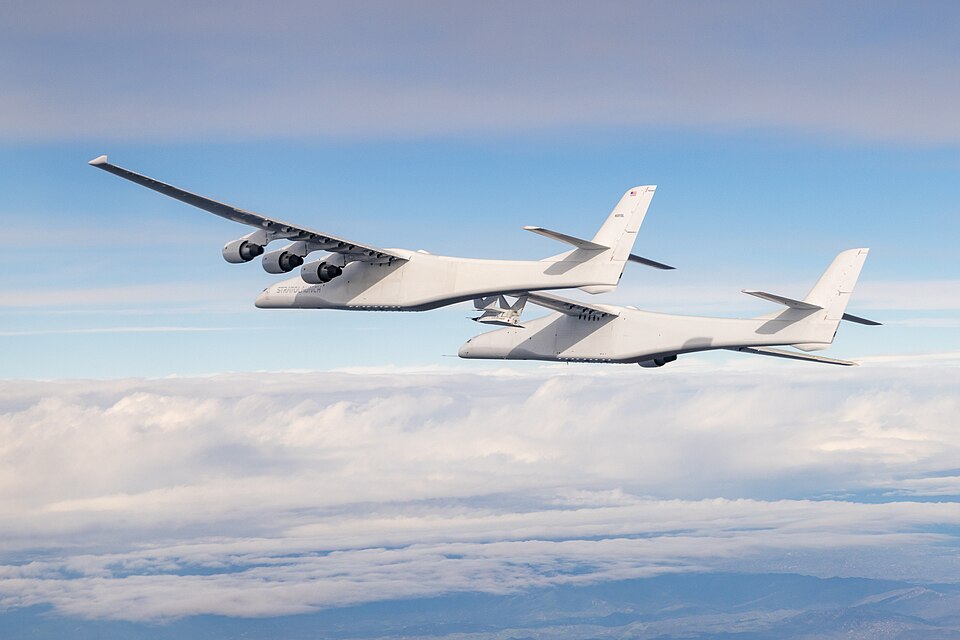
The Stratolaunch is widely considered one of the largest aircraft by wingspan ever built, reaching about 117 meters from tip to tip. That number is almost impossible to picture until you see it next to something familiar. It is wider than an American football field. The closest thing in nature is a giant albatross, which has long been considered the bird with the largest wingspan, and the Stratolaunch shares that same wide, gliding silhouette.
The aircraft was constructed from carbon fiber composites, keeping it light enough to fly despite its enormous size. It uses a twin-fuselage design with six engines, and its primary job is to carry rockets into the upper atmosphere and release them at altitude. The rockets then fire and reach orbit. The design borrows from the same principle that large soaring birds use. Get up high, spread wide, and use the altitude to your advantage.
Key facts about the Stratolaunch:
- Wingspan around 117 meters
- Six Pratt and Whitney engines
- Built as an airborne rocket launch platform
- First flight in April 2019
- Twin fuselages connected by a center wing
2. Northrop Grumman B-2 Spirit
The B-2 is one of the most recognized aircraft shapes in the world, and it looks almost exactly like a massive bird soaring with its wings spread wide. There are no vertical tail fins. There is no traditional fuselage. The entire aircraft is one continuous blended wing shape, which is nearly identical to the silhouette of a large soaring raptor viewed from below.
This design was not chosen because it looks cool. The blended fixed-wing shape dramatically reduces radar reflection, making the B-2 one of the hardest aircraft in the world to detect. The same wing shape that makes a soaring bird nearly silent in the sky helps make the B-2 nearly invisible to radar.
Good to Know: The B-2 is widely considered one of the most lethal aircraft ever built, and its bird-like silhouette is central to what makes it so effective. If powerful military aircraft interest you, the rundown on top U.S. fighter jets is a great companion read.
Key facts about the B-2:
- Wingspan around 52.4 meters
- Top speed around 630 mph
- Role as a stealth strategic bomber
- First flight in 1989
- Crew of two
3. Solar Impulse 2
Solar Impulse 2 looks like someone stretched a bird's body as thin as possible and attached enormous wings to it. The wingspan reaches about 72 meters, wider than many large airliners, but the aircraft itself weighs about as much as a family car. That extreme ratio of wing area to weight is exactly what large soaring seabirds like albatrosses use to stay airborne for days without flapping.
The aircraft is covered in thousands of solar cells that charge batteries during the day, allowing it to fly through the night using stored energy. Solar Impulse 2 completed a full circumnavigation of the globe in 2016 using no fuel at all. It is one of the clearest examples of bird-inspired design principles applied to a real-world engineering challenge. How do you fly as far as possible on as little energy as possible?
Key facts about Solar Impulse 2:
- Wingspan around 72 meters
- Weight close to that of a family car
- Powered by solar cells and lithium batteries
- First solar-powered round-the-world flight
- Single pilot
4. Lockheed SR-71 Blackbird
The SR-71 Blackbird was named after a bird, and it earns that name in more ways than one. Its long, narrow body and swept-back wings give it a silhouette that closely resembles a peregrine falcon in a full-speed dive. The peregrine has long been considered the fastest animal on Earth, capable of reaching incredible speeds in a dive. The SR-71 is widely considered the fastest crewed jet aircraft ever built.
Both the bird and the aircraft achieve their speed through the same basic approach. They use a narrow, tapered body that cuts through the air with minimal resistance, and wings swept far back to reduce drag at extreme speeds. The SR-71's engineers studied bird flight and applied the same aerodynamic logic the peregrine falcon uses naturally. The result is an aircraft that held the air speed record for a crewed jet for decades.
Key facts about the SR-71 Blackbird:
- Top speed above 2,000 mph
- Built for strategic reconnaissance
- In service from 1966 to 1998
- Crew of two
- Distinctive chined forebody that acts like a lifting surface
5. NASA Ptera
The NASA Ptera is a small experimental aircraft built specifically to test wing design ideas inspired by how birds change the shape of their wings mid-flight. Its name references the pterosaur, an ancient flying reptile, but its design is rooted in the study of birds and how their flexible wing structures allow them to adjust to changing air conditions instantly.
Ptera is a remotely piloted research vehicle used to test morphing wing technology. The idea is that an aircraft whose wings can change shape during flight, just like real birds adjust their feathers and wing angle, can be far more efficient than one locked into a single fixed shape.
Heads Up: Morphing wing tech is still mostly experimental, but the lessons from research aircraft like Ptera are already shaping ideas for future commercial designs.
Key facts about NASA Ptera:
- Remotely piloted research aircraft
- Built to test morphing wing technology
- Inspired by avian wing flexibility
- Sub-scale demonstrator
- Uses flexible wing control surfaces
6. Airbus Bird of Prey
The Airbus Bird of Prey is a concept demonstrator that does exactly what its name suggests. It is shaped to look and perform like a bird of prey in a steep, controlled glide. The behavior of birds during high-speed flight directly influenced every major surface on this aircraft, from the curved leading edge of the wing to the blended body shape that eliminates sharp corners where drag builds up.
Airbus revealed the Bird of Prey to demonstrate what commercial aviation aircraft could look like if engineers fully committed to nature-inspired shapes. The result is an aircraft that generates significantly less drag than conventional tube-and-wing designs. Energy savings from this type of shape could translate into meaningful fuel reductions for full-scale commercial jets.
Key facts about the Airbus Bird of Prey:
- First revealed in 2019
- Built as a technology demonstrator
- Features raked wingtips inspired by bird feathers
- Focused on drag reduction and aerodynamics
- Built by the Airbus UpNext division
7. Joby Aviation S4
The Joby S4 is an electric vertical take-off and landing aircraft, and the closest real-world design comparison is a hummingbird. Hummingbirds are the only birds that can hover in place, fly forward, fly backward, and transition instantly between those states. The S4 does the same thing using six tilting rotors that shift from pointing upward for vertical lift to pointing forward for cruise flight.
Looking at birds like the hummingbird for inspiration allowed Joby's engineers to solve one of the hardest problems in urban air mobility. How do you build something that is efficient both when hovering and when flying fast? Birds solved this long before the question was ever asked in an engineering lab. If smaller-scale aviation interests you, the deeper look at practical regional aircraft covers similar short-distance flight challenges.
Key facts about the Joby S4:
- Top cruise speed around 200 mph
- Range close to 150 miles per charge
- Six tilting electric rotors
- Designed as an urban air taxi
- Vertical take-off with no runway needed
8. Aerospatiale/BAC Concorde
The Concorde looks like a seabird skimming just above the water at full speed. Its body sits low, the wings are swept far back, and the nose stretches forward into a point. That long, tapered shape was not chosen for looks. It was the result of solving the same problem a swift or gannet solves when moving through air at extreme speed. How do you shape a body so air barely notices it passing?
The Concorde's curvature of the wing, called an ogival delta, allowed it to generate lift at very high speeds without the traditional straight leading edge. Aviation pioneers of the supersonic era were watching birds in flight and applying the same logic to aircraft that needed to fly above 1,300 mph while still being capable of long transatlantic routes. The Concorde is also widely regarded as one of the safest passenger aircraft ever flown in terms of its overall accident rate during commercial service.
Key facts about Concorde:
- Top speed close to Mach 2
- Built for supersonic passenger transport
- In service from 1976 to 2003
- Carried up to about 128 passengers
- Long, slender, needle-nosed fuselage
9. Boeing X-48
The Boeing X-48 is a blended wing body demonstrator, and birds in flight inspired its entire concept. Traditional airliners have a tube for a body and separate wings bolted on. The X-48 blends everything into one smooth shape, the way a migrating bird's profile looks from above during a long soaring glide. It is one continuous surface from wingtip to wingtip with no sharp joins.
This design allows the entire aircraft surface, not just the wings, to generate lift. The result is significant fuel savings and a much quieter aircraft because the engines can be positioned above the body rather than under the wings. Many aerospace engineers believe the X-48 represents the future of large commercial aircraft design. For comparison, the largest passenger aircraft flying today still mostly use the traditional tube-and-wing layout.
Keep in Mind: The dream of an ornithopter, an aircraft that flaps like a bird, was never fully workable at large scale, and ornithopters remain experimental at best. But the blended wing approach the X-48 demonstrates shows that, like birds, aircraft can generate lift from their whole body.
Key facts about the Boeing X-48:
- Sub-scale demonstrator at about 8.5% of full size
- Demonstrator wingspan around 6.4 meters
- Built for blended wing body research
- Significantly higher lift-to-drag ratio than conventional designs
- Active research from 2007 onward
How These Bird-Like Aircraft Compare at a Glance
Each of these aircraft solves a different problem, but a side-by-side view makes it easier to see how their bird-inspired traits stack up against each other.
| Aircraft | Bird-Like Trait | Standout Capability |
| Stratolaunch | Albatross-style wide wingspan | Carrying rockets to launch altitude |
| B-2 Spirit | Soaring raptor silhouette | Stealth strategic bombing |
| Solar Impulse 2 | Long, light albatross-like wings | Solar-powered global flight |
| SR-71 Blackbird | Falcon-style narrow body | Extreme high-speed reconnaissance |
| NASA Ptera | Bird-like flexible wings | Morphing wing research |
| Airbus Bird of Prey | Raptor in a dive | Concept-level drag reduction |
| Joby S4 | Hummingbird hover | Urban air taxi flight |
| Concorde | Seabird in a glide | Supersonic passenger travel |
| Boeing X-48 | Blended soaring profile | Fuel-efficient airliner research |
Quick Tip: If you enjoy spotting design lineage, look at the wings first. Wide and flat usually means efficiency and endurance. Narrow and swept usually means speed.
Conclusion
The nine planes on this list are not accidents. Every swept wing, blended fuselage, and tapered wingtip traces back to a decision some engineer made after watching a bird and asking the right question. Nature spent millions of years refining the mechanics of flight, and the aviation industry has spent over a century learning from it.
The results show up in speed records, stealth capability, solar-powered circumnavigation, and aircraft that can hover like a hummingbird over a city street. Birds were the first engineers, and as long as people keep building aircraft, they will keep being the inspiration.
For more aviation reads that go from engineering deep dives to ownership tips, head over to Flying411.
Frequently Asked Questions
Are there any planes specifically designed to flap their wings like birds?
Yes, these are called ornithopters. Most remain experimental and small-scale. A human-piloted ornithopter is said to have achieved brief self-powered flight in a Canadian research project in 2010, but flapping-wing aircraft have never been developed into practical full-size planes. The mechanical complexity makes them far less efficient than fixed-wing designs at larger scales.
Did any ancient cultures actually try to build bird-like flying machines?
Several ancient civilizations are said to have attempted flight using bird-inspired designs. Beyond the myth of Icarus, historical records and drawings from cultures in China, the Middle East, and Europe show sketches of winged contraptions based on bird anatomy. None achieved powered flight, but they show how deeply the observation of birds shaped humanity's earliest ideas about what a flying machine should look like.
How do engineers today use computer tools to study bird-inspired designs?
Modern engineers use computational fluid dynamics software to simulate how air flows around bird-inspired shapes without building physical prototypes. These digital wind tunnels let researchers test thousands of wing shapes, body curves, and surface textures in the time it once took to test one physical model. Much of the blended wing and morphing wing research happening today relies on these tools.
Which bird species has influenced aircraft design the most?
The albatross has had one of the strongest influences on long-range aircraft design because of its impressive wingspan-to-weight ratio and its ability to glide for very long distances using almost no energy. Winglet design was also heavily influenced by eagles and condors. The peregrine falcon shaped thinking around high-speed, low-drag fuselage profiles used in military jets.
Is bird-inspired aircraft design still an active area of research today?
It is very active. Researchers are currently studying how birds change the stiffness and shape of their wings mid-flight to improve efficiency. Projects focused on morphing wings, feather-inspired surface textures that reduce drag, and bio-inspired tail designs are all active areas of aerospace research at universities and institutions around the world, including NASA and Airbus.
Do bird-like aircraft designs actually save fuel in real-world use?
In many cases, yes. Winglets, which were directly inspired by the wingtip feathers of soaring birds, are widely credited with helping airlines reduce fuel burn on long flights. Blended wing body research, like the work behind the Boeing X-48, suggests even larger fuel savings are possible if commercial aircraft fully adopt bird-inspired shapes in the future.
Can hobby pilots or homebuilders use bird-inspired design ideas?
Absolutely. Many homebuilt and experimental aircraft borrow ideas like tapered wingtips, light frames, and curved airfoils. If you are exploring this world, looking into vintage aircraft worth restoring is a fun way to see how older airframes already captured many of these same principles in simpler forms.