Every day, thousands of commercial flights depend on satellite signals to know where they are. Those signals are quiet and invisible. Most people never think about them.
GPS signals travel over 20,000 kilometers from orbit to reach Earth, and by the time they arrive, they are extremely weak, weak enough that a small ground transmitter can overpower them entirely. That vulnerability is now being exploited near conflict zones around the world, where those signals are being blocked, scrambled, and faked.
This is now a real safety problem. It shows up in cockpits on routes that once seemed completely safe.
GNSS interference in conflict zones has gone from a military concern to a front-page aviation issue. Here is a look at how it works, why it happens, and what it means for flights in the air today.
Key Takeaways
GNSS interference near conflict zones is disrupting GPS signals used by commercial aircraft worldwide. Military forces use jamming to block signals and spoofing to send false ones. Neither method can tell the difference between a fighter jet and an airliner. This has caused serious cockpit problems, including false terrain warnings, navigation failures, and position errors of hundreds of miles. Incidents have risen over 220% since 2021. The highest-risk areas are Eastern Europe, the Middle East, and the Baltic Sea. Regulators and airlines are working on fixes, but the threat keeps growing.
| Key Point | Detail |
| What is jamming | Blocks GPS signal entirely, crews know it is gone |
| What is spoofing | Sends false GPS signals, harder to detect |
| Biggest hotspots | Eastern Europe, Middle East, Baltic Sea |
| Systems affected | FMS, EGPWS, ADS-B, autopilot, Wi-Fi |
| Rise in incidents | Over 220% increase from 2021 to 2024 |
| Who is responding | EASA, IATA, FAA, ICAO all have active plans |
What Is GNSS and Why Do Planes Rely on It?
GNSS stands for Global Navigation Satellite System. It is the term used for all satellite navigation networks in use today. The United States runs GPS. Europe uses Galileo. Russia has GLONASS. China operates BeiDou. Each one works by sending signals from satellites about 20,000 kilometers above Earth. A device on the ground, or inside an aircraft, picks up those signals. It uses them to find its exact position. The more satellites a receiver can hear, the more accurate the result.
Commercial aircraft use GNSS for a lot more than the map on the back of a seat. It sits at the center of almost every key flight system. Here is what GNSS powers on a typical airliner:
- Flight Management System (FMS): Uses GPS position to plan routes, track fuel burn, and estimate arrival times
- Autopilot: Needs accurate position data to follow the planned flight path
- ADS-B (Automatic Dependent Surveillance-Broadcast): Sends the aircraft's position to air traffic control and nearby planes
- EGPWS (Enhanced Ground Proximity Warning System): Checks GPS position against terrain data and warns pilots of ground hazards
- RNP Approaches: GPS-guided approaches that let planes land at tough airports in bad weather or mountainous areas
This deep reliance is what makes GNSS problems so serious. When navigation systems lose good satellite data, the effects spread fast. They do not stop at the moving map. They ripple through the whole cockpit.
GNSS signals are also easy to overpower. They travel over 20,000 kilometers to reach Earth. By the time they arrive, they are very weak. A small transmitter on the ground can easily drown them out. Military planners have known this for decades. What changed is that the tools to disrupt these signals are now cheap, easy to get, and used at a much bigger scale than anyone planned for when aviation became so GPS-dependent.
GPS Jamming vs. Spoofing: What Is the Difference?
There are two ways to interfere with a GPS signal. They work very differently. And one is far more dangerous than the other.
GPS Jamming is the simpler method. A jamming device sends radio frequency noise on the same frequency GPS satellites use. This drowns out the real signal. The aircraft's GPS receiver stops receiving data. Cockpit alerts appear. The flight crew knows something is wrong and can switch to backup systems like inertial navigation. Jamming causes problems, but it is obvious. Crews are trained for it.
GPS spoofing works differently. Instead of blocking the signal, it sends a fake one. The aircraft's receiver picks it up and treats it as real. The position on the cockpit screen looks correct. All systems keep running as normal. But the aircraft thinks it is somewhere it is not. That could mean it appears dozens of miles off course, at the wrong altitude, or in a completely wrong place on the map.
What makes spoofing so dangerous:
- It is hard to detect. No alarm sounds when a fake signal looks valid. Crews may not know anything is wrong until the aircraft starts behaving strangely.
- It hits multiple systems at once. Many cockpit systems pull from the same GPS feed. A false position corrupts all of them at the same time.
- It triggers false safety alerts. The terrain warning system may think the plane is near the ground when it is actually at cruise altitude. It fires a "PULL UP" warning. Pilots who respond may climb fast and without coordination, creating new risks.
- Recovery takes time. Some aircraft need a full system reset to clear a false GPS position from all avionics.
The growth in jamming and spoofing has pushed regulators to rethink how aviation uses satellite navigation. EASA updated its Safety Information Bulletin to flag spoofing as the bigger risk. It is harder to catch in real time. Both threats are serious. But spoofing is the one that can fool the flight deck into thinking all is well when it is not.
Why Conflict Zones Are the Biggest Source of GNSS Interference
Armies have a clear reason to jam and spoof GPS signals. Drones and guided weapons use GPS to navigate. Jam the signal, and a drone loses its way. Send a false signal, and a guided weapon misses its target. So forces defending against drone attacks set up electronic warfare gear to block those signals across the surrounding airspace.
The problem is that this gear cannot tell a military drone from a passenger jet. It sends interference in all directions. It covers wide areas. The signal strength is high enough to beat the real satellite signals coming from space. Any commercial aircraft flying nearby picks up the same disruption.
This has happened across several active conflict zones:
- Ukraine and Eastern Europe: Since Russia's invasion of Ukraine in 2022, GPS jamming has spread across the region. Effects have reached into the Baltic Sea, Finland, Estonia, Latvia, Poland, and beyond. In 2024, Finnair stopped flights to the Estonian city of Tartu because GPS outages made safe landings impossible.
- Middle East: The Israel-Hamas conflict brought heavy spoofing to the eastern Mediterranean. Cockpit displays on aircraft in the area showed positions near Beirut or Cairo, hundreds of miles from where the planes actually were.
- Caucasus region: The area near Grozny, Russia has seen intense electronic warfare tied to Ukrainian drone activity. This has had major effects on civil aviation in the region.
- India/Pakistan border and Myanmar: Researchers tracking ADS-B data found spoofing events in both areas. The problem is not limited to one region.
GNSS receivers on commercial aircraft can pick up interference from hundreds of kilometers away. The affected area never stays contained to the battlefield. It spreads. It shifts based on where electronic warfare systems are moved or turned on.
Russia has confirmed that it jams GPS signals in the Baltic region and said those operations will continue for military reasons. North Korea has also been named by ICAO for similar activity. This interference is not a mistake. It is a military tool. But it has real costs for commercial flight operations nearby.
How GPS Jamming and Spoofing Disrupt Commercial Flights
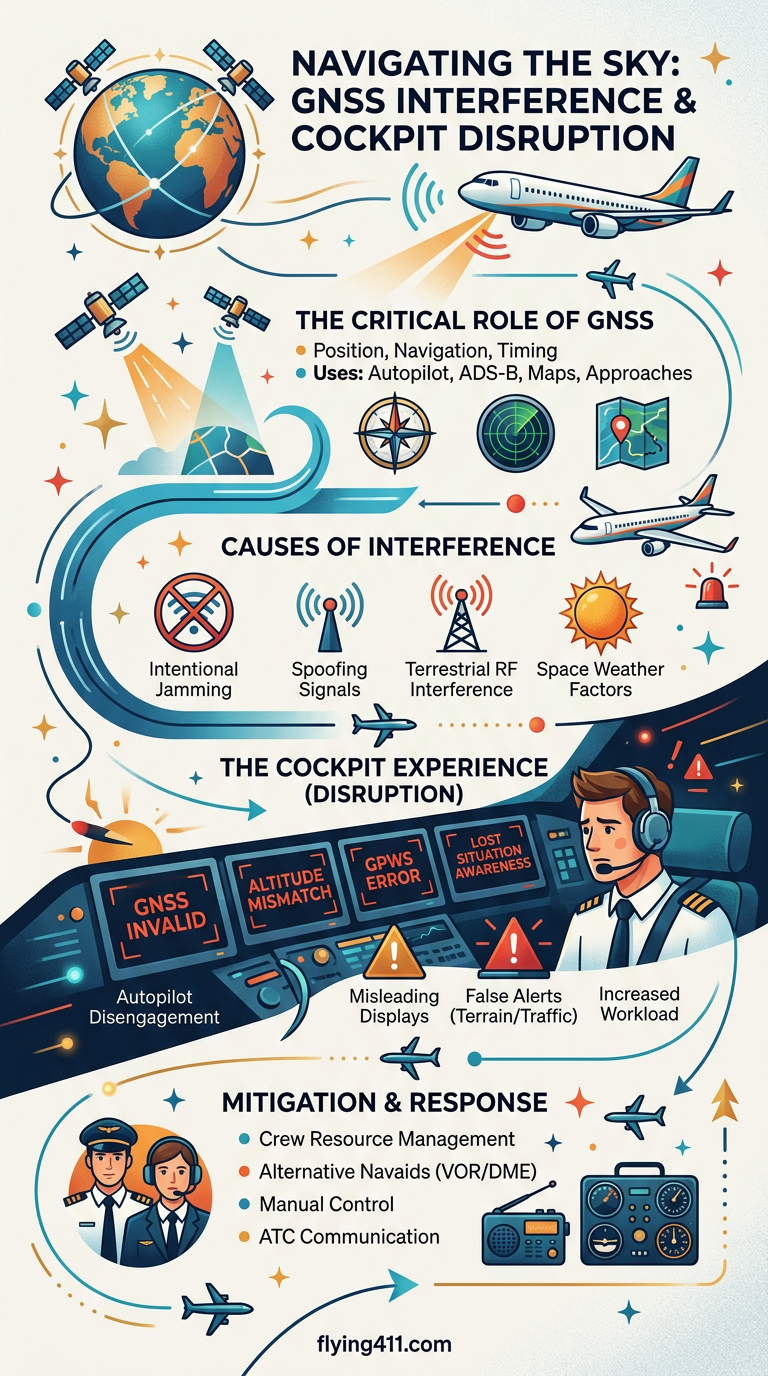
When a commercial aircraft flies into an area with active gps jamming, the problems can pile up fast. The cockpit does not lose one system cleanly. It loses several at once. Workload goes up. In some cases, the situation becomes dangerous. This is what sets gnss interference apart from most cockpit issues crews deal with.
The first thing that goes is position. The aircraft's gps receiver stops getting valid data from satellites. The moving map freezes or jumps. The flight management computer loses its fix and starts throwing alerts. If the crew is flying a GPS-based approach, they may not be able to continue it. The FMS may also try to tune radio navigation aids using the false position. It picks stations far out of range. That can look like a radio nav failure when GPS is actually the problem.
Spoofing adds another layer. The gps signal does not go away. It gets swapped for a fake. The aircraft systems keep running because they think the data is fine. Here is what can go wrong:
- False terrain warnings: The EGPWS compares GPS position to terrain data. A false position can make the system think the plane is near the ground when it is at cruise altitude. It fires a "PULL UP" alert with no real threat. Pilots who follow the full response may climb fast and hard, which creates new risk in busy airspace.
- ADS-B corruption: Ads-b sends the plane's position to controllers and nearby aircraft. A fake GPS position means a fake ADS-B broadcast. Controllers see the plane in the wrong spot. Other aircraft get bad collision avoidance data. Separation can break down without anyone on the flight deck knowing.
- Clock errors: GPS also sends timing signals. Spoofing can reset aircraft clocks or make them run backward. Systems that need accurate timing can act up in unexpected ways.
- Lost comms and Wi-Fi: Satellite communications and cabin internet can drop out when GPS position data is wrong.
An OpsGroup report from September 2024 found cases where fixing a spoofed position required a full system reset. That takes time. In a busy phase of flight, that is time crews do not have to spare.
The numbers tell the story. In just one month between July and August 2024, around 41,000 flights were spoofed. Gps interference went from about 300 affected flights per day in early 2024 to roughly 1,500 per day by August. Military radio frequency gear cannot tell a fighter drone from an airliner. Commercial civil aviation ends up in the middle.
The reach of this disruption is also wider than most people expect. Gnss receivers can pick up interference from hundreds of kilometers away. A flight near the Baltic Sea or the eastern Mediterranean does not need to cross a war zone to be affected. The electronic environment spreads well past the front lines.
Pilots are trained to cross-check instruments, use the Inertial Reference System, and ask controllers for radar vectors when GPS is bad. Those tools work. But spoofing slows recognition. A flight crew can react to a false warning or drift off track before they know what hit them. Catching it fast is everything.
The Azerbaijan Airlines Flight 8243 Case
On December 25, 2024, Azerbaijan Airlines Flight 8243 left Baku for Grozny in Russia. It never got there. Thirty-eight people died. The crash is now the clearest real-world example of what happens when jamming and spoofing meet an active conflict.
In the weeks before the flight, Grozny had been hit by Ukrainian drone attacks. Russia had put electronic warfare systems in the area to jam drone signals. Ukraine's drone operations had pushed Russia to use these tools across a wide stretch of territory. On December 25, the airspace around Grozny was closed to counter drone threats. The city was also covered in dense fog.
When the Embraer 190 entered Russian airspace, the crew reported losing GPS. Tracking data shows the plane stopped sending valid ads-b position data at 04:25 UTC when it flew into strong GPS interference. The signal came back briefly, then dropped again. During that gap, investigators say the aircraft was struck by a Russian Pantsir-S1 missile. The jamming made it very hard to identify the plane as a civilian aircraft.
The damage was severe. Hydraulics failed. Control surfaces stopped working correctly. The crew flew across the Caspian Sea and tried to land at Aktau, Kazakhstan. The aircraft hit the ground about three kilometers short of the runway.
The GPS interference mattered in two key ways. First, losing global navigation satellite system data likely helped lead to the misidentification of the plane by Russian air defenses. Their own systems were also operating in a jammed environment. Second, the crew could not use GPS to navigate a safe approach in fog at Grozny. That pushed the diversion. For anyone thinking about how military electronic warfare affects civilian flights, this case shows exactly what the stakes are.
How militaries close and manage airspace directly affects civilian aviation. The article No Fly Zone Explained: Types, Rules, and Who Enforces Them covers the rules behind restricted airspace, who sets them, and what happens when they are not enforced.
What Airlines, Regulators, and Pilots Are Doing About It
The response has picked up speed. Regulators, airlines, and avionics makers are all working on the problem at the same time. There is no single fix. The threat is too large and too technical for one answer. So flight operations teams are pushing forward on several fronts at once.
What regulators have done:
- EASA updated its Safety Information Bulletin on GNSS outages several times, calling out spoofing as the bigger risk because it is harder to spot than jamming
- The FAA issued Safety Alert for Operators 24002 and published a GNSS Interference Resource Guide for both jamming and spoofing
- In October 2025, ICAO member states voted to formally condemn Russia and North Korea for GPS interference affecting civil aviation
- In June 2025, EASA and IATA held a joint workshop with over 120 experts and released an action plan
The four areas that plan covers:
- Information gathering: Standard reporting of interference events, live airspace monitoring, and better data sharing between civil and military navigation systems teams
- Prevention and mitigation: Export controls on jamming devices, portable spoofing detectors for cockpits, better EGPWS alert logic, and faster recovery steps for gnss receivers after signal loss
- Infrastructure backup: Keeping a Minimum Operational Network of traditional aids like VOR and DME so crews always have a non-GPS option
- Coordination: Standard radio calls for reporting gps interference, standardized NOTAM codes, and better links between civilian and military air traffic management
What pilots and airlines are doing now:
- Checking GPS interference NOTAMs before every flight on affected routes
- Reviewing non-GPS approach procedures before entering high-risk areas
- Cross-checking GPS position with IRS data and ATC radar in known interference zones
- Some airlines have rerouted flights away from the worst areas, even if it means longer flights and more fuel
- Circuit breaker steps to reset a gps receiver with bad data are now standard at some airlines
Technology being developed:
- Multi-constellation receiver units that combine GPS, galileo, glonass, and other systems are harder to fool because the spoofer must fake all of them at once
- Controlled Reception Pattern Antennas can block interference coming from certain directions
- Galileo now has a signal check feature that lets gnss receivers confirm data has not been tampered with
- Low Earth Orbit positioning systems on different frequencies from GNSS give pilots a backup option
- Research into laser-based navigation and chip-scale gyroscopes may offer future tools that are immune to radio frequency interference entirely
Regulators are clear that there are no quick answers. GPS became deeply embedded in aviation before anyone fully thought through how easy the signal is to disrupt. Fixing it takes time, money, and countries working together. For now, training and good procedure are the strongest tools the flight deck has.
The military systems behind this interference are advanced, costly, and built for exactly this kind of electronic warfare. To understand the platforms involved, the article How Many B-2 Bombers Are There? America's Stealth Fleet Explained gives a useful look at how military aircraft operate in the same skies where these events are happening.
Conclusion
GPS jamming near conflict zones is no longer a rare edge case. It is a daily reality for commercial aviation. The signals that guide flights, trigger safety systems, and keep planes separated are being blocked and faked at a scale that was hard to imagine just a few years ago. Pilots, airlines, and regulators are all pushing back. But the threat is moving fast.
Understanding GNSS interference in conflict zones is now a key part of staying informed about how safe air travel actually is. Stay current and keep learning at Flying411.
Frequently Asked Questions
Can GPS jamming cause a plane to crash?
Jamming alone rarely causes a crash. Pilots are trained to handle GPS loss. But it can combine with other problems. The Azerbaijan Airlines Flight 8243 case shows this. GPS disruption helped set off a chain of events that killed 38 people.
How do pilots know if they are being spoofed?
Key signs include sudden large jumps in the displayed position, a GPS groundspeed that does not match airspeed and wind data, clock resets, and gaps between GPS and IRS position. Checking multiple data sources at the same time is the main way to catch it.
Are some aircraft more vulnerable to GPS interference than others?
Yes. Older aircraft with only one GPS source and no inertial navigation backup are more at risk. Planes with tightly linked IRS and GPS systems and multi-constellation receivers handle interference much better.
Do passengers need to worry about flying over affected regions?
The risk is real, but airlines watch interference zones closely and change routes when needed. Crew training, regulatory guidance, and backup navigation tools provide several layers of protection.
What is the difference between RAIM and spoofing detection?
RAIM checks if GPS satellite signals agree with each other. It catches satellite faults well but can be fooled by a spoofing signal that fakes consistency across several satellites. True spoofing detection needs more advanced tools, including signal authentication and cross-checks with non-GPS data.