Every day, militaries around the world watch the sky. They track thousands of objects moving at high speeds, some friendly, some unknown, and some dangerous. The technology that makes this possible is one of the most impressive in modern defense. Air defense systems are the reason that countries can respond to aerial threats in minutes, sometimes in seconds.
Think about how much is happening above us at any given moment. Commercial planes carry passengers across continents. Military jets patrol borders. And in conflict zones, missiles can be launched with little warning. Keeping all of that sorted, identified, and controlled takes an enormous system working around the clock. In fact, that around-the-clock commitment once led to something unexpected. In 1955, a newspaper misprinted a phone number for children to call Santa Claus. The number rang directly to the Continental Air Defense Command. Rather than hang up, the officer on duty started giving the kids updates on Santa's location and the now-famous NORAD Tracks Santa tradition was born.
This is not just a military concern, either. Pilots, aviation professionals, and anyone who spends time around airspace benefit from understanding how air defense works. It shapes the rules of the sky, the technology in cockpits, and even the way air traffic control operates.
From the radar dish spinning on a hilltop to the interceptor missile streaking through the stratosphere, every piece of an air defense network has a job. And each job has to happen fast, accurately, and in the right order. What follows is a breakdown of how it all fits together.\
Key Takeaways
Air defense systems are networks of radar, missiles, sensors, and command centers that work together to detect, identify, track, and destroy airborne threats. They protect cities, military bases, and airspace from aircraft, drones, cruise missiles, and ballistic missiles. No single system handles all threats alone. Instead, multiple systems work in layers, each covering a different range and altitude.
| Key Element | What It Does |
| Radar | Detects and tracks objects in the sky |
| IFF System | Identifies if a target is friendly or hostile |
| Command and Control | Processes data and makes engagement decisions |
| Interceptor Missile | Destroys incoming threats mid-flight |
| Layered Defense | Uses multiple systems to cover all ranges and altitudes |
| Hypersonic Challenge | New fast-moving threats that are harder to intercept |
What Is an Air Defense System?
An air defense system is not one single weapon. It is a network. Picture a web of sensors, radars, missiles, aircraft, and computers all connected to one goal: protect the airspace.
The U.S. Department of Defense defines it as the structure, equipment, personnel, procedures, and weapons used to stop enemy aircraft or missiles from entering protected territory. That is a broad definition, and rightfully so. Because the threats are broad too.
What kinds of threats do air defense systems deal with?
- Ballistic missiles that arc high into the atmosphere before diving toward a target
- Cruise missiles that fly low and fast, following the terrain to avoid radar
- Manned aircraft, including fighter jets and bombers
- Drones and unmanned aerial vehicles (UAVs)
- Hypersonic weapons that travel over Mach 5 with unpredictable flight paths
Each of these threats behaves differently. A ballistic missile follows a predictable curve through the atmosphere. A cruise missile hugs the ground. A hypersonic glide vehicle can change direction mid-flight. This is why one type of surface-to-air missile cannot handle every threat. Different problems need different tools.
The core components of any air defense system include:
- Sensors and radar that scan the sky and collect data
- Command and control centers that process data and decide what action to take
- Interceptors such as missiles, aircraft, or directed energy weapons
- Communication networks that tie everything together in real time
The U.S. Air Force calls the full version of this an Integrated Air and Missile Defense System, or IADS. It is not just a collection of weapons. It is an organized system with clear roles and responsibilities. Every part depends on the others. A radar that spots a threat is useless without a missile ready to respond. A missile is useless without a radar telling it where to go.
Modern air defence systems are also designed with one important reality in mind: no system is perfect. Even the best radar has blind spots. Even the best missile can miss. This is why defense planners use layers. Multiple systems. Multiple chances. If one layer fails, another is ready.
The United States, Russia, Israel, China, and NATO allies all operate versions of this kind of layered network. And while the equipment differs, the core logic is the same: see the threat, identify it, track it, and stop it before it reaches its target.
How Does Radar Spot a Threat in the Sky?
Radar is the backbone of any air defense network. Without it, the rest of the system has nothing to work with. The word RADAR stands for Radio Detection And Ranging, and that name tells you exactly what it does.
Here is how it works in plain terms. A radar system sends out a burst of radio waves. Those waves travel outward in all directions, or in a focused beam depending on the radar type. When those waves hit an object, like an aircraft or missile, they bounce back. The radar system picks up that reflection and calculates where the object is, how fast it is moving, and in which direction.
Air defense radars can determine:
- The range (distance) to a target
- The bearing (direction) of a target
- The altitude (height) of a target
- The speed and trajectory of a target
A 2D radar gives range and bearing. A 3D radar adds altitude, which is critical for air defense. Knowing something is out there is one thing. Knowing exactly where it is in three-dimensional space is what allows a missile to intercept it.
Some radars can detect objects over 300 miles away. Others are designed for short-range precision. The AN/TPY-2 radar used in the THAAD missile defense system can operate in a forward-based mode and track targets at ranges up to 3,000 kilometers. That is roughly the distance from Los Angeles to New York and back.
There are a few important radar types used in modern air defense:
- Long-range surveillance radars that scan wide areas and provide early warning
- Fire control radars that lock onto a specific target and guide a missile to it
- Phased array radars that can track many targets at once without physically moving
- Over-the-horizon radars that extend detection beyond normal line-of-sight limits
One well-known challenge for ground-based radar is the Earth's curve. Radar works in straight lines. Anything flying low enough can hide below the radar horizon. This is exactly how cruise missiles are designed to evade detection, by flying at low altitudes and following the terrain. To combat this, systems like the JLENS program used radar lifted by large aerostats, essentially tethered balloons, to look downward from altitude and catch low-flying threats that ground radar would miss.
The U.S. Ballistic Missile Early Warning System, known as BMEWS, has operated radar stations in Alaska, Greenland, and the United Kingdom since the Cold War. These stations still perform detection and tracking of missiles today, updated with modern hardware but rooted in decades of operational experience.
Radar is not just one thing. It is a family of tools, each built for a specific job in the air defense chain. When they work together, they create a picture of the sky that is detailed, fast, and nearly impossible to hide from.
How Does an Air Defense System Know Friend from Foe?
Spotting something in the sky is one thing. Knowing what it is, friend, enemy, or civilian, is another problem entirely. Get it wrong, and you could shoot down your own aircraft. This is one of the most critical challenges in air defense, and it has its own dedicated technology: Identification Friend or Foe, known as IFF.
IFF is a system built into military aircraft, ships, and ground vehicles. It works like a digital handshake. A ground-based radar sends out a coded radio signal, called a challenge. The aircraft carries a transponder that receives that signal and sends back an encrypted response. If the response is correct, the aircraft is tagged as friendly on the radar screen. If there is no response, or the wrong one, the aircraft is marked as unknown.
Here is a simplified version of how IFF works:
- Ground radar sends a coded challenge signal on 1030 MHz
- The aircraft transponder replies on 1090 MHz with an encrypted code
- The full exchange happens in milliseconds
- A correct reply = friendly; no reply or wrong reply = unknown
The current military standard is Mode 5, which uses spread-spectrum encryption and changes codes daily. This makes it very difficult for an enemy to fake a friendly signal. Mode 5 also includes a final challenge before a weapon is fired, a last check to prevent accidentally shooting down a friendly aircraft.
Why does this matter for civilian pilots?
Civil aviation uses a related system. The Mode 3/A and Mode C transponders on commercial and general aviation aircraft broadcast identification and altitude data to air traffic control. These overlap with military IFF frequencies, which is one reason that civilian planes can sometimes appear on military radar as identifiable contacts. A pilot squawking 7700 (emergency), 7600 (radio failure), or 7500 (hijack) sends an immediate alert to both ATC and nearby military systems.
IFF has one important limitation worth knowing. IFF can only confirm a friendly aircraft. It cannot confirm a hostile one. An aircraft with no transponder response is unknown, not automatically an enemy. Civilian light aircraft often do not carry military transponders. Equipment can fail. This is why IFF is used alongside other information, like radar track data, flight plans, and intelligence inputs, before any engagement decision is made.
A full command and control center brings all of this data together. Operators there see radar tracks, IFF status, altitude, speed, and trajectory all on one screen. They assess the threat, consult rules of engagement, and authorize a response. The system supports human decision-making; it does not replace it.
This identification layer is one of the most important, and most invisible, parts of any air defense network. It keeps the sky organized, reduces the risk of friendly fire, and gives operators the confidence to act when a real threat appears.
Step by Step — How Air Defense Systems Detect, Track, and Shoot Down Threats
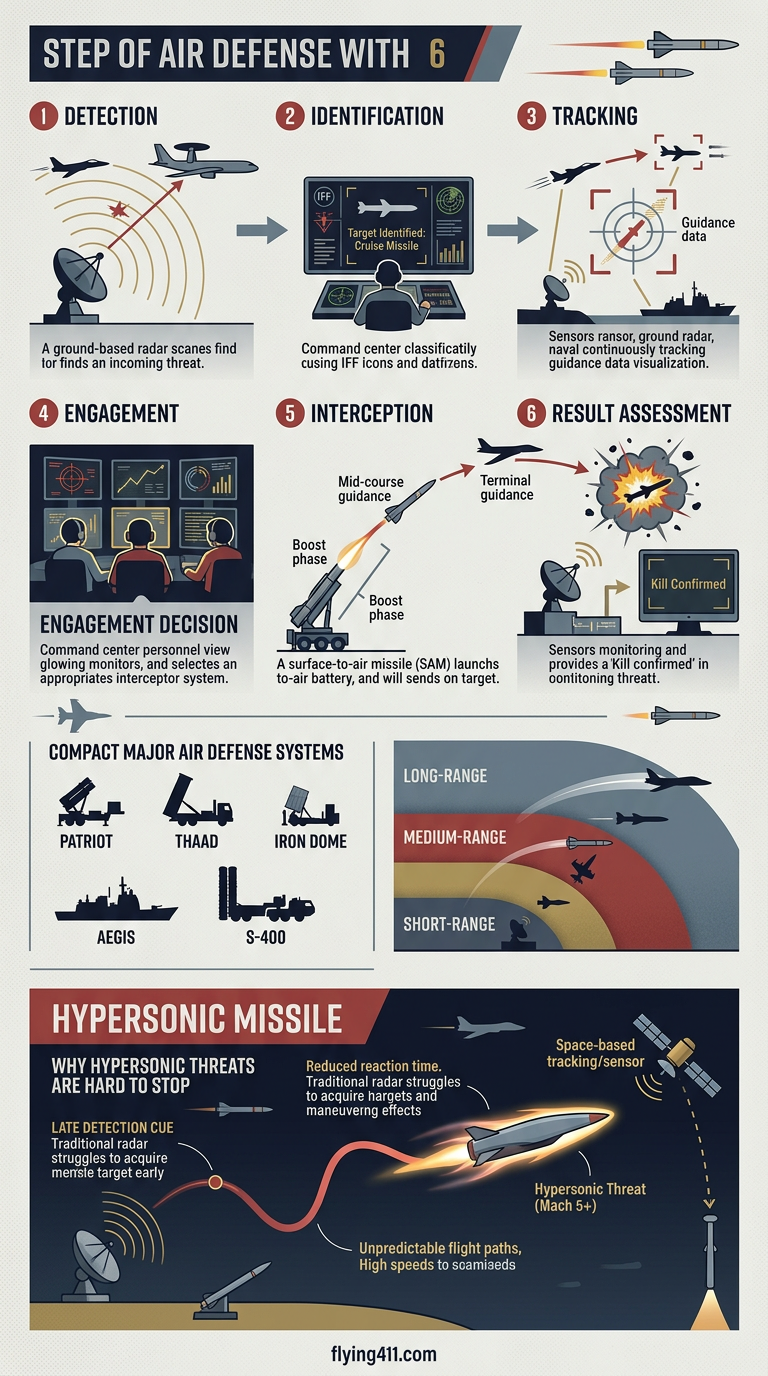
Stopping a threat in the sky is not a single action. It is a sequence. Every step has to work, and it has to work fast. Here is how it unfolds from the moment a threat appears to the moment it is destroyed.
Step 1 — Detection
It starts with radar. Ground-based, ship-based, and airborne radar systems constantly scan the sky. The moment an object appears, the system records its position, speed, altitude, and direction. Some radar systems can detect objects hundreds of miles away, giving operators precious minutes to respond.
Step 2 — Identification
Not every blip on a radar screen is an enemy. This is where IFF (Identification Friend or Foe) comes in. The system sends a coded challenge to the target. A friendly aircraft responds with the correct encrypted code. No response, or the wrong one, flags the contact as unknown. Operators then cross-reference radar data, flight plans, and intelligence to make a call.
Step 3 — Tracking
Once a target is flagged as a potential threat, the system locks onto it and tracks it continuously. Fire control radars take over here. These are high-precision systems that calculate the target's exact trajectory and predict where it will be in the future. That prediction is what allows an interceptor to meet the threat mid-air rather than chase it.
Step 4 — Engagement Decision
Data flows into a command and control center where trained operators review the situation. They evaluate the threat level, check rules of engagement, and decide what weapon to use. In some systems, parts of this process are automated to save time. But a human still holds final authority in most military frameworks.
Step 5 — Interception
An interceptor is launched. Depending on the system, this could be a surface-to-air missile, a naval interceptor, or an air-launched weapon. The missile is guided toward the target using tracking data fed from ground radar or the missile's own onboard sensors. Many modern interceptors use a "hit-to-kill" approach, meaning they destroy the threat by colliding with it directly rather than detonating near it.
Step 6 — Result Assessment
After the engagement, the system checks the outcome. Did the intercept succeed? Is the threat still active? If needed, a second interceptor can be launched. This cycle repeats until the threat is confirmed destroyed or has cleared the defended area.
The Most Important Air Defense Systems in Use Today
Several systems stand out as the most capable and widely used in the world today.
Patriot Missile System (MIM-104)
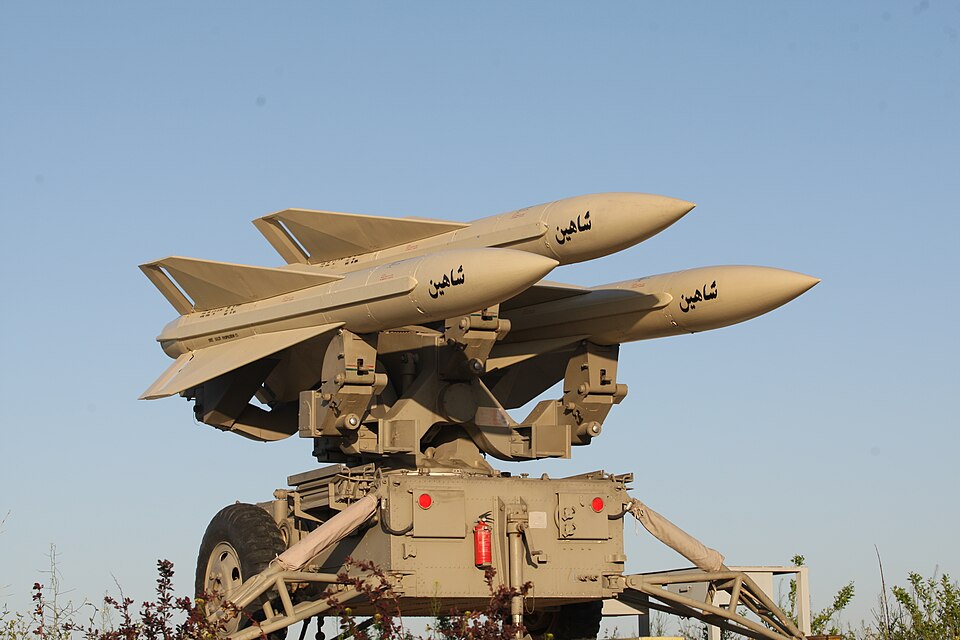
The Patriot is one of the most recognized names in missile defense. It is a mobile, ground-based system used by the U.S. military and over 18 allied nations. Patriot handles cruise missiles and theater ballistic missiles, targets that are typically high-altitude and fast-moving. The PAC-3 version uses direct-impact kill technology, hitting the target rather than exploding near it. A single Patriot battery includes radar, launchers, and a command and control station all in one deployable package.
THAAD — Terminal High-Altitude Area Defense
THAAD is the only U.S. system designed to intercept short-range and medium-range ballistic missiles both inside and outside the atmosphere. Each battery includes six truck-mounted launchers with eight missiles each, an AN/TPY-2 radar, and a crew of 90 soldiers. THAAD has a perfect intercept record in testing. Its deployment to South Korea in 2017 and Israel in 2024 made international headlines due to its strategic significance.
Iron Dome
Developed by Israel, Iron Dome is built for close-range threats, rockets, mortars, and short-range missiles fired from distances between 4 and 70 kilometers. What makes it smart is its selective engagement feature. If an incoming missile is tracked and calculated to land in an empty field, Iron Dome holds fire. It only launches when a threat is headed toward a populated or critical area. This saves interceptors and keeps costs down. The system has recorded an intercept rate of 87 to 90 percent in active combat operations.
Aegis Combat System
The Aegis system is the U.S. Navy's primary air defence platform at sea. Ships equipped with Aegis use the SPY-1 radar and SM-series missiles to engage threats across a wide range of altitudes and distances. Aegis integrates with THAAD and Patriot through the U.S. integrated air and missile defense architecture, forming a connected multi-layer network across land, sea, and air.
S-400 Triumf (Russia)
The S-400 is Russia's most advanced long-range air defense system. It can engage targets up to 400 kilometers away and track multiple threats simultaneously. Several countries have attempted to purchase the S-400, which has caused significant geopolitical friction, particularly when NATO allies like Turkey moved forward with acquisition. Understanding how the S-400 works alongside how stealthy aircraft try to defeat it is explored further in BEST STEALTH AIRCRAFT: MODERN TECHNOLOGY, DESIGN, AND PERFORMANCE — a topic worth reading for anyone interested in how offense and defense evolve together.
Why One System Is Never Enough — The Layered Defense Approach
No single system covers every threat. A system built for ballistic missile intercepts at high altitude is not the right tool for stopping a low-flying drone. And a system designed for short-range rockets cannot reach a threat launched from 300 miles away. This is why every serious defense architecture uses layers.
The three primary layers are:
- Short-range layer — handles threats within about 70 kilometers. Systems like Iron Dome and SHORAD platforms operate here, targeting drones, rockets, and low-altitude aircraft.
- Medium-range layer — covers roughly 50 to 150 kilometers. This layer engages tactical missiles and fighter aircraft before they close in on a defended area.
- Long-range layer — extends out to 400 kilometers or more. Systems like Patriot, THAAD, and Aegis work here, intercepting ballistic missile threats and cruise missiles during their mid and terminal flight phases.
Each layer also covers different altitudes. A threat flying at 100 feet behaves completely differently from one at 100,000 feet. Layering means that at least one system is always in the right position to act.
The real power of this approach is redundancy. If a surface-to-air missile from the outer layer misses, the medium layer has another shot. If that fails, the short-range layer is still ready. Layering gives defenders multiple chances without relying on any one system to be perfect.
The U.S. missile defense architecture connects all of these layers through a shared data network. Radar data from an Aegis ship at sea can cue a THAAD battery on land. A missile launch detected by a satellite can alert ground radar thousands of miles away. This is what makes modern air defence systems so capable. They do not work in isolation. They work as a team.
Understanding how bombers were designed to penetrate exactly these kinds of layered networks is a fascinating side of military aviation history. Check out 11 Best Bomber Aircraft for a look at the aircraft built to challenge air defense from above.
The Biggest Challenge Facing Air Defense Today — Hypersonic Missiles
Here is the hard truth. Every air defense system described above was built with a certain type of threat in mind. Ballistic missiles follow predictable arcs. Cruise missiles fly low but at known speeds. Radar and interceptors have been designed around these known behaviors for decades.
Hypersonic weapons break those rules.
A hypersonic missile travels at Mach 5 or faster, which is roughly one mile per second. But speed alone is not the biggest problem. The bigger issue is maneuverability. Unlike a ballistic missile that follows a fixed arc after launch, a hypersonic glide vehicle can change direction mid-flight. This makes it extremely difficult to predict where it will be when an interceptor arrives.
Why hypersonic threats are so hard to stop:
- Most ground-based radar cannot detect them until late in their flight due to line-of-sight limits, leaving very little reaction time
- Their thermal signatures are 10 to 20 times fainter than traditional ballistic missiles, making them hard for satellites to track
- The plasma envelope created by their speed can interfere with both their own guidance systems and radar tracking signals
- They often fly at altitudes between traditional air defense layers, in a zone that neither high-altitude nor low-altitude systems cover well
Russia has already fielded hypersonic weapons, including the Kinzhal air-launched missile used in Ukraine. China has tested the DF-17 hypersonic glide vehicle and reportedly has multiple operational systems. The detection window for defenders is measured in seconds, not minutes.
The U.S. response includes the Hypersonic and Ballistic Tracking Space Sensor (HBTSS), a satellite-based system designed to track fast-moving hypersonic threats from orbit. In March 2025, a joint test between the Missile Defense Agency and the U.S. Navy confirmed that HBTSS data could successfully detect, track, and simulate an engagement against a maneuvering hypersonic target. The "Golden Dome for America" initiative, directed by executive order in January 2025, also calls for accelerated deployment of these space-based tracking systems alongside next-generation interceptors.
The race between hypersonic offense and long-range defense is one of the defining military technology challenges of this decade. And it is far from decided.
Conclusion
Air defense systems are some of the most advanced technology ever built. They blend radar, tracking, identification, missiles, and human judgment into a single working network. Each layer of defense has a job. Each job has to happen fast. And the whole thing has to work right the first time, because in real air defense, there is no second chance.
For pilots and aviation professionals, this is not a distant subject. IFF technology, radar transponders, and airspace rules are all connected to the same systems described in this article. Understanding how air defense systems work gives you a clearer picture of why the sky is organized the way it is.
As threats continue to evolve, especially with the rise of hypersonic weapons and drone swarms, so will the technology used to stop them. The fundamentals will not change: see it, identify it, track it, and stop it. But the tools will keep getting faster, smarter, and more precise.
Want to stay sharp on the latest in aviation technology and airspace knowledge? Head over to Flying411 for more articles, guides, and resources built for pilots and aviation enthusiasts just like you.
Frequently Asked Questions
How fast does an air defense system have to respond to a threat?
Response times vary by threat type. A ballistic missile gives defenders several minutes to act. A short-range rocket may allow only seconds. Systems like THAAD and Patriot are designed to detect and engage threats in under two minutes. This is why automation plays a major role in modern air defense networks.
Can civilian aircraft accidentally trigger an air defense system?
In most cases, no. Civilian aircraft broadcast transponder codes that air defense systems recognize as non-threatening. Air traffic control also coordinates with military operators. Problems occur when an aircraft enters restricted airspace without a valid transponder signal or a filed flight plan, which flags it as unknown.
What role do satellites play in air defense?
Satellites provide early warning of missile launches by detecting the heat signature of a rocket engine at the moment of ignition. This gives ground-based systems more time to prepare. The U.S. Hypersonic and Ballistic Tracking Space Sensor, known as HBTSS, is being developed specifically to track fast-moving hypersonic threats from orbit.
What is the difference between a strategic and tactical air defense system?
Strategic systems defend large areas like cities or entire countries, often against long-range ballistic missiles. Tactical systems protect smaller areas like military bases or troop formations from shorter-range threats. Most modern defense architectures use both types working together in a layered network.
How do air defense systems handle drone swarms?
Drone swarms are one of the newest challenges in air defense. Traditional interceptor missiles are too expensive to use against cheap drones in large numbers. New solutions include directed energy weapons like lasers, electronic jamming to disrupt drone communications, and high-speed cannons designed for rapid fire against multiple small targets.