You've decided you want to learn to fly. You start looking up flight schools, and suddenly you're staring at terms like "Part 141," "Part 61," and "Part 91" and nobody gives you a cheat sheet. Here's a number that puts this choice in perspective: according to AOPA, roughly 80% of student pilots drop out before earning a certificate.
The wrong program, the wrong structure, or the wrong fit for your life is one of the biggest reasons why. These labels pop up everywhere in flight training, and picking the wrong program for your goals can cost you real money and time.
Let's go over exactly what each one means, clear up a very common mistake people make about Part 91, and help you figure out which path actually fits where you want to go as a pilot.
Key Takeaways
Part 61 and Part 141 are the two types of flight training programs in the U.S. Part 61 is flexible and instructor-driven, great for private pilot learners and hobbyists who want to set their own pace. Part 141 uses a structured training approach with an FAA-approved curriculum, better for full-time, career-focused students. There is no such thing as a "Part 91 flight school." Part 91 is a set of operating rules all pilots follow in the air, not a type of school.
| Feature | Part 61 | Part 141 |
| FAA-approved curriculum | No | Yes |
| PPL minimum flight hours | 40 hours | 35 hours |
| CPL minimum flight hours | 250 hours | 190 hours |
| Flexible scheduling | Yes | Limited |
| GI Bill eligible | No | Yes |
| International M-1 visa | No | Yes |
| R-ATP airline pathway | No | Yes (with aviation degree) |
| Best for | Hobbyists, part-time students | Career pilots, full-time students |
What Do "Part 61," "Part 91," and "Part 141" Actually Mean?
When people talk about flight school programs, they use numbers like Part 61, Part 91, and Part 141. These numbers come from the federal aviation regulations, the rulebook that governs all aviation in the United States. Think of these regulations like chapters in a big book. Each chapter covers a different part of how flying works in America.
Here's a simple breakdown of each one:
- Part 61 covers how a person earns a pilot certificate. It sets the rules for who can get a license, what knowledge you need, and how many flight hours you must log. Any certified flight instructor can train you under Part 61, even an independent instructor who works out of a small airport. There's no required classroom, no set lesson plan, and no stage tests. It's the most flexible way to train.
- Part 91 covers how all aircraft must be operated in U.S. airspace. It sets rules like minimum safe altitudes, weather limits, equipment requirements, and communication rules. Here's the key thing: every pilot follows Part 91 rules in the air, no matter how they trained. Part 91 is not a training program. It's the set of rules you fly by once you're up there.
- Part 141 covers how flight schools are certified. A school that earns a Part 141 certificate from the FAA has gone through a five-phase approval process. The FAA reviews the school's curriculum, inspects its facilities, checks its instructors, and continues monitoring the school over time. These schools must follow a structured training program approved by the FAA. Right now, there are about 509 FAA-certified Part 141 schools in the United States.
So to put it plainly: Part 61 tells you how to earn a license. Part 91 tells you how to fly once you have one. Part 141 tells schools how to operate a certified aviation training program. All three are parts of the same federal aviation regulations, but they cover very different things.
Here's a helpful way to remember it:
- Part 61 = rules for the pilot
- Part 91 = rules for the flight
- Part 141 = rules for the school
Understanding this difference is the first step to making a smart choice about your training. The real comparison, the one that actually matters for choosing where to train, is Part 61 vs Part 141.
Is There Really Such a Thing as a "Part 91 Flight School"?
Short answer: No. There is no such thing as a "Part 91 flight school." But you're not alone in searching for it. This is one of the most common sources of confusion for new student pilot learners in the U.S.
Here's what probably happened. You heard someone say they trained at a "Part 91 school," or you came across the phrase while researching pilot training. What they likely meant was this: they trained with a small local school or an independent instructor that operates under Part 61 rules. Because those schools also follow Part 91 operating rules in the air (just like everyone else), the two terms sometimes get jumbled together.
Let's clear it up once and for all:
- Part 91 is not a school type. It's a set of in-flight operating rules that every pilot must follow, from student pilots to airline captains.
- When someone says "Part 91 training," they usually mean they trained at a smaller, less formal school, which is actually a Part 61 training environment.
- The actual choice you face as a new pilot is Part 61 vs Part 141, not Part 91 vs anything.
Here's a real-world example to make this click. Say you go to a small local airport and hire a certified flight instructor who runs his own one-man teaching operation. You learn to fly with him three mornings a week. When you're up in the air, both of you are following Part 91 rules. That's just the law of the sky. But your training is guided by Part 61, because that's the regulation that sets what you need to learn and how many hours you need to log to earn your private pilot license.
That instructor's little operation is not a "Part 91 school." It's a Part 61 operation.
Now, Part 91 does matter to you as a pilot. Once you earn your wings, you'll be flying under Part 91 rules constantly. You'll learn about them in ground school, things like cloud clearance minimums, airspace categories, and how to handle emergencies. But for the purpose of choosing your training program, Part 91 is not the decision you need to make.
The decision you need to make is simple: do you want flexible, instructor-led training under Part 61, or do you want a structured, school-approved program under Part 141? That's the real fork in the road, and the rest of this article will walk you through exactly how to choose.
Part 141 vs Part 61 vs Part 91: Which Flight Training Program Fits Your Goals?
So now you know what the terms mean. But knowing the definition is one thing. Understanding how these programs actually feel day to day is another. The difference between Part 61 vs Part 141 shows up in your schedule, your classroom, your checkbook, and your career timeline. Part 91 shows up every single time you fly. Let's walk through each one.
Structure: Rigid vs. Flexible
This is the biggest difference between the two paths. A Part 141 flight school operates under a strict, FAA-approved curriculum. Every lesson follows a set plan. Every student goes through the same stages in the same order. Before you can move on to the next phase of training, you have to pass a stage check. That's a test that confirms you've actually learned what you were supposed to learn.
Part 141 flight training is built like a trade school program. You start on Day 1 with a schedule already mapped out. You know what you'll be covering in Week 3, Week 7, and Week 12. The school submits its entire Training Course Outline to the FAA for review before a single student ever sets foot on the ramp. The FAA then keeps checking in over time to make sure the school stays on track.
Part 61 training works the other way around. There's no FAA-required lesson plan. Your flight instructor designs the training program around you, your schedule, your strengths, and your weak spots. If you're nailing landings but struggling with navigation, your instructor can spend more time on navigation without anyone pushing back. The training adapts to the person, not the paperwork.
That flexibility is a big deal for a lot of people. A working parent who can only fly on Saturday mornings will do well in Part 61. A fresh high school grad who wants to be an airline pilot in the shortest time possible will likely do better in Part 141.
Part 91: The Rules You Always Fly By
Here's the thing about Part 91. It's not a training path you choose. It's the foundation every pilot operates under, every single flight. The federal aviation regulations divide aviation into different parts, and Part 91 covers general operating rules. That means cloud clearance minimums, altitude requirements, airspace rules, equipment requirements, and communication procedures.
Every student pilot flying with an instructor follows Part 91 rules in the air. Every private pilot flying to a weekend destination follows Part 91 rules. Even the most experienced commercial pilot flying a personal aircraft follows Part 91 rules. It applies across the board, no exceptions.
You'll learn Part 91 rules thoroughly in ground school, and you'll need to know them cold for your FAA written knowledge test. But when someone says "I trained at a Part 91 school," what they really mean is they trained at a small local school or with an independent instructor under Part 61 certification rules. Part 91 just describes how they operated the aircraft while doing it. The real choice is always between Part 61 and Part 141.
Flight Hours: The Numbers That Matter
One of the most talked-about differences is minimum flight hours. Because Part 141 program schools are tightly structured and FAA-monitored, the agency allows them to certify pilots with fewer total hours. Here's how that breaks down:
| Certificate | Part 61 | Part 141 |
| Private Pilot | 40 hours | 35 hours |
| Instrument Rating | 50 hrs XC + 40 hrs instrument | 35 hours instrument |
| Commercial Pilot | 250 total hours | 190 total hours |
| CFI | Proficiency-based | 25 hours minimum |
At the private pilot level, that 5-hour gap sounds appealing on paper, but it rarely plays out that way in real life. FAA data shows the average student pilot logs 55 to 60 hours before they're truly ready for a checkride, regardless of which path they're on. Most people simply need more flight time than the legal minimum to build real confidence in the cockpit.
But the gap at the commercial pilot certificate level is a different story. Sixty fewer flight hours adds up fast. At $150 to $200 per hour for aircraft rental, you're looking at potential savings of $9,000 to $12,000 on the road to your commercial certificate. That's a real difference.
Here's the catch though. Part 141 schools tend to charge more per hour than Part 61 schools because they carry higher overhead. That includes FAA audits, required facilities, stage check administration, and more. So the actual dollar difference may be smaller than the hour difference suggests. Do the math for each specific school you're considering, not just the program type.
If you're thinking about the aircraft side of pilot training too, like owning the plane you train in, check out Buying a Flight School Cessna 172: Smart or Risky? for a full breakdown of the ownership angle. And if you're considering renting your aircraft to a school, Leasing a Cessna 172 to a Flight School: Resale Pros and Cons covers what that does to long-term value.
Ground School: Classroom vs. Self-Study
Ground school is required in a Part 141 program. You'll sit in a classroom or attend structured online sessions covering everything from weather theory to airspace rules, navigation, and aircraft systems. This happens on a set schedule, and attendance matters.
Under Part 61 training, you still need to pass the same FAA written knowledge test. But how you prepare is completely up to you. Many students use online courses they can take at 10 p.m. after the kids are in bed. Others study one-on-one with their instructor before each flight. The path to the written test is flexible. As long as you pass it, the FAA doesn't care how you got there.
Both approaches work well. Some people thrive with the accountability of a classroom schedule. Others learn better on their own timeline. Know which type of learner you are before you commit to a program.
The Training Environment: Full-Time vs. Part-Time
A Part 141 flight school is designed for students who can commit fully to flight training. You're expected to show up, keep pace with the schedule, and progress on time. This works well if becoming a pilot is your only goal right now and you have the time to make it happen fast.
A Part 61 school or an independent instructor works on your timeline. You can train once a week, twice a week, or three times a week. You can pause for a month if life gets busy. There's no cohort to keep up with and no stage check deadline looming over you.
That said, consistency is critical in pilot training no matter which path you choose. Pilots who train infrequently spend more time re-learning things they've forgotten between lessons. The less you fly, the more total hours you'll need, and the more money you'll spend. If you go the Part 61 route, try to fly at least twice a week to keep your skills sharp.
The Same Destination, Two Different Roads
Here's something that surprises a lot of first-time researchers. The pilot certificate you earn looks exactly the same whether you trained under Part 61 or Part 141. The FAA doesn't stamp your certificate with which path you took. The examiner at your checkride doesn't care. They only care that you meet the standards, nothing more, nothing less.
What matters most is the quality of your flight instructor, the consistency of your training schedule, and how well the program fits your life. A great instructor at a small Part 61 school will produce a better-prepared pilot than a distracted instructor at a big-name Part 141 program every single time.
Cost: The Full Picture
Here's a realistic cost snapshot for each major certificate level:
| Certificate | Part 61 Estimate | Part 141 Estimate |
| Private Pilot License | $12,000 to $20,000 | $15,000 to $22,000 |
| Instrument Rating | $8,000 to $15,000 | $7,000 to $13,000 |
| Commercial Pilot Certificate | $30,000 to $50,000 | $25,000 to $45,000 |
| Full airline track (PPL to CPL) | $50,000 to $100,000 | $80,000 to $150,000+ |
Two things stand out here. First, a private pilot license tends to cost more at Part 141 schools because the 5-hour savings get eaten up by higher hourly rates. Second, the savings flip at the commercial pilot level, where the 60-hour reduction makes a real dent in the total bill.
The full airline-track cost at a Part 141 university program looks much higher, and it is, because those programs include tuition, housing, fees, and a full aviation degree bundled together. That degree unlocks the R-ATP pathway, which lets qualifying graduates fly for a regional airline at 1,000 hours instead of 1,500. For someone who wants to become a pilot for a career, that 500-hour head start can be worth every dollar.
A Private Pilot Certificate vs. a Career Track: Know Your Goal First
This is probably the most important question to answer before you pick a school. Are you training for fun, or are you training for a career?
If your goal is personal flying, weekend trips, or just the thrill of being up in the air on your own terms, a private pilot certificate through Part 61 will get you there comfortably and affordably. You don't need the structure of a Part 141 program to enjoy flying.
If your goal is to sit in the left seat of a regional jet, a corporate turboprop, or a cargo aircraft one day, Part 141 gives you a faster, more structured path. The FAA has built in hour reductions specifically to help full-time students move efficiently from zero experience to a commercial certificate and beyond.
Either way, the flight school experience is what shapes you as a pilot far more than the regulatory label on the door. Visit schools. Talk to instructors. Ask to sit in on a ground lesson. The right program won't just teach you to fly. It will set you up to keep flying safely for years to come.
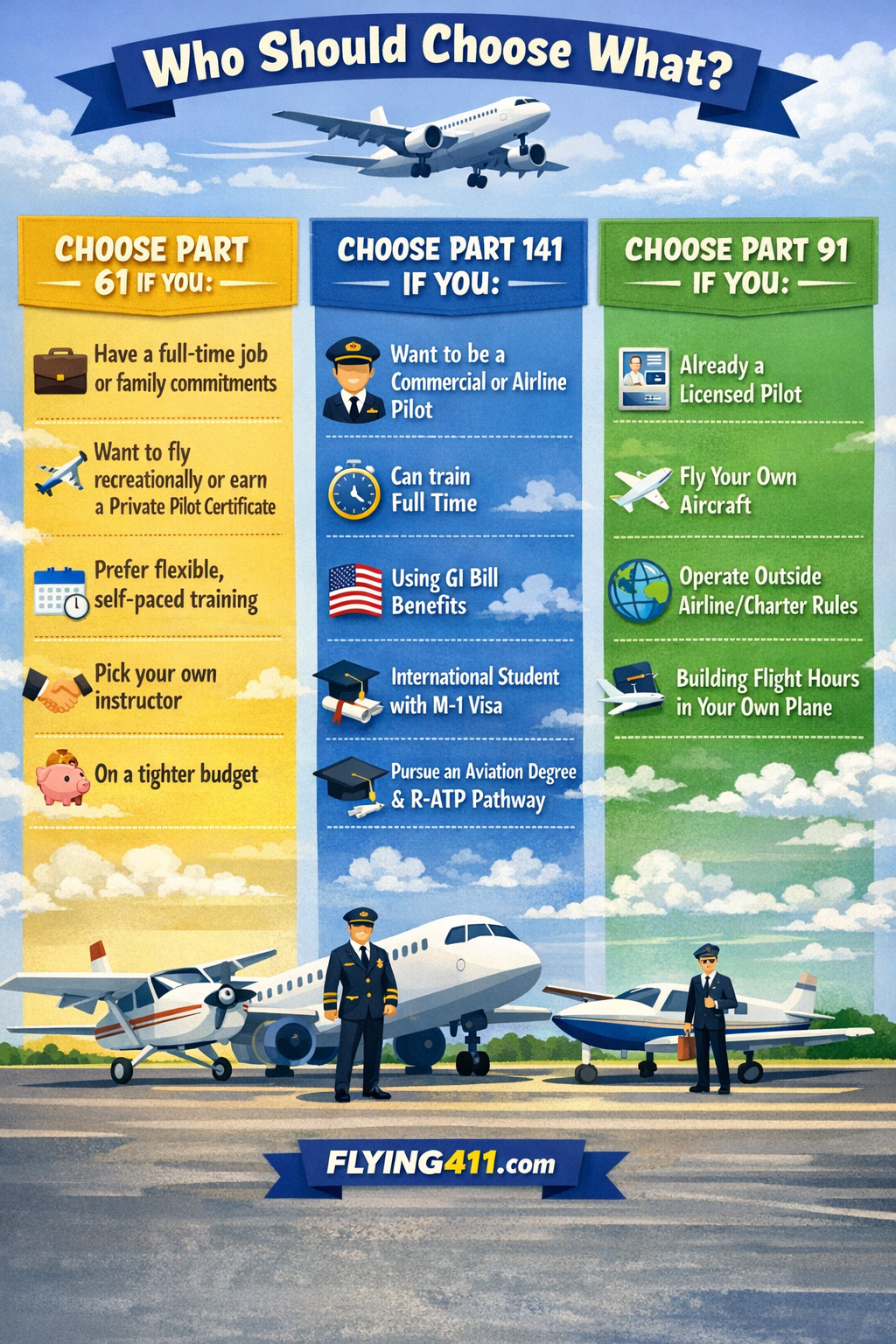
Who Should Choose What
Here's a quick guide to help you decide:
Choose Part 61 if you:
- Have a full-time job or family commitments
- Want to fly recreationally or earn a private pilot certificate for personal use
- Prefer a flexible, self-paced training approach
- Want to pick your own instructor and keep them throughout training
- Are on a tighter budget at the PPL level
Choose Part 141 if you:
- Want to be a commercial pilot or airline pilot
- Can train full time
- Are a veteran using GI Bill benefits
- Are an international student needing an M-1 visa
- Want to pursue an aviation degree and the R-ATP reduced-hours airline pathway
- Value the accountability of structured training
"Choose Part 91" if you:
- Already hold a pilot certificate and fly your own aircraft
- Operate a personal or business aircraft outside of airline or charter rules
- Want the most flexible operating rules allowed in U.S. airspace
- Fly general aviation trips for personal travel, business, or recreation
- Are building flight hours in your own plane after completing your training
Keep in mind, Part 91 is not a training program you enroll in. It's the set of operating rules that governs how you fly once you have your certificate. Every pilot flies under Part 91 rules at some point. But if someone told you to look into "Part 91 flight training," what they most likely meant was Part 61. The two get mixed up all the time, and now you know the difference.
The federal aviation regulations give pilots two solid, well-supported training options. Neither is better across the board. The right choice is the one that fits your goals, your schedule, and your budget.
Conclusion
Picking between a Part 141 vs Part 61 vs Part 91 flight school comes down to one thing: knowing your own goals. If you want to fly on weekends, learn at your own pace, and keep your costs flexible, Part 61 gives you the freedom to do that. If you want to reach the airlines as fast as possible, use your GI Bill benefits, or train in the U.S. on a student visa, Part 141 is the path built for you. And Part 91, well, now you know that's not a school type at all. It's the set of rules you'll follow every single time you take off. Both paths lead to the same FAA certificate. The right one depends on your life, your schedule, and where you want flying to take you.
For more guides on pilot training, aircraft ownership, and everything in the world of general aviation, head over to Flying411, your go-to resource for real answers in the air and on the ground.
FAQs
Can I switch from Part 61 to Part 141 training after I've already started?
You can switch, but it comes with a cost. Part 141 schools will only give you credit for 25 to 50% of the hours you logged under Part 61. That means you may have to repeat some lessons. Switching from Part 141 to Part 61, on the other hand, is much easier since Part 61 has no structured credit restrictions.
Does the FAA pilot certificate look different depending on how you trained?
No. Your pilot certificate looks exactly the same no matter which path you took. The FAA examiner who gives your checkride only cares that you meet the skill and knowledge standards, not how you got there. Part 61 and Part 141 students take the same checkride.
Can veterans use the GI Bill for a private pilot license?
No. The GI Bill does not cover the cost of earning a private pilot license because the FAA considers it a recreational certificate. GI Bill benefits for flight training are limited to advanced certificates like the instrument rating, commercial pilot certificate, and certified flight instructor rating, and only at VA-approved Part 141 schools.
Is Part 141 training better than Part 61 for someone who learns slowly?
Not necessarily. Part 141 has a rigid syllabus, which means instructors can't always slow down to focus on areas where you're struggling. Part 61 often works better for students who need more time on certain skills, since the instructor can adapt the pace and focus on weak areas without a fixed timeline to follow.
Do I need a college degree to train at a Part 141 flight school?
No. Most Part 141 schools do not require a college degree to enroll. However, if you want to take advantage of the R-ATP reduced flight hour pathway to the airlines (1,000 hours instead of 1,500), you will need to complete a four-year aviation degree at an FAA-approved university that also offers Part 141 flight training.