Humans have always had a thing for speed. From the first rickety biplanes barely clearing 100 mph to rocket planes brushing the edge of space, we've never stopped pushing the limit. But of all the aircraft ever built, only a tiny handful have reached speeds so extreme they sound more like science fiction than aviation history.
The fastest manned aircraft in the world don't just go fast — they rewrite the rulebook on what flight even means. We're talking about machines that generate enough heat on their skin to melt steel, require pilots to wear full pressure suits, and can cross the continental United States in under an hour. Some of these records were set decades ago and have never been broken.
If you've ever stared up at a contrail and wondered how fast it was really going, this is the list for you. These nine aircraft are in a class of their own — and the stories behind them are just as wild as the numbers.
Key Takeaways
The fastest manned aircraft ever flown is the North American X-15, a rocket-powered research plane that reached Mach 6.72 (around 4,520 mph) in October 1967 — a record that has never been broken. For jet-powered aircraft that take off and land under their own power, the Lockheed SR-71 Blackbird holds the official speed record at roughly Mach 3.3. Most of the aircraft on this list were built during the Cold War era, driven by the race between the U.S. and Soviet Union to dominate the skies.
| Aircraft | Top Speed | Mach Number | Type |
| North American X-15 | ~4,520 mph | Mach 6.72 | Rocket-powered research aircraft |
| Lockheed SR-71 Blackbird | ~2,193 mph | Mach 3.3 | Jet-powered reconnaissance |
| Lockheed YF-12 | ~2,070 mph | Mach 3.2+ | Jet-powered interceptor prototype |
| MiG-25 Foxbat | ~1,920 mph (sustained) | Mach 2.83 | Supersonic interceptor |
| Bell X-2 Starbuster | ~2,094 mph | Mach 3.196 | Rocket-powered research aircraft |
| XB-70 Valkyrie | ~2,056 mph | Mach 3.1 | Experimental bomber |
| MiG-31 Foxhound | ~1,900 mph | Mach 2.83 | Supersonic interceptor |
| F-15 Eagle | ~1,650 mph | Mach 2.5 | Air superiority fighter |
| Convair F-106 Delta Dart | ~1,525 mph | Mach 2.3 | Single-engine interceptor |
At Flying411, aviation isn't just a hobby — it's a passion. Whether you're a seasoned pilot or just beginning your journey into the world of flight, Flying411 is your go-to resource for aircraft news, guides, and everything in between.
What Does "Fastest Manned Aircraft" Actually Mean?
Before diving into the list, it helps to understand what counts. Speed records in aviation are divided into several categories. Some cover jet-powered aircraft only. Others include rocket-powered planes. Some require the aircraft to take off and land under its own power.
The North American X-15, for example, was dropped from a B-52 mothership at high altitude and could not take off on its own. That's why some lists treat it separately from "conventional" aircraft like the SR-71. For this article, we're covering all crewed aircraft — no matter the propulsion system — as long as a human pilot was in the cockpit.
Good to Know: Mach 1 is roughly 767 mph at sea level, but this changes with altitude and temperature. At high altitudes where these aircraft operate, the actual air temperature is much colder, which means the speed of sound is lower — so "Mach 3" at 80,000 feet is actually a lower mph than Mach 3 at sea level.
The Cold War's Need for Speed
Nearly every aircraft on this list was born out of Cold War competition. After World War II, both the United States and Soviet Union poured enormous resources into building faster, higher-flying aircraft — for reconnaissance, interception, and sheer psychological dominance.
The space race and the arms race ran in parallel. If you could fly faster and higher than your enemy, you could conduct reconnaissance without being shot down. You could intercept bombers before they reached their targets. And sometimes, you could just make your rival feel like they'd already lost.
That pressure produced some of the most extraordinary machines ever built — and some of the most dangerous to fly.
Fun Fact: During the Cold War, the SR-71 Blackbird reportedly could not be caught by any missile or interceptor aircraft ever launched at it. If radar spotted it, the standard pilot response was simply to push the throttle further forward and outrun the threat.
A Quick Note on Speed Measurements
You'll see aircraft speeds listed in mph, km/h, and Mach numbers. For these kinds of extreme speeds, Mach numbers are the most meaningful comparison. Here's a rough guide:
- Subsonic: Below Mach 1 (under ~767 mph)
- Transonic: Around Mach 1
- Supersonic: Mach 1 to Mach 5
- Hypersonic: Mach 5 and above
Only two aircraft on this list — the X-15 and arguably the X-2 — crossed into the hypersonic range. Everything else is still blindingly fast by any human standard, but "only" supersonic.
For context on what today's advanced aircraft look like, the most advanced planes in the world make for a fascinating comparison with these speed legends.
The 9 Fastest Manned Aircraft in the World
These nine aircraft represent the absolute ceiling of human-piloted speed — from Cold War interceptors to rocket planes that grazed the edge of space. They're ranked by verified or widely reported top speed, fastest to slowest.
1. North American X-15 — Mach 6.72 (~4,520 mph)
This is the one. The undisputed, still-unbroken world record holder for the fastest crewed, powered aircraft ever flown.
On October 3, 1967, U.S. Air Force Major William "Pete" Knight climbed aboard the X-15A-2 and was carried aloft beneath the wing of a modified B-52 Stratofortress. Dropped at around 45,000 feet over Mud Lake, Nevada, Knight fired the XLR99 rocket engine and accelerated into aviation history.
He reached Mach 6.72 — approximately 4,520 mph — at an altitude of about 102,100 feet. That's nearly 19 miles above the Earth's surface. The heat generated was so extreme that the aircraft's skin suffered significant damage, including large holes burned through the tail section and evidence of melting.
Key facts:
- Powered by a single Reaction Motors XLR99 rocket engine
- Launched from a B-52 mothership — could not take off independently
- Flew 199 total research flights from 1959 to 1968
- Eight of the 12 pilots who flew it qualified as astronauts by exceeding 50 miles altitude
- Neil Armstrong was among its pilots
The X-15 wasn't just fast — it was transformative. Data gathered from its flights directly shaped the Mercury, Gemini, and Apollo programs. It proved that winged aircraft could survive reentry conditions, paving the way for the Space Shuttle.
Why It Matters: The X-15's Mach 6.72 record has stood for over 57 years. No crewed aircraft has come close to breaking it. That says everything about how remarkable — and how unrepeated — this achievement truly was.
2. Lockheed SR-71 Blackbird — Mach 3.3 (~2,193 mph)
If the X-15 is the record holder, the SR-71 Blackbird is the legend. It's the fastest jet-powered aircraft ever flown by a human pilot, and the fastest aircraft that can take off and land under its own power.
On July 28, 1976, Captain Eldon W. Joersz and Major George T. Morgan Jr. set the official Guinness World Record of approximately 2,193 mph over a 25-kilometer course near Beale Air Force Base in California. That record has never been broken.
The Blackbird was designed for reconnaissance — flying too high and too fast to be intercepted. It cruised at altitudes above 80,000 feet, which is above the operational ceiling of virtually any surface-to-air missile of its era.
Key facts:
- Built by Lockheed's legendary "Skunk Works" division
- Skin temperature during high-speed flight could exceed 600°F
- The aircraft actually expanded during flight — panels were left loose on the ground to allow for thermal expansion
- Fuel would leak slightly on the runway before takeoff because the tanks only fully sealed once the aircraft heated up at speed
- Operational from the early 1960s through 1999
Flying the Blackbird required extreme skill and specialized pressure suits similar to space suits. Pilots had to plan fuel stops carefully since the SR-71 burned fuel at an enormous rate at high speed.
Fun Fact: The SR-71 holds a coast-to-coast speed record — it once flew from Los Angeles to Washington D.C. in just over 64 minutes. A commercial flight covers the same route in about five hours.
If you're curious how the Blackbird compares to the most feared combat aircraft ever built, the most feared fighter jets in the world puts its dominance in perspective.
3. Lockheed YF-12 — Mach 3.2+ (~2,070 mph)
The YF-12 is the lesser-known sibling of the SR-71, and it deserves far more attention than it gets. Built on the same A-12 airframe, the YF-12 was developed as an interceptor prototype — designed to shoot down Soviet bombers at extreme speed and altitude.
During testing, the YF-12 set a speed record of around 2,070 mph. Only three were ever built, and the program was ultimately canceled in favor of the SR-71 reconnaissance variant.
Key facts:
- Armed with AIM-47 Falcon missiles stored in internal weapons bays
- Set multiple speed and altitude records in the early 1960s
- Could theoretically engage multiple targets simultaneously
- Operated by the U.S. Air Force as a high-altitude interceptor
The YF-12 was never put into production, but the technology it developed — particularly its fire control systems — influenced several later aircraft designs.
Pro Tip: If you want to see a surviving YF-12, the National Museum of the United States Air Force at Wright-Patterson Air Force Base in Dayton, Ohio, has one on display.
4. Bell X-2 Starbuster — ~Mach 3.196 (~2,094 mph)
The Bell X-2 was built with one mission in mind: test flight between Mach 2 and Mach 3, the regime where aerodynamic heating and control became major unknowns.
The program ran briefly between November 1955 and September 1956. On September 27, 1956, test pilot Milburn G. Apt pushed the X-2 to approximately 2,094 mph — becoming the first human to break Mach 3. Tragically, the aircraft entered an uncontrollable spin during the flight, and Apt was killed before he could safely eject.
Key facts:
- Joint project between Bell Aircraft Corporation, the U.S. Air Force, and the National Advisory Committee for Aeronautics (NACA)
- Swept-wing design to manage supersonic heating
- Powered by a Curtiss-Wright XLR25 rocket engine
- The pilot who set the record did not survive the flight
Despite the tragedy, the X-2 contributed vital data about high-speed aerodynamics that shaped every aircraft that came after it.
Heads Up: The X-2's fatal flight is a sobering reminder of how dangerous early experimental aviation was. These pilots were pushing into completely unknown territory with every single flight.
5. Lockheed A-12 — Mach 3.2+ (~2,200 mph)
The A-12 was the direct predecessor to the SR-71, operated exclusively by the CIA under the classified OXCART program. It flew reconnaissance missions over hostile territory before the SR-71 entered service.
In many respects, the A-12 was actually faster than the SR-71. It was lighter — it carried only a single pilot rather than a crew of two — and some performance estimates suggest it could exceed Mach 3.2 in operational conditions.
Key facts:
- Operated from the mid-1960s onward by the CIA, not the military
- Flew some of the first overflights of North Vietnam
- Single-seat design, compared to SR-71's two-seat layout
- Retired in 1968 when the SR-71 took over reconnaissance duties
- Its existence was classified for many years
The A-12 and SR-71 share the same lineage and general appearance, but aviation historians often note that the A-12 has a strong case as one of the fastest jet-powered aircraft ever flown — even if its exact records were never officially certified due to its classified nature.
Flying411 covers some of the most dangerous and remarkable aircraft ever built, including a deep dive into the most dangerous military aircraft to fly — the A-12 would fit right in.
6. Mikoyan MiG-25 Foxbat — Mach 2.83 sustained (~1,920 mph)
When Western intelligence agencies first spotted the MiG-25 in the late 1960s, they panicked. The aircraft's large wings suggested extreme maneuverability, leading analysts to assume they were looking at an unstoppable dogfighter. They were wrong — but the truth was almost as impressive.
The MiG-25 was built for one thing: raw speed. Its official top speed is listed as Mach 3.2, but reaching that speed causes severe engine damage, so the practical sustained maximum is around Mach 2.83. Even so, that made it the fastest operational interceptor in the world.
Key facts:
- Still considered the fastest manned serially-produced aircraft ever built
- Powered by two massive Tumansky R-15 turbojet engines
- Large wings were for structural strength, not maneuverability
- First flew in 1964, entered Soviet service around 1970
- Still in limited service with some air forces today
The MiG-25 shocked the West and triggered several major U.S. aircraft development programs in response. Its very existence helped justify the development of the F-15 Eagle.
Good to Know: A Soviet pilot famously defected to Japan in 1976 with a MiG-25. Western engineers who examined the aircraft were surprised to find vacuum tubes rather than transistors in its avionics — a design choice made deliberately, as vacuum tubes are resistant to the electromagnetic pulse of a nuclear detonation.
7. XB-70 Valkyrie — Mach 3.1 (~2,056 mph)
The XB-70 Valkyrie was designed to be America's next-generation strategic bomber — a Mach 3 aircraft that could fly so high and so fast that no Soviet interceptor could catch it. It was one of the most ambitious aircraft projects in history.
Only two were ever built. During testing, the Valkyrie reached speeds of approximately Mach 3.1. The program was ultimately canceled before entering production, largely because surface-to-air missiles made high-altitude, high-speed bombers less survivable than originally believed.
Key facts:
- Six General Electric YJ93 turbojet engines
- Used "compression lift" — riding its own shockwave to generate additional lift at high speed
- Canard-delta wing design with variable wingtip droop for stability
- One of the two prototypes was lost in a mid-air collision during a photo flight in 1966
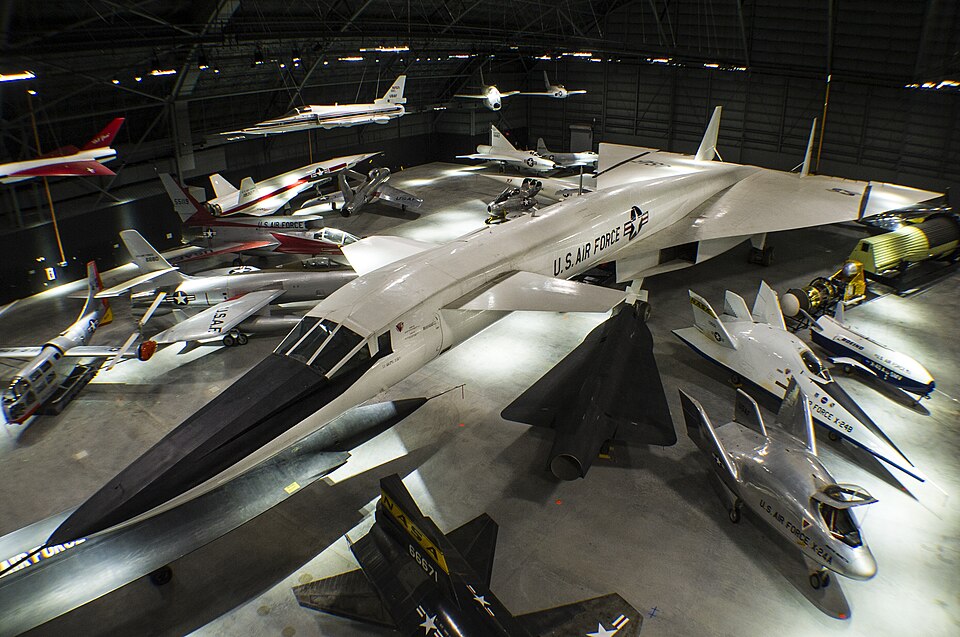
- The surviving XB-70 is on display at the National Museum of the United States Air Force
The XB-70 remains one of the most visually striking aircraft ever built. Even today, images of it look futuristic.
Fun Fact: The XB-70 was so large that its cockpit was roughly the size of a compact car. The aircraft itself stretched nearly 197 feet long — about two-thirds the length of a football field.
For a look at how strategic bombers evolved over time, the best bomber aircraft ever built provides excellent context for where the Valkyrie fits in aviation history.
8. MiG-31 Foxhound — Mach 2.83 (~1,900 mph)
The MiG-31 was developed as a successor to the MiG-25, correcting many of its predecessor's weaknesses. Where the MiG-25 was fast but fragile at its top speed, the MiG-31 was designed for sustained high-speed performance at both high and low altitudes.
Its top speed is roughly on par with the MiG-25's sustainable maximum — around Mach 2.83 — but the MiG-31 could maintain that speed more safely and across a wider range of conditions.
Key facts:
- Two-seat aircraft with a pilot and weapons systems officer
- Long-range radar capable of tracking multiple targets simultaneously
- Armed with R-33 long-range air-to-air missiles
- Still in active service with the Russian Air Force
- One of the few aircraft capable of intercepting cruise missiles and low-flying aircraft at supersonic speeds
The MiG-31 represents a different design philosophy than its American counterparts — optimized less for pure speed records and more for real-world operational effectiveness at very high speeds.
Keep in Mind: The MiG-31 is one of the few aircraft on this list still in active frontline service as of the mid-2020s, which speaks to how capable the original design remains even decades after its first flight.
9. Convair F-106 Delta Dart — Mach 2.3 (~1,525 mph)
The F-106 Delta Dart closes out this list as one of the most capable single-engine interceptors ever built. Introduced in 1959, it was designed specifically to intercept and destroy Soviet bombers during the Cold War.
The Delta Dart holds the official world record as the fastest single-engine fighter aircraft, with a top speed of approximately 1,525 mph. It carried a sophisticated avionics suite, including the Hughes MA-1 fire control system, and was armed with air-to-air missiles including a nuclear-tipped Genie rocket.
Key facts:
- Single Pratt & Whitney J75 turbojet engine
- Served as the primary U.S. Air Force interceptor from 1959 through the late 1980s
- Featured a distinctive delta-wing design without a conventional horizontal tail
- Pilots nicknamed it "The Ultimate Interceptor"
- Continued to serve in Air National Guard units well into the 1980s
The F-106 represents the pinnacle of single-engine interceptor design. No single-engine aircraft has ever flown faster in level flight.
Pro Tip: Several F-106s were converted into unmanned target drones late in their service life, designated QF-106. They were used as aerial targets for missile testing — a strange but fitting end for aircraft that had spent their careers intercepting simulated threats.
How Do These Aircraft Achieve Extreme Speeds?
Getting a manned aircraft to Mach 3, let alone Mach 6, involves solving a cascade of engineering problems — each one more difficult than the last.
Propulsion
Most aircraft on this list use either rocket engines or specially designed turbojet engines. Conventional jet engines struggle above Mach 3 because air entering the intake becomes so hot from compression that combustion becomes difficult or impossible. The SR-71 used a hybrid ramjet/turbojet system that shifted modes at high speed to manage this.
The X-15 bypassed the problem entirely by using a pure rocket engine — no air intake required.
Heat Management
At Mach 3+, aerodynamic friction generates enormous heat. The SR-71 used special titanium alloy construction and a distinctive black paint that helped radiate heat. The X-15 used Inconel X, a nickel alloy that retained its strength up to around 1,200°F. Even so, the X-15's record-setting flight caused visible melting on the airframe.
Pilot Protection
At hypersonic speeds, a simple cockpit pressurization system isn't enough. X-15 pilots wore full pressure suits that could maintain breathable conditions even if the cockpit was breached. SR-71 pilots wore similar suits, essentially the same equipment as early astronauts.
Structural Integrity
The SR-71 was built with titanium — expensive, difficult to machine, but essential for surviving sustained Mach 3+ flight. The entire airframe expanded several inches during high-speed flight due to thermal expansion.
Speed vs. Combat Effectiveness
It's worth noting that raw speed isn't the same as combat effectiveness. The F-22 Raptor and F-35 Lightning II — two of the most capable modern fighters — top out at around Mach 2. But they have stealth, advanced sensors, and weapons systems that make them far more dangerous in actual combat than a fast but simple interceptor.
The aircraft on this list represent the engineering pursuit of pure speed. Most were never intended to dogfight — they were built to fly high, fly fast, and either gather intelligence or reach a target before anything could stop them.
Speed is one dimension of aviation capability. It's just the most spectacular one.
Whether you're drawn to the blazing speed of these aircraft or the elegance of smaller planes, Flying411 has resources for every aviation enthusiast. Check out guides on the best light twin aircraft, best ultralight aircraft, and best light sport aircraft for a completely different side of aviation.
Mach Numbers Compared: A Visual Breakdown
| Mach | Approx. Speed (mph) | Category | Example Aircraft |
| Mach 1 | ~767 mph | Sonic | Bell X-1 |
| Mach 2 | ~1,534 mph | Supersonic | F-15 Eagle |
| Mach 3 | ~2,300 mph | High Supersonic | SR-71 Blackbird |
| Mach 5 | ~3,836 mph | Hypersonic threshold | — |
| Mach 6.72 | ~4,520 mph | Deep Hypersonic | X-15 |
What Comes Next? The Future of High-Speed Manned Flight
For decades, the question has been: will anything ever break the X-15's record? So far, the answer is no. But aerospace companies and government programs are actively developing the next generation of hypersonic aircraft.
Concepts like the proposed SR-72 — a possible successor to the SR-71 — have circulated in aviation circles for years. Some reports suggest it could reach Mach 6 as an unmanned or optionally-manned vehicle, though no official specifications have been confirmed.
Scramjet technology, which powered the unmanned X-43A to Mach 9.6, is also being studied for potential manned applications. The engineering challenges are formidable — managing heat, providing enough fuel, and keeping a human pilot alive at those speeds all require solutions that don't fully exist yet.
For now, Pete Knight's 1967 flight remains the gold standard. And honestly? There's something poetic about the fact that a 1960s rocket plane still holds the ultimate speed crown.
Quick Tip: If hypersonic aviation interests you, the best STOL aircraft represents the complete opposite end of the aviation spectrum — aircraft designed for ultra-short takeoffs and landings rather than blinding speed. Both push the limits of what flight can do, just in very different directions.
For the latest in aviation news, aircraft reviews, and flight guides, Flying411 is your trusted co-pilot in everything aviation.
Conclusion
The fastest manned aircraft in the world are more than speed records — they're monuments to human ambition. From the Cold War reconnaissance missions of the SR-71 Blackbird to the edge-of-space flights of the X-15, these machines represent what happens when brilliant engineers are given an impossible goal and told to solve it anyway.
The records on this list were hard-won. Some cost lives. Most required technology that didn't exist until someone built it. And nearly all of them came from a single remarkable period in history — the 1950s through 1970s — when governments were willing to spend whatever it took to fly faster than anyone had ever flown before.
The next time you see a jet contrail scratching across the sky, remember: even a fast airliner is barely a third of what the Blackbird could do on a routine Tuesday afternoon.
Ready to go deeper into the world of aviation? Flying411 has everything you need — from aircraft guides and buying tips to the stories behind the machines that changed the world.
FAQs
What is the fastest manned aircraft ever flown?
The North American X-15 holds the record for the fastest crewed, powered aircraft, having reached approximately Mach 6.72 (around 4,520 mph) on October 3, 1967, piloted by Major William "Pete" Knight.
Is the SR-71 still the fastest jet-powered aircraft?
Yes. The Lockheed SR-71 Blackbird remains the fastest jet-powered aircraft that takes off and lands under its own power, with a top speed of approximately Mach 3.3 (~2,193 mph). That record has stood since 1976.
Why haven't we built anything faster than the X-15?
Building manned aircraft that can safely sustain hypersonic speeds involves enormous engineering and cost challenges — heat management, structural integrity, pilot survival systems, and propulsion all become exponentially harder above Mach 5. Unmanned aircraft like the X-43A have gone faster, but carrying a human pilot adds layers of complexity that have yet to be solved affordably.
What is the fastest production military aircraft today?
Among aircraft currently in active production or service, the MiG-25 Foxbat and MiG-31 Foxhound hold the distinction of being the fastest serially-produced aircraft ever fielded. Most modern fighters like the F-22 and F-35 prioritize stealth and sensor fusion over outright top speed.
Could a passenger ever fly as fast as the SR-71 one day?
Possibly. Several companies and government programs are working on hypersonic commercial transport concepts. While nothing has entered service yet, some proposals suggest point-to-point travel at Mach 3–5 could become viable within the coming decades — though the technical and cost hurdles remain significant.