Most people think about the cockpit when they think about aviation. Pilots get the glory. But every aircraft that takes off does so because a team of skilled technicians made it safe to fly. Those technicians rarely make the headlines. That is especially true in general aviation.
According to ATEC's 2025 Pipeline Report, certificated mechanics make up 86% of the general aviation maintenance workforce. But one of the biggest events in their professional world? Most of them have never heard of it.
The Aerospace Maintenance Competition is a global event built to change that. It puts aviation technicians in the spotlight. GA mechanics have more to gain from it than most people know. Here is where that story starts.
Key Takeaways
The Aerospace Maintenance Competition (AMC) is an annual event where teams of aviation technicians compete in real-world maintenance tasks. It has a dedicated General Aviation category. The skills tested, from safety wiring to borescope work, are the same ones used in GA shops every day. GA mechanics can compete, spectate, network, and win scholarships.
| Key Detail | Summary |
| What it is | Annual skills competition for aviation maintenance technicians |
| Hosted by | The Aerospace Maintenance Council |
| Where it's held | MRO Americas exhibition floor; also VERTICON |
| Team size | 5 members per team |
| Number of events | ~27 timed real-world maintenance tasks |
| Categories | Commercial, General Aviation, Military, School, MRO/OEM, Space |
| Grand prize | William F. "Bill" O'Brien Award for Excellence |
| Tool prizes | $140,000+ in Snap-on tools and equipment |
| Student scholarships | $1,000 to $2,500 per award |
| First held | 2013 |
The Mechanics Behind Every Safe Flight Rarely Get the Spotlight
Aviation has a recognition problem. Pilots get books, films, and museum wings dedicated to their work. But the men and women who pull apart engine parts, trace electrical faults, and sign off on safety checks before every flight? They mostly work in the background. That is true across all of aviation, but it is hardest in general aviation.
A GA mechanic at a small FBO or shop handles a wide range of tasks. On any day, that could mean a borescope check on a cylinder, a magneto swap, a logbook review, or a pre-buy inspection. There is no large MRO team behind them. No specialists for each system. It is usually a small crew doing serious work. Every signature on a maintenance record carries full responsibility for that aircraft.
Aviation maintenance takes deep knowledge, steady hands, and a drive to get things right. The stakes are high. A missed problem does not stall on the side of the road. It stays in the air. The people doing this work know that every time they pick up a wrench.
But most people never see it. When a flight goes well, the pilot gets the credit. When something goes wrong, the pilot is first in the news. The technicians who spent hours getting that aircraft ready? They are rarely mentioned.
This gap has real effects on the industry:
- Young people do not consider aircraft maintenance as a career because they do not know what the job involves
- About one-third of FAA maintenance school seats went unfilled in 2024. Most students just did not know the career existed
- GA shops are having trouble finding and keeping good technicians
- Pilots are waiting longer than ever for their annual inspection appointments
The industry is working on this. Pay has gone up. More training programs have opened. Schools are reaching out to students earlier. But one of the most visible efforts is a global competition. It puts skilled technicians in front of thousands of industry people and streams it live around the world. That event started with one man who went from an engine bay to a seat on the National Transportation Safety Board.
What Is the Aerospace Maintenance Competition?
The story starts with John Goglia. Goglia worked for decades as a mechanic at United Airlines and US Airways. He then became the first and only FAA-certified aircraft mechanic ever appointed to the National Transportation Safety Board. He served from 1995 to 2004. During that time, he pushed hard for attention on maintenance as a factor in aviation accidents.
In 2025, he was inducted into the National Aviation Hall of Fame. He became only the second aviation maintenance technician ever honored that way. The first was Charles E. Taylor, the Wright Brothers' original mechanic.
Goglia went on to found the Aerospace Maintenance Council. It is a nonprofit built to celebrate and promote aviation maintenance technicians around the world. Its main event, the Aerospace Maintenance Competition, launched in 2013. It has been held every year since.
The competition is held on the floor of MRO Americas. That is Aviation Week Network's annual show and the world's largest gathering of aviation maintenance professionals. A second event was added at VERTICON in 2025. VERTICON is the industry's top rotorcraft show. The series is set to expand internationally in 2027.
Here is a quick look at the size of this event today:
- 86 to 90 teams compete each year
- Teams come from airlines, military units, repair stations, schools, space companies, and GA operators
- The event draws thousands of industry professionals and spectators
- It is livestreamed for those who cannot attend in person
The AMC is often called the Olympics of aviation maintenance. Top technicians complete real maintenance tasks in front of a live crowd. Airlines design the events. OEMs supply the equipment. Manufacturers sponsor the challenges. Teams of five compete for top honors in their category.
The grand prize is the William F. "Bill" O'Brien Award for Excellence in Aircraft Maintenance. It is a five-foot traveling trophy. The winning team gets to display it for a full year. Top finishers also take home over $140,000 in tools and equipment from Snap-on. The prizes are serious. But the mission behind this event goes well beyond any trophy.
How the Competition Works and Who Competes
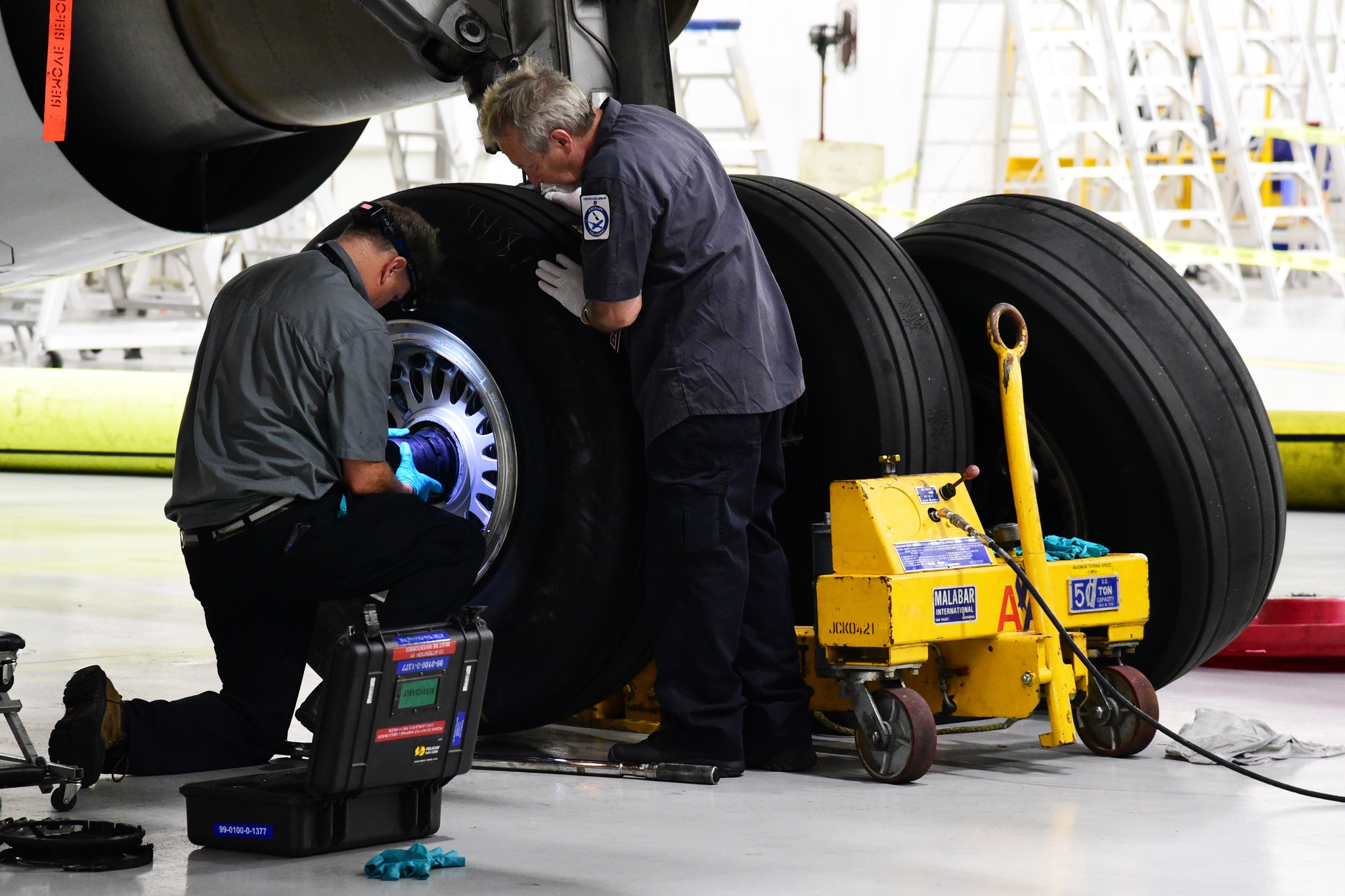
Walking onto the AMC competition floor for the first time is a lot to take in. There are roughly 27 events set up side by side. Each one is sponsored and designed by an airline, OEM, or repair station. Teams of five rotate through stations in 15-minute timed rounds. They complete real maintenance tasks as fast and accurately as they can.
The tasks come directly from daily shop work. That is by design. Some events test hands-on skills. Others test problem-solving. All of them test speed, accuracy, and safety awareness at the same time.
Here are examples of events from recent competitions:
- Safety wiring on aircraft fasteners
- Borescope inspection of engine parts
- Precision torque application
- Antenna gasket installation
- Electrical wire harness testing and assembly
- Airframe damage inspection and measurement
- Antiskid system troubleshooting and repair
- Leading edge and panel sealing
Scoring is based on three things: time, bonus points, and penalties. Penalties come from improper tool use, recordkeeping errors, and safety violations. A live scoring dashboard lets anyone follow the results as they happen.
Teams compete in one of six categories:
- Commercial Aviation: airlines like American, Southwest, United, and Alaska
- General Aviation: fractional operators, charter companies, FBOs, and GA shops
- Military: USAF, US Army, US Navy, Coast Guard, and international military units
- School/Education: students from FAA Part 147 aviation maintenance programs
- Repair and Manufacturing/MRO/OEM: FedEx, Boeing, StandardAero, and similar organizations
- Space: Blue Origin, Virgin Galactic, and others in the space sector
To compete, teams need licensed airframe and powerplant technicians, international aviation maintenance engineers, or students from an FAA Part 147 school. Military and international teams follow their own rules.
Students get real financial help at this event. The Phoebe Omlie scholarship is named after the first woman to earn an FAA aircraft mechanic's license, in 1927. It gives between $1,000 and $2,500 to qualifying student competitors. More cash prizes come from American Airlines, TechForce Foundation, and Chix Fix. American Airlines also donates flight miles to help student teams cover travel costs. Students sponsored by Americans are guaranteed a job interview after they graduate. That kind of reward is rare.
Why GA Mechanics Have More to Gain from the Aerospace Maintenance Competition Than They Might Think
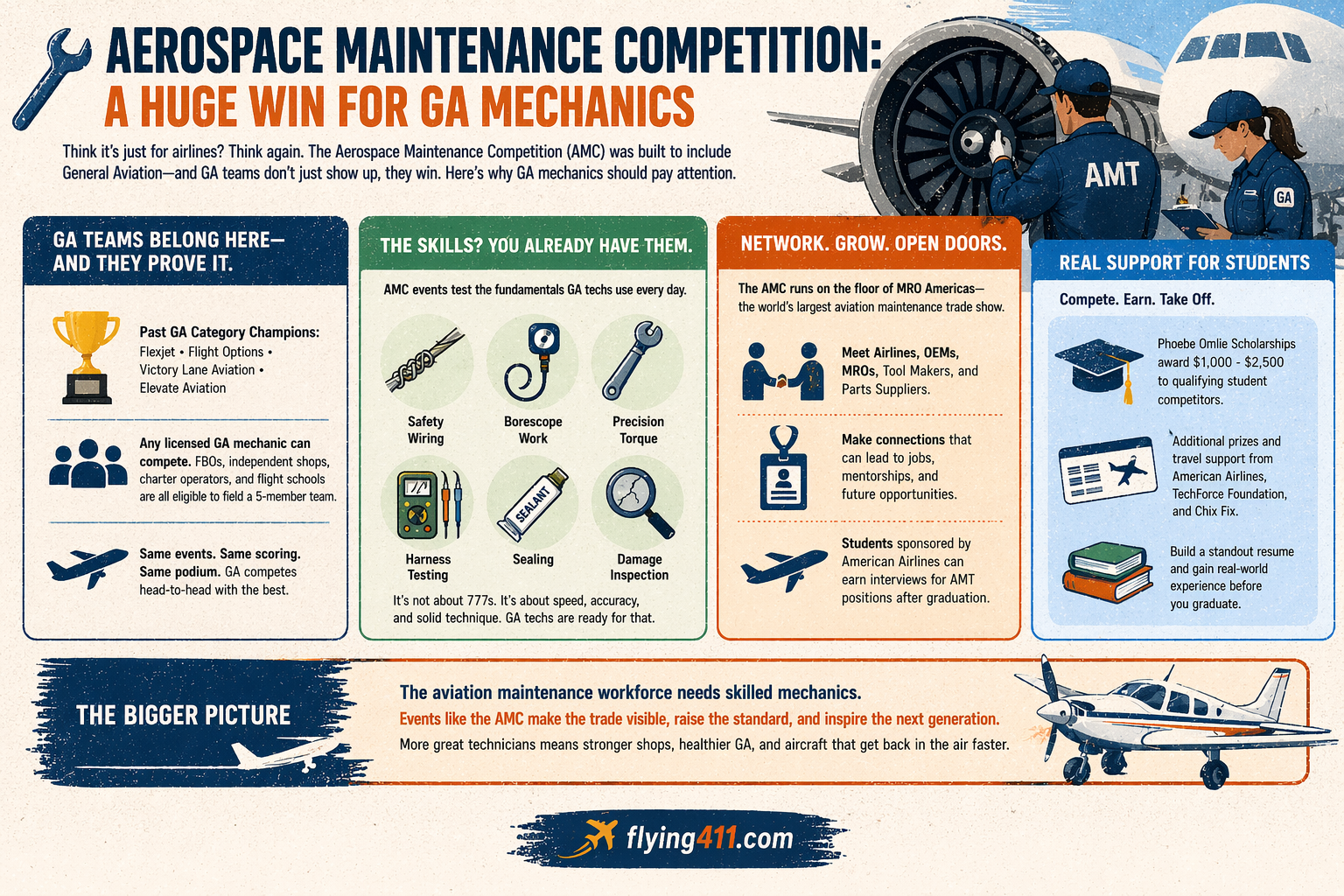
The phrase "that sounds like an airline thing" comes up a lot when GA mechanics first hear about this event. And honestly, it makes sense on the surface. The aerospace maintenance competition is held at a big commercial aviation trade show. The sponsors are airlines and OEMs. The teams that make headlines tend to come from FedEx, United, or Alaska Airlines.
But that first impression misses a lot. The aerospace maintenance council built this event to include general aviation as a full competitive category. Not an add-on. Not a side bracket. GA teams compete on the same floor, in the same events, against the same clock as everyone else. And they win.
Past General Aviation category champions include Flexjet, Flight Options, Victory Lane Aviation, and Elevate Aviation. These are fractional jet operators, charter companies, and GA organizations. Their technicians showed up, competed hard, and took first place. No asterisks. No separate scoring. The same events and the same judges as the airlines.
Any licensed mechanic in general aviation can join. FBOs, shops, charter operators, and flight schools with maintenance departments are all eligible. You do not need to work for a major airline. You just need a team and the drive to show up.
The Skills Being Tested Are Already in Your Toolbox
Here is something important to know. The events are not built around airline-only equipment. A GA aircraft maintenance technician would recognize most of the tasks. Safety wiring, borescope work, torque checks, harness testing, sealing, and damage inspection are all on the list. These are skills used in any GA shop.
A GA tech who does annual inspections on Cessnas and Pipers already knows torque checks. They already know safety wiring. They already use borescopes. The competition does not ask you to work on a 777. It asks you to show strong aviation maintenance skills at speed. A well-trained GA technician can do that.
Competing also pushes you to sharpen the basics. Your regular workday does not always demand that. With 15 minutes on the clock and a judge watching every move, you learn fast where you are strong and where you need work. Years of routine work do not always show you that.
What Happens Off the Competition Floor Matters Too
The networking at the AMC is hard to find anywhere else. The event runs on the floor of MRO Americas, the world's largest annual gathering of aviation maintenance professionals. Airlines, OEMs, parts suppliers, and tool makers are all in the same building. Many of them sponsor individual events.
For a GA mechanic in a small shop, this kind of access is rare. A talk with a Snap-on rep or a Boeing engineer on the competition floor can become a career-changing contact. Students sponsored by American Airlines are guaranteed interviews for AMT jobs after they graduate. That is a direct career path built into the event itself.
For students still picking a direction, the competition shows you the full range of aviation. Rotorcraft, commercial jets, GA, military, and space all show up on that floor. If you want to understand how licensing works across different aircraft types, Helicopter License vs Pilot License: Key Differences Every Aspiring Aviator Should Know is a good place to start sorting out your options.
Scholarships, Student Support, and Real Financial Access
The FAA Part 147 School category is one of the most active divisions in the competition. The financial support for student teams is strong. The Phoebe Omlie scholarship gives between $1,000 and $2,500 to qualifying student competitors. More prizes come from American Airlines, TechForce Foundation, and Chix Fix. American Airlines also donates flight miles to help teams with tight budgets cover travel costs.
For a student working toward their airframe and powerplant certificate, this is one of the best chances to build a resume, earn money, and meet future employers before graduation. Students who compete leave with something a classroom cannot give them. They have shown what they can do under pressure in front of an industry crowd.
The Bigger Picture for GA
The aviation maintenance workforce shortage is real. General aviation feels it hard. Pilots wait longer than ever for routine appointments. Shops turn away from work because they do not have enough staff. One solution is making the trade more visible to people who have never thought about it.
Events like the AMC help do that. They put skilled technicians in front of a global audience. They show young people that this is a respected career with real rewards. Every mechanic who enters the field because of that makes life a little better for GA aircraft owners who just want their annual done on time.
The same care that makes a great technician also makes thorough maintenance records important. If you are shopping for an aircraft and want to know what good maintenance history looks like, Aircraft Logbook and Maintenance History Verification: What Buyers Need to Know walks you through what to check and why it matters.
The competition celebrates the technicians who do that work right. GA mechanics are already doing it every day. The AMC is one place where the rest of the world finally gets to see it.
Conclusion
The aviation maintenance world has plenty of skilled technicians. What it has lacked is recognition. The Aerospace Maintenance Competition exists to change that, one timed event at a time. It gives GA mechanics a place to compete. It gives them a real standard to measure against. And it puts them in a room full of industry contacts who take the work seriously.
If you are a GA mechanic wondering how your skills stack up, this competition has a category built for you. If you are a student working toward your certificate, there are scholarships and job opportunities waiting. And if you just want to see what top-level aviation maintenance looks like, you can watch it live or stream it from anywhere in the world.
The technicians keeping GA aircraft flying deserve more than a background role. So do the owners trying to find the right parts and support. Flying411 connects GA pilots and owners with the vendors and listings they need and posting your aircraft or parts costs nothing.
Frequently Asked Questions
Can a small GA shop or FBO register a team for the competition?
Yes. Licensed AMTs in general aviation, including those at FBOs, flight schools, charter operators, and independent shops, can register a team and compete in the General Aviation category.
When does team registration open each year?
Registration typically opens October 1 each year. Teams register at amccompetition.com. Both the MRO Americas and VERTICON events open registration at the same time.
Do competitors need to bring their own tools?
No. Snap-on, the official tool sponsor of the AMC, supplies all tools and equipment used during competition. Competitors focus on their skills, not on sourcing gear.
Is there an age requirement to compete?
There is no set age requirement. Professional competitors must hold a valid AMT certificate. Students in the School category must be enrolled in an FAA Part 147 program.
Can the AMC help GA mechanics find job opportunities?
Yes. Airlines, MROs, and OEMs attend the event looking for talent. American Airlines has guaranteed job interviews to student competitors they sponsor after graduation, making it a strong networking opportunity for anyone in aviation maintenance.