Most GA pilots think about weather, fuel prices, and their next annual inspection. Very few think about a big trade show in Florida every spring. But the choices made at that show, by airlines, parts makers, and regulators, quietly affect what you pay at your local shop. They also affect how long you wait to get your aircraft back. According to Boeing's 2025 Pilot and Technician Outlook, the aviation industry will need 710,000 new maintenance technicians over the next 20 years, and North America alone needs 123,000 of them. The event is called MRO Americas, and the 2026 edition is one of the biggest yet. Here is what every GA pilot and aircraft owner in the USA needs to know.
Key Takeaways
MRO Americas 2026 is the world's largest aviation maintenance event. It runs April 21–23 in Orlando, Florida. Airlines, parts suppliers, mechanics, and regulators from around the world all attend. The event is focused on commercial aviation. But the trends talked about there directly affect GA pilots and aircraft owners. Think rising maintenance costs, parts shortages, and new tools coming to general aviation.
| Key Detail | Info |
| Event Name | MRO Americas 2026 |
| Dates | April 21–23, 2026 |
| Location | Orange County Convention Center, Orlando, FL |
| Organizer | Aviation Week Network / Informa Markets |
| Anniversary | 30th year |
| Attendees Expected | 17,000+ |
| Exhibitors | 1,000+ |
| Countries Represented | 93+ |
| Why GA Owners Should Care | AMT shortage, parts costs, and new tech all trace back here |
| Can GA Pilots Attend? | Yes, floor passes are open to the public |
What Is MRO Americas and Why Does It Exist?
If you have never heard of MRO Americas, you are not alone. Most GA pilots are busy flying. They are not tracking commercial aviation trade shows. But this event has been running for 30 years. It has a real impact on the maintenance world you rely on every time you book a shop visit.
MRO stands for Maintenance, Repair, and Overhaul. It covers everything from routine inspections to full engine rebuilds. The aviation maintenance industry is huge. Global MRO spending hit $136 billion in 2025. It is expected to reach close to $193 billion by the end of the decade. An industry this big needs one central place to meet. That is what MRO Americas became.
Aviation Week Network puts on the event each year. They are one of the most trusted names in aerospace media. The 2026 edition is a big milestone. It marks the 30th year of the show. It takes place April 21–23 at the Orange County Convention Center in Orlando, Florida. Orlando is a smart pick. It is close to airline offices, MRO facilities, and training centers all across the region.
Here is a quick look at what makes the 2026 show stand out:
- 17,000+ attendees from 93 countries
- 1,000+ exhibitors covering every part of the maintenance industry
- 2,000+ airline and lessor buyers looking for solutions on the show floor
- Co-located with the Military Aviation Logistics and Maintenance Symposium (MALMS)
- Special features include an all-new Tech Hub, the Go Live! Theater, and the A-WING jobfAIR
The aerospace maintenance industry sends its best people to this event every year. Airlines send buying teams. Parts makers send engineers. Regulators like the FAA send staff. OEMs, the companies that build the engines and parts in your aircraft, use the show to launch new products and deals.
One of the best parts of the event is the Aerospace Maintenance Competition. Ninety five-person teams of trained technicians compete in 27 skills challenges. Each one tests real maintenance tasks under timed pressure. Watching it is eye-opening. The level of skill needed to do this work safely is impressive, and the competition puts that on full display.
The show also has the A-WING jobfAIR. It is a career fair that connects job seekers with aviation maintenance employers. The mechanic shortage is serious right now. That makes this one of the most needed parts of the whole event.
Knowing what MRO Americas 2026 is leads to a bigger question: how does a commercial aviation trade show in Florida affect a GA pilot's annual inspection in Ohio, Texas, or anywhere else in the country?
How a Commercial Aviation Event Sends Ripples Into Your Hangar
Here is something most GA pilots do not think about. When airlines, regulators, and makers make choices at MRO Americas, those choices move through all of aviation. Your local A&P, your go-to parts supplier, and the shop doing your engine overhaul are all part of that same system.
Here is how it works. Commercial aviation is the biggest buyer of aircraft parts, maintenance labor, and new tools. When that market is under pressure, and right now it is, the effects reach every part of aviation. That includes GA.
Here are the main ways this plays out:
- Parts availability: Airlines buy parts in huge amounts. When global supply chain issues hit, OEMs take care of their biggest buyers first. GA operators often wait longer and pay more. In 2025 alone, airlines paid an extra $3.1 billion in maintenance costs tied to supply chain problems. That pressure does not go away. It spreads.
- Labor competition: The same A&P mechanics who work on Cessnas and Pipers are also wanted at airline MRO shops. Airlines often pay more. When commercial aviation is hiring fast, GA shops lose workers. North America is short roughly 17,000 aviation technicians right now. That number is growing.
- Technology adoption: Almost every new maintenance tool used in commercial aviation ends up in GA too. Digital inspection tools, monitoring systems, and AI-based checks all started in the commercial world. The aftermarket tools on display at MRO Americas 2026 are the GA tools of 2030.
- Regulatory direction: Regulators attend MRO Americas and join in on sessions. The talks happening there shape future FAA rules, airworthiness directives, and maintenance rules. These apply to all of aviation.
This is why a show built around airlines and OEMs matters to someone flying a Piper Cherokee on weekends. Commercial aviation moves first, and GA follows. When you know what is being talked about at events like this, you get an early look at what is coming.
Here is a simple example. A new digital inspection tool gets shown at MRO Americas. A few big MRO shops start using it. A year or two later, smaller shops pick it up. A few years after that, your local A&P has it in the shop. It takes time, but the path is clear and it keeps repeating.
The 2026 show has a clear set of topics: worker shortages, supply chain fixes, AI-based tools, and 3D-printed parts for old aircraft. Each of these topics has a direct link to GA. The next section covers what GA pilots and owners need to know about each one.
What the 2026 Show Is Telling Us About the Future of GA Maintenance
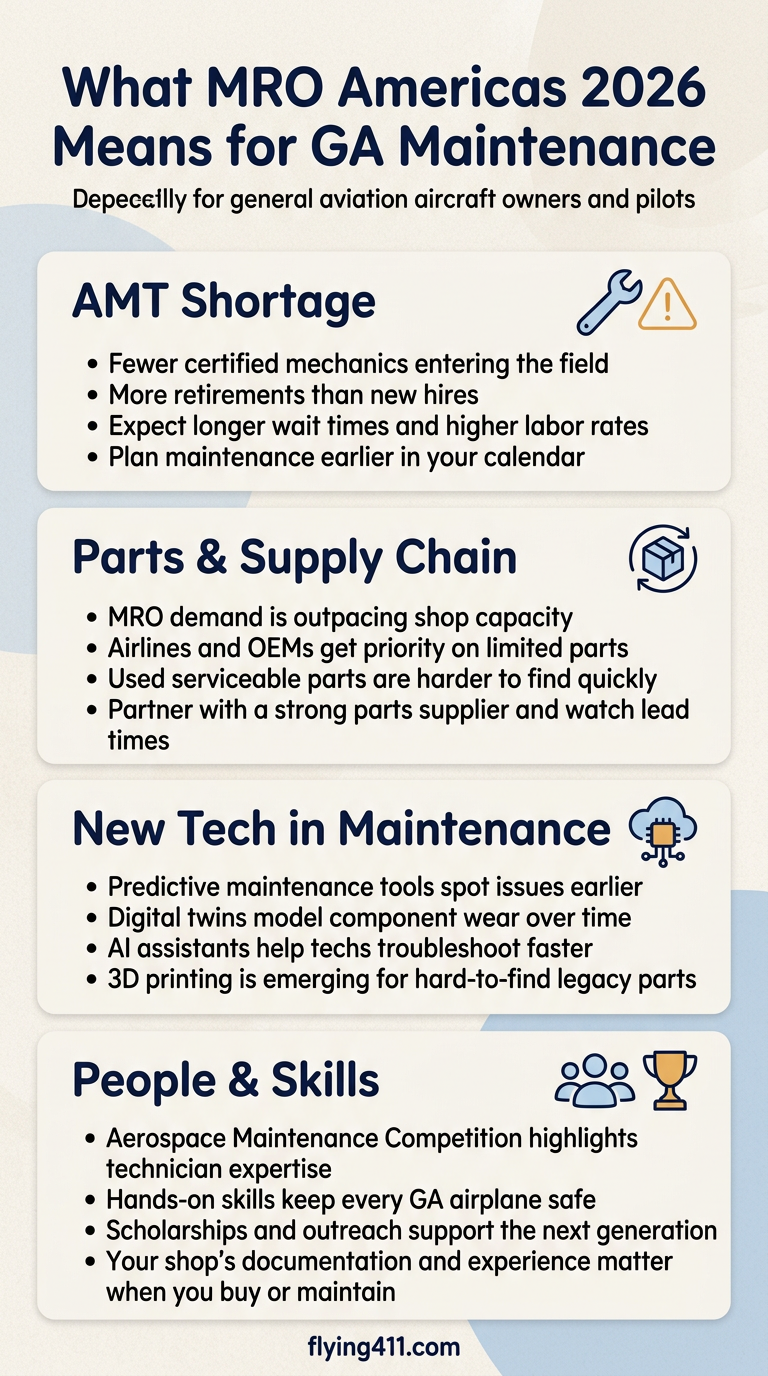
Every year, MRO Americas shows where the aviation maintenance industry is going. The talks on that show floor in Orlando are early signs. They show up in your shop's labor rates, parts wait times, and tool options a year or two later. The 2026 show has five big topics, and all of them connect directly to GA.
The AMT Shortage Is the Most Urgent Issue on the Floor
If there is one topic everyone is talking about at MRO Americas 2026, it is the shortage of aviation maintenance technicians. This is not a future problem. It is happening right now. GA owners are already feeling it.
North America is short roughly 17,000 certified mechanics today. That number is expected to climb to 30,000 by 2028. On top of that, 27% of certified mechanics in the country are over 64 years old. When they retire, there are not enough new techs coming in to replace them.
Here is what that means for you as a GA owner:
- Longer wait times to get your aircraft into a shop, for anything beyond basic maintenance
- Higher labor rates as shops compete to keep good A&Ps on staff
- Fewer choices in smaller GA markets where independent mechanics are already hard to find
The A-WING jobfAIR and the Aerospace Maintenance Competition at the Aviation Week event are both direct responses to this problem. The competition raises the profile of aviation maintenance as a career. Scholarships are funded right on the show floor to help students pay for training. These efforts matter a lot. But building a pipeline takes years. In the meantime, the best thing you can do is plan your maintenance calendar farther ahead. If you want a full breakdown of your duties as an owner, the AIRCRAFT OWNER MAINTENANCE GUIDE: WHAT YOU NEED TO KNOW TO STAY COMPLIANT AND SAFE is a great place to start.
Parts Supply Chain Pressure Is Real, and GA Owners Feel It
The supply chain story in aviation is not a good one right now. MRO spending jumped 40% since 2019. But global capacity only grew by about 10% in that same time. The gap between those two numbers is a problem. Someone always pays for it.
In 2025, airlines paid an extra $3.1 billion in maintenance costs tied to supply chain problems. OEMs are working hard to support commercial operators, new aircraft deliveries, and a long backlog of engine shop work. When their capacity runs out, GA parts orders get pushed back.
The aftermarket is also under pressure. Used parts, the ones GA operators depend on most, are getting more costly and harder to find fast. Engine overhaul shops are dealing with longer wait lists and higher prices for key parts.
What can GA owners do about it?
- Work with a trusted parts supplier who has good inventory contacts and can warn you about long wait times early
- Think about buying key parts before you need them, especially for older or rare aircraft types
- Ask your A&P which parts are running long lead times for your specific aircraft right now
The aerospace maintenance industry is working on fixes for these supply chain problems. These include 3D printing and parts sharing programs. They will take time to grow, but they are part of the plan being talked about in Orlando this April.
New Technology Is Coming, and Some of It Is Already Here
The brand-new Tech Hub at MRO Americas 2026 is full of tools that will reach GA hangars before long. Here is what to watch for:
- Predictive maintenance tools: AI systems that read engine data and spot problems before they ground your aircraft. Commercial operators are already using these. Expect to see them show up in GA avionics in the next few years.
- Digital twins: Virtual copies of aircraft parts that model wear over time. Shops use them to know when an overhaul is due before anything breaks. GE and Rolls-Royce use them on their biggest engines today.
- AI troubleshooting agents: Digital helpers that let technicians find problems faster and with more accuracy. Think of them as a helper that has read every maintenance manual ever written and never forgets a thing.
- 3D printing: This one matters most for GA owners with older aircraft. Rules around printed parts have been relaxed. 3D printing is now a real option for finding hard-to-get parts for legacy aircraft. A part that once took weeks to track down can now be printed in days.
These are not far-off ideas. They are being shown on the show floor right now. Early adopters in the commercial world are already using them. GA always takes a bit longer, but the direction is clear.
The Aerospace Maintenance Competition: A Spotlight on the People Keeping Your Aircraft Safe
It is easy to think of aircraft maintenance as something that just happens in the background while you wait. The Aerospace Maintenance Competition at MRO Americas puts the people doing that work front and center.
Ninety five-person teams compete in 27 skills challenges. Each one tests real maintenance tasks under timed conditions. Watching these events is a good reminder of how much skill and care goes into keeping any aircraft airworthy. These are the same skills your A&P uses at your annual every year.
If you are buying an aircraft, that skill history is very important. Checking the records is a must. If you are looking at a used aircraft right now, the AIRCRAFT LOGBOOK AND MAINTENANCE HISTORY VERIFICATION: WHAT BUYERS NEED TO KNOW is a must-read before you sign anything.
The competition also funds AMC scholarships on the show floor. They help the next group of mechanics pay for training, tools, and testing fees. Every scholarship is one more certified technician entering a pipeline that GA needs badly right now.
Can GA Pilots and Owners Attend?
Yes, and it is worth thinking about if you want to stay up to date on where aviation maintenance is going. Floor passes are open to the public at mroamericas.aviationweek.com. A floor pass gets you into the full exhibit hall, the Aerospace Maintenance Competition, and the Go Live! Theater.
When you are on the show floor, spend your time on:
- Parts suppliers and distributors with GA inventory, especially those who know older aircraft well
- Avionics vendors showing new monitoring and inspection tools
- Independent MRO providers who work on both commercial and GA aircraft
- The Aerospace Maintenance Competition for a real look at the skills that keep your aircraft safe
Conference sessions cost more but are worth it if you care about workforce trends, rule changes, or new tools for your operation.
Conclusion
MRO Americas 2026 is not something most GA pilots think about. But the trends and challenges being talked about in Orlando this April are already showing up at your local shop. Parts are harder to find. Labor takes longer to book. Maintenance costs keep going up. These things are connected. They are the result of industry-wide pressure that MRO Americas works to address every year.
The good news is that the industry sees these problems. People are working on real fixes. AI-based tools, 3D printing, and new training programs are all moving in the right direction. Staying informed about what is happening at the industry level makes you a better, more prepared aircraft owner.
Can't make it to Orlando this April? You don't have to be on the show floor to stay ahead of what's coming. Flying411 breaks down the trends, tools, and maintenance news that matter to GA pilots and aircraft owners across the USA
Frequently Asked Questions
Is MRO Americas only for commercial aviation professionals?
No. Floor passes are open to the public. The event is built around commercial aviation, but GA pilots, aircraft owners, and A&P mechanics can all attend. The exhibit floor has parts suppliers, avionics vendors, and independent MRO providers that work with GA operators.
When will MRO Americas take place in 2026?
MRO Americas 2026 runs April 21–23, 2026, at the Orange County Convention Center in Orlando, Florida. Conference sessions begin as early as April 20 for those who sign up.
Does MRO Americas cover general aviation aircraft specifically?
The event focuses mainly on commercial aviation. But many exhibitors serve both commercial and GA markets. The big trends covered, such as parts access, workforce needs, and new maintenance tools, apply directly to GA aircraft owners.
What is the Aerospace Maintenance Competition at MRO Americas?
It is a live skills contest on the show floor. Teams of five aviation maintenance technicians compete in 27 timed challenges based on real maintenance tasks. It is free to watch with a floor pass and is one of the most interesting parts of the event.
How do I register for MRO Americas 2026?
Registration is done through the official MRO Americas website at mroamericas.aviationweek.com. Floor passes cover the exhibit hall and the Aerospace Maintenance Competition. Conference sessions may need a separate sign-up.