According to McKinsey, the global shortfall of aviation maintenance technicians could reach roughly 22,000 full-time employees by the end of 2026, and is projected to nearly triple over the following three years.
That number is already shaping your experience as a pilot and aircraft owner. The wait at your local shop is longer. The mechanic you relied on for years just retired. That part you needed took months to show up. This is what a shortage in motion looks like from the ground level.
Every spring, the largest gathering in the world dedicated to aircraft maintenance takes place. This year, MRO Americas 2026 brought together more than 17,000 attendees and 1,000+ exhibitors in Orlando, Florida. Over 2,000 airline and lessor buyers also attended. It brings together the people who keep aircraft flying around the world. They gather to share ideas, sign deals, and plan for the year ahead.
Most of the coverage that comes out of this show focuses on airlines and large commercial operators. But the trends discussed there do not stay in those boardrooms. They move into the broader aviation world. Higher maintenance costs. Longer wait times at your local shop. Harder-to-find parts. A workforce that is aging out faster than the next generation is stepping in.
This year, three topics dominated the show above all others. Those topics were AI in maintenance operations, the growing shortage of qualified technicians, and the ongoing pressure on parts supply chains. Each one connects directly to what GA pilots and aircraft owners deal with every day. Here is what happened at MRO Americas 2026, and what it means for the pilot community.
Key Takeaways
The aviation maintenance industry is under serious pressure in 2026. A shortage of mechanics, a shortage of parts, and aging fleets are pushing costs higher and wait times longer at every level of aviation, including general aviation. AI tools are helping commercial operators work smarter with fewer people, but those benefits are just beginning to reach GA. The most important thing GA pilots and owners can do right now is plan further ahead and budget more for maintenance. Learning what options are available when parts are hard to find will also help.
| Topic | Key Detail |
| MRO Americas 2026 | April 21–23, Orlando, FL. 30th anniversary. 17,000+ attendees from 93+ countries. |
| Mechanic Shortage | 22,000+ global technician shortfall projected by end of 2026. Median U.S. mechanic age: 54. |
| Parts Supply | Lead times jumped from 4–6 weeks to 20–40+ weeks for many common parts. |
| AI in Maintenance | Airlines using AI diagnostics are seeing 35–40% fewer unscheduled maintenance events. |
| GA Impact | Longer waits, higher costs, and parts scarcity are hitting GA shops and owners directly. |
| Career Opportunity | AMT starting salaries: $45,000–$55,000. Experienced mechanics can earn $80,000–$120,000+. |
What Is MRO Americas — and Why Does It Matter?
MRO stands for maintenance, repair, and overhaul. It covers everything that keeps aircraft flying safely. That includes routine oil changes and brake inspections, avionics repairs, structural work, engine rebuilds, and full-scale refurbishments. Every aircraft in the sky depends on MRO work to stay airworthy. Without it, aircraft simply do not fly.
MRO Americas is the largest trade show in the world dedicated to this work. Organized by Aviation Week Network, the event has been running for 30 years. The 2026 show was held April 21–23 at the Orange County Convention Center in Orlando, Florida. It drew professionals from every corner of the maintenance world. Here is who shows up:
- Airlines looking for maintenance contracts and new technology
- MRO providers showcasing services and capacity
- OEMs and parts manufacturers presenting new products
- Aerospace companies and technology developers
- Parts distributors and logistics specialists
- Regulators and certification experts
- Thousands of mechanics, engineers, and operations managers
The show is where the aftermarket sets its course for the year. This is the industry that supports aircraft after they leave the factory. Deals get signed. New tools get unveiled. Industry leaders compare notes on what is working and what is failing. It is one of the few places where the full chain of aviation maintenance, from the factory floor to the flight line, comes together in one room.
So why should a GA pilot or small aircraft owner care about a show that is mostly focused on airlines?
Because the aviation maintenance ecosystem is shared at every level. Your local A&P mechanic trained in the same regulatory framework as an airline technician. The parts for your Cessna or Cirrus come from suppliers who also serve major carriers. The rules that govern how your aircraft gets maintained come from the same FAA system. When the commercial side of aviation feels pressure, GA feels it too, and usually faster. GA shops have less financial cushion to absorb rising costs.
MRO Americas 2026 made it clear that pressure is building on three fronts at once: the workforce, the supply chain, and the rapid adoption of technology. All three are reshaping what aviation maintenance looks like at every level.
The Big Picture: What Is Happening to Aviation Maintenance Right Now?
To understand why MRO Americas 2026 felt so urgent, you need to understand what is happening to the global aviation industry right now.
Fleets are getting older. The global commercial fleet has an average age of 15.1 years, up significantly from pre-pandemic levels. That number matters because older aircraft need more maintenance, more parts, and more skilled labor to keep them airworthy. The reason fleets are aging is simple. Airlines ordered thousands of new aircraft, but Boeing and Airbus are struggling to deliver them. The worldwide aircraft backlog now stands at more than 17,000 planes. That equals roughly 12 to 14 years of production at current build rates.
Airlines cannot get new planes, so they keep old ones flying. Old planes mean more shop visits. More shop visits mean more demand for mechanics, parts, and hangar time. This has created what industry analysts call an MRO "supercycle," a sustained surge in maintenance spending that shows no signs of slowing down.
The numbers tell the story clearly:
- Global MRO demand reached $136 billion in 2025, up 8% from 2024
- By end of the decade, spending is expected to approach $193 billion
- Engine maintenance alone accounts for 53% of total commercial aftermarket revenue in 2026
- Engine repair wait times for modern turbine engines have surged by 150% in recent years
- Items that used to take 4–6 weeks to source now take 20–40+ weeks in many cases
The pandemic made all of this worse. COVID-19 disrupted production lines, accelerated retirements, and emptied training pipelines at the exact moment when aviation needed to be building capacity. The industry is still recovering. Raw material shortages, geopolitical instability, and rising labor costs have continued to pile pressure on a system that was already strained.
What does this mean for GA?
When commercial MRO shops are overloaded, general aviation customers often wait longer. When engine overhaul shops have long commercial queues, your piston overhaul waits too. When parts lead times stretch, the components your A&P needs for your aircraft may be caught in the same backlog. The commercial aviation world and the GA world pull from the same pool of mechanics, parts, and shops. When the commercial side runs hot, GA feels the heat.
Two Problems the Industry Cannot Ignore
At MRO Americas 2026, two problems came up in nearly every panel, session, and side conversation. Both have been building for years. Both are getting worse before they get better. And both hit general aviation in very direct ways.
Problem 1: There Are Not Enough Mechanics
The aviation maintenance workforce is facing a serious shortage. Here is what the data shows:
- The global AMT shortfall is projected to reach 22,000 full-time employees by end of 2026
- In North America, approximately 24,000 mechanic positions are currently unfilled
- That number is expected to grow to nearly 40,000 by 2028
- Boeing's 2025 Outlook forecasts demand for 710,000 new maintenance technicians worldwide over the next 20 years
- The median age of a certificated mechanic in the U.S. is 54 years old
- 27% of certified mechanics are over age 64
- 80% of the current workforce is expected to retire within six years
Even with record numbers of new mechanic certificates being issued, the pipeline is not keeping up. About one-third of seats in aviation maintenance training schools across the country sit empty. There simply are not enough people entering the field to replace those who are leaving.
For GA, this plays out at the local level. Shops near your home airport are losing experienced mechanics to airline jobs that pay more and offer better benefits. Some shops are turning away work because they do not have the staff to take it on. A few have closed. If you have noticed longer wait times for your annual inspection in the last year or two, the workforce shortage is a major reason.
Problem 2: Parts Are Getting Harder to Find
The second major problem is parts availability. Every supplier in the global aviation parts chain is under strain right now. The reasons stack up:
- Airlines keeping older planes flying are consuming more replacement parts
- Many parts now carry lead times of 20–40+ weeks, up from 4–6 weeks before the pandemic
- 38% of MROs reported problems with incomplete or unverifiable parts documentation in the past year
- When parts are scarce, the risk of counterfeit and suspect unapproved parts entering the supply chain goes up
For GA owners, this means a job that should take a week can drag on for months. That happens when a backordered part is stuck in the supply chain. It also means your A&P may bring up alternatives like PMA (Parts Manufacturer Approval) parts or USM (Used Serviceable Material). Both are legitimate, FAA-approved options. Both are playing a bigger role in keeping aircraft flying as new parts become harder to source quickly.
These two problems set the stage for the third major topic at MRO Americas 2026. That topic is the rapid rise of AI and technology. It is starting to change how maintenance gets done, and what that shift means for everyone in aviation.
How AI and New Technology Are Changing Aviation Maintenance
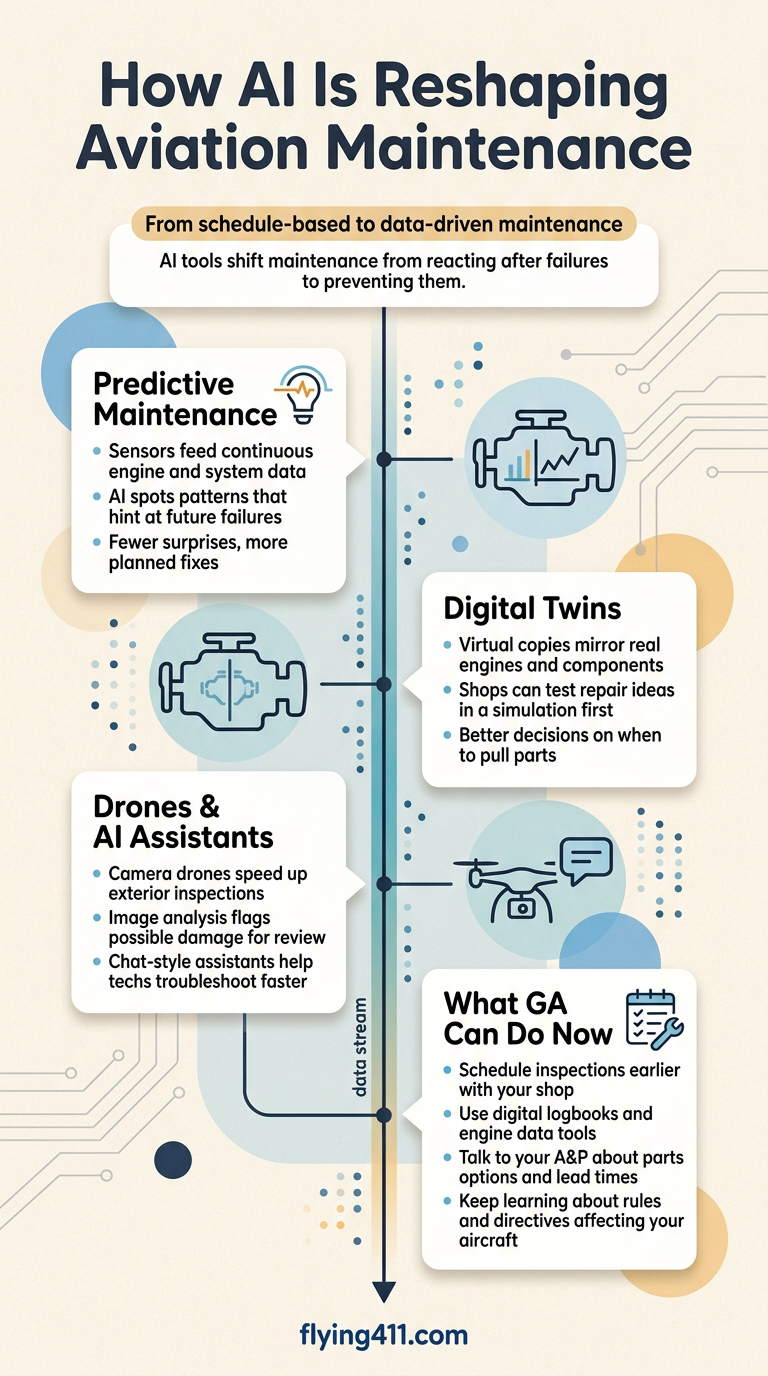
The biggest buzz at MRO Americas 2026 was about AI. Not the science-fiction kind. It is the kind that already runs inside real airline operations today and is changing how mechanics plan, inspect, and complete their work. And it is producing results that are hard to argue with.
For years, aviation maintenance worked on a simple principle: fix things on a schedule or fix them after they break. A component had a set number of flight hours before it came off the aircraft. Inspections happened at regular intervals. It was reliable, but it was also blunt. You might pull a part that had years of life left in it. Or worse, miss a problem developing between inspection windows.
AI has changed that equation entirely.
Predictive Maintenance: Catching Problems Before They Happen
Modern aircraft are packed with sensors. These sensors collect data on everything from engine temperature and vibration to hydraulic pressure and fuel flow. AI systems analyze that data in real time, comparing it against historical patterns to spot early signs of wear or failure.
The results in commercial aviation speak for themselves:
- Airlines using AI-driven diagnostics are seeing 35–40% fewer unscheduled maintenance events
- Platforms like Airbus Skywise aggregate data from over 11,000 aircraft and can flag maintenance needs up to six months in advance
- According to Deloitte, predictive maintenance cuts downtime by 15% and improves labor productivity by 20%
- McKinsey estimates AI and digital tools can unlock 15–35% more capacity from the existing workforce
Between 2019 and 2025, easyJet avoided 1,343 cancellations and 171 major delays through predictive AI in its MRO operations. In 2024 alone, United Airlines used the same approach to prevent more than 300 out-of-service events. That is not a small edge. That is a fundamental shift in how maintenance gets done.
Digital Twins: A Virtual Copy of the Real Thing
A digital twin is a live, virtual model of an aircraft, engine, or component. It is updated with real sensor data, so it mirrors the actual condition of the physical aircraft at all times.
Rolls-Royce, GE Aerospace, and Lufthansa Technik use digital twins to track engine wear, simulate repair scenarios, and decide when components actually need attention. GE's AI-powered digital twin program has produced 60% earlier lead time on maintenance planning, a 45% increase in issue detection, and 50% fewer false alerts.
For a mechanic, this means being able to run a simulation before touching the aircraft. You can test a repair approach digitally, check how a component is likely to perform over the next 200 flight hours, and make decisions based on data rather than guesswork.
Drone Inspections and AI-Assisted Troubleshooting
After years of regulatory groundwork, commercial drone inspections are scaling up in 2026. A drone equipped with high-resolution cameras and AI image analysis can complete a full exterior aircraft inspection in under one hour. The same job takes human technicians 10 to 12 hours manually. Delta Air Lines, KLM, and LATAM have all received regulatory approval and are deploying drones in regular operations.
On the shop floor, AI troubleshooting agents are now being deployed as digital assistants for mechanics. A technician can ask the system a question in plain language and get a step-by-step response based on maintenance manuals, historical repair data, and current aircraft condition. This is especially valuable for newer technicians who are still building experience. It helps them work faster and make fewer errors. As the aviation industry deals with a thinning workforce, these tools help stretch the capacity of the people who are available.
The aftermarket side of the industry is investing heavily in these tools too. Parts distributors and supplier networks are using AI to forecast demand, manage inventory, and cut lead time surprises. Those surprises have caused a lot of headaches across fleet management. Tools like these also help operators stay on top of FAA compliance windows. For a deep look at one recent example, New FAA Airworthiness Directive for Pratt & Whitney GTF Engines: What Operators Must Know covers the latest requirements and what affected operators need to do.
What This Means for GA Right Now
Large-scale AI platforms are built for airline-sized data sets and budgets. But the technology is starting to appear in tools that GA pilots and owners can actually use:
- Garmin engine trend monitoring (available on G1000 NXi and compatible systems) tracks engine performance over time and flags deviations
- Savvy Aviation offers remote engine data analysis and pre-buy inspection support for piston aircraft owners
- CAMP Systems provides maintenance tracking and forecasting for turbine and piston fleets
- Digital logbooks and mobile maintenance apps are replacing paper records at even the smallest GA shops
The shift toward condition-based maintenance for piston aircraft is coming. It is not here at scale yet, but the direction is clear.
What GA Pilots and Aircraft Owners Should Do Right Now
Knowing what is happening in the industry is useful. Knowing what to do about it is better. Here are the most practical steps GA pilots and aircraft owners can take right now.
Schedule your annual inspection earlier than usual. Wait times at GA shops have been stretching. Many shops are short-staffed, and the mechanics they have are busier than ever. Calling two or three months ahead, instead of the usual few weeks, gives you a much better chance of getting the slot you need.
Budget more for maintenance going forward. Labor costs are rising as shops compete for fewer mechanics. Parts costs are up. The overhaul shops handling engine work are operating with backlogs. This is a structural shift, not a temporary spike. Building a larger maintenance reserve into your operating budget is a smart move right now.
Ask your A&P about parts options before a job starts. If a needed part is on backorder, knowing early gives you options. PMA parts and USM are both FAA-approved alternatives that can shorten wait times and reduce cost. Your local supplier network matters more than ever, and a good A&P will know where to look.
Start using digital maintenance records if you are not already. Digital logbooks make it easier to track what has been done, what is coming due, and what your aircraft's maintenance history looks like for a future buyer. Several tools are available that work well for owner-flown GA aircraft.
Keep learning about the rules that affect your aircraft. Airworthiness directives, maintenance intervals, and aerospace certification requirements are not static. Staying current on what applies to your aircraft protects your investment and keeps your airplane legal. For a practical guide to building good habits around your aircraft, How to Maintain an Aircraft to Extend Its Life walks through the key steps every owner should know.
The aviation maintenance world is under real pressure right now. GA pilots and owners who stay informed and plan ahead will be in a strong position. Working closely with good mechanics will keep their aircraft flying safely for years to come.
Conclusion
The story coming out of MRO Americas 2026 is about the entire aviation ecosystem, and that includes every GA pilot and aircraft owner in the country. Mechanics are retiring faster than new ones are coming in. Parts are harder to source and more expensive than they used to be. Fleets are older and need more care. The technology being deployed to solve these problems is still years away from reaching most small shops.
That does not mean the situation is hopeless. It means it requires planning. Book your annual inspection earlier this year. Ask your A&P about parts availability before a job starts. Learn what PMA and USM options exist for your aircraft. And if you know someone who is hands-on, curious, and looking for a career with real job security, aviation maintenance is one of the best opportunities in a generation.
The industry is investing heavily in solving these problems. The tools being built today will eventually reach every level of aviation. Staying informed is the first step to staying ahead.
If the supply chain pressure is already hitting your aircraft, Flying411 is where GA owners find parts and connect with vendors. List what you have for free and reach buyers who are already looking.
Frequently Asked Questions
What is an A&P mechanic, and what are they allowed to work on?
An A&P mechanic holds an Airframe and Powerplant certificate issued by the FAA. This allows them to inspect, repair, and maintain both the airframe and engine systems of certificated aircraft. Most GA maintenance work is performed by A&P mechanics, sometimes working under a repair station.
What are PMA parts in aviation?
PMA stands for Parts Manufacturer Approval. These are replacement parts made by FAA-approved manufacturers as alternatives to original OEM parts. They go through FAA testing and approval before use. PMA parts are a legal, accepted option and are increasingly popular when OEM parts have long lead times or are out of production.
What is USM, and is it safe to use on my aircraft?
USM stands for Used Serviceable Material. These are removed aircraft components that have been inspected, tested, and certified as airworthy. USM is FAA-compliant and widely used across the industry. It is a common and cost-effective solution when new parts are backordered or no longer manufactured.
What is a repair station, and how is it different from an independent A&P?
An FAA-certificated repair station is a company approved to perform specific maintenance work under Part 145. They operate under stricter quality systems and recordkeeping requirements than an independent A&P. Airlines and larger operators typically use repair stations, but many GA shops hold repair station certificates too.
How does the global aircraft backlog affect my GA aircraft specifically?
The commercial aircraft backlog means airlines are keeping older planes flying longer, which drives up demand for the same parts and shop time that GA uses. It also means mechanics are in short supply at every level. The result for GA owners is higher costs, longer wait times, and more competition for available parts and shop appointments.