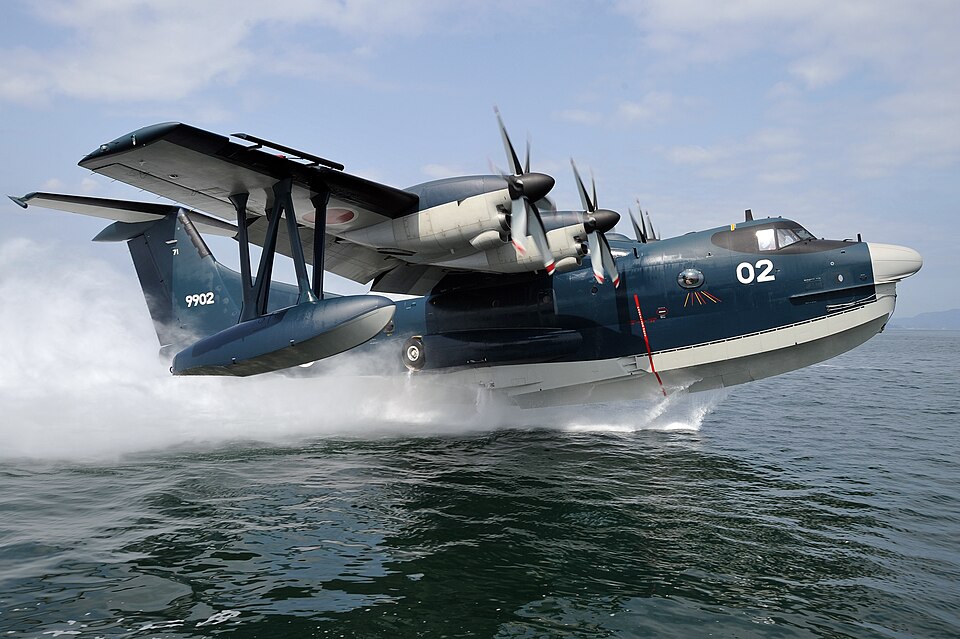
Japan's ShinMaywa US-2 can take off and land on waves as tall as ten feet — an engineering feat that almost no other aircraft in the world can match. That single capability has made Japan's amphibious aircraft program one of the most respected in global aviation.
While most countries have stepped back from large flying boats, Japan kept pushing forward, refining the technology decade after decade. The result is a seaplane platform that handles open-ocean conditions better than nearly anything flying today.
Japan's ShinMaywa US-2 is a large amphibious aircraft built for open-ocean search-and-rescue operations. It uses a system called boundary layer control to fly slowly enough for safe water landings, paired with a deep-V hull and four powerful turboprop engines.
Built by ShinMaywa Industries and operated by the Japan Maritime Self-Defense Force, the US-2 represents the most refined flying boat technology available today.
If you've ever wondered how an aircraft can operate like a boat and a plane at the same time, you're about to find out exactly how Japan pulled it off.
Key Takeaways
The ShinMaywa US-2 is Japan's premier amphibious aircraft, designed specifically for rough open-ocean conditions that would ground every other amphibious platform currently in service. Its boundary layer control system blows high-pressure air over the wings to keep the aircraft flying at very low speeds, which is what makes short water takeoffs and controlled sea landings possible. Built by ShinMaywa Industries and flown by the Japan Maritime Self-Defense Force, the US-2 carries four Rolls-Royce AE 2100J turboprop engines and can operate hundreds of miles offshore in sea states that most aircraft cannot touch.
| Key Detail | Information |
| Aircraft | ShinMaywa US-2 |
| Operator | Japan Maritime Self-Defense Force (JMSDF) |
| Builder | ShinMaywa Industries |
| Primary Role | Open-ocean search and rescue |
| Signature Technology | Boundary layer control (BLC) |
| Wave Height Capability | Up to approximately 10 feet (3 meters) |
| Engine | Rolls-Royce AE 2100J turboprop, four total |
| Approximate Ferry Range | Around 4,700 kilometers |
| Predecessor | ShinMaywa US-1 and US-1A |
Flying411 is your go-to resource for in-depth aviation content, from amphibious aircraft engineering to aircraft buying guides. Bookmark it and come back often.
What Sets Japanese Amphibious Aircraft Apart From Everything Else
Most amphibious aircraft are designed for calm conditions. A glassy lake. A sheltered river mouth. Maybe a light chop on a bay. Japan needed something entirely different.
The Japan Maritime Self-Defense Force operates across the open Pacific Ocean, where the water is almost never calm and rescue calls don't wait for good weather. That requirement pushed Japanese engineers into territory no one else was seriously exploring: a large flying boat capable of operating in genuine open-ocean sea states, far from the nearest port or airfield.
Why It Matters: The open Pacific has no protected harbors for hundreds of miles at a stretch. An aircraft that can only land on calm water is practically useless for true open-ocean rescue. Japan built the US-2 to work where it actually needs to work.
The answer started with the US-1, which entered service in the 1970s and was produced by the company then known as Shin Meiwa, now called ShinMaywa Industries. That aircraft traced its engineering heritage directly to the Kawanishi aircraft company, which had built Japan's wartime flying boats and was widely considered among the best in the world at the time. The lineage between those wartime designs and today's US-2 is real and direct.
Four Design Choices That Made the Difference
The US-2 did not get its capabilities from a single invention. It got them from a cluster of design decisions that each made the others work better.
- Deep-V hull shape: Instead of skipping across wave faces, the hull cuts through them in a controlled way. This allows the aircraft to manage rough water contact without bouncing or being thrown off course.
- High-lift wing system: The wing is sized and shaped to generate lift at unusually low speeds. This is essential for slowing down enough to land safely on open water.
- Four-engine layout: Four Rolls-Royce AE 2100J turboprop engines provide redundancy if one fails, plus the raw power needed for the aircraft's boundary layer control system.
- Built-in STOL performance: Short takeoff and landing capability is woven into every major system, from flap design to engine positioning.
Good to Know: STOL stands for short takeoff and landing. In water operations, it means the aircraft needs less open water to get airborne and can touch down at slower, safer speeds. For rough-ocean work, this is not a nice extra feature. It is a survival requirement.
The US-1A, an upgraded version of the original US-1, served the JMSDF for many years and proved the core concept was solid before engineers moved on to designing the US-2. You can read about how these aircraft fit into the broader world of modern amphibious aircraft that are still operating today.
Japan's willingness to keep investing in flying boat technology when other countries had largely walked away is what made all of this possible. That long-term commitment, decade after decade, is the real reason the US-2 exists.
Japan's Flying Boat Program
Understanding the US-2 means understanding where it came from. Japan's relationship with large flying boats goes back further than most people realize.
From Kawanishi to Shin Meiwa
During World War II, Japan's Kawanishi company produced the H8K flying boat, which aviation historians have long considered one of the finest flying boats ever built by any nation. It was fast, long-ranged, and well-armed. When the war ended and Japan rebuilt its aviation industry under strict postwar rules, some of that engineering knowledge survived within successor companies.
Shin Meiwa, which carried forward key parts of Kawanishi's engineering staff and facilities, developed the PS-1 anti-submarine flying boat in the 1960s. That aircraft led directly to the US-1 rescue variant. The progression from the H8K to the PS-1 to the US-1 to the US-2 is not a series of unrelated programs. It is one continuous thread of institutional knowledge being passed forward and refined over roughly eight decades.
Fun Fact: Japan's wartime H8K flying boat is said to have impressed Allied pilots who encountered it. Some accounts describe it as one of the most capable maritime patrol aircraft of its era, regardless of nationality.
Why Japan Kept Going When Others Stopped
Through the 1970s and 1980s, most major air forces moved away from flying boats. Jet airfields became widely available. Helicopters got longer range. The need for large amphibious platforms seemed to shrink.
Japan's geography told a different story. The country is made up of thousands of islands. Its fishermen, merchant sailors, and military personnel operate across millions of square miles of open ocean. Helicopter range was never going to be enough, and airfields don't help when your rescue target is a capsized vessel four hundred miles from the nearest coast. Japan kept building flying boats because Japan genuinely needed them.
Where the US-2 Has Operated and What It Has Done
The US-2's record is built on real missions, not simulations or demonstrations.
Open-Ocean Search and Rescue
This is the aircraft's core purpose, and it is where the engineering justifies every dollar spent. When a vessel sinks hundreds of miles offshore, when a sailor goes overboard in heavy weather, the US-2 is often the only aircraft that can actually land near the survivors and bring them aboard.
Helicopters lack the range. Fixed-wing aircraft can drop supplies but cannot land on open water to retrieve survivors. The US-2 does both. It flies to the scene, lands on the water, taxis toward the survivors, and pulls them through a hatch using onboard rescue equipment. The aircraft is designed to hold its position on the water safely even in rough conditions while that process happens.
Pro Tip: If you are evaluating amphibious aircraft for range and rescue capability, pay attention to ferry range and sea-state tolerance together. Ferry range tells you how far the aircraft can reach. Sea-state tolerance tells you whether it can actually land when it gets there. The US-2 scores well on both.
Disaster Response
Japan sits in one of the world's most seismically active regions and receives powerful typhoons every year. Following major earthquakes and serious storms, the US-2 has been used to transport personnel and supplies to communities that were cut off from road or port access. The aircraft's ability to land on sheltered coastal water where a runway does not exist gives it flexibility that conventional transport aircraft cannot match.
Patrol Operations
While rescue is the primary mission, the US-2's long endurance and large sensor suite also make it useful for monitoring Japan's extensive coastline and surrounding waters. The same range and loiter capability that help it find survivors in the water translate naturally into patrol operations.
The Companies Behind the Aircraft
ShinMaywa Industries is the primary manufacturer of Japan's modern amphibious fleet. The company has been building large flying boats continuously since the postwar period, making it one of the very few organizations anywhere in the world with genuine institutional expertise in this class of aircraft.
ShinMaywa and Its Partners
ShinMaywa does not work alone. Nippi Corporation, another Japanese aerospace firm, handles significant structural manufacturing and maintenance work on the US-2 program. Together, these companies have built a supply chain and a knowledge base that is essentially unique. No other country has maintained this level of expertise in large flying boat production through the postwar decades.
Keep in Mind: The rarity of this expertise is itself strategically significant. If ShinMaywa's production capability were lost, rebuilding it would take decades. Japan's ongoing investment in the program is partly about keeping that capability alive.
Japan's Ministry of Defense has been the only customer for every US-2 produced so far. Production runs have been small, reflecting the modest size of the JMSDF's fleet, but the quality standard for each aircraft is exceptionally high.
The Export Question
India has maintained sustained interest in purchasing the US-2 for its own maritime rescue operations. Negotiations have stretched over many years, complicated by pricing, customization requirements, and India's domestic defense procurement policies. As of the most recent available reporting, no foreign sale has been completed, but the ongoing interest from a major naval power underlines how unusual the US-2's capabilities are. No other country currently produces a flying boat with comparable rough-water performance.
If you are curious about how amphibious aircraft are categorized by size and mission type, light sport amphibious aircraft occupy a very different corner of the market and offer a useful contrast to understand what makes a platform like the US-2 so specialized.
How the US-2 Is Engineered to Perform
The engineering of the US-2 is not one clever idea. It is a system of interconnected decisions, each one making the others work better. Here is how each piece fits together.
Boundary Layer Control: The Technology That Makes Everything Possible
Boundary layer control, commonly called BLC, is the single most important engineering feature of the US-2. Understanding it is the key to understanding why this aircraft can do things that other flying boats cannot.
When air flows over a wing, there is a thin layer of relatively slow-moving air right at the surface. This is called the boundary layer. At low speeds, that boundary layer tends to separate from the wing surface, disrupting airflow and eventually causing a stall. BLC addresses this directly by blowing high-pressure air, taken from the engines, over the wing surfaces and flaps. That stream of energized air keeps the boundary layer attached at speeds where it would otherwise break away.
Fun Fact: BLC technology has been explored by several countries over the years, but the US-2 is said to use one of the most advanced operational implementations of the system currently flying anywhere in the world.
The practical results of BLC are significant:
- The aircraft's minimum flying speed drops substantially, allowing shorter water takeoff runs and slower, more controlled landings.
- Stall protection improves, giving pilots a larger margin of safety at low altitudes over water where there is no room for error.
- The aircraft can slow down to speeds that make rough-water landings survivable rather than catastrophic.
Without BLC, an aircraft the size of the US-2 would need far more open water to get airborne and would have to touch down at speeds that would make even moderate wave heights dangerous.
STOL Performance in Detail
The US-2's short takeoff and landing capability goes well beyond BLC alone. The wing is large relative to the aircraft's weight, which produces a high lift coefficient even with BLC switched off. The flaps are unusually large and deflect to steep angles. The engines are positioned so that their exhaust and propeller wash flows over the flap surfaces during takeoff and landing, adding even more lift at the moments when it matters most.
The result is an aircraft that can lift off from a water run of roughly 280 meters under good conditions. For reference, most jet airliners need well over a thousand meters of paved runway. The US-2 achieves a fraction of that distance, on open water, with wind and chop working against it.
Heads Up: Takeoff distance varies with weight, wind, temperature, and wave conditions. The figures cited here represent favorable operating conditions. Real-world performance in challenging sea states will differ, which is part of why the four-engine layout and BLC redundancy are so important.
Twin-engine amphibious aircraft face genuine tradeoffs in power reserve and BLC capacity compared to a four-engine platform like the US-2, which helps explain some of the design choices ShinMaywa made.
The Hull: Where the Aircraft Becomes a Boat
An airplane fuselage almost never has to behave like a boat. The US-2's hull does, every time the aircraft lands on water.
The hull must absorb enormous hydrodynamic forces on every water landing. The bottom surface is shaped with a feature called a step, which is a carefully designed break in the hull's profile. The step controls how water pressure builds up and then releases during the takeoff run. Without it, the aircraft would struggle to break free from the water's surface because of suction forces acting on the hull.
The US-2's hull represents a refinement of the earlier US-1A design, shaped by decades of operational data and extensive model testing. Every curve and angle was chosen to balance three competing needs: strength to survive rough-water impacts, hydrodynamic efficiency for takeoff, and aerodynamic cleanliness for cruise flight.
The Powerplant
Four Rolls-Royce AE 2100J turboprop engines power the US-2, each producing roughly 4,591 shaft horsepower. That is a substantial amount of power for a propeller-driven aircraft, and it is necessary for several reasons.
First, if the water surface changes unexpectedly during a landing approach, the crew needs enough thrust reserve to execute an immediate go-around. Second, BLC operation requires engine bleed air, which means some of the engines' output is being diverted to the wing system rather than the propellers. The four-engine layout ensures there is always enough power left over for both jobs simultaneously.
Mission Systems and Crew
A standard US-2 crew includes pilots, a rescue coordinator, sensor operators, and maintenance personnel capable of handling minor issues during long sorties far from any base. The aircraft carries radar, optical sensors, and communication equipment that allow the crew to locate survivors at night or in poor weather.
These systems have been upgraded progressively as technology has improved. The current JMSDF configuration represents the most capable version of the aircraft yet fielded.
Other Roles the US-2 Platform Could Support
The engineering that makes the US-2 exceptional at open-ocean rescue also lends itself to other demanding missions.
Aerial Firefighting
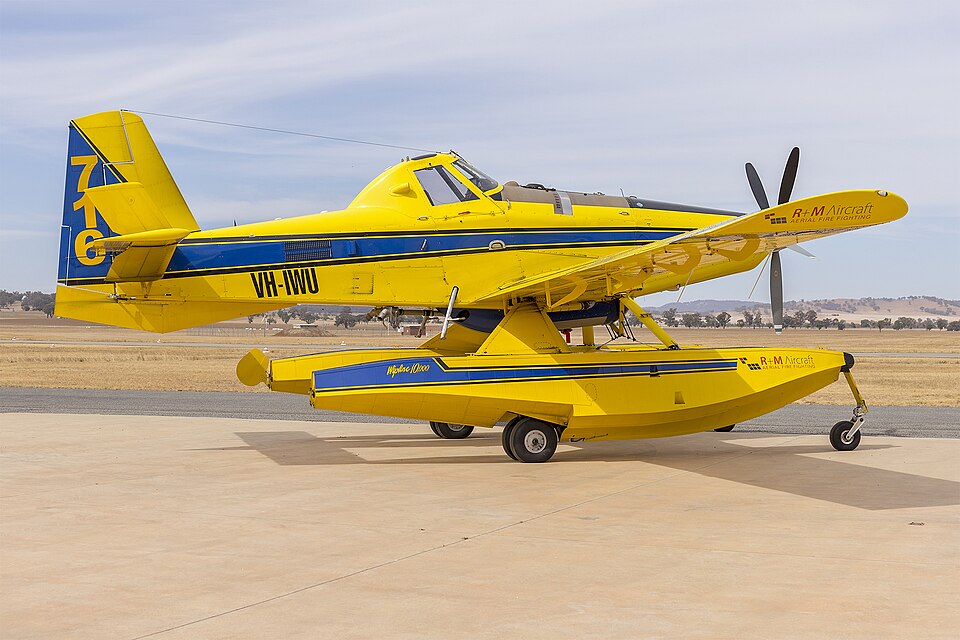
A water-scooping variant of the US-2 could theoretically fill its tanks from a lake or bay and drop water on wildfires. For an aircraft of its size, the potential water load would be significant compared to most dedicated air tankers. This role has been studied but not formally pursued as a production program.
Anti-Submarine and Maritime Patrol
Early iterations of Japan's flying boat program, including aircraft that preceded the US-1, were studied for anti-submarine warfare roles. Long endurance, large sensor payload capacity, and the ability to operate independently far from shore are all natural strengths of a platform in this class. The current US-2 is not configured for anti-submarine work, but the basic architecture would support it.
Good to Know: Japan's postwar defense posture has historically emphasized humanitarian and rescue operations. That context shaped the decision to focus the US-2 on rescue rather than combat roles, even though the platform could physically support both.
Transitioning the Fleet
The US-1A, the US-2's predecessor, has been aging out of service gradually rather than all at once. Managing the transition while keeping the JMSDF's rescue capability fully operational has required careful coordination between ShinMaywa, Nippi, and Japan's Ministry of Defense. The approach has been deliberate and steady, consistent with Japan's broader philosophy of prioritizing operational continuity over rapid procurement cycles.
For anyone researching aircraft that operate across a range of sizes and configurations, small amphibious aircraft offer an interesting contrast to the scale and complexity of a platform like the US-2.
Conclusion
Japan's ShinMaywa US-2 is what happens when a country commits to solving a hard engineering problem and refuses to walk away from it. The boundary layer control system, the deep-V hull, the four-engine layout, and the decades of refined STOL capability all came together because the JMSDF needed something that did not yet exist and was willing to fund the work of creating it. Every technical detail in this aircraft traces back to a real operational requirement, tested against real Pacific Ocean conditions, and improved through generations of actual service. That is engineering in the most honest sense of the word.
For more in-depth aviation content like this, head over to Flying411 — it is built for readers who want the full picture.
FAQ
What is the ShinMaywa US-2 used for?
The US-2 is used primarily for open-ocean search and rescue by the Japan Maritime Self-Defense Force. When vessels sink or crew members go overboard hundreds of miles from shore, the US-2 can fly to the scene, land on the water, and recover survivors directly. It has also been used for disaster response and maritime patrol duties.
How does boundary layer control help the US-2 land on rough water?
Boundary layer control works by blowing high-pressure air, drawn from the engines, over the wing surfaces and flaps. This keeps the airflow attached to the wing at very low speeds, which prevents stalls and allows the aircraft to slow down far more than a comparable aircraft without the system. Slower approach speeds mean more controlled landings, which is what makes rough open-ocean operations feasible.
How many ShinMaywa US-2 aircraft does Japan currently operate?
The JMSDF operates a modest fleet of US-2 aircraft, generally reported at around five to six active airframes. The fleet is intentionally small because each aircraft is expensive to build and maintain, but the individual capability of each one is exceptionally high.
Has any country other than Japan purchased the ShinMaywa US-2?
As of the most recent available reporting, no foreign sale has been completed. India has been in discussions with Japan about acquiring the aircraft for many years, but negotiations have been complicated by pricing, customization requirements, and India's domestic procurement policies. The US-2 remains exclusively operated by Japan's JMSDF.
What is the approximate range of the ShinMaywa US-2?
The US-2 has a reported ferry range of around 4,700 kilometers. That figure allows the aircraft to reach distant areas of the Pacific Ocean from Japanese bases, which is essential for a rescue platform whose targets may be hundreds of miles offshore.
How does the crew actually rescue survivors from the water?
The US-2 lands on the water near the survivors, then taxis toward them. Rescue personnel use an onboard hatch and equipment to bring survivors aboard. The hull is designed to hold safely on the water surface in rough conditions while this process takes place, which can take meaningful time depending on how many people need to be recovered.
What happened to Japan's flying boat program before the US-1?
Japan's flying boat lineage goes back to the wartime Kawanishi H8K, which has long been considered one of the finest flying boats ever built. After the war, Shin Meiwa developed the PS-1 anti-submarine flying boat in the 1960s, which led to the US-1 rescue variant. The US-2 is the latest step in that unbroken line of development.
Could the US-2 be used as a firefighting aircraft?
The concept has been studied. A water-scooping variant could fill tanks from a lake or bay and drop large amounts of water on wildfires. The aircraft's size would give it significant capacity compared to most dedicated air tankers. However, no firefighting production program has been formally launched as of the most recent reporting.
How does the US-2 compare to smaller amphibious aircraft?
The US-2 is far larger, more powerful, and more expensive than typical civilian amphibious aircraft. Its rough-water tolerance, range, and mission systems are in a completely different category. Smaller amphibious platforms are better suited for calm-water operations, recreational use, or short regional flights. The US-2 was built specifically for conditions that smaller aircraft cannot handle at all.