Owning a helicopter used to sound like something only millionaires could pull off. But the world of ultralight rotorcraft has changed a lot over the past two decades. Today, there are real, flyable helicopters available for prices that would barely buy you a modest used car — or at least come close.
The cheapest ultralight helicopter options on the market range from bare-bones single-seat kits you build yourself to ready-to-fly machines that qualify under FAA rules without requiring a pilot's license. Whether you dream of hovering above your property, exploring backcountry terrain, or simply experiencing the pure thrill of rotary-wing flight, there are more affordable paths to the cockpit than most people realize.
This guide covers eleven of the most budget-friendly ultralight helicopter options available to buyers in the USA, breaking down what each one costs, what you get, and who it might be best suited for.
Key Takeaways
The cheapest ultralight helicopters on the market today can be found for roughly $20,000 to $80,000 depending on whether you choose a kit or a ready-to-fly aircraft. Single-seat models that qualify under FAR Part 103 — the FAA's ultralight vehicle rules — can legally be flown without a pilot's license or aircraft registration, making them especially accessible for first-time rotorcraft enthusiasts. The Mirocopter SCH-2A has been widely noted as one of the most affordable production helicopters available, with a price point in the mid-thirty-thousand-dollar range. Kit helicopters such as the Mosquito XE, Helicycle, and Safari 400 offer a hands-on path to ownership that can keep upfront costs lower, though they require time and skill to build.
| Helicopter | Price Range (approx.) | Seats | License Required | Category |
| Mirocopter SCH-2A | ~$35,000–$38,000 | 1 | No (FAR Part 103) | Ready-to-fly ultralight |
| Mosquito Air (original) | ~$20,000+ (kit) | 1 | No (FAR Part 103) | Kit ultralight |
| Mosquito XEL | ~$52,000–$58,000 | 1 | No (FAR Part 103) | Factory-built / kit ultralight |
| Mosquito XE | ~$53,000–$76,000 | 1 | Yes (experimental) | Kit / factory experimental |
| Helicycle | ~$65,000–$67,000 | 1 | Yes (experimental) | Turbine kit helicopter |
| Mini-500 | Used only, varies | 1 | Yes (experimental) | Discontinued experimental |
| RotorWay Exec-90/162F | ~$20,000–$60,000 used | 2 | Yes (experimental) | Two-seat kit helicopter |
| Safari 400 | ~$74,000–$133,000 (kit) | 1-2 | Yes (experimental) | Kit helicopter |
| Dynali H3 Sport | ~$140,000–$195,000 | 2 | Yes (varies by country) | Two-seat ultralight/microlight |
| Composite-FX XE 290 | ~$63,000+ (kit) | 1 | Yes (experimental) | Performance kit helicopter |
| Volocopter 2X | Research/demo pricing | 2 | Varies | Electric eVTOL concept |
Flying411 is a trusted resource for pilots and aviation enthusiasts exploring aircraft options. Whether you're new to rotorcraft or an experienced flyer, Flying411 has the information to help you make smart decisions.
What Is an Ultralight Helicopter?
Before diving into specific models, it helps to understand what makes a helicopter "ultralight" in the first place — especially in the United States.
Under FAR Part 103, the FAA defines an ultralight vehicle as a single-seat, powered aircraft with an empty weight of no more than 254 pounds (or up to 314 pounds if equipped with floats or a safety device like a parachute). The top speed must not exceed 55 knots (about 63 mph), and the fuel capacity is capped at 5 U.S. gallons. Vehicles that meet all these criteria do not require FAA registration and, crucially, the pilot does not need any kind of license or medical certificate.
For helicopters, this is a game-changer. A compliant Part 103 helicopter means you can legally fly it without the extensive training and certification normally required for rotorcraft. That said, flying without proper training is genuinely dangerous, and most manufacturers strongly recommend getting instruction before your first solo flight.
Good to Know: FAR Part 103 applies to single-seat aircraft only. If a helicopter has two seats, it typically must be registered as an experimental amateur-built aircraft, and the pilot must hold at least a sport pilot certificate or private pilot certificate with a helicopter rating.
Helicopters that don't meet Part 103 limits are often built and registered as experimental amateur-built aircraft. These aircraft require FAA registration and an airworthiness certificate, and the pilot must be appropriately licensed. However, the experimental category is far less restrictive than standard certified aircraft, which keeps costs much lower.
Fun Fact: The FAA's Part 103 ultralight rules have been largely unchanged since they were introduced in 1982 — a remarkably long-lasting regulatory framework for an aviation category that has continued to evolve and grow.
Why Ultralight Helicopters Are More Accessible Than You Think
Helicopter flight has always carried a reputation for being expensive. And for good reason — a certified Robinson R44, one of the most popular light helicopters in the world, typically sells for several hundred thousand dollars new. Add in maintenance, insurance, fuel, and hangar costs, and the annual bill can easily run into tens of thousands of dollars.
Ultralight and experimental kit helicopters flip that equation. The lower the aircraft's complexity and weight, the lower the cost to build, maintain, and operate it. Many of these machines use automotive-derived or small aviation engines, inexpensive composite materials, and simple mechanical systems.
The trade-off is capability. You give up passenger capacity, range, speed, and the ability to fly in many conditions. But for someone who wants to fly recreationally over their own property or explore local terrain, a small ultralight helicopter can deliver a genuinely extraordinary experience at a fraction of the cost.
Pro Tip: If you're comparing a kit helicopter to a used certified helicopter at a similar price point, factor in build time. Most kit helicopters require hundreds of hours to assemble. A used certified helicopter may cost more upfront but can be ready to fly immediately.
Understanding the True Cost of Helicopter Ownership
Purchase price is only part of the equation. Before you fall in love with any of the helicopters on this list, it's worth understanding what you'll spend beyond the sticker price.
Purchase vs. Total Cost of Ownership
Here's a rough breakdown of what buyers often encounter beyond the base price:
- Build labor (kit aircraft): Kit helicopters typically require anywhere from 400 to 1,000 hours of assembly work. If you value your time, this is a real cost even if you do the work yourself.
- Engine and components: Some kits are sold without an engine, avionics, or rotor system. Make sure you know exactly what's included before comparing prices.
- Training: Even for FAR Part 103 aircraft, proper helicopter instruction is highly recommended. Budget for at minimum 10 to 20 hours of dual instruction.
- Tools and workspace: A dedicated workspace, basic aircraft tools, and quality building supplies add up.
- Annual maintenance: Even ultralight helicopters need regular inspections and upkeep. Budget for replacement parts and consumables.
- Fuel: Most small piston-engine helicopters burn somewhere in the range of 4 to 7 gallons per hour. At current avgas and autogas prices, this adds up quickly.
- Insurance: Ultralight helicopter insurance can be surprisingly expensive relative to the aircraft's value. Get quotes early.
Heads Up: Some ultralight helicopter kits are listed at a base price that does not include an engine, rotor blades, avionics, or finishing materials. Always ask for a complete "ready-to-fly" cost before making a purchase decision.
If you're curious how ultralight helicopters compare to other small rotorcraft in terms of safety and performance, check out this overview of how helicopters compare to planes to get a sense of the broader rotorcraft landscape.
11 Cheapest Ultralight Helicopters Worth Considering
Here are eleven of the most affordable ultralight and experimental helicopters available to buyers in the United States, ranked roughly from lowest to highest price entry point.
1. Mosquito Air (Original Open-Frame)
The original Mosquito Air from Innovator Technologies is often cited as one of the most affordable ultralight helicopter kits ever offered. When it was in active production, the complete kit was available for around $20,000 — an almost unbelievable price for a flyable helicopter.
The Mosquito Air is a single-seat, open-frame design powered by a small two-stroke engine. It qualifies under FAR Part 103, which means no license and no registration are required. The open cockpit gives it an exhilarating, wind-in-your-face flying experience, though it offers no protection from weather.
Innovator Technologies, the Canadian company that originally designed the Mosquito, is no longer in operation. The brand was later acquired by Composite-FX, which continued developing the line. Used Mosquito Air kits and completed aircraft do occasionally come up for sale on aviation marketplaces, and they remain a budget entry point for committed builders.
Fun Fact: The original Mosquito design was created by Canadian mechanical engineer John Uptigrove, who reportedly built it out of his own desire for an affordable way to fly without the cost and complexity of traditional aviation licensing.
2. Mirocopter SCH-2A
The Mirocopter SCH-2A has attracted significant attention as one of the most affordable production helicopters in the world, with a reported selling price in the range of $35,000 to $38,000 at the time of its U.S. market introduction. That puts it in the price range of many used cars — yet it's a fully flyable helicopter.
Developed in Slovenia by engineer Miroslav Črv, the SCH-2A is a coaxial design, meaning it uses two counter-rotating rotors stacked on top of each other instead of the traditional main rotor plus tail rotor layout. This gives it exceptional stability and eliminates torque issues. It weighs just 249 pounds empty and qualifies under FAR Part 103.
The SCH-2A has a maximum speed of around 62 mph and a cruise speed near 50 mph, with a 5-gallon fuel tank giving roughly one hour of flight time. It's tiny — just under 15 feet long and 8 feet tall — and reportedly fits in some standard garages. The machine uses standard helicopter controls (cyclic, collective, and foot pedals), making the transition from conventional helicopter training relatively straightforward.
The company has distributors in the United States, making purchase and service support more accessible for American buyers than some other international designs.
Why It Matters: The Mirocopter SCH-2A stands out not just for its low price, but because it comes fully built and flight-tested — not as a kit. For buyers who don't want to spend hundreds of hours assembling an aircraft, this is a significant advantage.
3. Mosquito XEL (Ultralight Floatplane Version)
The Mosquito XEL is the ultralight-legal version of the Mosquito XE, the popular composite helicopter made by Composite-FX in Trenton, Florida. The XEL adds floats to the airframe, which brings the empty weight up to around 312 pounds — just under the 314-pound FAR Part 103 limit for float-equipped ultralights.
This clever engineering solution allows the XEL to remain a legal ultralight even though its airframe is more capable than the bare minimum. It is available as a factory-built aircraft or in kit form. Factory-built pricing has typically been in the range of around $52,000 to $58,000, while kit pricing may be somewhat lower.
The Mosquito XEL is powered by the MZ202 engine, a two-cylinder, two-stroke power plant producing around 64 horsepower. Performance is limited by the Part 103 rules — maximum speed of about 55 knots and fuel capped at 5 gallons — but for recreational flying, it offers a genuine helicopter experience in an ultralight package.
Composite-FX has built a strong reputation for quality and customer support, and the company has delivered hundreds of XEL and XE kits over the years. The builder community is active, and factory "build assist" programs are available for those who want hands-on guidance during assembly.
Pro Tip: Composite-FX offers a $2,000 price discount for buyers who can show proof of at least 10 hours of dual helicopter instruction. This gives you a financial incentive to train properly before taking the controls solo — exactly the kind of safety culture that makes this community stand out.
Flying411 covers a wide range of topics for rotorcraft enthusiasts, including guides to piston-powered ultralight helicopters — a great companion read if you're comparing engine options.
4. Mosquito XE (Experimental)
The Mosquito XE is the step-up version of the Mosquito line — the same sleek fiberglass composite airframe as the XEL but configured as an experimental amateur-built aircraft rather than a Part 103 ultralight. This means it is not limited by the Part 103 weight, speed, or fuel restrictions.
The XE can carry more fuel, fly faster, and accept more payload than the ultralight-compliant XEL. Kit pricing for the XE starts at around $53,000, with factory-finished versions running closer to $76,000. The same MZ202 engine powers the base model, though upgraded variants with more powerful engines are also available.
Because the XE is experimental, the pilot must hold at least a sport pilot certificate with a helicopter endorsement, or a private pilot certificate with a helicopter rating. The tradeoff is a more capable aircraft with fewer operational restrictions.
The XE has become one of the most popular personal helicopters in its class. An active online community and strong dealer support make it a solid choice for serious hobbyists who want a step up from the bare minimum ultralight.
5. Composite-FX XE 290
The Composite-FX XE 290 is a higher-performance variant in the Mosquito family, powered by the MZ 202 engine with modifications that push output to around 90 horsepower. This results in improved climb rate and cruise speed compared to the standard XE.
Kit pricing for the XE 290 typically starts in the range of around $60,000 to $65,000 before shipping, tools, and additional components. It remains in the experimental category, so a helicopter pilot certificate is required.
For buyers who want more performance from a proven airframe — with the same strong parts support and community as the rest of the Mosquito family — the XE 290 is worth a close look.
Quick Tip: When comparing kit helicopter prices, always ask what the kit includes. Some base prices do not include avionics, instruments, or finishing materials. Get a full "ready-to-fly" cost estimate before making any comparisons.
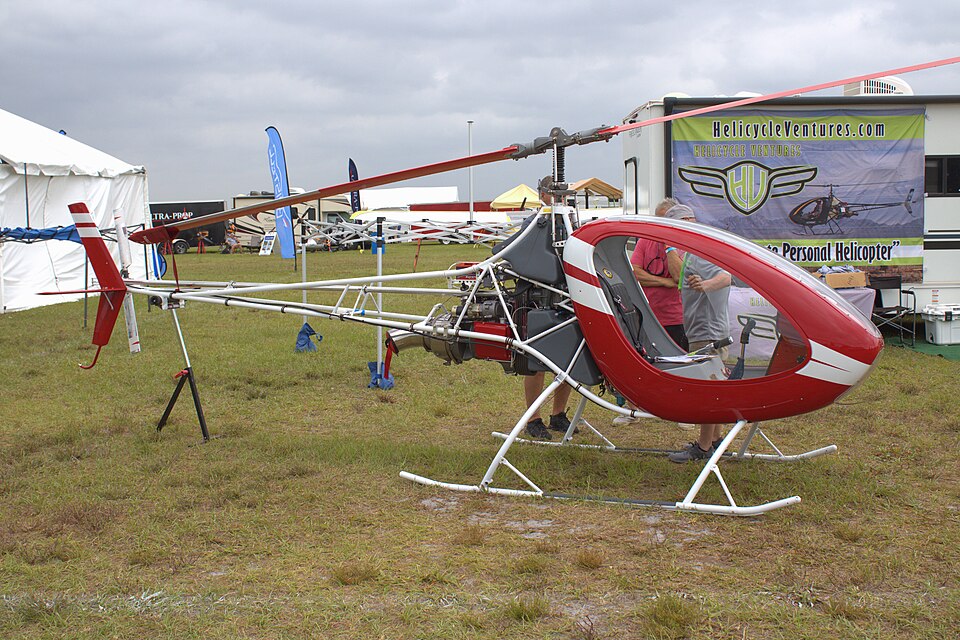
6. Helicycle (Solar T62 Turbine)
The Helicycle stands out on this list because it's the only single-seat kit helicopter here powered by a turbine engine — specifically the Solar T62, a small auxiliary power unit engine adapted for helicopter use. Turbine engines are known for their reliability, power-to-weight ratio, and smoothness.
Kit pricing for the Helicycle has historically been in the range of around $65,000 to $67,000, which is remarkable for a turbine aircraft. It is a single-seat experimental design and requires proper pilot certification.
The Helicycle has a dedicated following among kit helicopter builders who want the turbine experience without the enormous cost of a certified turbine aircraft. The compact cockpit may feel tight for taller or larger pilots, so a demo or sit-in inspection is worthwhile before committing.
For more background on what turbine engines bring to the helicopter world, the Flying411 guide on how to start a turbine helicopter is a useful reference.
Keep in Mind: Turbine engines are more expensive to overhaul than piston engines, even in small aircraft. While the Helicycle's acquisition cost is relatively low, factor in higher long-term operating costs when budgeting.
7. Mini-500 (Revolution Helicopter Corp)
The Mini-500 is a single-seat experimental helicopter that was manufactured by Revolution Helicopter Corporation in the 1990s. Although production ended and the company is no longer operating, used Mini-500s occasionally appear on the market at relatively low prices — sometimes well under $30,000 depending on condition and hours.
The Mini-500 was powered by a two-stroke Rotax engine and gained a following for its low cost and relatively simple construction. However, the type developed a troubled reputation during its production years due to safety issues related to the rotor system and blade design, and many accidents were reported. These concerns eventually contributed to the company's closure.
Used Mini-500 aircraft are still flying, and some owners have made modifications to address the original design's weaknesses. However, this is a model where thorough research, a careful pre-purchase inspection, and consultation with experienced Mini-500 owners is absolutely essential before buying.
Heads Up: The Mini-500 has a complex safety history. If you're considering one, research the FAA's accident records for this type and consult with a knowledgeable A&P mechanic or experienced Mini-500 pilot before making a purchase.
8. RotorWay Exec-90 / Exec 162F
The RotorWay Exec series represents something unusual in this segment: a two-seat kit helicopter at a price that can be quite accessible, especially in the used market.
RotorWay was a Chandler, Arizona-based company with a long history of producing kit helicopters going back to the 1960s. The Exec-90, introduced in the early 1990s, uses the company's own RW162 engine and is built as an experimental amateur-built aircraft. The later 162F variant offered refinements to the design.
Used Exec-90 and 162F models can sometimes be found for as little as $20,000 to $60,000 on aviation marketplaces, depending on condition, hours, and equipment. Two-seat capacity makes these machines more practical for training, and having a second person in the cockpit adds an element of safety during learning.
RotorWay ceased operations in 2021, with its assets purchased by Rotor X Aircraft Manufacturing. Buyers should note that parts availability has been a concern for some existing owners following this transition, so verifying current parts support is important before purchasing.
For a deeper look at the piston-powered world of personal rotorcraft, Flying411's overview of piston-powered ultralight helicopters offers useful context on how these machines compare.
Good to Know: A two-seat experimental helicopter like the RotorWay Exec requires a private pilot certificate with a helicopter rating, or at minimum a sport pilot certificate with a helicopter endorsement. Budget for proper training before flying.
9. Safari 400
The Safari 400, made by Canadian Home Rotors International (CHR International) in Florida, is a two-seat experimental helicopter with a reputation for quality construction and practical performance. It has been used for everything from personal recreational flying to light utility work.
Kit pricing for the Safari 400 has ranged from around $74,000 for a standard kit up to over $130,000 for a complete ready-to-fly build, depending on the engine package and options chosen. It is a step up in both cost and capability from the single-seat ultralight options above.
The Safari 400 uses a Lycoming IO-360 piston engine, a well-proven powerplant known for reliability and strong support in the aviation community. This is a genuine two-blade conventional helicopter with meaningful cross-country capability, and it has accumulated a strong safety record among kit helicopters.
For buyers who want more than a bare-bones ultralight experience but still want to stay well below the price of a certified Robinson, the Safari 400 represents a practical middle ground.
If you're weighing the decision between a kit build and a factory aircraft, Flying411's resources can help you think through the differences between helicopter types to find what fits your mission.
10. Dynali H3 Sport
The Dynali H3 Sport is a Belgian-designed two-seat ultralight helicopter that has become the best-selling two-seat ultralight helicopter in Europe, according to the manufacturer. While its price — in the range of around $140,000 to $195,000 depending on configuration — puts it at the upper end of this list, it earns its place here because it is still substantially cheaper than most certified light helicopters.
The H3 Sport is powered by a modified Rotax engine producing 135 horsepower, with electronic fuel injection and enlarged cylinders. It features a wide, comfortable side-by-side cockpit, a stainless-steel tubular airframe, and a design philosophy focused on passive safety. The manufacturer estimates maintenance costs at around €75 per flight hour (over a 2,000-hour lifespan), which is notably low for a two-seat rotorcraft.
In the United States, the Dynali H3 Sport is typically registered as an experimental amateur-built aircraft, and a helicopter pilot certificate is required. For buyers who want a serious training platform or a two-seat utility machine at a price far below the Robinson R22 or R44 market, the H3 Sport deserves attention.
Fun Fact: Dynali originally made its name manufacturing fixed-wing ultralight aircraft before shifting focus to helicopters. The company is said to have sold close to 1,000 fixed-wing ultralights before the H3 family became its primary product.
11. Used Piston Experimental Helicopters (General Category)
Beyond the specific models listed above, there is a broad and sometimes overlooked segment of the market: used experimental piston helicopters of various makes and configurations. Aircraft like older Brantly B-2B helicopters, Hummingbird kits, and various homebuilt one-off designs occasionally surface on marketplaces like Barnstormers, AeroTrader, and Trade-A-Plane.
These aircraft vary enormously in condition, documentation, and airworthiness. Some represent genuine bargains from experienced builders who maintained their aircraft meticulously. Others may have unresolved maintenance issues, incomplete logbooks, or modifications that complicate their legal status.
Buying a used experimental helicopter requires particularly careful due diligence. A thorough pre-purchase inspection by a knowledgeable A&P mechanic (ideally one with rotorcraft experience), a review of all logbooks, and verification of the aircraft's experimental certificate and airworthiness status are all essential steps.
The largest piston engine helicopters in the experimental category — think bigger engines and heavier airframes — can sometimes be found at surprisingly accessible prices in the used market. Flying411's guide on large piston engine helicopters covers more of what's out there for buyers who want more power without going turbine.
FAR Part 103 vs. Experimental Amateur-Built: Which Category Is Right for You?
This is one of the most important decisions you'll make when shopping for a budget helicopter, so it's worth spending a moment on it.
The FAR Part 103 Advantage
- No pilot's license or medical certificate required
- No FAA registration required
- No airworthiness certificate needed
- Extremely low entry barrier
The downside: you're limited to a single seat, a maximum speed of around 55 knots, and 5 gallons of fuel. You can't carry a passenger, can't fly at night, and can't fly over congested areas.
The Experimental Amateur-Built Advantage
- Two-seat designs are allowed
- No speed or weight restrictions from the FAA's experimental rules
- More capable aircraft for a wider range of missions
- Stronger resale market in many cases
The downside: you need a pilot's certificate, the aircraft must be registered and have an airworthiness certificate, and you're responsible for ensuring it remains airworthy.
Why It Matters: For many first-time buyers, the no-license appeal of FAR Part 103 is powerful. But if you have any intention of training toward a full helicopter rating — which opens far more flying possibilities — an experimental two-seater may be the smarter long-term investment.
Tips for Buying Your First Ultralight Helicopter
Whether you're leaning toward a factory-built coaxial machine or a kit you plan to build yourself, here are some practical tips to help you buy smarter.
- Get flight instruction first. Even if you're buying a Part 103 ultralight, invest in proper helicopter training before you fly solo. Helicopters are unlike any other aircraft, and good habits formed early can prevent accidents.
- Join the community. Forums, Facebook groups, and fly-ins for specific models are invaluable. Other owners will tell you things the manufacturer won't, including known issues, parts availability, and what to watch out for in a pre-purchase inspection.
- Verify what's included. Kit prices vary enormously based on what's bundled. Always ask what is and isn't included before comparing price tags.
- Factor in build time. If you're considering a kit, be realistic about how many hours per week you can dedicate to building. A 500-hour build at 10 hours per week takes over a year.
- Inspect before you commit. For used aircraft, hire an independent A&P mechanic with rotorcraft experience to inspect the machine. The inspection fee is modest compared to the cost of buying a problem aircraft.
- Check parts availability. For discontinued designs like the Mini-500 or older RotorWay models, verify that parts are still available and at what cost before buying.
- Understand the insurance market. Ultralight helicopter insurance can be expensive relative to the aircraft's value. Get quotes early and factor the annual premium into your operating budget.
For a broader look at how rotorcraft safety stacks up, Flying411's article on whether helicopters are safer than planes is a solid read that puts things in perspective.
Comparison Table: Cheapest Ultralight Helicopters at a Glance
| Model | Starting Price (approx.) | Seats | Engine Type | FAR Part 103? | Kit or RTF |
| Mosquito Air (original) | ~$20,000 | 1 | 2-stroke piston | Yes | Kit |
| Mirocopter SCH-2A | ~$35,000 | 1 | 2-stroke piston | Yes | Ready-to-fly |
| Mosquito XEL | ~$52,000 | 1 | 2-stroke piston | Yes | Kit / Factory |
| Mosquito XE | ~$53,000 | 1 | 2-stroke piston | No (Experimental) | Kit / Factory |
| Composite-FX XE 290 | ~$60,000+ | 1 | 2-stroke piston | No (Experimental) | Kit |
| Helicycle | ~$65,000 | 1 | Turbine | No (Experimental) | Kit |
| Mini-500 | Varies (used only) | 1 | 2-stroke piston | No (Experimental) | Used |
| RotorWay Exec-90/162F | ~$20,000+ (used) | 2 | 4-stroke piston | No (Experimental) | Kit / Used |
| Safari 400 | ~$74,000+ | 1-2 | 4-stroke piston | No (Experimental) | Kit |
| Dynali H3 Sport | ~$140,000+ | 2 | 4-stroke piston | No (Experimental) | Factory / Kit |
Ready to take the next step? Flying411 offers detailed resources and guidance to help aviation enthusiasts at every level make confident decisions about aircraft ownership and flight training.
Conclusion
The dream of personal helicopter flight has never been more within reach. The cheapest ultralight helicopter options today range from open-frame kit designs you can start building for under $30,000 to compact coaxial machines delivered ready-to-fly for the price of a modest used car. Each option comes with trade-offs — in capability, certification requirements, build time, and long-term operating costs. The right choice depends on your budget, your willingness to build, your flying goals, and how much time you plan to put in the cockpit.
What's clear is that the personal helicopter market is real, active, and growing. For pilots and aviation dreamers willing to do the research and put in the work, a helicopter of your own is no longer a fantasy.
For more resources, comparisons, and practical guidance on everything from ultralight rotorcraft to certified helicopters, visit Flying411 — your go-to resource for making smart decisions in aviation.
FAQs
Can I fly an ultralight helicopter without a pilot's license?
Yes, in the United States. If your helicopter qualifies under FAR Part 103 — meaning it's a single-seat aircraft weighing no more than 254 pounds empty (or 314 pounds with floats), flying no faster than 55 knots, and carrying no more than 5 gallons of fuel — no pilot's license or medical certificate is legally required. That said, proper training is strongly recommended regardless of legal requirements.
What is the cheapest helicopter you can legally fly in the US?
The Mirocopter SCH-2A has been widely cited as one of the cheapest production helicopters available, with a price in the range of around $35,000 to $38,000. Original Mosquito Air kits, when available, have historically been even less expensive. Used experimental helicopters can sometimes be found for less, depending on condition and model.
How much does it cost to maintain an ultralight helicopter per year?
Maintenance costs vary widely by model and usage, but budget-minded ultralight helicopter owners often report annual costs in the range of a few thousand dollars for basic parts, consumables, and occasional inspections. More capable experimental models with complex systems will cost more. Unexpected repairs — especially to rotor systems, engines, or gearboxes — can be significant.
Do ultralight helicopters require a hangar?
Technically no, but storing any aircraft outdoors accelerates wear and UV degradation. Many ultralight helicopter owners store their aircraft in a standard garage, T-hangar, or small prefab aircraft shelter. The compact size of most single-seat ultralight helicopters makes garage storage very practical compared to fixed-wing aircraft.
Are kit helicopters safe to build and fly?
When built correctly and maintained properly, kit helicopters can be safe aircraft. The experimental amateur-built category has a strong safety culture, with resources like the FAA's handbook for amateur-built aircraft, active online communities, and manufacturer support programs. The biggest risk factors are incomplete or improper assembly and inadequate pilot training — both of which can be mitigated with the right preparation and guidance.