Before turbine engines took over the skies, piston-powered helicopters were doing the heavy lifting — literally. These machines carried troops into battle, rescued downed pilots, hauled cargo across continents, and helped shape the entire science of rotorcraft design. Some were compact two-seat trainers. Others were enormous twin-engine beasts that could swallow a jeep whole.
The story of the 7 largest piston engine helicopters is really the story of helicopter aviation itself — a golden age when engineers were still figuring out what these machines could do, and piston power was the only tool they had to find out.
Key Takeaways
The 7 largest piston engine helicopters ever built span from early WWII utility aircraft to massive Cold War military transports, with the Sikorsky CH-37 Mojave (S-56) widely regarded as the largest piston-powered helicopter ever constructed. These aircraft ranged in gross weight from a few thousand pounds up to roughly 31,000 pounds, and they were powered by everything from a single small radial engine to twin 2,100-horsepower Pratt and Whitney R-2800 Double Wasp radials. Piston technology eventually gave way to turbine engines in the 1960s, but these helicopters defined what modern rotorcraft could become.
| Helicopter | Engine | Gross Weight (approx.) | Notable Role |
| Sikorsky S-56 / CH-37 Mojave | 2x P&W R-2800 (2,100 hp each) | ~31,000 lb | Heavy assault transport |
| Piasecki H-21 Shawnee | Wright R-1820 (1,425 hp) | ~14,700 lb | Arctic rescue / Vietnam transport |
| Sikorsky S-58 / H-34 Choctaw | Wright R-1820 (1,525 hp) | ~14,000 lb | ASW / utility transport |
| Piasecki HRP-1 "Flying Banana" | P&W R-1340 (600 hp) | ~7,200 lb | Early tandem-rotor transport |
| Sikorsky S-55 / H-19 Chickasaw | Wright R-1300 (700 hp) | ~7,900 lb | Multi-role utility |
| Sikorsky H-5 / S-51 | P&W R-985 (450 hp) | ~5,500 lb | Rescue and utility |
| Sikorsky R-4 Hoverfly | Warner R-550 (~185 hp) | ~2,100 lb | First mass-produced helicopter |
Fun Fact: The Sikorsky S-56 / CH-37 Mojave is said to be the largest piston-powered helicopter ever built anywhere in the world — a record it still holds today.
Flying411 is your trusted resource for aviation knowledge, aircraft listings, and expert guidance for pilots and enthusiasts across the United States.
Why Piston Engines Powered the First Helicopters
To understand why these aircraft were so large for their era, it helps to understand the technology behind them. Early helicopter designers had one engine type available: the piston engine.
Piston engines — the same basic concept found in car engines — use combustion inside cylinders to move pistons up and down, converting that energy into rotational power. In a helicopter, that rotation drives the main rotor and tail rotor systems.
Good to Know: Piston engines in helicopters are typically air-cooled radial engines, meaning the cylinders are arranged in a circle around the crankshaft. This design maximizes cooling airflow and packs a lot of power into a relatively compact package.
The challenge with piston engines is their power-to-weight ratio. Compared to turboshaft engines (which came into widespread helicopter use in the late 1950s and 1960s), piston engines are heavier relative to the power they produce. To get more lift, designers had to use bigger, more powerful engines — which added more weight — which required even more power. It was a constant engineering balancing act.
That is exactly what makes the aircraft on this list so impressive. Engineers pushed piston helicopter design about as far as it could go before turbines made the whole conversation irrelevant.
If you are curious about how these two technologies compare today, the differences between piston and turbine helicopters come down to cost, performance, and intended use case.
A Brief History of Piston Helicopter Development
The very first practical helicopters flew in the late 1930s and early 1940s. Igor Sikorsky's VS-300 — considered by many to be the ancestor of the modern helicopter — flew in 1939 and used a modest single-cylinder engine.
From those humble beginnings, the engineering community moved fast. World War II created immediate demand for utility aircraft that could hover, land in tight spots, and rescue personnel from places fixed-wing planes could never reach. The U.S. military poured resources into helicopter development, and each new design grew larger, more capable, and more powerful.
Why It Matters: The piston helicopter era, roughly 1942 to the mid-1960s, produced most of the foundational design concepts still used in modern rotorcraft — articulated rotor heads, tandem rotor configurations, folding blades, and automatic stabilization systems.
By the mid-1950s, engineers had pushed piston-powered designs to their practical limits. The Sikorsky S-56, discussed below, represents the absolute peak of what piston helicopter technology could achieve. Shortly after it entered service, turbine engines made most of its capabilities accessible in a much lighter, more efficient package.
The 7 Largest Piston Engine Helicopters
These seven aircraft represent the full arc of piston helicopter development — from a two-seat WWII trainer that barely cleared 2,000 pounds to a twin-engine Cold War giant that could haul a howitzer.
They are ranked roughly by gross weight, from largest to smallest, so you can see just how dramatically the technology scaled over two decades of rapid innovation.
1. Sikorsky S-56 / CH-37 Mojave (The Largest Piston Helicopter Ever Built)
The Sikorsky S-56 — known in U.S. Marine Corps service as the HR2S-1 Deuce and in Army service as the CH-37 Mojave — is widely regarded as the largest piston-powered helicopter ever constructed.
Developed in response to a U.S. Navy specification issued in 1950 for an assault helicopter, the S-56 was enormous by any standard of its time. It was powered by two Pratt and Whitney R-2800 Double Wasp radial engines, each producing approximately 2,100 horsepower at takeoff. Those engines were mounted in outboard pods on a short high wing, leaving the fuselage entirely open for cargo.
Key specs (approximate):
- Gross weight: around 31,000 lb
- Main rotor diameter: 72 feet
- Powerplant: 2x P&W R-2800 (up to 2,100 hp each)
- Crew: 3
- Capacity: up to 26 fully equipped troops
The nose of the aircraft featured large clamshell cargo doors, allowing vehicles, artillery pieces, and heavy equipment to be loaded directly. The S-56 could carry a 105mm howitzer or two light jeeps inside its fuselage.
Fun Fact: In 1956, the S-56 set three world records in a single year — a speed record without payload, a record altitude with a 5,000 kg load, and a load-carrying record to altitude. All three on piston power alone.
The CH-37 also made history in Vietnam. In 1963, a small detachment of Mojaves was sent to recover downed U.S. aircraft, reportedly recovering aircraft worth millions of dollars by sling-lifting them out of enemy-held territory that was inaccessible by any other means.
Flying411 has a growing library of articles covering piston helicopter history, safety, and performance — perfect for pilots and aviation enthusiasts looking to go deeper.
Production ended with around 150 total airframes. The Mojave was retired by the late 1960s, replaced by turbine-powered machines like the CH-54 Tarhe and the CH-47 Chinook. But it remains, to this day, the largest piston helicopter ever built anywhere in the world.
2. Piasecki H-21 Shawnee (The Flying Banana Goes to War)
The Piasecki H-21 Shawnee is one of the most recognizable helicopters of the early Cold War era. Its distinctive bent-fuselage silhouette earned it the nickname "Flying Banana" — a name that stuck across every generation of Piasecki tandem-rotor design.
The H-21 was originally developed for the U.S. Air Force as a high-altitude arctic rescue helicopter. It used a tandem-rotor configuration, meaning two large rotors mounted at opposite ends of the fuselage rather than a single main rotor with a tail rotor. This arrangement is excellent for carrying heavy payloads without worrying too much about center-of-gravity limitations.
Key specs (approximate):
- Gross weight: around 14,700 lb
- Powerplant: 1x Wright R-1820 Cyclone (approximately 1,425 hp)
- Rotor diameter: 44 feet (each rotor)
- Capacity: up to 20 troops in later variants
Pro Tip: Tandem-rotor helicopters like the H-21 are especially well-suited for cargo operations because the load can be positioned anywhere along the fuselage without destabilizing the aircraft. This is why Boeing continues to use the same basic configuration in the modern CH-47 Chinook.
The H-21 served in Korea and became one of the U.S. Army's primary workhorses in the early stages of Vietnam. It performed poorly in Vietnam's heat and humidity — engines rated for 600 flight hours were sometimes lasting fewer than 200 in those conditions — but it served as a critical bridge until the Bell UH-1 Huey arrived.
In 1954, an H-21 called "Amblin' Annie" completed the first non-stop transcontinental helicopter flight across the United States, with inflight refueling. Over 700 H-21s were produced, serving the United States, France, Canada, West Germany, Japan, and several other nations.
3. Sikorsky S-58 / H-34 Choctaw (The Last Great Piston Workhorse)
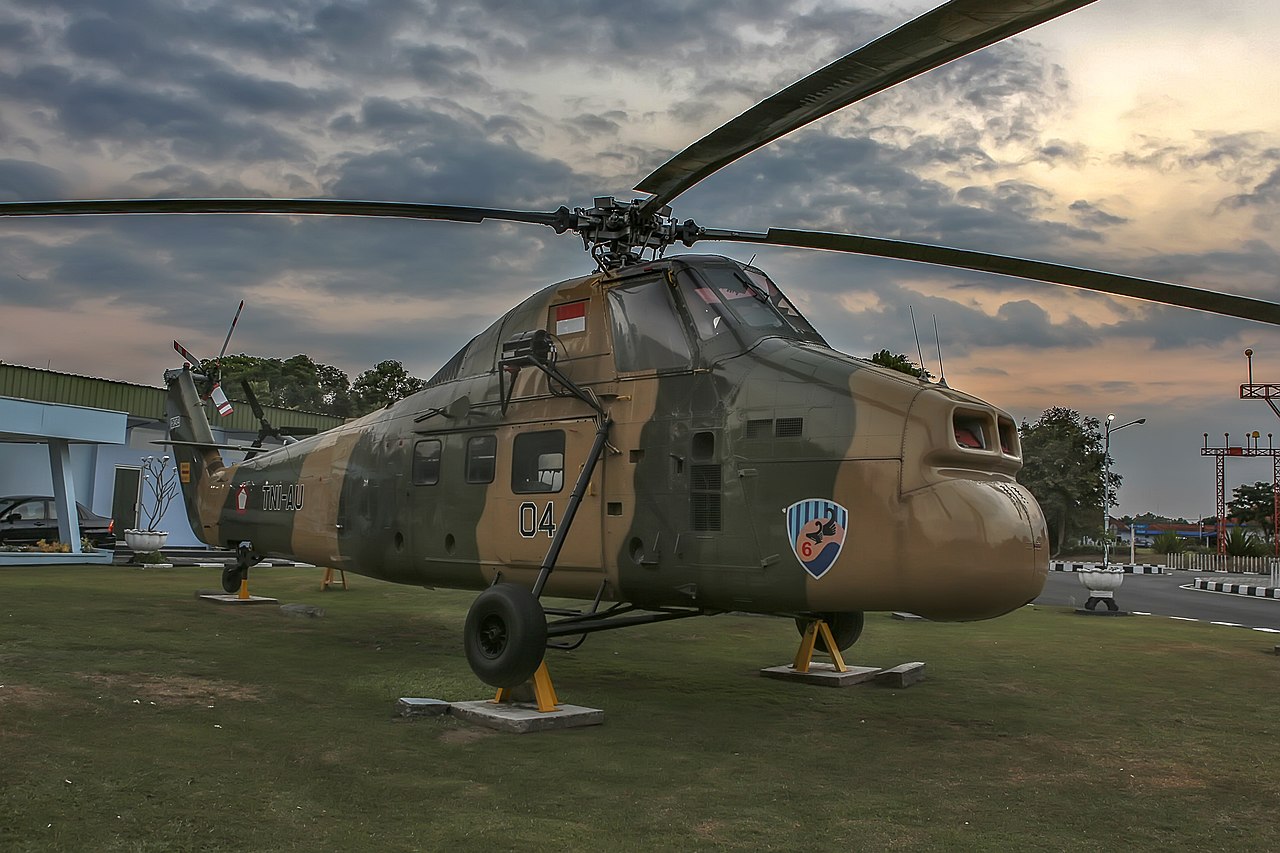
The Sikorsky S-58 — known in U.S. Army service as the CH-34 Choctaw, in Navy service as the SH-34 Seabat, and in Marine Corps service as the UH-34 Seahorse — is arguably the most successful piston helicopter ever built in terms of sheer production numbers and operational versatility.
Over 2,100 S-58s were produced, and the aircraft served with the armed forces of more than 25 countries. It flew in combat across Algeria, Vietnam, the Dominican Republic, and the Middle East. It carried presidents. It recovered astronauts. And it was the last piston-powered helicopter to be flown operationally by the United States Marine Corps.
Key specs (approximate):
- Gross weight: around 13,000-14,000 lb depending on variant
- Powerplant: 1x Wright R-1820 Cyclone radial (approximately 1,525 hp)
- Main rotor diameter: 56 feet
- Capacity: up to 16 troops or 12 litter cases
Good to Know: The S-58's engine was mounted in the nose and angled so that the drive shaft passed diagonally through the cabin up to the main transmission. This unusual layout freed up the cabin floor for cargo and passengers — a clever engineering solution.
The S-58 was designed as a larger, more powerful follow-on to the successful S-55. It was twice as powerful as its predecessor and significantly more aerodynamic. In 1956, it set a speed record on a 100-kilometer closed course.
The aircraft's legacy continued even after piston production ended. Sikorsky and Westland both developed turbine-powered conversions, and the Westland Wessex — a turbine variant — served with the British military for decades. The basic airframe was so well-designed that it simply outlasted the engine technology that originally powered it.
4. Sikorsky S-55 / H-19 Chickasaw (The People's Helicopter)
The Sikorsky S-55 — designated the H-19 Chickasaw by the U.S. Army and Air Force — was the first Sikorsky helicopter truly designed for transport duties from the ground up. It was smaller than the Choctaw that followed it, but it punched well above its weight in terms of historical importance.
The S-55 used the same nose-mounted radial engine layout that would later define the S-58. Its Wright R-1300 engine produced around 700 horsepower, and the elevated cockpit perched on top of the nose allowed the entire cabin beneath to be used for passengers or cargo.
Key specs (approximate):
- Gross weight: around 7,900 lb
- Powerplant: 1x Wright R-1300 (approximately 700 hp)
- Main rotor diameter: 53 feet
- Capacity: up to 10 passengers
Keep in Mind: The S-55 was the first Sikorsky helicopter to offer genuine passenger capacity. Commercial operations began in the early 1950s, and airlines in the United States and Europe briefly operated the type on scheduled passenger routes.
The H-19 saw service in Korea, where it was used extensively for combat search and rescue and logistics. It was also one of the first helicopters exported widely to allied nations under U.S. military assistance programs.
The S-55 was manufactured under license by Westland in the United Kingdom and by SNCASE in France, and it formed the direct design basis for the larger S-58. Around 1,800 examples were built across all variants.
5. Piasecki HRP-1 "Flying Banana" (The Original Tandem Rotor)
The Piasecki HRP-1 was the first tandem-rotor helicopter to enter U.S. military service, and it introduced a concept that is still used in modern heavy-lift helicopters like the CH-47 Chinook today.
Designed for the U.S. Navy in the mid-1940s, the HRP-1 was powered by a Pratt and Whitney R-1340 radial engine producing around 600 horsepower. The fuselage had a distinctive upward angle at the rear — necessary to keep the two large rotors from striking each other — which gave it the unmistakable "flying banana" profile.
Key specs (approximate):
- Gross weight: around 7,200 lb
- Powerplant: 1x P&W R-1340 (approximately 600 hp)
- Cargo/troop capacity: up to 8 troops or around 1,800 lb of cargo
Fun Fact: The HRP-1's nickname — the "Flying Banana" — was so popular that it was informally applied to every subsequent Piasecki tandem-rotor design, including the H-21 Shawnee. The name has long been considered one of the most affectionate in helicopter history.
The HRP-1 proved that a tandem rotor configuration was viable for military transport, opening the door for a series of increasingly capable designs from Piasecki. The company's later work eventually became the foundation for Boeing Vertol — the manufacturer behind the CH-47 Chinook.
6. Sikorsky H-5 / S-51 (The First Commercial Helicopter)
The Sikorsky H-5 — company designation S-51 — holds a special place in aviation history. It was the first helicopter to be certified for commercial use and the first to be operated commercially in the United States, beginning services in 1946.
It was developed as a larger, more capable follow-on to the R-4, powered by a Pratt and Whitney R-985 Wasp Junior engine producing around 450 horsepower. The military designated it the R-5, and later the H-5, and it served with the U.S. Army Air Forces, Navy, Coast Guard, and Air Force in roles ranging from search and rescue to utility transport.
Key specs (approximate):
- Gross weight: around 5,500 lb
- Powerplant: 1x P&W R-985 Wasp Junior (approximately 450 hp)
- Capacity: pilot plus up to 3 passengers
Why It Matters: The S-51 was the first helicopter to be operated commercially, and it was the first to appear on the civilian market for non-military buyers. It helped establish the idea that helicopters could be commercially viable — a concept that shapes the entire general aviation industry today.
The S-51 was also produced under license by Westland Aircraft in the United Kingdom as the Westland Dragonfly, powered by a British Alvis Leonides engine. Over 300 examples of all variants were built, and the type served in Antarctic exploration, airline passenger service, and search and rescue missions around the world.
Understanding piston helicopter safety considerations is just as relevant today as it was in the S-51 era — especially for owners and pilots operating older airframes.
7. Sikorsky R-4 Hoverfly (The Helicopter That Started It All)
The Sikorsky R-4 Hoverfly is the smallest aircraft on this list, but it may be the most historically significant. It was the world's first large-scale mass-produced helicopter and the first to be used operationally by U.S. military forces during World War II.
Developed by Igor Sikorsky from the earlier VS-300 design, the R-4 was powered by a Warner R-550 radial engine producing around 185 horsepower. It was a two-seat aircraft designed for training, observation, and search and rescue duties.
Key specs (approximate):
- Gross weight: around 2,100 lb
- Powerplant: 1x Warner R-550 (approximately 185 hp)
- Main rotor diameter: approximately 38 feet
- Capacity: pilot plus one passenger
Pro Tip: The R-4 was the first helicopter used operationally in combat. In April 1944, R-4s were used to rescue downed airmen in Burma — a mission that would have been impossible for any fixed-wing aircraft. That single operation changed how military planners thought about helicopters forever.
The R-4 set numerous endurance, altitude, and airspeed records during its development and was adopted by the U.S. Army Air Forces, U.S. Navy, U.S. Coast Guard, and the Royal Air Force. In British service, it was known as the Hoverfly.
By today's standards, the R-4 is tiny and underpowered. But as the starting point for every helicopter on this list — and every helicopter that has flown since — it deserves its place among the greats.
If you want to understand how a piston engine helicopter actually comes to life before a flight, reading about the piston engine helicopter startup process is a great place to start.
How These Helicopters Compare: A Quick Specs Overview
| Helicopter | Gross Weight | Engine HP (total) | Capacity | Era |
| Sikorsky S-56 / CH-37 Mojave | ~31,000 lb | ~4,200 hp | 26 troops | 1950s-60s |
| Piasecki H-21 Shawnee | ~14,700 lb | ~1,425 hp | 20 troops | 1950s-60s |
| Sikorsky S-58 / H-34 Choctaw | ~13,000-14,000 lb | ~1,525 hp | 16 troops | 1954-70s |
| Sikorsky S-55 / H-19 Chickasaw | ~7,900 lb | ~700 hp | 10 pax | Early 1950s |
| Piasecki HRP-1 "Flying Banana" | ~7,200 lb | ~600 hp | 8 troops | Late 1940s |
| Sikorsky H-5 / S-51 | ~5,500 lb | ~450 hp | 3 pax | Late 1940s |
| Sikorsky R-4 Hoverfly | ~2,100 lb | ~185 hp | 1 pax | WWII era |
What Ended the Piston Helicopter Era?
The piston helicopter era did not end because of any single failure. It ended because turbine technology simply made a better argument. Turboshaft engines produce significantly more power for their weight, run more smoothly, are more reliable at altitude and in extreme temperatures, and require less maintenance over time.
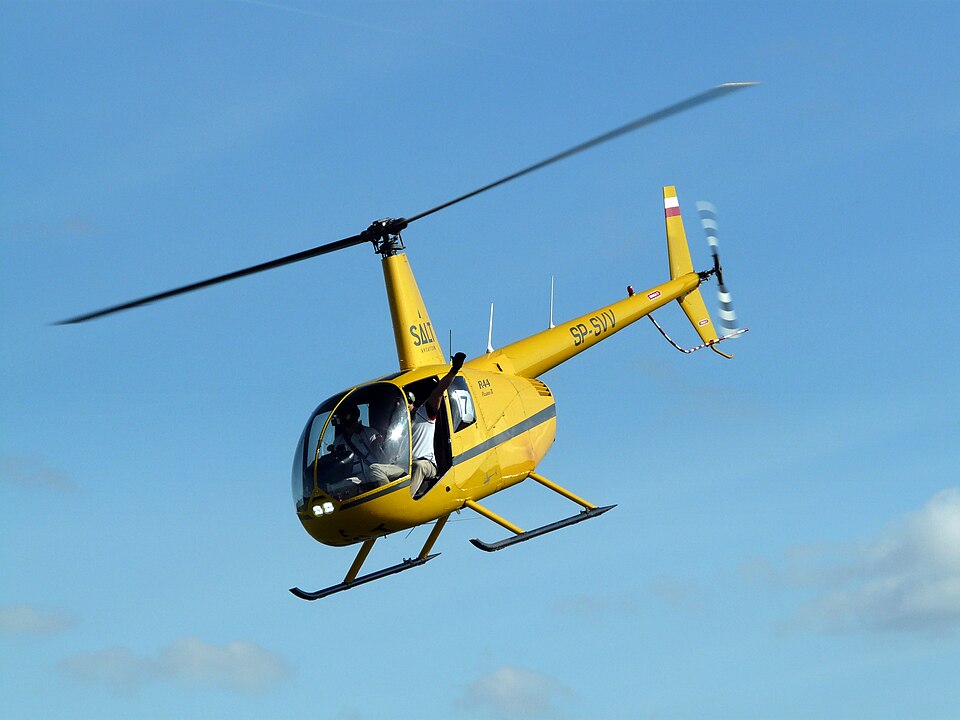
Heads Up: The piston helicopter is not obsolete. Thousands of Robinson R22s, Robinson R44s, and similar aircraft fly every day across the United States. Piston helicopters remain the practical choice for training, personal transportation, and light utility work where turbine economics do not make sense.
By the early 1960s, every major military helicopter program had shifted to turbines. The aircraft on this list were retired or converted, replaced by turbine-powered machines that weighed less, carried more, and flew farther.
But the piston era left behind an enormous legacy. The tandem rotor configuration pioneered by the HRP-1 and H-21 lives on in the CH-47 Chinook. The nose-mounted radial engine layout of the S-55 and S-58 influenced how engineers thought about separating the powerplant from the cabin. And the basic helicopter control systems developed during this period remain largely unchanged in every helicopter flying today.
Should You Care About Piston Helicopters Today?
Absolutely — especially if you are a pilot, a student, or someone thinking about getting into helicopter ownership.
Piston helicopters remain the most accessible entry point into rotorcraft flying. They are significantly less expensive to purchase and operate than turbine machines, and they are the platform on which most helicopter pilots in the United States earn their initial certificates.
The engineering principles are the same. The aerodynamics are the same. The joy of flight is certainly the same.
Quick Tip: If you are considering your first helicopter purchase, a piston-powered aircraft like the Robinson R44 or a well-maintained Bell 47 gives you genuine capability at a fraction of the cost of turbine ownership. Start there, build hours, and let your next step make itself obvious.
Ready to explore what helicopter ownership really looks like? Flying411 connects aviation enthusiasts with the knowledge, listings, and expert perspectives they need to make smart decisions.
Conclusion
The 7 largest piston engine helicopters tell the story of an era defined by ingenuity, engineering ambition, and the relentless drive to figure out what a helicopter could actually do. From the modest but groundbreaking R-4 to the enormous CH-37 Mojave — a machine that still holds the record as the largest piston helicopter ever built — these aircraft pushed every boundary that existed.
Turbine engines eventually took over, and rightly so. But the piston helicopter era built the foundation that every rotorcraft flying today still stands on. Understanding that history makes you a better pilot, a smarter buyer, and a more informed enthusiast.
If you want to keep learning about helicopters — their history, their mechanics, and how to find the right one for you — Flying411 is the place to start.
Frequently Asked Questions
What is the largest piston engine helicopter ever built?
The Sikorsky S-56, known in military service as the CH-37 Mojave, is widely regarded as the largest piston-powered helicopter ever constructed. It was powered by two Pratt and Whitney R-2800 Double Wasp radial engines and had a gross weight of around 31,000 pounds.
Why did the military stop using piston helicopters?
Turboshaft engines became available in the late 1950s and proved to be lighter, more powerful, more reliable, and more efficient than piston engines of comparable output. By the mid-1960s, virtually every major military helicopter program had shifted to turbine power.
Are piston helicopters still in use today?
Yes. Piston helicopters remain common in flight training, personal aviation, and light utility operations. Aircraft like the Robinson R22 and Robinson R44 are widely used across the United States and are among the most popular helicopters in the general aviation fleet.
What made the tandem rotor design used on the Piasecki H-21 special?
The tandem rotor layout places two large rotors at opposite ends of the fuselage, eliminating the need for a tail rotor and allowing the center of gravity to shift along the fuselage without destabilizing the aircraft. This makes tandem-rotor designs especially well-suited for heavy cargo operations.
How does the Sikorsky S-58 rank among piston helicopters in terms of production numbers?
The Sikorsky S-58 is one of the most-produced piston helicopters in history, with over 2,100 airframes built across military and licensed production variants. It served with the armed forces of more than 25 countries and remained in service in various forms well into the 1970s and beyond.