Discover insights, tips, and stories from the skies — from aircraft buying guides to pilot training.

Published: October 12, 2025
Water-landing aircraft have always sparked curiosity. There’s something fascinating about watching a plane glide over the waves, then touch down smoothly on the water surface. From early designs like the Curtiss biplane flying boat to advanced amphibious aircraft such as the ICON A5, these unique machines show how far aircraft manufacturing has come.
Long before modern jets ruled the skies, several seaplanes served as vital transport and search and rescue tools. They helped connect remote islands, deliver supplies, and even conduct military missions. Today, planes that can land on water still play an important role—especially for areas without runways, where being able to land on water can save lives or open access to new destinations.
So, how exactly do these aircraft capable of takeoff and land on lakes or the open ocean manage to stay afloat? Let’s find out how these incredible flying machines pull off such smooth landings and takeoffs on water and why they continue to matter in aviation today.
When a plane lands on the water, it’s performing a carefully balanced dance between air, drag, and buoyancy. The secret lies in its float design and hull shape, which keep it stable during both takeoff runs and water landings.
There are two main categories of seaplanes:
Some modern amphibian types combine both concepts. These amphibious planes have retractable landing wheels, allowing them to operate from land or water—giving true flexibility to land-based aircraft operations. The Progressive Aerodyne Searey, a popular light sport aircraft, is a great modern example.
When performing water landings, pilots must judge their speed and glide angle with care. Too steep, and the aircraft fuselage could strike hard; too shallow, and it may skip across the surface. The ability to land safely comes from design precision—especially the float shape, amphibious floats, and smooth hull construction.
Table: How Planes Land on Water
| Step | Process | Key Feature | Example Aircraft |
| 1 | Approach over calm water at low altitude | Glide control | ICON A5 |
| 2 | Reduce power and level off | Smooth descent | Seamax |
| 3 | Touch down on water surface | Buoyancy keeps it afloat | Twin Otter |
| 4 | Maintain direction using rudders | Water rudders stabilize | Grumman Albatross |
| 5 | Slow and taxi to stop | Controlled deceleration | Progressive Aerodyne Searey |
The first seaplane, created by Glenn H Curtiss in the early 1910s, marked the start of aircraft designs capable of water operation. Later aircraft of the first and second World Wars—like German aircraft and Japanese aircraft models—expanded this concept for transport aircraft and aircraft carriers.
Even though seaplanes gradually diminished after the rise of land-based and land plane operations, their technology influenced advanced aircraft that could land in the open or on rough surfaces. The NC-4, a powered seaplane, made the first transatlantic flight in 1919, proving that floatplanes and flying boats were more than capable of long-distance travel.
Even as runways cover much of the world, water instead of pavement still plays a huge part in modern aviation. Amphibious airplanes and float planes are essential tools for connecting isolated regions, performing search and rescue, and supporting scientific work.
Modern aircraft designs focus on efficiency and safety. Many use corrosion-resistant materials to handle salt water, lightweight composites for better performance, and retractable landing gear for versatility. Engineers have improved float design, amphibious floats, and hull shapes to shorten takeoff runs and enhance control on rough seas.
Companies continue to develop large amphibious and light sport aircraft, proving their relevance in the aircraft market. Models like the Progressive Aerodyne Searey and the ICON A5 show how aviation is blending fun, safety, and function.
Even transport aircraft built for specialized missions now include amphibious variants—proof that the legacy of early flying boats still lives on.
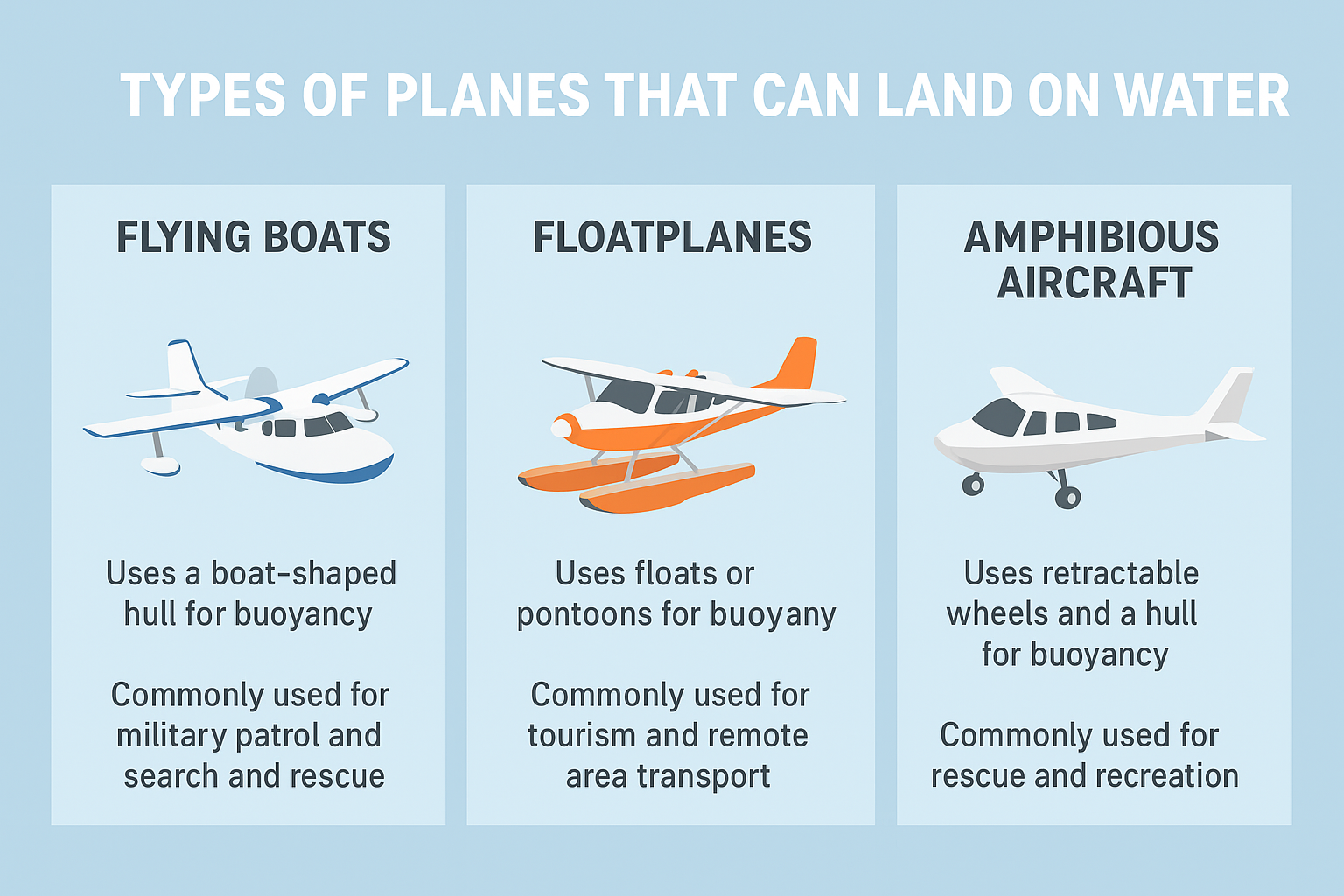
Water-landing aircraft come in several types, each designed with a special purpose and structure. From small personal planes that can take off and land on lakes to military patrol aircraft that handle the open sea, each design reflects years of innovation and testing. Let’s look at the main types and how they differ.
A flying boat is a water-landing aircraft that uses its main body, or hull, as the floating surface. Instead of relying on separate floats, its entire lower fuselage acts like a boat. This shape allows the plane to glide on the water’s surface smoothly and stay stable during landings and takeoffs.
Key Features of Flying Boats:
Examples:
Flying boats were especially useful before runways were common. They could land directly in harbors or coastal areas, making them essential for transport and mail delivery in the early 1900s. Even though their popularity has dropped, they remain an important part of aviation history.
The floatplane is another type of water-landing aircraft, but unlike the flying boat, it doesn’t use its fuselage for buoyancy. Instead, it rests on separate structures called floats or pontoons attached beneath the plane. The fuselage stays above water, reducing drag and protecting the main body.
Key Features of Floatplanes:
Examples:
Floatplanes are often used for tourism, cargo transport, and recreational flying. Their ability to reach islands and lakes makes them popular in adventure destinations like the Maldives, Norway, and the Pacific Northwest.
An amphibious aircraft combines the best of both worlds—it can operate from land or water. These planes are equipped with retractable wheels, allowing them to roll on runways or land based surfaces and also float on water when needed.
Key Features of Amphibious Aircraft:
Examples:
This category offers pilots maximum versatility. Many private owners prefer them because they can park at a regular airstrip or land on the water for a quick getaway.
The word seaplane refers to any aircraft that can land and take off from water—so technically, both flying boats and floatplanes fall under this group. Seaplanes have been around for over a century, serving in commercial, military, and private roles.
Common Uses of Seaplanes:
From the first aircraft since the early 1910s, seaplanes have proven their worth in connecting people and places where traditional airports are unavailable.
Over time, new technology has made these aircraft safer, faster, and more efficient. Modern engineers have focused on reducing drag, improving control during takeoff, and strengthening materials for both freshwater and saltwater conditions.
Design Enhancements Include:
These updates help today’s water-landing aircraft perform in a variety of environments—from calm inland lakes to rough coastal waters.
Although land-based planes dominate commercial aviation, water-landing aircraft fill a special niche that keeps them relevant. They can access places without runways, making them vital for island nations, river systems, and disaster relief zones.
Key Benefits:
Many nations and organizations still maintain fleets of seaplanes for transportation, defense, and humanitarian work. From coastal patrols to air tours, their practical value continues to shine.
Water-landing aircraft have shaped aviation history in remarkable ways. They paved the way for international travel before airports were widespread and helped develop early military and commercial flight networks.
Some notable milestones include:
Their influence continues in today’s designs, showing how innovation builds upon the lessons of the past.
The future looks promising for modern seaplane technology. With new materials, hybrid engines, and eco-friendly goals, engineers are reimagining what these aircraft can do. Some companies are even testing electric propulsion systems for short-range water flights.
What We Might See Next:
In short, water-landing aircraft continue to prove that aviation’s future is as exciting as its past. From classic seaplanes to next-generation amphibious aircraft, they remain an incredible blend of function and freedom—keeping the spirit of flight alive on both land and water.
Planes that can land on water remain among aviation’s most fascinating creations. From the first seaplane experiments by Glenn H Curtiss to the sleek light-sport amphibious airplane of today, these aircraft show how creative engineering can expand what’s possible. They serve remote communities, protect lives, and keep aviation history alive on both land and water.
To learn more about aircraft types, ownership tips, and buying options, visit Flying411.com for expert insights on planes that can land on water and other exciting aviation topics.
They rely on sealed floats filled with air, which provide buoyancy and stability while taxiing or resting on the water.
A floatplane uses pontoons to stay above water, while a flying boat has a boat-shaped hull that touches the surface directly.
Yes, but they require special coatings and regular maintenance to prevent corrosion from salt water exposure.
Yes, certain military and coast guard forces still use them for patrols, rescues, and island transport.
The ICON A5 remains a top choice for pilots who enjoy both water and land takeoffs in a compact, fun aircraft.
