Your flight is canceled. The storm passed two hours ago. The plane is sitting right at the gate. And the departure board is still flashing that dreaded word: CANCELED. So what is actually going on? Most passengers blame the weather. Sometimes that is fair. But a huge number of cancellations — especially during mass flight disruptions — come down to something most travelers never think about: the legal limits on how long pilots are allowed to work.
In fact, when Southwest Airlines' crew scheduling system failed to manage these limits during the 2022 holiday season, the airline canceled 16,900 flights and stranded over 2 million passengers — leading to the largest passenger protection fine in U.S. aviation history. These rules exist for a very good reason, and understanding them changes how you see the whole situation.
Once you know how crew duty time works, the chaos of a meltdown starts to make a lot more sense.
Key Takeaways
When mass flight disruptions hit, airlines cannot just keep flying. The FAA sets strict limits on how long a flight crew can work before they must rest. When delays pile up, crews hit those limits fast. Once a crew times out, that flight gets canceled — even if the plane is ready and the sky is clear. Airlines can extend duty time by up to two hours in unexpected situations, but there are hard limits they cannot cross. Reserve crews help fill the gaps, but when disruptions spread across a whole network, those backup pilots run out fast too. That is the real reason one big storm can cancel thousands of flights across the country.
| Key Takeaway | What You Need to Know |
| Duty time has hard limits | Pilots cannot work past their legal maximum, no exceptions |
| Extensions are limited | The FAA allows up to 2 extra hours in unforeseen situations |
| Reserve crews are the backup plan | When they run out, cancellations multiply quickly |
| Crew "out of position" causes cascades | Delays move pilots away from where they are needed |
| Safety science drives the rules | Fatigue causes real errors — the rules exist to prevent them |
| Southwest 2022 is the clearest example | 16,700+ cancellations showed how fast things can collapse |
| A new FAA rule is coming | A March 2026 proposal could tighten early-morning duty limits |
What Is a Flight Crew Duty Period?
Let's start at the beginning. A duty period is the total block of time that a pilot or crew member is officially "on the job." It does not just count flying time. It starts the moment a crew member reports for work — usually about an hour before departure — and it keeps running until they are officially released from their assignment.
That matters a lot. Say a pilot shows up at 6:00 a.m. Even if the plane sits at the gate for two hours because of a delay, the clock is still ticking. The pilot is on duty. Every minute of that wait counts toward their daily limit.
Here is what falls inside a duty period:
- Preflight checks and briefings
- Taxi and ground time
- Actual flight time in the air
- Turnaround time between flights
- Any delays at the gate or on the tarmac
And here is what does NOT count as a rest period: transportation between hotels and airports, meals during a layover, or any time the airline can still contact a crew member and ask them to work. True rest means completely off the clock — no calls, no assignments, no responsibilities.
A flight crew is typically made up of two pilots: a captain and a first officer. On very long international flights, a third or fourth relief pilot is added so that each crew member can take a break mid-flight and still have rested pilots at the controls during landing.
Now here is where the numbers get specific. Under FAA rules, the maximum length of a duty period depends on a few things: what time the crew started their shift, how many flight segments are scheduled, and whether extra pilots are on board. A standard duty day for an unaugmented two-pilot crew can range from about 9 to 14 hours, depending on the start time. The earlier the start time, the shorter the allowed duty period — because early morning hours overlap with the body's natural low point.
This is not just a scheduling rule. It is a hard legal line. Once a crew hits their limit, they cannot fly — period. The airline cannot override it. The pilot cannot volunteer to push through. The plane does not move.
One more term worth knowing: crew duty tracking happens in real time. Airlines use sophisticated software to monitor exactly how many hours each crew member has worked, how much rest they have had, and when they will time out. Under normal conditions, this system runs smoothly. Under a mass disruption? It becomes one of the hardest puzzles in all of aviation.
Why the FAA Sets Hard Limits on How Long Crews Can Work
The FAA — the Federal Aviation Administration — does not set these rules to be difficult. They set them because the science on fatigue is very clear: tired pilots make more mistakes. And in aviation, mistakes cost lives.
Fatigue is not just feeling sleepy. It quietly damages a person's ability to:
- Make fast decisions under pressure
- Notice small but important changes in the cockpit
- React quickly to unexpected events
- Communicate clearly with air traffic control
A tired pilot might not feel impaired. That is actually part of the problem. Fatigue can reduce self-awareness, making it harder to recognize that your own performance is slipping.
The rules that govern this today come primarily from a regulation called FAR Part 117, which took effect in January 2014. This rule was shaped in large part by the 2009 Colgan Air crash near Buffalo, New York, which killed 50 people. Investigators found crew fatigue was a contributing factor. Congress responded by requiring the FAA to overhaul its rest rules, and Part 117 was the result.
Under Part 117, the key time limitations include:
- Minimum 10 hours of rest between duty periods
- At least 8 of those hours must be available for uninterrupted sleep
- 30 consecutive hours free of flight duty within every 7-day period
- Flight time capped at 9 hours for most unaugmented operations (fewer at night)
There is also a concept called the Window of Circadian Low, or WOCL. This is the period between 2:00 a.m. and 5:59 a.m. when the human body is at its lowest point of alertness — even if the person slept. The FAA builds in tighter limits for duty periods that overlap with this window, because the risk of a fatigue-related error is highest during these hours.
Pilots also have the legal right — and the legal responsibility — to call in fatigued. When a pilot signs the flight release before departure, they are certifying that they are fit to fly. If they are not rested, they cannot sign it. A fatigue call to crew scheduling will pull them from the flight. A reserve pilot takes their place. This system is a critical safety check, but it also means that during a disruption, when crews are already stretched thin, a fatigue call can trigger yet another cancellation.
The required rest rules are non-negotiable. They apply equally to every airline operating under Part 121 — from the biggest carriers to regional commuter lines. No airline can waive them, and the FAA actively monitors compliance.
What Happens When Bad Weather or a System Failure Hits the Whole Network
Picture a normal day of airline operations. Thousands of flights are running on carefully timed schedules. Each airline plans its crews like a puzzle — Pilot A flies from Chicago to Denver, then Denver to Phoenix, then Phoenix back to Chicago. Everything fits together perfectly, down to the minute.
Now a major winter storm hits Chicago. The FAA issues a ground stop. Dozens of flights cannot depart. Those crews are sitting at the airport — on the clock, burning through their duty hours — while going nowhere.
Here is what that delay triggers across the system:
- The Chicago-to-Denver flight is delayed two hours. The crew's duty clock has been running since they reported at 6:00 a.m.
- The Denver-to-Phoenix leg is now in jeopardy. These same pilots may not have enough remaining duty time to complete the next segment.
- The Phoenix crew waiting for the inbound Chicago plane is now delayed too. Their outbound passengers wait. Their duty clock is also running.
- The Denver airport now has a backlog of delayed aircraft. Gate space is limited. Ground crews are scrambling. And more delays pile on top.
This is the cascade. One weather event at one hub ripples outward through every connected route. The disruption does not stay local — it spreads across the whole country within hours.
Point-to-point networks — where planes fly directly between cities without returning to a central hub — are especially fragile during these events. When one leg falls behind, every leg after it falls behind too. Hub-and-spoke airlines have more flexibility to reposition crews through their central hubs, which is one reason they typically recover faster.
The deeper problem is what happens to the crew duty hours during all of this waiting. A crew that reported at 6:00 a.m. and spent three hours sitting at a delayed gate has already burned through a significant chunk of their legal duty window. By the time the storm clears and flights can resume, some of those crews are nearly timed out.
And the backup plan — reserve crews — can only absorb so much. Airlines keep pools of reserve pilots on call for exactly these situations. But in a large-scale disruption covering multiple hubs at once, the reserve pool drains fast. When the reserves are exhausted, the airline has no one left to legally cover the remaining flights. Those flights get canceled. Passengers are told to rebook.
The reason some flights still operate while others cancel, even on the same route, often comes down to which crew started their duty day later and still has time left on the clock. It is not random. It is math — specifically, the hard math of hours logged versus hours allowed.
How Mass Disruptions Push Crew Duty Time Rules to the Breaking Point
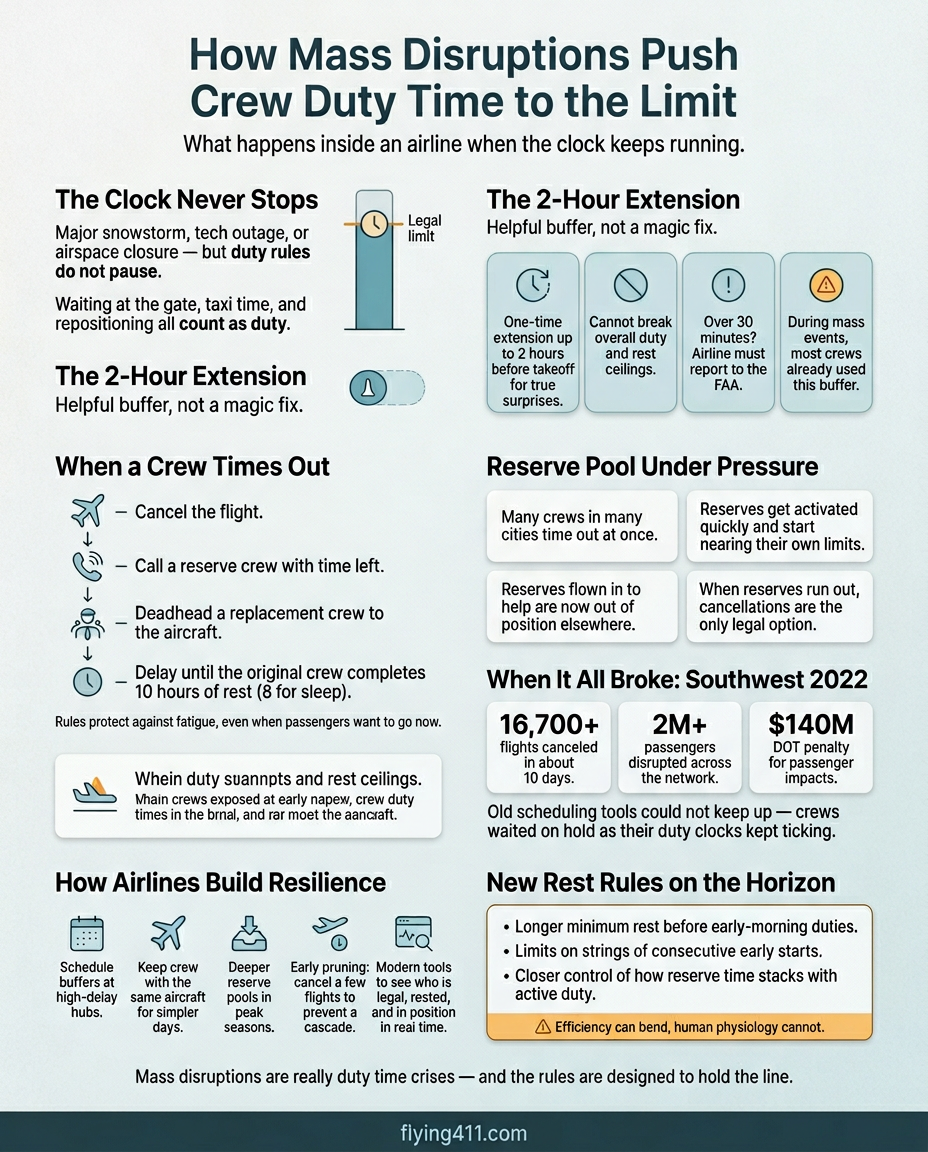
So you now know what a duty period is, why the rules exist, and how a delay in one city can ripple across hundreds of flights. Now let's look at what actually happens inside an airline operation when a major disruption hits — and how the rules around crew work time shape every single decision that gets made.
When a mass event strikes — a major snowstorm, a system failure, an airspace closure — airlines do not get to pause the rulebook. Every crew member still has a legal limit on how long they can work. Every rest requirement still applies. The clock keeps running no matter what.
The 2-Hour Extension: A Real but Limited Tool
The FAA does give airlines one important tool for unexpected situations. Under federal regulations (specifically FAR Part 117, Section 117.19), if something truly unforeseen happens before takeoff — like a sudden weather system or an unexpected air traffic delay — the captain and the airline can agree to extend the flight crew's scheduled duty window by up to two hours.
Here is exactly how that works:
- The extension can only happen once before the crew receives a proper rest break
- It cannot be used if it pushes a crew past their cumulative duty limits — there is an absolute ceiling that cannot be crossed
- Any extension over 30 minutes must be reported to the FAA within 10 days, with a full description of what happened
- If something unexpected happens after takeoff, a crew can exceed flight time limits only as far as needed to safely land at the next airport
This tool exists for genuine surprises. Think of it as a small buffer for real-life unpredictability. It is not a way to squeeze more flying out of a tired crew on a busy travel weekend.
And here is the key thing to understand: a two-hour extension sounds helpful in isolation. But during a mass event affecting hundreds of flights at once, most crews are not dealing with one small unexpected delay. They are dealing with hours of accumulated waiting, gate holds, and repositioning — all of which counts as duty time. By the time the skies clear, many crews have already burned through their entire window, extension included.
What Happens the Moment a Crew Times Out
When a crew hits their legal maximum, the airline's options get very narrow, very fast. There is no negotiating with the regulations. Here is what an airline can actually do:
- Cancel the flight outright — the most common outcome during a large-scale event
- Find a reserve crew with enough duty time left to take over
- Deadhead a replacement crew — fly them to the airport as passengers so they can operate the aircraft
- Delay the flight until the original crew has completed their rest period and is legal to fly again
That last option is the one that surprises most passengers. A crew that just completed a long duty day needs a minimum of 10 hours off before they can fly again. Eight of those hours must be available for uninterrupted sleep. So a flight that gets canceled at 9:00 p.m. may not be able to depart with the same crew until late the following morning — and that assumes no other scheduling conflicts exist.
This is the required rest rule in action. It feels like a long wait from the passenger side. From the safety side, it is exactly what the rule was designed to do.
The Reserve Pool: The Last Line of Defense
Every airline keeps a group of reserve pilots on standby. These are crew members who are available but not assigned to a specific trip. When a primary crew times out, the airline calls a reserve to cover the flight.
Under normal operations, this system works well. One crew times out, one reserve steps in, the flight goes. But during a large-scale disruption affecting multiple hubs at the same time, the reserve pool gets hit from every direction at once:
- Multiple crews at multiple airports time out in the same short window
- Reserves get activated quickly and begin accumulating their own crew duty hours
- Reserves who travel to cover a stranded aircraft are now "out of position" — far from where the next need might be
- Reserves who were activated early in the disruption may themselves time out before the system stabilizes
When the reserve pool runs dry, there is simply no one left to legally cover the remaining flights. The airline has no option but to cancel. It does not matter how much passengers need to get somewhere. The regulations do not flex for that.
If you have ever wondered how one storm can cancel thousands of flights across a country, this is the answer. It is not just aircraft out of position. It is crews — and their time limitations — running out faster than the system can replenish them.
The Southwest 2022 Meltdown: When It All Broke at Once
The best real-world example of all of this happened in December 2022. A major winter storm hit during the peak holiday travel period. Every large airline deals with holiday weather disruptions — most recover within a day or two. Southwest did not recover for 10 days.
The reason came down to crew scheduling technology. Southwest was using older internal software that could not handle the scale of reassignments needed. Crews sat at airports, willing to fly, but unable to get a legal assignment through the system. While they waited on hold with crew scheduling — sometimes for hours — their duty time clock kept running. By the time they finally reached a scheduler, many were timed out and could not fly at all.
Here is what that looked like in numbers:
- 16,700+ flights canceled over 10 days
- Over 2 million passengers affected
- 5,500+ flights canceled on December 25 and 26 alone — while competitor Delta canceled just 311 during the same two-day window
- Southwest was fined $140 million by the U.S. Department of Transportation — the largest passenger protection fine in the agency's history at that time
Southwest's point-to-point network made recovery harder. Unlike hub-and-spoke carriers, there was no central location to funnel available crews through. Pilots were spread thin across dozens of cities with no efficient way to reposition them at the speed the situation demanded.
Learning about how pilots are certified and what it takes to earn the right to sit in that seat can add a lot of context here. Pilot License Types and Requirements: Full Breakdown Guide is a good place to start if you want to understand the training and qualifications behind the people operating these flights.
What Airlines Do to Protect Against This
Airlines have learned a lot from events like Southwest 2022. Most major carriers now take steps to build resilience into their scheduling before a disruption ever starts:
- Schedule buffers — extra connection time built into flight segments at high-delay airports like Chicago O'Hare and New York JFK
- Crew-aircraft pairing — keeping the same crew with the same aircraft across a full day to reduce handoff complexity
- Deeper reserve pools — especially during holiday seasons and summer storm periods
- Early pruning — proactively canceling a small number of lower-priority flights at the start of a disruption to prevent a much larger cascade later
- Modern scheduling software — real-time tools that can instantly identify which crew members are legal, available, and geographically close to the aircraft that needs them
Safety on the ground matters just as much as safety in the air. If you spend time around aircraft during disruptions or any other situation, How to Approach a Helicopter Safely: A Complete Guide for Passengers and Ground Crew covers the ground safety basics that every aviation-curious person should know.
The 2026 Proposed Rule Change
On March 28, 2026, the FAA published a Notice of Proposed Rulemaking that would be the biggest update to pilot rest rules since Part 117 launched in 2014. The proposal is directly aimed at scheduling patterns that have become more common since then — especially repeated early-morning duty starts.
Key changes on the table:
- Raise the minimum rest period before any duty starting between midnight and 6:00 a.m., from 9 hours to 10 hours
- Cap consecutive early-morning duty starts at three — after three back-to-back early starts, a longer reset rest would be required before the crew could be scheduled for another early departure
- Address reserve stacking — limiting how reserve availability time combines with active duty time in ways that compound fatigue
Airlines for America estimates the new rules could require between 4,800 and 8,000 additional pilot hires to maintain current schedule density. Regional carriers say the caps hit them especially hard, since short-haul flying accumulates duty hours quickly relative to actual flight time.
The NTSB formally recommended these updates in September 2025, pointing to research showing that fatigue builds in compounding ways across successive early-morning shifts — something the 2014 rules did not fully account for.
The debate over these rules reflects a tension that has always existed in commercial aviation: the push to operate efficiently versus the hard limits of human physiology. Those limits are real. The rules that protect them are there for a reason.
Conclusion
The rules around flight crew duty time are not red tape. They are the line between a safe flight and a dangerous one. When a mass disruption hits, those rules do not bend — and that is exactly the point. Pilots who are too tired to fly safely cannot fly. Crews that have hit their legal limits must rest. The cascade of cancellations that passengers experience during a major meltdown is, in large part, the safety system doing exactly what it is supposed to do.
Understanding this does not make a canceled flight any less frustrating. But it does show that the decision to cancel is rarely careless. More often, it is the result of a carefully monitored system protecting everyone on board.
Next time you're planning a trip and want to stay ahead of disruptions, check out Flying411 for clear, practical aviation knowledge written for real people — not just pilots.
Frequently Asked Questions
Can an airline force a pilot to fly past their duty time limit?
No. The FAA's duty time limits are federal law, and no airline can require a pilot to exceed them. The captain also has the independent authority to refuse a flight if they feel unsafe, fatigued, or unfit to fly — regardless of airline pressure.
Do cargo pilots have the same rest rules as passenger airline pilots?
Not exactly. Cargo airlines operating under Part 121 can choose to follow Part 117, but many still operate under the older Subparts Q, R, and S rules, which are somewhat less restrictive. Some cargo carriers have voluntarily adopted Part 117 for added safety consistency.
What does "deadheading" mean and how does it help during disruptions?
Deadheading is when an airline flies crew members as passengers on a commercial flight to position them where they are needed. It does not count as flight duty time, but it does count toward their overall schedule. It is one tool airlines use to get fresh crews to stranded aircraft.
How do flight attendants' rest rules compare to pilots' rules?
Flight attendants have their own rest requirements under FAA regulations, but they are generally slightly different from pilot rules. They are also protected from working past certain limits, and their rest requirements can similarly trigger cancellations when disruptions cause scheduling conflicts.
Why do disruptions during holidays tend to be worse than disruptions at other times?
Holiday travel periods pack more flights, more passengers, and more crew into the schedule at once. Reserve pools that might easily cover a normal disruption get overwhelmed faster. Airports operate with less margin. And when delays start, there is almost no slack in the system to absorb them.