You're cruising at 8,500 feet, hands off the yoke, and your plane is holding its course with precision. That's the magic of a modern autopilot.
The idea of a plane flying itself has fascinated people for over a century — back in 1914, a 21-year-old inventor named Lawrence Sperry proved it was possible by flying past a crowd of thousands along the River Seine in Paris with both hands raised above his head, his mechanic standing out on the wing, and the plane holding perfectly level on its own. The crowd went wild.
But not all autopilots work the same way. Some use a spinning gyro connected to your vacuum pump. Some read your bank angle directly. And some talk straight to your GPS. The type you have (or plan to install) makes a real difference in how your plane flies, how reliable your system is, and what it can actually do for you in the cockpit.
Understanding the differences between rate-based, altitude-based, and GPS-coupled autopilots gives you the knowledge to make smarter decisions about your avionics. It also helps you fly your current system more safely. Let's break down how these systems work — starting with the basics of what an autopilot actually does.
Key Takeaways
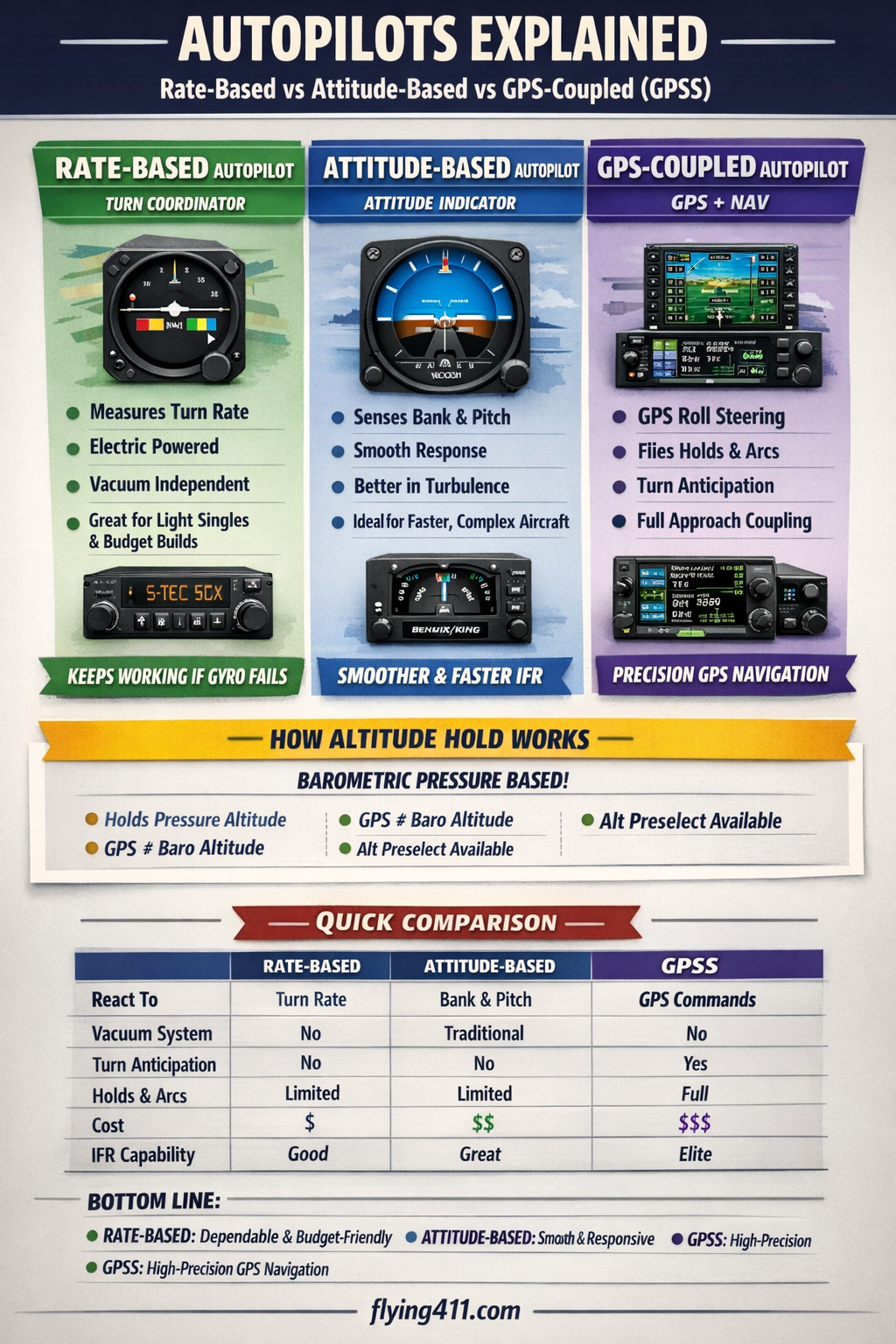
Rate-based autopilots use a turn coordinator for attitude data and are electrically reliable since they don't need a vacuum pump. Attitude-based autopilots read the attitude indicator directly, flying more smoothly but depending on vacuum systems in older setups. GPS-coupled autopilots go a step further by connecting your GPS to the autopilot for precise course tracking and turn anticipation — making IFR flying significantly easier.
| Feature | Rate-Based | Attitude-Based | GPS-Coupled |
| Sensor Used | Turn coordinator | Attitude gyro / AHRS | GPS + AHRS |
| Vacuum Dependency | No | Yes (analog) / No (digital) | No |
| Smoothness | Good | Better | Best |
| GPS Navigation | Basic (NAV mode) | Basic (NAV mode) | Advanced (GPSS) |
| Turn Anticipation | No | No | Yes |
| Approach Capability | Limited | Moderate | Full (ILS, LPV, GPS) |
| Best For | Light singles, budget builds | IFR, faster aircraft | Cross-country IFR, approaches |
| Example Systems | S-TEC 30, 55X | King KFC 150, Garmin GFC 500/600 | Garmin GFC 500/600 with GTN |
| Cost (Hardware) | $2,000–$10,000 | $7,000–$24,000+ | Included in modern systems |
What Does an Autopilot Actually Do in a Small Plane?
A lot of pilots hear the word autopilot and imagine something out of a sci-fi movie — a robot pilot flying the whole plane while the human naps in the back. Real life is a little more grounded than that, but still pretty impressive.
An autopilot in a small general aviation plane is a system that controls the aircraft's flight surfaces to hold a specific attitude, heading, or course. It moves the controls so you don't have to — at least for a while. Think of it as a very precise co-pilot that never gets tired, never gets distracted, and has no opinion about where to eat for lunch.
Here's what an autopilot actually controls:
- Roll axis (left and right): The most basic autopilots only control this axis. They keep the wings level or track a heading. These are called wing levelers or single-axis autopilots.
- Pitch axis (up and down): Adding pitch control gives you altitude hold and vertical speed control. This is the second axis, and it's where things get really useful for IFR flying.
- Yaw axis (nose left and right): A third-axis autopilot includes a yaw damper, which helps reduce that uncomfortable fishtailing motion you sometimes feel in twins or V-tail aircraft.
One of the most common misconceptions in GA is that altitude hold counts as a "third axis." It doesn't. Altitude hold is part of the pitch axis — the second axis. A true third axis means rudder control. The distinction matters because it tells you exactly what your autopilot can and can't do.
A two-axis autopilot is the most common setup in general aviation singles. It controls roll and pitch — meaning it can hold a heading, track a course, maintain altitude, and fly instrument approaches when properly equipped. That covers the needs of most pilots flying cross-country or doing IFR work.
Here's a quick breakdown of autopilot levels:
| Type | Controls | Common Use |
| Single-axis (wing leveler) | Roll only | Light workload reduction |
| Two-axis | Roll + Pitch | Heading, altitude, approaches |
| Three-axis | Roll + Pitch + Yaw | Twins, V-tail aircraft |
One more thing worth knowing: autopilots don't fly the whole flight for you. They handle the repetitive, precise control inputs — but you, the pilot, are still responsible for monitoring the system, setting the right modes, and knowing how to take back control instantly. The autopilot flies the aircraft. You fly the mission.
Why the Sensor Inside Your Autopilot Changes Everything
Here's something most pilots don't think about when they first look at an autopilot: the type of sensor feeding information to the flight computer is just as important as the autopilot brand on the face plate. That one detail determines how smooth the autopilot flies, how reliable it is, and what happens when something goes wrong in the cockpit.
All autopilot systems need to know the airplane's attitude — is it banking left? Pitching up? Turning? The autopilot uses that information to decide what corrections to make. But different systems get that information from different places. That's the core difference between the three autopilot types.
Rate-based autopilots get their attitude data from the turn coordinator — the small gyro instrument you've seen in almost every GA panel. The turn coordinator measures the rate at which the aircraft is turning and rolling. It's electrically powered, which means it doesn't need the vacuum system to run.
Attitude-based autopilots get their data from the attitude indicator — the instrument that shows your actual bank angle and pitch. These systems react the moment the wings begin to move, without waiting for a turn to develop. That makes them faster to respond and smoother in flight.
GPS-coupled autopilots go even further. They connect to your GPS navigator and use position data to calculate the exact course, speed, and required bank angle. Instead of chasing a needle, the system talks directly to the GPS and tells the autopilot exactly what to do.
Here's why the sensor matters so much in practice:
- A rate-based autopilot detects a turn after it starts developing. There's a small lag before the turn shows up on the turn coordinator.
- An attitude-based autopilot detects a bank as it begins, giving it a head start on corrections.
- A GPS-coupled system doesn't just react — it anticipates turns before they happen, rolling into course changes ahead of time.
The sensor also determines what happens when equipment fails. If you have a vacuum-driven attitude gyro tied to your autopilot, a vacuum pump failure can affect both your primary attitude reference and your autopilot at the same time. With a rate-based or modern digital system, the electric attitude indicator and autopilot remain independent of the vacuum system entirely.
Now you can see why sensor type isn't a small technical detail. It's the foundation the whole system is built on — and it has real safety implications, especially in IMC.
The Vacuum Pump Problem Nobody Talks About at the Hangar
Let's talk about something that doesn't get nearly enough attention in pre-flight briefings or hangar conversations: the vacuum pump. Specifically, what happens to your autopilot when it fails.
Most traditional GA aircraft use a vacuum pump to spin the gyros inside instruments like the attitude indicator and directional gyro. These gyros need to spin fast and consistently to give accurate readings. The vacuum pump is what keeps them spinning.
Here's the problem — vacuum pumps fail. A lot.
- Vacuum pump mean time between failure (MTBF): approximately 650 hours
- Attitude gyro MTBF: approximately 2,600 hours
- Turn coordinator MTBF: approximately 8,000 hours
Those numbers tell a clear story. The vacuum pump is the weakest link in the chain. And when it fails, it doesn't just knock out your attitude indicator. If your autopilot is tied to that vacuum-driven attitude gyro, it may start following false attitude information as the gyro slowly tumbles and precesses.
Here's the danger: the autopilot can appear to be working normally while it's actually driving the airplane toward an unusual attitude. You might not catch it right away — especially in IMC when you're already busy.
Rate-based autopilots avoid this problem entirely. Because they use the electric turn coordinator instead of the vacuum-driven attitude gyro, a vacuum pump failure has zero effect on autopilot function. The system keeps running on battery power.
What to do if you have a vacuum-dependent autopilot:
- Know where your vacuum pump backup is and test it regularly
- Check if your aircraft has a standby vacuum or manifold pressure backup pump
- Consider how much battery reserve you have to run essential avionics if the alternator also fails
The good news: modern digital autopilots, like the Garmin GFC 500 and GFC 600, use solid-state AHRS (Attitude and Heading Reference System) — no spinning gyros, no vacuum pump dependency at all. These systems are dramatically more reliable and don't carry the vacuum failure risk. The old debate between rate-based and attitude-based systems largely disappears with modern solid-state technology. But since thousands of GA aircraft still fly with legacy analog autopilots, understanding this risk is something every pilot needs to know.
The vacuum pump problem is one of the best arguments for understanding exactly what's inside your autopilot panel — before you need that information at 6,000 feet in the clouds.
Rate-Based, Attitude-Based, and GPS-Coupled Autopilots — What Sets Each One Apart
Rate-Based Autopilots
A rate-based autopilot gets its attitude information from the turn coordinator — that small gyro instrument sitting in almost every GA panel. The turn coordinator measures how fast the aircraft is turning and rolling. That data feeds into the flight computer, which tells the servos how to move the controls.
Here's what makes rate-based systems stand out:
- Electrically powered — the turn coordinator runs on electricity, not vacuum pressure, so a vacuum pump failure has zero effect on the autopilot
- Slight lag in response — the system detects a turn after it starts developing, not the instant the wings begin to move
- Consistent turn rate — because the system measures turn rate rather than bank angle, it holds the same rate of turn regardless of airspeed
- Long track record — S-TEC (now Genesys Aerosystems) built its reputation entirely on rate-based autopilots, and the S-TEC 30, 50, and 55X are among the most common autopilots in the GA fleet today
Rate-based autopilots work best for:
- Light singles like Cessna 172s and Piper Cherokees
- Owners who want to remove or avoid the vacuum system entirely
- Pilots looking for a reliable, budget-friendly entry into IFR-capable autopilots
One real advantage worth highlighting: if your attitude gyro fails in IMC, a rate-based system keeps working. It doesn't care about the vacuum system. That kind of independence has genuine safety value on cross-country IFR flights.
If you fly a Cessna 172 and are thinking about autopilot options alongside other panel upgrades, it's worth reading about Common Avionics Upgrade Mistakes Cessna 172 Owners Make before you commit to anything — some of the most common and costly errors happen right at this decision point.
Attitude-Based Autopilots
An attitude-based autopilot — sometimes called a position-based autopilot — reads its data directly from the attitude indicator. Instead of waiting for a turn to develop, it reacts the moment the wings begin to move. That faster response is what gives attitude-based systems their reputation for smoother, more precise flight.
Here's how they work:
- Two pickup coils inside the attitude gyro sense bank angle and pitch angle
- A third coil in the directional gyro or HSI picks up the heading bug position for heading hold
- The flight director — a set of command bars on the attitude indicator — shows the pilot exactly what pitch and roll inputs the system is commanding, even when the autopilot is disengaged
- Traditional analog versions depend on the vacuum system, which is the key tradeoff compared to rate-based systems
What attitude-based autopilots do well:
- Smoother corrections in light turbulence
- Faster reaction to deviations because they sense bank angle directly
- Better heading hold in crosswinds
- Strong IFR performance in faster, more complex aircraft
The most common attitude-based systems you'll find in the GA fleet include the Bendix/King KFC 150 and KFC 200, Century autopilots, and the modern Garmin GFC 500 and GFC 600 — which use solid-state AHRS instead of vacuum gyros, eliminating the vacuum dependency entirely.
A two-axis autopilot in this category controls both roll and pitch, meaning it can hold a heading, track a course, maintain altitude, and fly coupled instrument approaches. For most IFR pilots, that covers everything needed for real-world cross-country flying.
How Altitude Hold Really Works
Here's something that surprises a lot of pilots: altitude hold doesn't use GPS. It uses barometric pressure — specifically, the pressure altitude at the exact moment you engage the mode.
When you hit the altitude hold button, the autopilot locks onto that pressure value and works to maintain it. The pitch servo adjusts the elevator to keep the aircraft at that pressure level. Simple enough. But here's where it gets important:
- Pressure changes mid-flight — flying through a weather front means the altimeter setting changes, but the autopilot doesn't know that. It's still holding the old pressure value. You have to disengage, update the altimeter, and re-engage.
- GPS altitude and barometric altitude are not the same — in real-world conditions, they can differ by 200 to 400 feet. ATC separation is based entirely on barometric altitude under FAR Part 91. GPS altitude is not the legal standard.
- Even WAAS-corrected GPS has vertical accuracy errors of 30 to 65 feet — fine for terrain awareness, but not precise enough for ATC separation
Altitude preselect takes altitude hold to the next level:
- Dial in your target altitude before starting a climb or descent
- The autopilot climbs or descends at your selected vertical speed
- It levels off automatically when it hits the target
- Available on the Garmin GFC 500, KAP 140, S-TEC 55X, and higher-end autopilot systems
One practical tip: in moderate or severe turbulence, disengage altitude hold and use attitude mode or wing leveler only. Fighting to hold altitude in rough air stresses the airframe and makes for a very uncomfortable ride. Request a block altitude from ATC if needed.
GPS-Coupled Autopilots and GPSS
GPSS — GPS Steering, also called roll steering — is a fundamentally different way of connecting your GPS to your autopilot. Old NAV mode chases a CDI needle. GPSS sends direct bank angle commands to the autopilot and anticipates turns before they happen.
The old NAV mode problem:
- The autopilot watches CDI needle deflection and banks to correct it
- Near waypoints, this creates S-turns and course overshoots
- Curved paths like DME arcs, holding patterns, and procedure turns simply can't be flown in NAV mode
What GPSS changes:
- The GPS sends a precise bank angle command directly to the autopilot
- The system begins turning before the waypoint and rolls out right on the new course
- Holds, procedure turns, and full GPS approaches become flyable — all hands-off
- Tracking stays tight with no scalloping or S-turns
Adding GPSS to a legacy autopilot:
- External converters like the S-TEC ST-901 or DAC International GDC31 can retrofit GPSS to many older analog autopilots
- Hardware cost: approximately $2,000–$3,000 plus installation
- The autopilot must be in HDG mode when using an external converter — the converter sends heading commands that mimic roll steering
Modern autopilot systems make it built-in:
- The Garmin GFC 500 and GFC 600 include GPSS natively
- Paired with a GTN 650 or 750, they can fly full IFR approaches — ILS, LPV, VOR, LOC, and missed approaches — completely coupled
- A yaw damper option on the GFC 600 adds rudder control for twins and high-performance aircraft, smoothing out yaw oscillations in turbulence and cruise
One important rule when flying GPS approaches with GPSS: once you're established inbound on the final approach course, switch to APR mode to capture vertical guidance. GPSS handles lateral tracking beautifully, but the glideslope or LPV path requires APR mode to be active.
If you're weighing a GPSS upgrade or a full autopilot replacement and want to know which investments actually pay off at resale, check out Which 172 Upgrades Actually Increase Resale Value — avionics decisions and aircraft value are more connected than most owners realize.
Conclusion
Autopilots are one of the most useful safety tools in general aviation — and knowing the difference between rate-based vs altitude-based vs GPS-coupled autopilots helps you use yours correctly and choose wisely when it's time to upgrade. Rate-based systems win on electrical reliability. Attitude-based systems win on smoothness and IFR precision. And GPS-coupled systems with GPSS take everything to the next level, giving you turn anticipation, approach coupling, and hands-off procedure flying that would have seemed futuristic not long ago.
The best autopilot for your cockpit depends on what aircraft you fly, how often you fly IFR, and what panel you're working with. But no matter which system you have, understanding how it works makes you a safer, more confident pilot.
Ready to explore autopilots, avionics upgrades, and GA aircraft equipped with the latest systems? Head over to Flying411 to browse listings and resources built specifically for general aviation pilots and aircraft owners.
Frequently Asked Questions
Can a single-axis autopilot be used for IFR flight?
Yes, but with limitations. A single-axis autopilot controls roll only and can track a VOR or GPS course. It cannot hold altitude, so the pilot must manage pitch manually the entire time. For real IFR workload relief, a two-axis system is the practical minimum.
What is the difference between a flight director and an autopilot?
A flight director shows you what inputs to make on the attitude indicator — it gives command guidance. An autopilot physically moves the controls to follow those commands. You can use a flight director without the autopilot engaged, flying manually while following its precise guidance cues.
Do I need WAAS GPS to use GPSS?
For basic enroute GPSS tracking, a non-WAAS GPS can work. But for full GPSS capability — flying holding patterns, procedure turns, and LPV approaches — a WAAS-capable GPS navigator is required. Without WAAS, the system can't guide you through the curved path segments of instrument procedures.
Will my autopilot disconnect automatically in turbulence?
Many autopilots have torque limits built in — if turbulence forces the controls beyond what the servo can handle, the autopilot will disconnect. This is a safety feature, not a malfunction. In rough air, it is often better to hand-fly using attitude mode or disconnect entirely and manage the aircraft manually.
Is it legal to log instrument currency using the autopilot?
Yes. The FAA interprets FAR 61.51 to allow pilots to log PIC time while the autopilot is engaged. Flying a coupled instrument approach with the autopilot on counts toward instrument currency requirements — though staying proficient at hand-flying in IMC is equally important for overall safety.