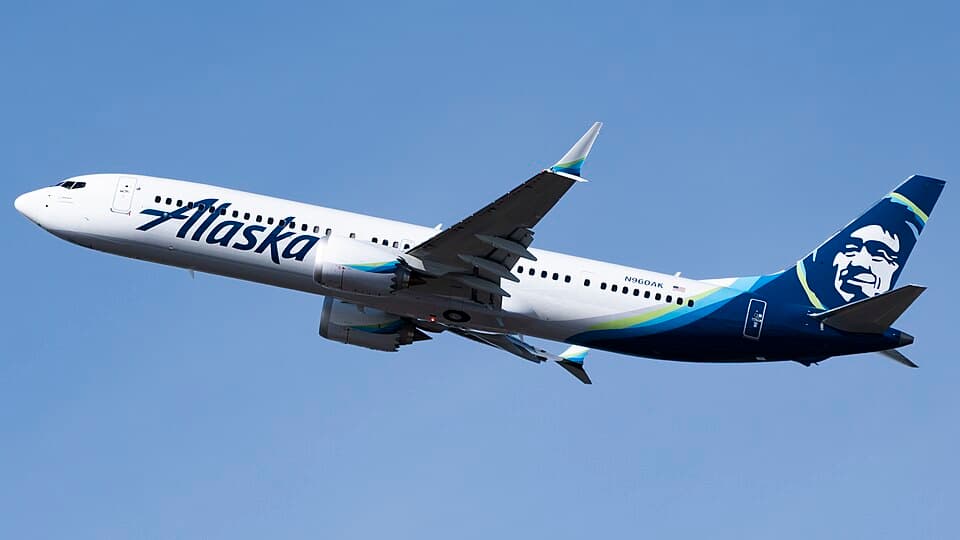
On January 5, 2024, passengers on Alaska Airlines Flight 1282 heard a loud bang. A door plug had blown out of the side of the plane while it was still in the air. The plug weighed 60 pounds and was found two days later in a Portland neighborhood by a schoolteacher. No one died, but the event shook the aviation community to its core.
Within 24 hours, the FAA grounded 171 Boeing 737-9 MAX planes across the country. That single incident shows exactly why airworthiness directives exist, and why operators who fly the MAX need to stay on top of them at all times.
The 737 MAX has faced more regulatory action than almost any other commercial jet in modern history. Knowing what those actions require keeps aircraft flying safely and legally. Let's walk through everything operators need to know.
Key Takeaways
Boeing 737 MAX airworthiness directives are legally binding safety orders from the FAA. They require operators to inspect, repair, or modify specific parts of the aircraft. Some are routine. Others, like the January 2024 emergency AD, ground the entire fleet without warning. Operators must comply within the deadlines stated in each AD or the aircraft cannot legally fly.
| Topic | Key Detail |
| What is an AD? | A legally binding FAA safety order under 14 CFR Part 39 |
| Who must comply? | All U.S. operators of affected Boeing 737 MAX aircraft |
| Types of ADs | Standard AD (NPRM process) and Emergency AD (immediate) |
| Major MAX ADs | 2018 MCAS, 2020 return-to-service, 2024 door plug, 2025 spoiler wire |
| Penalty for non-compliance | Aircraft is not airworthy and cannot be operated |
| Where to track ADs | FAA website, Federal Register, Boeing service bulletins |
| Latest NPRM | Fuselage/bear strap cracks, proposed November 2025 |
What Is an FAA Airworthiness Directive?
An airworthiness directive is a safety order issued by the Federal Aviation Administration. Think of it as a required fix. When the FAA finds a problem with an aircraft, whether it is a wiring issue, a structural crack, or a software flaw, they do not send a suggestion. They issue an AD. Every operator with an affected aircraft must act.
ADs are issued under Part 39 airworthiness directives. This is a section of federal law that gives the FAA the power to require corrective action on any aircraft flying in U.S. airspace. That includes engines, propellers, and aircraft parts, not just the airframe.
There are two main types of ADs operators will run into:
- Standard ADs go through a Notice of Proposed Rulemaking (NPRM) process. The FAA publishes the proposed rule in the Federal Register, opens a public comment period of usually 45 days, reviews the feedback, and then issues a final rule. This gives operators time to plan ahead.
- Emergency airworthiness directives skip the comment period entirely. They take effect the moment operators are notified. The January 2024 grounding of the 737-9 fleet is a clear example. Operators had hours, not weeks, to respond.
Once an AD is final, compliance is not a choice. Miss a deadline and the aircraft is no longer legally airworthy. It cannot fly. The FAA can also issue civil penalties against operators who keep flying non-compliant aircraft.
Every AD has three key parts operators need to read closely:
- Applicability — which specific aircraft are affected, usually identified by a Boeing Alert Requirements Bulletin (ARB) that lists line numbers or serial numbers
- Compliance time — the deadline, measured in flight cycles, flight hours, or calendar days from the AD's effective date
- Required actions — what must be done, from a basic inspection to a full part replacement or software update
Some ADs also include on-condition actions. The inspection is required for everyone, but repairs are only needed if the inspection finds a problem. This approach works well when fleet-wide failure rates are expected to be low.
Operators can also apply for an Alternative Method of Compliance (AMOC) if they believe a different procedure can achieve the same level of safety. The FAA must approve it before the operator can use it. Many 737 MAX ADs include AMOC options, which gives maintenance teams some room to work.
Why the Boeing 737 MAX Has More ADs Than Most Aircraft
The Boeing 737 MAX did not end up under this level of regulatory scrutiny by accident. It got here through a series of serious events that made it one of the most closely watched aircraft in aviation safety history.
The MAX entered service in 2017. It was Boeing's updated version of the long-running 737 family, redesigned with larger, more fuel-efficient engines. To fit those engines on the wing, Boeing had to reposition them slightly forward and higher. That change affected how the aircraft handled at certain speeds and angles. To fix that handling issue, Boeing added a new automated system called the Maneuvering Characteristics Augmentation System, or MCAS.
Here is the problem. MCAS relied on a single angle-of-attack (AOA) sensor. If that sensor gave a bad reading, MCAS would push the nose of the aircraft down, over and over, even while pilots fought to correct it. Pilots flying the 737 MAX 8 and 737-9 variants were not fully told about MCAS during their training. The system was also not clearly explained in the flight manuals they used every day.
On October 29, 2018, Lion Air Flight 610 crashed into the Java Sea. All 189 people on board were killed. Five months later, on March 10, 2019, Ethiopian Airlines Flight 302 crashed shortly after takeoff. Another 157 people lost their lives. Both crashes were directly linked to MCAS activating based on faulty sensor data.
The FAA grounded the entire MAX fleet on March 13, 2019. The review that followed was the most intensive look at any commercial aircraft type in modern FAA history. It lasted 20 months and involved testing, redesign, and close coordination with aviation regulators around the world. The national transportation safety investigation findings, along with congressional hearings, showed deep problems in both Boeing's safety culture and how the FAA had been overseeing Boeing's work.
When the final airworthiness directive for return to service came out in November 2020, it required four major design changes, new pilot training, and gave the FAA full control over issuing airworthiness certificates for all new MAX production. Boeing lost the right to self-certify its own aircraft. That was a significant and rare step that had no recent precedent in U.S. commercial aviation.
Then the Alaska Airlines door plug blowout happened in January 2024. It triggered another emergency AD and sparked a new wave of production audits. The FAA found problems in Boeing's manufacturing process and stopped planned production rate increases. A $3.14 million fine was proposed in September 2025 for hundreds of production oversight failures.
All of this explains why the MAX has a longer and more complex AD record than most commercial jets. It is not just how many ADs there are. It is the wide range of systems they cover, from flight controls to fuselage structure to spoiler wiring.
How the FAA Issues and Enforces ADs on the 737 MAX
Understanding how ADs get made helps operators stay ahead of what is coming. It also helps avoid getting surprised by a new compliance deadline with little time to act.
The process usually starts when someone spots an unsafe condition. That could be a report from an airline, a maintenance team finding something unexpected, a Boeing Company Model 737-8 service bulletin, or data that comes out of an accident investigation. The FAA looks at the report, decides how serious the risk is, and determines if an AD is needed.
For a standard AD, here is how the process works:
- Step 1: FAA writes a Notice of Proposed Rulemaking (NPRM) and publishes it in the Federal Register
- Step 2: A public comment period opens, typically 45 days for MAX-related issues
- Step 3: FAA reads all the comments, including feedback from operators, manufacturers, and foreign aviation regulators
- Step 4: FAA issues the final airworthiness directive with a full compliance schedule attached
For an emergency AD, steps one through three are skipped completely. The FAA issues the directive right away, and it takes effect immediately. The January 2024 emergency airworthiness directive that grounded the 737-9 fleet is a good example of this. Operators got the notification and had to pull their aircraft before the next scheduled flight.
Enforcement is managed through FAA inspectors and the airline certification process. The FAA has dedicated Aviation Safety Engineers assigned to Boeing MAX programs. After the 2024 Alaska Airlines incident, the FAA placed inspectors directly inside Boeing's factory in Renton, Washington, and at Spirit AeroSystems in Wichita, Kansas.
Safety management systems at airlines are expected to track every open AD and keep compliance schedules up to date. Part 121 operators, which are commercial airlines, are required to have FAA-approved maintenance programs that include AD tracking. If a deadline is missed, the aircraft is considered unairworthy. The legal and regulatory consequences are serious.
Here is what solid AD compliance tracking looks like for a MAX aircraft operator:
- Review all new FAA NPRM postings in the Federal Register every week
- Cross-reference each AD's applicability with your aircraft serial numbers using the Boeing ARB
- Build compliance deadlines into your maintenance planning software
- Confirm your FAA-approved Minimum Equipment List (MEL) is updated for any AD that includes MEL provisions
- Verify pilot training records are current when an AD changes flight procedures or the AFM
- Submit AMOC requests early if standard compliance methods do not work for your operation
The operator holds the compliance responsibility. Boeing puts out the service documentation. The FAA issues the mandate. But the operator is the one who has to get it done on time and keep proper records. Staying organized and proactive is the best way to avoid a gap in compliance, especially with the pace at which MAX-related ADs have been coming out over the past several years.
Major FAA Airworthiness Directives Every 737 MAX Operator Must Know
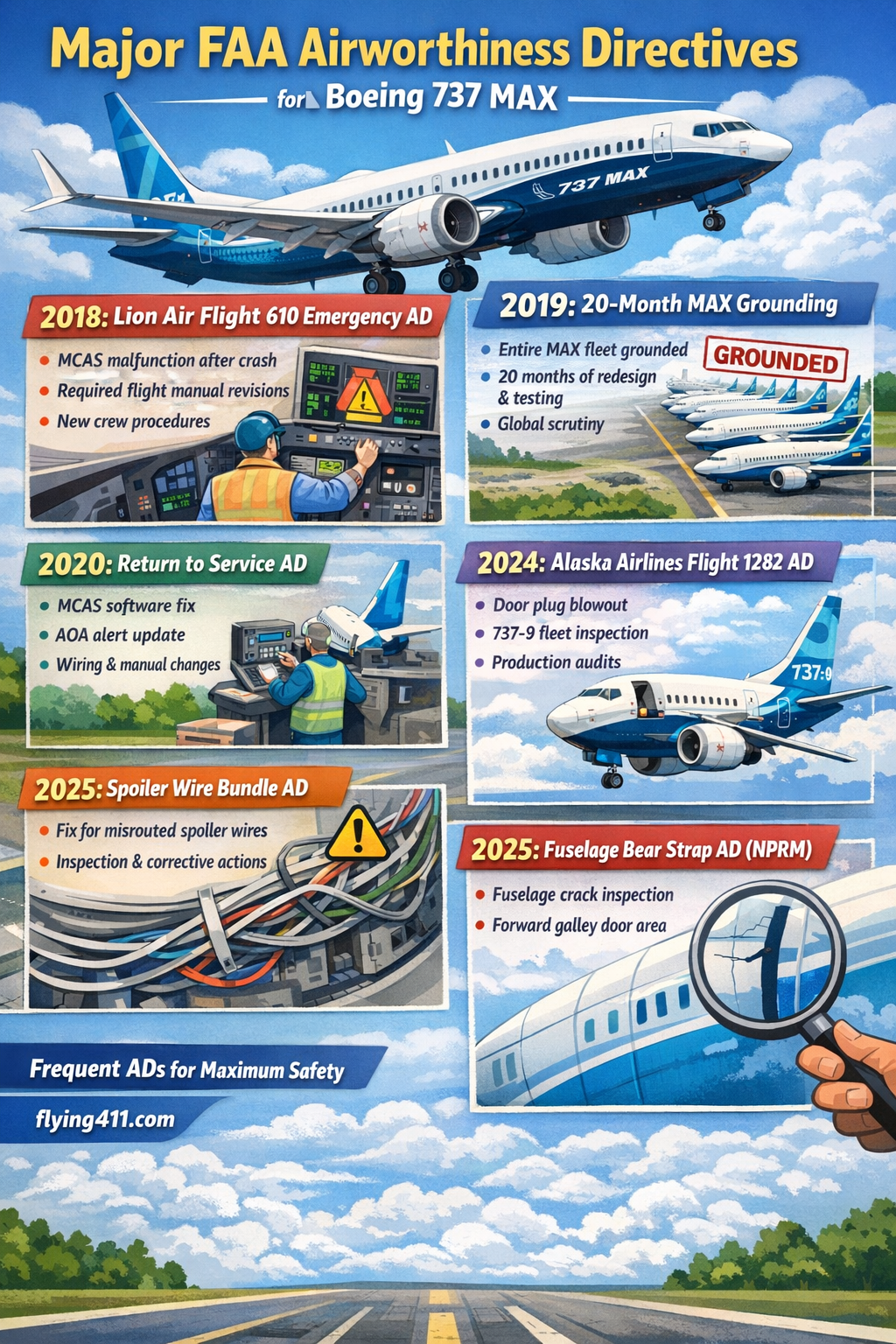
The Boeing 737 MAX has built up one of the most significant AD records in commercial aviation history. Each directive on that list came from a real safety finding that required real action from operators. Some of these ADs changed how the aircraft flies. Others grounded entire fleets overnight. Here is a look at the major ones, in order, that every operator needs to understand.
2018: The First Emergency AD After Lion Air Flight 610
The FAA issued its first emergency airworthiness directive on the MAX just nine days after Lion Air Flight 610 crashed into the Java Sea on October 29, 2018. That directive, AD 2018-23-51, targeted MCAS, which had pushed the aircraft's nose down repeatedly after receiving a bad signal from a faulty angle-of-attack sensor.
The AD required operators to revise their flight manuals right away and gave flight crews new steps for dealing with uncommanded nose-down stabilizer movement. It was a temporary fix. The federal aviation administration knew a deeper solution was needed, but this AD kept the aircraft in the air while Boeing worked on a software redesign.
Key details of AD 2018-23-51:
- Applied to all 737 MAX 8 and 737-9 aircraft in service at the time
- Required immediate flight manual revisions
- Gave crews step-by-step procedures for handling erroneous MCAS activation
- Did not ground the fleet but put every operator on notice that a larger fix was coming
2019: The 20-Month Grounding Begins
On March 13, 2019, four days after Ethiopian Airlines Flight 302 crashed with the same MCAS problem, the FAA grounded the entire MAX fleet. This was not an AD by itself, but it set the stage for the most complex return-to-service AD process in modern aviation history.
The national transportation safety investigations into both crashes, combined with congressional pressure, showed that MCAS had been poorly designed, not disclosed properly to pilots, and not reviewed well enough during certification. The aviation community watched closely as the FAA spent 20 months on testing, redesign, and global coordination.
2020: The Return-to-Service Final Airworthiness Directive
On November 18, 2020, the FAA issued the final airworthiness directive that allowed the MAX to fly again. That directive was published in the federal register as AD 2020-24-02 and required four mandatory design changes before any MAX could return to service. No exceptions. Every affected aircraft had to be modified before it could carry passengers again.
The four required changes were:
- New Flight Control Computer (FCC) software to prevent erroneous MCAS activation and limit MCAS to a single activation cycle
- Updated cockpit display system software to generate an AOA disagree alert when the two angle-of-attack sensors give conflicting readings
- Revised Airplane Flight Manual (AFM) procedures giving crews the tools to recognize and respond to erroneous stabilizer movement
- Rerouted horizontal stabilizer trim wires to meet FAA wire-separation safety standards
The FAA also kept full authority to issue airworthiness certificates for all new MAX production. Boeing lost its ability to self-certify the aircraft, a step with no modern precedent in U.S. commercial aviation. Under Part 39 airworthiness directives, AD 2020-24-02 became the legal foundation for all MAX operations going forward.
2024: Alaska Airlines Flight 1282 and the MAX 9 Emergency AD
On January 5, 2024, a door plug blew out of an Alaska Airlines Boeing Company Model 737-8 variant at roughly 16,000 feet. There were no fatalities, but the incident triggered an immediate regulatory response. The aviation safety implications were serious enough that the FAA acted within 24 hours.
Emergency AD 2024-02-51 grounded all 171 Boeing 737-9 MAX aircraft operated by U.S. airlines or in U.S. territory. The required inspections took four to eight hours per aircraft and focused on:
- Both left and right cabin door exit plugs
- Door components and associated hardware
- Bolts and fasteners securing the door plug assembly
Aircraft could not return to service until all inspection findings were addressed and corrective action was completed. The FAA also launched a special production audit of Boeing's Renton, Washington factory. That audit turned up non-compliance issues in manufacturing process control, parts handling, and product storage. Production rate increases were halted, and the number of onsite FAA inspectors was significantly increased.
This AD was a turning point. It showed that safety management gaps at the manufacturing level can create airworthiness problems that only show up after an aircraft has been flying for years. For operators, it reinforced the need to understand why ADs exist, not just check the compliance box. If you want to know more about how aircraft age factors into safety risk overall, Aircraft Age and Safety: Are 20 Year Old Planes Safe? breaks that topic down in detail.
2025: Spoiler Wire Bundle AD (AD 2024-23-11)
Effective January 6, 2025, the FAA issued AD 2024-23-11 targeting a non-conforming installation of flight spoiler control wire bundles on MAX aircraft. The finding was serious. A mis-routed wire bundle had caused unintended spoiler movement, including one confirmed case of a flight spoiler hardcover. Further investigation showed the potential for multiple spoiler hardovers on the same wing at the same time, which could exceed the aircraft's full lateral control capability and lead to loss of control.
AD 2024-23-11 applied to Boeing 737-8, 737-9, and 737-8200 models and required:
- A one-time inspection of clearance between spoiler control wire bundles and adjacent structure
- On-condition corrective action if a non-conforming installation is found
- Reference to Boeing Alert Requirements Bulletin 737-27A1325 RB for applicability by serial number
Before this AD was finalized, more than 650 MAX aircraft had already been voluntarily inspected under a Boeing Service Letter. Zero findings of wire chafing were reported across all of them. The FAA used that data to set a reasonable compliance timeline rather than issuing an emergency response. This is a useful example of how airline voluntary reporting and cooperation with the FAA can influence how an AD is written and when it needs to be done.
2025: Fuselage Bear Strap NPRM (FAA-2025-3985)
In November 2025, the federal aviation administration published proposed AD FAA-2025-3985 for the 737-8, 737-9, and 737-8200 after reports of cracks in the bear strap at the forward upper corner of the forward galley door cutout. Left unaddressed, these cracks can weaken the fuselage skin's ability to hold structural loads under normal operating conditions.
FAA-2025-3985 proposes:
- An external general visual inspection of the fuselage skin for any existing repairs
- On-condition follow-up actions based on what the inspection finds
- Reference to Boeing Alert Requirements Bulletin 737-53A1408 RB, dated December 20, 2024
The public comment period closed January 9, 2026. A similar AD, numbered 2024-06-01, had already been issued for the 737NG fleet covering the same structural area. That is why the FAA extended its review to include the MAX fleet as well. When FAA-2025-3985 becomes a final AD, operators will need to add it to their compliance schedules right away.
The range of ADs issued on the MAX over the past several years covers flight controls, fuselage structure, door assemblies, wiring, and software. That range shows how carefully this aircraft has been examined. Operators who stay current with every AD are flying an aircraft that has been reviewed more thoroughly than almost any other commercial jet in service today. If you want to see how the MAX compares to other aircraft in terms of overall passenger safety, Top 10 Safest Planes in the World is a great next read.
Conclusion
The Boeing 737 MAX airworthiness directives tell a larger story about aviation safety. They show what can go wrong when oversight gaps appear and how the system works to fix them. From the original MCAS emergency AD in 2018 to the fuselage crack NPRM proposed in late 2025, each AD came from a real finding that required real action. For operators, keeping up with ADs is a core part of running a safe and legally compliant operation. The compliance deadlines are firm. The consequences of missing them are serious. And the pace of new MAX-related ADs shows no sign of slowing down. Stay current, stay organized, and treat every new AD as the priority it is.
For more aviation insights, regulatory updates, and practical guidance for pilots and aircraft operators, visit Flying411, your go-to resource for everything in general aviation.
Frequently Asked Questions
What is the difference between an AD and a service bulletin on the Boeing 737 MAX?
A service bulletin is a recommendation from Boeing. An AD is a legal mandate from the FAA. When the FAA issues an AD that references a Boeing service bulletin, completing that bulletin becomes legally required. Operators cannot treat an AD like an optional update.
Can an operator fly a Boeing 737 MAX while an AD inspection is pending?
It depends on the AD's compliance time. Standard ADs give operators a set window to complete the work. Emergency ADs typically require the inspection before the next flight. Always read the specific compliance section of each AD to know exactly when the aircraft must be grounded.
How does an AMOC work for a Boeing 737 MAX airworthiness directive?
An AMOC, or Alternative Method of Compliance, lets an operator use a different procedure than the one listed in the AD, as long as it provides the same level of safety. The FAA must review and approve the AMOC before the operator can use it. Many MAX ADs include AMOC provisions built in.
Who is responsible for tracking AD compliance on a leased Boeing 737 MAX?
The operator, meaning the airline or entity with operational control of the aircraft, is responsible for AD compliance regardless of who owns it. If a MAX is leased, both the lessor and lessee should spell out AD compliance responsibilities in their lease agreement. But the operating airline carries the regulatory responsibility.
Are foreign operators of the Boeing 737 MAX required to comply with FAA ADs?
FAA ADs apply directly to U.S.-registered aircraft. Foreign-registered MAX aircraft fall under the authority of their own country's civil aviation authority. However, many foreign regulators issue equivalent ADs based on FAA directives, and U.S. ADs often serve as the starting point for international action through ICAO coordination.